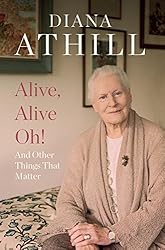
Alive, Alive Oh! And Other Things That Matter by Diana Athill

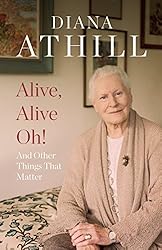
Alive, Alive Oh! And Other Things That Matter by Diana Athill (published in 2015) contains memories, thoughts and reflections on her life as she approaches her 100th year (she was born in 1917). I quoted the opening paragraph of this book and a teaser paragraph in an earlier post, First Chapter, First Paragraph.

It’s only a short book (168 pages), but it covers a wide range of Diana Athill’s memories, many images of beautiful places, and the friends and lovers she has known. The chapters follow on chronologically but are unconnected except for the fact that they demonstrate her love of life.

She writes about her Great Grandfather’s garden at Ditchingham Hall in Norfolk, which she used to love visiting in the 1920s and 1930s, when her grandparents lived there. Her writing is so clear and precise, describing in detail its exact layout and expressing her delight in her memories of it.

In other chapters she describes post-war life and her visits to Florence, and in particular the Club Mediterranee in Corfu in the 1950s; her experiences in Trinidad and Tobago, where she was struck by the disparity between the local people and the tourists/incomers; and the miscarriage when she was in her early 40s, when she nearly died. It was heart breaking to read this remarkably candid account both about what happened and how she felt, her detachment, her resentment that she had lost the baby, even her relief, and finally her gratitude that she was still alive, and her love of life:

‘I AM ALIVE.’ 

It was enough.

It was everything. It was filling me to the brim with pure and absolute joy, a feeling more intense than any I had known before. (page 87)

It is this love of life that is evident in her writing that makes it such a remarkable book. She writes about her decision to move into a home, persuaded by a friend who lived there and about how much she enjoys living there. And her main luxury now is her wheelchair, which she finds has unexpected benefits, such as when she was at an art exhibition – the crowds fell away from her in her wheelchair and she was able to lounge in perfect comfort in front of Matisse’s red Dance.

Of course, she writes about death and dying, as ‘death is no longer something in the distance, but might well be encountered any time now.’ She doesn’t find this alarming, and remembers when she was close to death after her miscarriage that her feelings were of acceptance: ‘Oh well, if I die, I die‘. Death is not something she fears, although she has some degree of anxiety at the process of dying and recognises that whereas it’s ‘unwise to expect an easy death, it is not unreasonable to hope for one.

This book has given me much to think about, including this paragraph:

Looking at things is never time wasted. If your children want to stand and stare, let them. When I was marvelling at the beauty of a painting or enjoying a great view it did not occur to me that the experience, however intense, would be of value many years later. But there it has remained, tucked away in hidden bits of my mind, and now it comes out, shouldering aside even the most passionate love affairs and the most satisfying achievements, to make a very old woman’s idle days pleasant instead of boring. (pages 5 – 6)

I loved it.

First Chapter, First Paragraph

First chapterEvery Tuesday Diane at Bibliophile by the Sea hosts First Chapter First Paragraph Tuesday Intros, where you can share the first paragraph, or a few, of a book you are reading or thinking about reading soon.

One of the books I’ll be reading soon is Alive, Alive Oh! And Other Things That Matter by Diana Athill OBE. From what I’ve read so far it promises to be very interesting. Born in 1917 Diana Athill helped Andre Deutsch establish his publishing company and worked as a literary editor for many years. She is also a novelist and has published several memoirs.

Alive, Alive Oh! And Other Things That Matter begins:

‘Sometimes I sits and thinks and sometimes I just sits’: I have forgotten who it is who is supposed to have said that, but it is a good description of a state quite often observed in a retirement home, and considered pitiable. Disconcertingly, I recently realized that I myself (not very often, just now and then) might say those very words if somebody asked me what I was doing. It is not a welcome thought, but less dreadful than it might be because I now know from experience that the state is not necessarily pitiable at all. It is even pleasant – or it can be. That probably depends on the nature of the person sitting. To me it has been, because the thinking turns out to be about events in the past which were enjoyable, and when the mind relaxes itself it is those same events which float in and out of it.

Blurb:

What matters in the end? In the final years of life, which memories stand out? Writing from her retirement home in Highgate, London, as she approaches her 100th year, Diana Athill reflects on what it is like to be in her nineties, and on the moments in her life which have risen to the surface and sustain her in her later years.

She recalls in sparkling detail the exact layout of the garden of her childhood, a vast and beautiful park attached to a large house, and writes with humour, clarity and honesty about her experiences of the First and Second World Wars, and her trips to Europe as a young woman. In the remarkable title chapter, Athill describes her pregnancy at the age of forty-three, losing the baby and almost losing her life, and her gratitude on discovering that she had survived.

With vivid memories of the past mingled with candid, wise and often very funny reflections on the experience of being very old, Alive, Alive Oh! reminds us of the joy and richness to be found at every stage of life.

Teaser Tuesday newTeaser Tuesday is a weekly bookish meme, hosted by MizB of Books and a Beat. ! Just do the following:

‘¢ Grab your current read
‘¢ Open to a random page
‘¢ Share two (2) ‘teaser’sentences from somewhere on that page

My teaser is from page 29:

It annoys me when someone describes this country in the late 1940s and 1950s as being dreary, an opinion usually based on the continuation of rationing for some years after the war’s end. People who see it like that can’t have lived through the war. Those of us still alive who did so see it differently.

It’s a short book – just 168 pages – but she seems to have packed so much into it.

The Pattern in the Carpet by Margaret Drabble

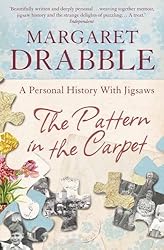
I began reading The Pattern in the Carpet: A Personal History With Jigsaws in December and finished it this morning. It took me a long time not because it’s difficult reading (it isn’t) but because I only read short sections each day – I often read non-fiction like that.

FOREWORD

This book is not a memoir, although parts of it may look like a memoir. Nor is it a history of the jigsaw puzzle, although that it was what it was once meant to be. It is a hybrid. … This book started off as small history of the jigsaw, but it has spiralled off in other directions and now I am not sure what it is.

It is not the book she meant to write and it is not the book I expected to read. I enjoyed parts of immensely – those parts about her childhood, and life at Bryn, her grandparents’ house in Long Bennington and about her beloved Aunt Phyl (Phyllis Boor) and of course those parts about jigsaws, both personal and historical, about mosaics (looking at them as a form of jigsaw), the history of children’s games and puzzles and amusements. She does ‘spiral off in other directions’ which meant in parts it lacks a clear structure in a sort of ‘stream of conciousness’ style, particularly in her reminiscences and nostalgia about life (reproduced in some jigsaws) in a rural community that no longer exists.

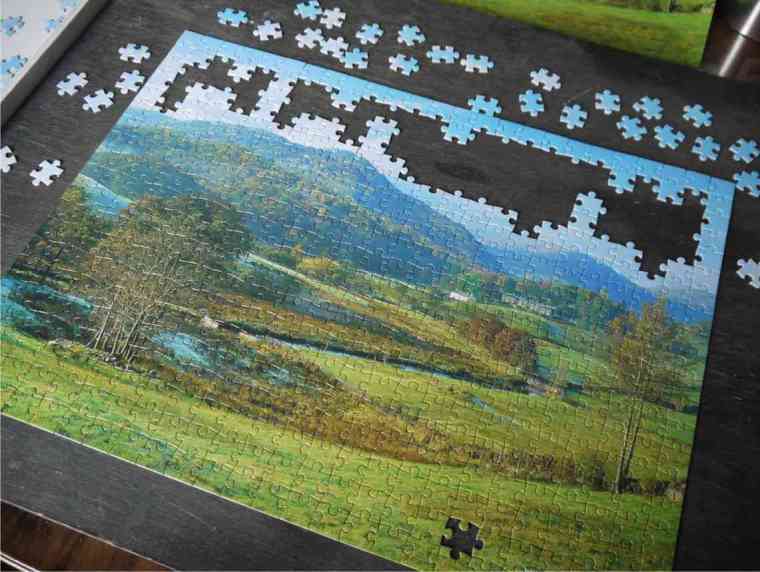
I noted down a few points she made about jigsaws:

  • jigsaws renew the brain cells – that’s good! (page 66)
  • putting away a finished jigsaw can be a sad moment – I agree and usually leave mine for a while before dismantling them. These days I take a photo. (page 94)
  • because they have no verbal content they exercise a different part of the brain, bringing different neurons and dendrites into play. (that’s good too) (page 122)
  • some people disapprove of jigsaws, some of knitting, of card games and other activities and artistic traits. (page 187)
  • jigsaws maybe connected with depression and used as time-killers, filling empty days and evenings (page 242)
  • people can be addicted to jigsaws (page 244)
  • doing a jigsaw is like creating order out of chaos (page 245)
  • jigsaws reproducing works of art helps you learn about art (pages 250-1)
  • jigsaws as metaphors  and simile are everywhere eg wikipedia etc (page 267)

I don’t think I’m a jigsaw addict, in the same way as I am a book addict, after all I do just a few jigsaws now and then, whereas reading is a constant and I feel lost if I don’t have a book on the go. And you may have noticed (from the side bar) that I am not currently reading a book! Time to find the next one to read …

H is for Hawk by Helen Macdonald

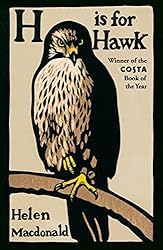
I really wanted to love H is for Hawk by Helen Macdonald, which  won the 2014 Samuel Johnson Prize for Non-Fiction, as well as the 2014 Costa Book of the Year but I found it difficult to read and draining, despite some richly descriptive narrative.  It’s really three  books in one – one about herself, her childhood and her intense grief at the sudden death of her father, one about training a goshawk and another about T H White and his book, The Goshawk in which he describes his own struggle to train a hawk.

When her father died she bought Mabel, a ten week old goshawk and became obsessed with training her. It is the training that made this book so difficult for me to read. I am not comfortable with keeping wild creatures in captivity and in my naivete I hadn’t realised just what training a hawk entailed. Even though Helen Macdonald tells her friend’s husband that it had not been a battle training Mabel because ‘she’s a freakishly calm hawk‘, it came across to me that it had been a battle of wills, as she kept Mabel indoors in a darkened room, in a hood, on a perch or restrained on a leash for much of the time. It was a physical battle too that evoked rage, violence and frustration.

I found it difficult too because it is so personal as she exposed just how bereft she was, how she suffered the loss of her father and became depressed almost to the state of madness:

It was about this time that a kind of madness drifted in. Looking back, I think I was never truly mad. More mad north-north-west. I could tell a hawk from a handsaw always but sometimes it was striking to me how similar they were. I knew I wasn’t mad mad because I’d seen people in the grip of psychosis before, and that was madness as obvious as the taste of blood in the mouth. The kind of madness I had was different. It was quiet, and very, very dangerous. It was a madness designed to keep me sane. My mind struggled to build across the gap, make a new and inhabitable world. (location 219)

This a book unlike any other that I’ve read, about wildness, grief and mourning, and obsession, which made it heavy reading for me.

  • Format: Kindle Edition
  • File Size: 1875 KB
  • Print Length: 322 pages
  • Page Numbers Source ISBN: 0802123414
  • Publisher: Vintage Digital (31 July 2014)
  • Source: I bought it

Books Read in May 2015

I’m pleased that I’ve read 8 books in May as my reading and blogging was interrupted by gardening. The grass is now growing at a rate of knots and the weeds, especially the ground elder, are rampant, threatening to take over the borders. So I’ve spent a lot of time this month mowing, weeding and strimming.

But I’ve also read these books and written about all of them, except H is for Hawk – post to follow some time soon (I hope). Three of the books are non fiction, one is a book from Lovereading for review and six are library books – no TBR books (books acquired before 1 January 2015) this month! I must get back to reading from those books I’ve had for years very soon!

These are the books I read:

Bks May 2015

Gray Mountain by John Grisham (Library book) – this book is just as much a campaign against injustice and the misuse of power, about the good little guys against the big bad guys as his earlier books are. In this case it’s the big coal companies that come under the microscope, companies that are  ruining the environment by strip-mining in the Appalachian mountains. I liked the view of the small town community, the mountain scenery, the legal cases large and small and the tension created by the danger of opposing the big coal companies.

The Lost Garden by Katharine Swartz (Review book) – an emotionally intense novel of love, loss and grief, set in both the past and the present day, in a small village on the Cumbrian coast, a gentle story, well told and an enjoyable read. In 1919 Eleanor, the daughter of the vicar of Goswell, is struggling to adjust to the loss of her brother, Walter who died just before the Armistice was declared and in the present day half-sisters Marin and Rebecca are coming to terms with the death of their father and his wife.

Gently North West by Alan Hunter (Library book) – set in the fictitious village of Strathtudlem in Scotland in 1967 where Gently is on holiday with his friend, Barbara Merryn and his sister, Bridget and her husband. Gently gets involved in the investigations into the murder of Donnie Dunglass,  found, stabbed in the back, face down on the heather. I thought it was an enjoyable book although I thought the murder mystery was rather far-fetched.

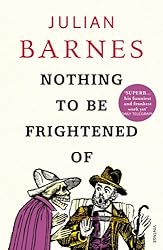
Nothing To Be Frightened Of by Julian Barnes (Library book, Non Fiction) – a collection of thoughts centred around Barnes’s fear of death and so inevitably he considers the question of religion and especially God. Interwoven with his thoughts about his agnosticism and death are anecdotes about his family and himself, thoughts on literature (particularly French literature) and it’s relationship to life. I found it all fascinating.

Dry Bones That Dream by Peter Robinson (Library book) – Banks investigates the murder of Keith Rothwell, an accountant, a  mild-mannered, dull sort of person it seems. But is that all there is to Rothwell? Banks unearths the secrets the characters have kept hidden from their family and friends. There’s also money-laundering and international and political shenanigans involved. Maybe not the best Banks book I’ve read.

H is for Hawk by Helen Macdonald (KindleNon Fiction) – no post yet. In some ways a difficult book to read – about training a goshawk and the author’s struggle with grief, mourning the death of her father.

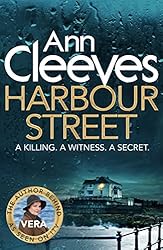
Harbour Street by Ann Cleeves (Library book) This is the fifth Vera book and I loved it. It’s so good I read it twice because I watched the TV version after I finished reading the book – and it confused me as it’s different from the book! So I went back and re-read it. It is so much better than the TV adaptation, which I think suffered from being condensed into just one hour and a half length programme.

Poirot and Me by David Suchet (Library book, Non Fiction) – this consists largely of Suchet’s summaries of the stories and how he went about analysing Poirot’s character and how he played the part. This is a fascinating account of both the Poirot series and of David Suchet’s career.

I have no difficulty this month with naming my favourite book of the month. All the time I was reading it I was thoroughly absorbed and intrigued by Harbour Street by Ann Cleeves.

Nothing To Be Frightened Of by Julian Barnes

I read Nothing To be Frightened Of over several weeks, reading short sections at a time. This book is described on the back cover by Penelope Lively as:

A maverick form of family memoir that is mainly an extended reflection on the fear of death and on that great consolation, religious belief … it is entertaining, intriguing, absorbing … an inventive and invigorating slant on what is nowadays called “life writing”.

It is a collection of thoughts centred around Barnes’s fear of death and so inevitably he considers the question of religion and especially God – in fact he begins his book with this statement: I don’t believe in God, but I miss him.

Later, he writes, Missing God is rather like Being English, a feeling aroused mainly by attack. When my country is abused, a dormant, if not to say narcoleptic, patriotism stirs. And when it comes to God, I find myself more provoked by atheistic absolutism than by, say, the often bland, tentative hopefulness of the Church of England. (page 77)

His agnosticism doesn’t help him with his fear of dying, but then, again, he thinks that faith does not necessarily remove the fear of death anyway – there are those who fear death among those who have faith as well as among the irreligious.

But this is more than a book about dying because interwoven with his thoughts about his agnosticism and death are anecdotes about his family and himself, thoughts on literature (particularly French literature) and it’s relationship to life. I found it all fascinating,  but it’s his autobiographical passages that I found the most interesting, sharing details about his family’s beliefs and the deaths of his parents and grandparents, of the rivalry between him and his brother, his mother’s solipsism and manipulative behaviour, his father’s seemingly passive approach to life and the difficulties of really knowing a person.

He states that it is easier with fiction than with life – fictional characters are easier to see, whereas in real life ‘the better you know someone , the less well often you see them. … They may be so close as to be out of focus … Often when we talk about someone very familiar, we are referring back to the time when we first properly saw them, when they were held in the most useful -and flattering light – light at the correct focal distance.’ (page 157)

He and his brother have different memories of their parents and grandparents and of their own early relationship, which shows how unreliable memory can be. I suppose I agree more with his brother, the philosopher Jonathan Barnes, who thinks that memories are often false and not to be trusted without external support, rather than Julian, who says he is more trusting, or self deluding, so shall continue as all my memories are true.

This is by no means a gloomy, pessimistic book.  It’s written in an informal tone, almost as though he is talking to the reader, and not being divided into chapters adds to that sense of being involved in a conversation. But is far from being a simple read – there is an awful lot packed into this book, an intensely personal book that reflects the complexity of our views of life and death. It gave me much to think about and even made me chuckle in parts.

And finally thinking about being remembered/forgotten after his death, Barnes considers who will be his last reader because with that reader he will finally be forgotten – and then he reflects that your last reader is, by definition, someone who didn’t recommend your books to anyone else. You bastard! Not good enough, eh? (page 226)

I think it extremely unlikely that I’ll be his last reader!

Reading Challenge: Non Fiction Reading Challenge 2015. This is only the 5th non fiction book I’ve read so far this year!