Lamentation by C J Sansom

Once again I am behind myself with writing about the books I’ve read! So here are just a few thoughts about C J Sansom’s historical novel, Lamentation, the sixth Matthew Shardlake book.
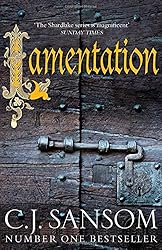
I have enjoyed the earlier books in the series so I had great expectations for Lamentation and I wasn’t disappointed. It’s set in 1546, the last year of Henry VIII’s life. Shardlake, a lawyer is asked by Queen Catherine (Parr) for help in discovering who has stolen her confessional book, Lamentation of a Sinner. What I like about these books is their historical setting and the Historical Notes giving yet more background to the period and emphasising that because the sources are ‘very thin’ that inevitably this is Sansom’s own interpretation of events and clarifying that Catherine Parr’s book was not, in the real world, stolen.

The book evokes the people, the sights, smells and atmosphere of Henry’s last year and at the same time it’s an ingenious crime mystery, full of suspense and tension. It begins as Shardlake is ordered to watch the burning at the stake of Anne Askew and other heretics (a real event). I’m not good at reading horrific scenes, but I managed this one without too much mental aversion of my eyes. Along with the mystery of the missing book, Shardlake is working on the Cotterstoke dispute between rival siblings, and has problems at home with his domestic servants.

I was also very taken with Shardlake’s introduction in Lamentation to William Cecil, Mary Tudor and a young Elizabeth I. I hope Sansom has more Shardlake books in mind.
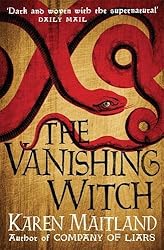
The Vanishing Witch by Karen Maitland

I found The Vanishing Witch by Karen Maitland a little slow at the beginning, although it’s full of interesting and well drawn characters, set in Lincoln during the reign of Richard II. It’s the time of the Peasants Revolt, a time of murder and mayhem and when suspicions of witchcraft were high as people started to die unnatural deaths, but it just didn’t have the magic spark that I’d enjoyed in her other books that I’ve read – The Company of Liars and The Owl Killers. It’s a long book of nearly 500 pages and it’s not just the beginning that’s slow, but it picks up towards the end.

The story revolves around Robert of Bassingham, a rich wool merchant, and his family – wife Edith and sons, Jan and Adam. All is fine until Robert meets Catlin, a wealthy widow, who comes to him for advice. Catlin is, of course, not as kind and good as Robert thinks she is and Robert’s family soon suffers because of his involvement with her. There are many other characters, including Gunter and his family. Gunter is a river boatman, struggling to make a living, burdened by heavy taxes he can’t pay. His life goes from bad to worse.

I liked the elements of the supernatural and suspicions of witchcraft in this book and the historical setting. There are several narrators, including a ghost and each chapter is headed by weather-lore, anti-witchcraft charms and spells taken from medieval ecclesiastical writings, recorded British folklore and from medieval spell books known as grimoires. For example this is the heading for Chapter 2:

If you fear that you are in the presence of a witch, clench both your hands into fists with the thumbs tucked under your fingers. Then she cannot enchant your mind.

Now that advice could be useful!

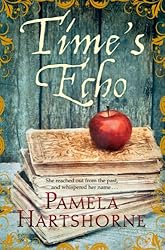
Time's Echo by Pamela Hartshorne


As I wrote in a First Chapter post  Time’s Echo mixes time as Grace Trewe is drawn into Hawise Aske’s life, four and a half centuries earlier in York, 1577. I saw this book in the library and although I hadn’t heard of Pamela Hartshorne I thought the title was interesting, and from the description on the back cover and the opening paragraphs, I thought it was worth borrowing.

It’s a good choice for Carl’s R.I.P. IX challenge, a time-slip story with an element of mystery and suspense in both time periods. Grace is staying in York to sort out the sale of her late godmother’s house when she experiences unnerving episodes in which she appears to be reliving the traumatic events in Hawise’s life beginning in 1577.  Grace likes to travel and although she survived the Boxing Day tsunami she is suppressing her memories of what happened. 

I think the suspense is somewhat diluted because right from the opening chapter it’s revealed that Hawise was drowned on All Hallows’ Eve, with her thumb tied to her toe – ie as a witch. But as Grace’s episodes continue she learns what happened in Hawise’s life to bring her to her dramatic death and this is interwoven with events in Grace’s life. It gets to the point where she dreads slipping out of current time into not only Hawise’s past but also into her own as what happened to her in the tsunami breaks through her mind.

What does add to the suspense is the unpredictability of the time-slips and the sense of malice and evil. So much so that the sceptic in me was unable to decide whether this was a question of whether Grace was suffering from post-traumatic stress disorder or was she really being “possessed” by Hawise, as she believed, feeling Hawise clamouring to be let into her mind. I found the historical sections more interesting than the modern story, which I think often happens when I read time-slip stories.

Pamela Hartshorne explains how she came to write this book in the Author’s Note at the end of the book. It grew out of her research on the wardmote-court returns of early modern York. These records dealt primarily with nuisances, things that affected the quality of life for the neighbourhood – such as noisy neighbours, blocked sewers. potholed streets etc (I note that local life hasn’t changed much over the centuries!). Some of the minor characters were real people, but this book is a work of fiction and Hartshorne is not intending this to be an accurate historical account, although she has tried to make it as convincing and as authentic as she could – I think she succeeded.

I thought the book was rather drawn out in parts, slowing the story down a bit too much for my liking. But, I like the fact that the book has a factual background, even though there are some liberties with the evidence – eg there was no plague in York in the 1570s or 1580s as featured in the book. So, on the whole I enjoyed Time’s Echo primarily because of its historical elements and I’ll look out for more books by Pamela Hartshorne. I see from her website that she has just published another time-slip book, The Memory of Midnight.

Almost Invincible by Suzanne Burdon

Almost InvincibleMary Shelley’s life and relationship with the poet Percy Bysshe Shelley was truly remarkable, a story of scandal, love and loss. And Suzanne Burdon using letters and diaries has written a remarkable novel, Almost Invincible, about her.

Mary ‘s parents were two radical writers, William Godwin and Mary Wollstonecraft, the advocate of women’s rights. At the age of sixteen she met Shelley, who was already married. They fell in love, abandoned their families and eloped, but significantly they took Mary’s step-sister, Claire with them. It was disastrous because Claire was in love with Shelley too and almost constantly in conflict with Mary.

The novel begins in Geneva in 1816 as Mary reads the opening pages of her novel, Frankenstein to Shelley, Lord Byron and their friends:

It was barely five on a summer afternoon but already eerily dark. The candles were lit and shivered in response to the wind and rain pounding against the panelled windows. Mary took up her scribbled pages and found her voice.

From then on the novel goes back to Mary’s meeting with Shelley in St Pancras churchyard in London two years earlier and follows their tempestuous lives until Shelley’s death in Italy in 1823. Mary went through so much; social outcasts they spent their time moving houses from France, England, Switzerland and Italy. She had two miscarriages and suffered the deaths of two of her children. Her father’s description of her shows her spirit:

She is singularly bold, somewhat imperious, and active of mind. Her desire of knowledge is great, and her perseverance in everything she undertakes, almost invincible.

But above all, it was her love for Shelley that sustained her. I found this a very moving book as it weaves its way through the tangled and often turbulent relationships of Mary, Shelley, Claire and their friends and acquaintances. At times Claire’s behaviour was so manipulative and destructive that Mary could not bear to be with her. Yet through all the sadness, grief, illnesses, and financial difficulties she found solace in her writing.

Suzanne Burdon has written a most impressive story. She has done extensive research, using original letters and stories in the Abinger Collection in the Bodleian Library in Oxford and the Carl Phorzheimer Collection of Shelley and His Circle in the New York Public Library. Almost Invincible is her first novel, based on fact but conveying the emotions, thoughts and feelings of her characters so convincingly. I was entranced.

  • Paperback: 340 pages
  • Publisher: Criteria Publishing
  • Language: English
  • ISBN-10: 0992354005
  • ISBN-13: 978-0992354008
  • Source: review copy from the publishers

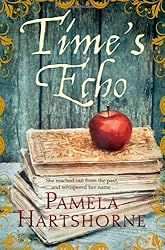
First Chapter, First Paragraph: Time's Echo

First chapterEvery Tuesday Diane at Bibliophile by the Sea hosts First Chapter First Paragraph Tuesday Intros, where you can share the first paragraph, or a few, of a book you are reading or thinking about reading soon.

My choice this week is Time’s Echo by Pamela Hartshorne, historical timeslip fiction.

It begins:

I feel no fear, not yet. I am just astounded to find myself in the air, looking down the murky rush of the river. It is as if time itself has paused, and I am somehow suspended between the sky and the wate, between the past and the present, between then and now. Between disbelief and horror.

It is All Hallows’ Eve, and I am going to die.

Time’s Echo mixes time as Grace Trewe is drawn into Hawise Aske’s life, four and a half centuries earlier in York, 1577. I saw this book in the library and although I hadn’t heard of Pamela Hartshorne I thought the title was interesting, and from the description on the back cover and the opening paragraphs, I thought it was worth borrowing.  From what I’ve read so far I’m hoping it will be an enjoyable book.

What's In A Name 7: Completed

Whats in a name 7Hosted by  by Charlie at The Worm Hole this challenge runs from January to December 2014. During this time you choose a book to read from six categories.

I’ve now completed the challenge and these are the books I read:

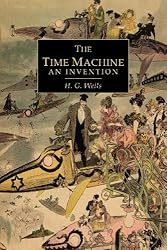
  • A reference to time €“ The Time Machine by H G Wells, first published in 1895, is a work of imagination and an early example of science fiction, but it is also a commentary on late 19th century society and a vehicle for H G Well’s views on socialism and industrialisation.

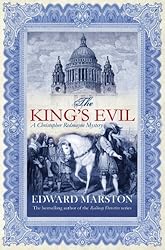
  • A position of royalty €“ The King’s Evil by Edward Marston. This is historical crime fiction set in London in September 1666, just as the Great Fire of London has begun, eventually devastating a large part of the old medieval City of London

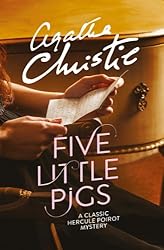
  • number written in letters – Five Little Pigs by Agatha Christie, a Poirot mystery
    first published in 1943. Caroline Crale was convicted of the murder of her husband, Amyas and died in prison. Sixteen years later, her daughter, a child of five at the time of the murder, asks Poirot to clear her mother’s name, convinced that she was innocent.
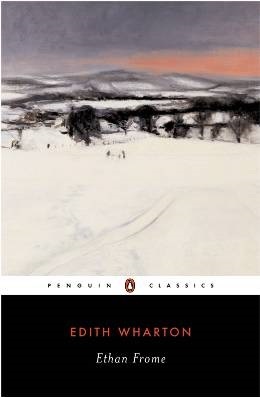
  • forename or names  Ethan Frome by Edith Wharton  a beautifully told tale €“ a tragedy, signalled right from the beginning of the book, when the unnamed narrator first saw Ethan Frome and was told he had been disfigured and crippled in a €˜smash up’, twenty four years earlier. Ethan Frome
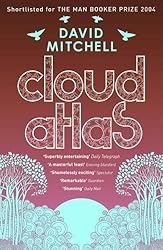
  • type or element of weather – Cloud Atlas by David Mitchell covers a time period from the 19th century to a post apocalyptic future. It’s not a book to read quickly; it requires patience, but on the whole I enjoyed it. I liked the change in style, suited to each time period, moving between straight narrative and letters and journal entries, encompassing historical fiction, thriller and sci-fi.

  • A book with a school subject in the title €“ The Brief History of the Dead by Kevin Brockmeier  fantasy fiction set some time in the future, about a place between heaven and earth, and the people who end up there after they’ve died and what happens to them. 

My favourite of these books is Ethan Frome by Edith Wharton.

Thanks to Charlie for an interesting challenge that helped me reduce my to-be-read piles.