Books Read in June

I read seven books in June, all of them ones that I’d included on my 20 Books of Summer Challenge, six of them books that qualify for the Mount TBR Reading Challenge (ie books I’ve owned prior to 1st January 2016). And I’ve managed to write about six of them – see the links to the books listed below.

  1. High Rising by Angela Thirkell (TBR) – an entertaining and witty social comedy, set in the 1930s.
  2. Talking to the Dead by Harry Bingham (TBR) – crime fiction introducing DC Fiona Griffiths, one of the most original fictional detectives I’ve come across.
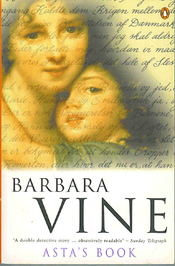
  3. Asta’s Book by Barbara Vine (TBR) – a murder mystery, a missing child, a question of identity and overarching it all are the stories of two families ‘“ the Westerbys and the Ropers. A brilliant book.
  4. A Shilling for Candles by Josephine Tey (TBR) – Inspector Alan Grant investigates the apparent suicide of a young and beautiful film star, Christine Clay, who was found dead beneath the cliffs of the south coast.
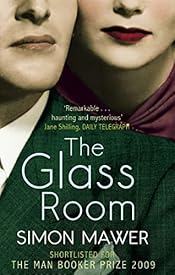
  5. The Glass Room by Simon Mawer (TBR) – a gripping novel that had me on tenterhooks as well as being a beautifully written book, set in a Europe at war and its aftermath. I loved it.
  6. Heat Wave by Penelope Lively (TBR) – an in depth study of angst, frustration and conflict, set against the changing landscape of the countryside, the effect of the heat on the land, the crops and the people.
  7. Wycliffe and the Quiet Virgin by W J Burley – a search for a missing person turns into a murder case. (My post on this book to come later.)

During June I continued reading Andrew Marr’s A History of Modern Britain, which has reminded me of all the difficult times we have lived through in the years after the Second World War and continue to experience.

I’ve been reading some excellent fiction and my favourite book has to be Asta’s Book by Barbara Vine:

closely followed by The Glass Room by Simon Mawer:

The Glass Room by Simon Mawer

The Glass Room by Simon Mawer 

Synopsis from Amazon:

Cool. Balanced. Modern. The precisions of science, the wild variance of lust, the catharsis of confession and the fear of failure – these are things that happen in The Glass Room.

High on a Czechoslovak hill, the Landauer House shines as a wonder of steel and glass and onyx built specially for newlyweds Viktor and Liesel Landauer, a Jew married to a gentile. But the radiant honesty of 1930 that the house, with its unique Glass Room, seems to engender quickly tarnishes as the storm clouds of WW2 gather, and eventually the family must flee, accompanied by Viktor’s lover and her child.

But the house’s story is far from over, and as it passes from hand to hand, from Czech to Russian, both the best and the worst of the history of Eastern Europe becomes somehow embodied and perhaps emboldened within the beautiful and austere surfaces and planes so carefully designed, until events become full-circle.

The house and its setting are not fictional, but are based on the Tugendhat House, Brno in the Czech Republic. A few of the characters are non-fictional but the rest are imaginary and their story has no basis in fact. In his introduction to the Abacus edition of the book, published in 2013, Simon Mawer describes his first visit to the house, which was then a museum. He hadn’t planned to write a novel centred on the house. To him is not a museum, but ‘vibrant and alive’, and the novel was born.

I found it a gripping novel that had me on tenterhooks as I was reading. It is, as the synopsis relates, the story of a house, the Landauer House, and specifically of a room within that house called the ‘Glass Room’.

Liesel and Viktor stood and marvelled at it [the Glass Room]. It had become a palace of light, light bouncing off the chrome pillars, light refulgent on the walls, light glistening on the dew in the gardens, light reverberating from the glass. It was as though they stood inside a crystal of salt. Isn’t it wonderful,’ she exclaimed, looking round with an expression of amazement. ‘You feel so free, so unconstrained. The sensation of space, of all things being possible. Don’t you think it is wonderful, Viktor? Don’t you think that Rainer has created a masterpiece for us?’ (pages 64-5)

The whole wall of the lower ground floor is plate glass. The room is a huge space, white walls, furnished with little decoration beyond a piano, specially designed chairs in the sitting area in front of an onyx wall veined with amber and honey, polished to a mirror-like gloss, reflecting the light, and a circular dining table in the dining area enclosed in a semicircle partition of Macassar wood.

But it was the story of the people who lived/worked in the house that captivated me and made me so anxious for them and about what would happen to them as the events of the Second World War and beyond overtook their lives. It’s not only a gripping novel, but also a beautifully written book with interesting and likeable characters, set in a Europe at war and its aftermath; and a book about architecture, ideas, about love and loss, about prejudice and persecution. A deeply moving and haunting book.

I’ve read two of Simon Mawer’s earlier books, The Gospel of Judas (2000) and The Fall (2003), both of which I also thoroughly enjoyed. He has also written:

Chimera (1989)
The Bitter Cross (1992)
A Place in Italy (1992)
A Jealous God (1996)
Mendel’s Dwarf (1997)
Swimming to Ithaca (2006)
The Girl Who Fell From the Sky (2012)
aka Trapeze
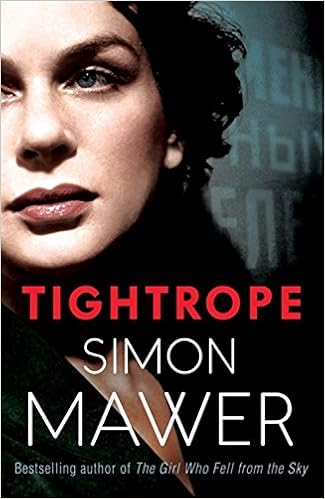
Tightrope (2015)

For more details see his website.

The Glass Room is my 27th book for Bev’s Mount TBR 2016 challenge and the 5th book I’ve read in the 20 Books of Summer Challenge.

The Walter Scott Prize for Historical Fiction

I’m currently reading The Glass Room by Simon Mawer, so I’m delighted to see that he has won the £25,000 Walter Scott Prize for Historical Fiction for his novel Tightrope.


Tightrope follows Marian Sutro, who has survived Ravensbruck and is back in dreary London trying to pick up the pieces of her post-War life. It is Simon Mawer’s tenth novel; his seventh,The Glass Room, was shortlisted for the Walter Scott Prize in 2010.

My Friday Post: The Glass Room by Simon Mawer

Book Beginnings ButtonEvery Friday Book Beginnings on Friday is hosted by Gillion at Rose City Reader where you can share the first sentence (or so) of the book you are reading, along with your initial thoughts about the sentence, impressions of the book, or anything else the opener inspires.

This week’s book is The Glass Room by Simon Mawer, which I’ve just begun to read. It begins:

Oh yes, we’re here.

She knew after all these years. Something about the slope of the road, the way the trajectory of the car began to curve upwards, a perception of shape and motion that, despite being unused for thirty years, was still engraved on her mind, to be reawakened by the subtle coincidence of movement and inclination.

Friday 56

Also every Friday there is The Friday 56, hosted by Freda at Freda’s Voice.

These are the rules:

  1. Grab a book, any book.
  2. Turn to page 56, or 56% on your eReader.
  3. Find any sentence (or a few, just don’t spoil it) that grabs you.
  4. Post it.
  5. Add the URL to your post in the link on Freda’s most recent Friday 56 post.

Page 56:

Her eyes were blue, so pale that they gave the curious illusion of transparency, as though you were looking through them and seeing the sky.

He fumbled for his lighter and watched as she bent towards the flame. She wore a grey cloche hat and her hair was dark and cut short, not cropped as severely as Liesel’s and her friends’, but short enough to be a statement that she was a modern woman. A Slav he fancied.

It looks from the opening sentences and the extract from page 56 that this is going to be a detailed, descriptive book. I like that.

Synopsis from Goodreads:

High on a Czechoslovak hill, the Landauer House has been built for newlyweds Viktor and Liesel Landauer, a Jew married to a gentile. But, when the storm clouds of WW2 gather, the family must flee, accompanied by Viktor’s lover and her child. But the house’s story is far from over, as it passes from hand to hand, from Czech to Russian.

This is a work of fiction, but the house in Prague is real. Mawer follows it through all of the upheavals of 20th century Czech history.

The Watchmaker of Filigree Street by Natasha Pulley

The Watchmaker of Filigree StreetNatasha Pulley’s first novel made a great impact on me from the start of the book. It is one of those books that I enjoyed very much, but don’t feel that I can really do it justice in a blog post. Even after a second reading I’m not at all sure I understand some of it. It’s long, complicated, packed with detail and an awful lot happens in it.

So instead of me trying to write something coherent about it I’ve copied the synopsis from the inside cover:

In 1883, Thaniel Steepleton returns to his tiny flat to find a gold pocketwatch on his pillow. But he has worse fears than generous burglars; he is a telegraphist at the Home Office, which has just received a threat for what could be the largest-scale Fenian bombing in history.

When the watch saves Thaniel’s life in a blast that destroys Scotland Yard, he goes in search of its maker, Keita Mori ‘“ a kind, lonely immigrant who sweeps him into a new world of clockwork and music. Although Mori seems harmless at first, a chain of unexpected slips soon proves that he must be hiding something.

Meanwhile, Grace Carrow is sneaking into an Oxford library dressed as a man. A theoretical physicist, she is desperate to prove the existence of the luminiferous ether before her mother can force her to marry.

As the lives of these three characters become entwined, events spiral out of control until Thaniel is torn between loyalties, futures and opposing geniuses.

Utterly beguiling, The Watchmaker of Filigree Street blends historical events with dazzling flights of fancy to plunge readers into a strange and magical past, where time, destiny, genius ‘“ and a clockwork octopus ‘“ collide.

My thoughts:

These are just a few thoughts that struck me both as I was reading the book and later thinking about it. It’s a mixture of historical fact and fantasy set in Victorian times, both in London and Japan, following the lives of the main characters, Thaniel Stapleton, Keita Mori and Grace Carrow. I like to know what is historical fact and what is the author’s own creation. So I was pleased to read in her Acknowledgements, that Natasha Pulley explains that there is some historical accuracy and cites Lee Jackson’s Dictionary of Victorian London for resources on the early days of the London Underground, the Knightsbridge Japanese show village, the bombing of Scotland Yard and numerous other interesting things.  (As I read the book I was very tempted to leave the story to find out more about these topics, but the story drew me on and I left them for later.)

I was completely convinced by the setting in a different time in a world that was familiar and yet so different. I  liked the writing style, although in parts it’s a bit ‘clunky’ and the use of ‘he’, ‘him’ and ‘they’ or ‘them’ made it a bit difficult to follow, but this is only a minor quibble. I also liked the characterisation and how the characters’ history was revealed and how their personalities were developed. Keita Mori is an interesting character and as I read my opinion of him kept changing – just who is he? He is an enigma, why is he living in London, is he the bomb maker, does he in fact know what is going to happen, is he a magician? He baffled and confused me as much as he baffled and confused the other characters.

Equally fascinating are the sections set in Japan; Grace’s story, her research into luminiferous ether (a bit hard to follow), her relationship with Akira Matsumoto, the elegant son of a Japanese nobleman; the Japanese show village in Hyde Park where Gilbert and Sullivan went to research for the Mikado; the early days of the London Underground; and of course the clockwork inventions, in particular Katsu, the clockwork octopus.

There is so much in this book, so many passages I underlined in my e-book, so many intertwining stories and lines that I have not mentioned – politics, the Fenians, bombs, the workings of the Home and Foreign Offices, suffragettes, racism, and class snobbery – I could go on and on. It may seem that this is a hotch-potch of a book, but the more I thought about it, the more I liked it. In fact I loved it both for its historical settings and for its ingenuity, producing a fantastical tale that occupied my mind during and after my reading.

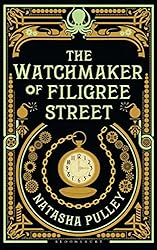
I reserved The Watchmaker of Filigree Street at the library but before it was available the e-book was on offer on Amazon, so I ended up reading from both editions. And in doing so, I can now see the benefits of both – I can underline in an e-book and make notes without any damage to the book and as it has X-Ray it’s easy to find passages about the characters and places etc. But the physical book is a joy to read – the text is set in Bell, originally cut for John Bell in 1788, and the cover is beautiful.
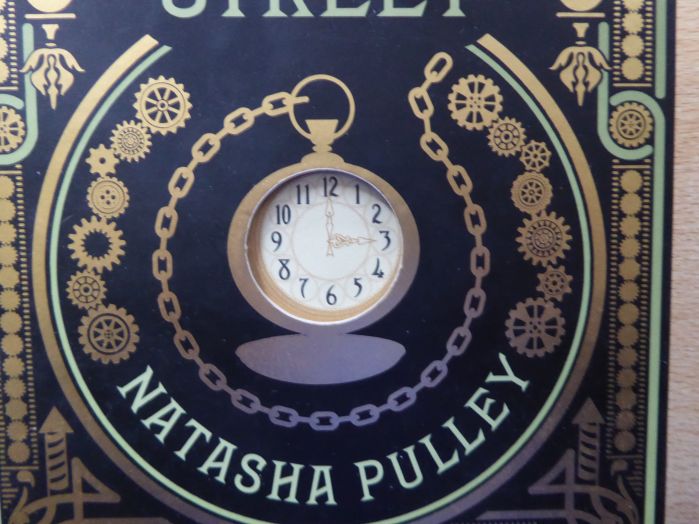
The Watchmaker cover P1020046

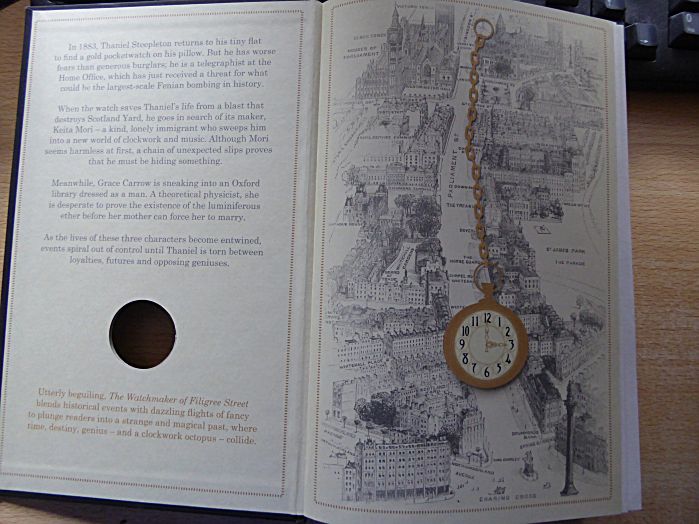
and the inside cover has this map:

The Watchmaker map P1020045

This book also fits so well into the Once Upon a Time Challenge in the Fantasy Genre. I’ve seen it described as ‘steampunk’ but I’m not at all sure what that is – to me it’s historical fantasy.
First Chapter, First Paragraph: The Silver Pigs

Every Tuesday Diane at Bibliophile by the Sea hosts First Chapter First Paragraph Tuesday Intros, where you can share the first paragraph, or a few, of a book you are reading or thinking about reading soon.

This week I’m featuring The Silver Pigs by Lindsay Davis, a book that I started reading last night. Whilst this is a new-to-me series, The Silver Pigs was first published in 1989 and there are now 20 books in the series. Lindsey Davis also writes the Favia Alba Mystery series. She has won many literary awards, and was honorary president of the Classical Association from 1997 to 1998.

It begins:

When the girl came rushing up the steps, I decided she was wearing far too many clothes.

It was late summer. Rome frizzled like a pancake on a griddleplate. People unlaced their shoes but had to keep them on; not even an elephant could cross the street unshod. People flopped on stools in shadowed doorways, bare knees apart, naked to the waist – and in the backstreets of Aventine Sector where I lived, that was just the women.

This is historical crime fiction, the first of the Marcus Didius Falco novels. Set in Rome in 70AD, Vespasian is the new Roman emperor and Falco is a private informer, or private eye. In this first book he and his partner Helena Justina rescue a young girl in trouble. He is then catapulted into a dangerous game involving stolen imperial ingots, a dark political plot and, most hazardous of all, a senator’s daughter connected to the traitors Falco has sworn to expose.

My copy has an introduction by Lindsey Davis in which she tells of how she began to write historical fiction, setting a typical private eye figure in Rome two thousand years ago. It has maps and a Dramatis Personae.

And I do like the cover.