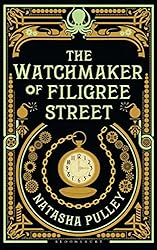
The Watchmaker of Filigree Street by Natasha Pulley

The Watchmaker of Filigree StreetNatasha Pulley’s first novel made a great impact on me from the start of the book. It is one of those books that I enjoyed very much, but don’t feel that I can really do it justice in a blog post. Even after a second reading I’m not at all sure I understand some of it. It’s long, complicated, packed with detail and an awful lot happens in it.

So instead of me trying to write something coherent about it I’ve copied the synopsis from the inside cover:

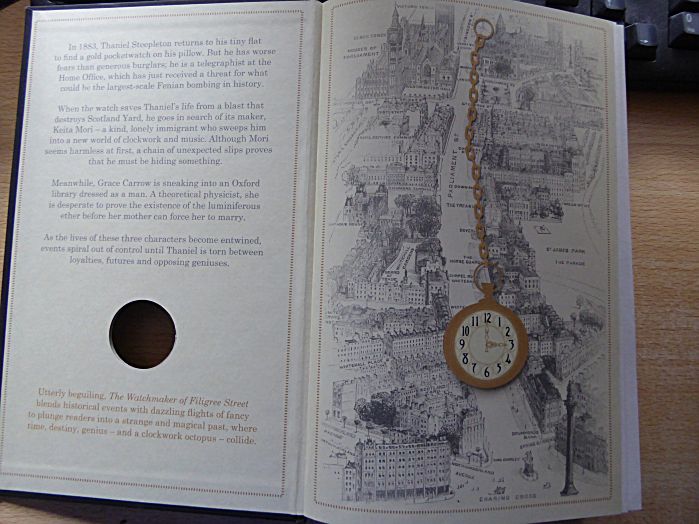
In 1883, Thaniel Steepleton returns to his tiny flat to find a gold pocketwatch on his pillow. But he has worse fears than generous burglars; he is a telegraphist at the Home Office, which has just received a threat for what could be the largest-scale Fenian bombing in history.

When the watch saves Thaniel’s life in a blast that destroys Scotland Yard, he goes in search of its maker, Keita Mori ‘“ a kind, lonely immigrant who sweeps him into a new world of clockwork and music. Although Mori seems harmless at first, a chain of unexpected slips soon proves that he must be hiding something.

Meanwhile, Grace Carrow is sneaking into an Oxford library dressed as a man. A theoretical physicist, she is desperate to prove the existence of the luminiferous ether before her mother can force her to marry.

As the lives of these three characters become entwined, events spiral out of control until Thaniel is torn between loyalties, futures and opposing geniuses.

Utterly beguiling, The Watchmaker of Filigree Street blends historical events with dazzling flights of fancy to plunge readers into a strange and magical past, where time, destiny, genius ‘“ and a clockwork octopus ‘“ collide.

My thoughts:

These are just a few thoughts that struck me both as I was reading the book and later thinking about it. It’s a mixture of historical fact and fantasy set in Victorian times, both in London and Japan, following the lives of the main characters, Thaniel Stapleton, Keita Mori and Grace Carrow. I like to know what is historical fact and what is the author’s own creation. So I was pleased to read in her Acknowledgements, that Natasha Pulley explains that there is some historical accuracy and cites Lee Jackson’s Dictionary of Victorian London for resources on the early days of the London Underground, the Knightsbridge Japanese show village, the bombing of Scotland Yard and numerous other interesting things.  (As I read the book I was very tempted to leave the story to find out more about these topics, but the story drew me on and I left them for later.)

I was completely convinced by the setting in a different time in a world that was familiar and yet so different. I  liked the writing style, although in parts it’s a bit ‘clunky’ and the use of ‘he’, ‘him’ and ‘they’ or ‘them’ made it a bit difficult to follow, but this is only a minor quibble. I also liked the characterisation and how the characters’ history was revealed and how their personalities were developed. Keita Mori is an interesting character and as I read my opinion of him kept changing – just who is he? He is an enigma, why is he living in London, is he the bomb maker, does he in fact know what is going to happen, is he a magician? He baffled and confused me as much as he baffled and confused the other characters.

Equally fascinating are the sections set in Japan; Grace’s story, her research into luminiferous ether (a bit hard to follow), her relationship with Akira Matsumoto, the elegant son of a Japanese nobleman; the Japanese show village in Hyde Park where Gilbert and Sullivan went to research for the Mikado; the early days of the London Underground; and of course the clockwork inventions, in particular Katsu, the clockwork octopus.

There is so much in this book, so many passages I underlined in my e-book, so many intertwining stories and lines that I have not mentioned – politics, the Fenians, bombs, the workings of the Home and Foreign Offices, suffragettes, racism, and class snobbery – I could go on and on. It may seem that this is a hotch-potch of a book, but the more I thought about it, the more I liked it. In fact I loved it both for its historical settings and for its ingenuity, producing a fantastical tale that occupied my mind during and after my reading.

I reserved The Watchmaker of Filigree Street at the library but before it was available the e-book was on offer on Amazon, so I ended up reading from both editions. And in doing so, I can now see the benefits of both – I can underline in an e-book and make notes without any damage to the book and as it has X-Ray it’s easy to find passages about the characters and places etc. But the physical book is a joy to read – the text is set in Bell, originally cut for John Bell in 1788, and the cover is beautiful.
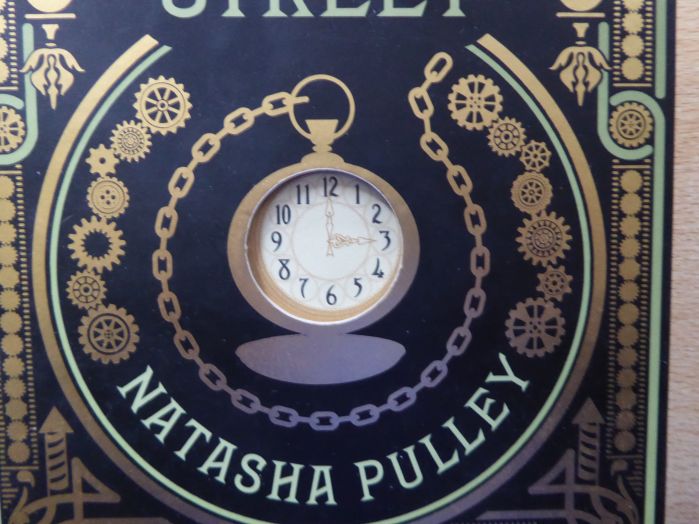
The Watchmaker cover P1020046

and the inside cover has this map:

The Watchmaker map P1020045

This book also fits so well into the Once Upon a Time Challenge in the Fantasy Genre. I’ve seen it described as ‘steampunk’ but I’m not at all sure what that is – to me it’s historical fantasy.
First Chapter, First Paragraph: The Silver Pigs

Every Tuesday Diane at Bibliophile by the Sea hosts First Chapter First Paragraph Tuesday Intros, where you can share the first paragraph, or a few, of a book you are reading or thinking about reading soon.

This week I’m featuring The Silver Pigs by Lindsay Davis, a book that I started reading last night. Whilst this is a new-to-me series, The Silver Pigs was first published in 1989 and there are now 20 books in the series. Lindsey Davis also writes the Favia Alba Mystery series. She has won many literary awards, and was honorary president of the Classical Association from 1997 to 1998.

It begins:

When the girl came rushing up the steps, I decided she was wearing far too many clothes.

It was late summer. Rome frizzled like a pancake on a griddleplate. People unlaced their shoes but had to keep them on; not even an elephant could cross the street unshod. People flopped on stools in shadowed doorways, bare knees apart, naked to the waist – and in the backstreets of Aventine Sector where I lived, that was just the women.

This is historical crime fiction, the first of the Marcus Didius Falco novels. Set in Rome in 70AD, Vespasian is the new Roman emperor and Falco is a private informer, or private eye. In this first book he and his partner Helena Justina rescue a young girl in trouble. He is then catapulted into a dangerous game involving stolen imperial ingots, a dark political plot and, most hazardous of all, a senator’s daughter connected to the traitors Falco has sworn to expose.

My copy has an introduction by Lindsey Davis in which she tells of how she began to write historical fiction, setting a typical private eye figure in Rome two thousand years ago. It has maps and a Dramatis Personae.

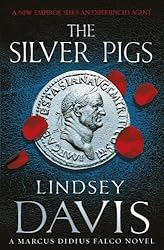
And I do like the cover.


People of the Book by Geraldine Brooks

When I began reading People of the Book by Geraldine Brooks I wondered why I’d left it nearly eight years on my book shelves before I  got round to reading it. I loved it; it’s a real gem! It has joined the ranks of my favourite books and is definitely a book for keeping and (I hope) for re-reading.

How could I not love a book about books, in particular an ancient book, one that was thought to be lost or destroyed, a book that escaped burning by the Inquisition and the Nazis, a book that survived shelling during the Bosnian War in the 1990s, a book known as the priceless Sarajevo Haggadah – a medieval Jewish prayer book containing the illustrated traditional text of the Passover Haggadah which accompanies the Feast of Passover.

In Geraldine Brooks’ Afterword she explains that People of the Book is fiction, inspired by the true story of the Hebrew codex known as the Sarajevo Haggadah. Some of the facts are true to the haggadah’s known history but most of the plot and all of the characters are imaginary. She then goes on to define what is true and what is fictional, which I think is the best way of presenting historical fiction.

Australian Hanna Heath is a rare-book restorer and it’s not only the content of the haggadah that interests her, it is the hidden history of the book that captured her imagination and also mine. She finds tiny clues to its history as she restores the book – a fragment of an insect’s wing, wine stains, salt crystals and a tiny white hair – clues to unlock its mysteries. The story of the book is told in reverse chronological order beginning in 1996 and working back to 1480. Interwoven with each story is Hanna’s own story as she too discovers her roots. It’s a story too of love and war, of family relationships, of Anti-Semitism and of historical religious conflicts as the haggadah survived disaster after disaster. It’s also a novel about preserving the past, its culture and history for future generations. It has depth and breadth and is beautifully written. I was irresistibly engrossed in this book and full of wonder at its stories, reaching back in time from Sarajevo to Vienna, Venice, Tarragona to Seville in 1480 and also Hanna’s story from 1996 to 2002.

There are many descriptions of the haggadah throughout the book, all of which made me eager to know more about it. This is just one example from the chapter on wine stains set in Venice in 1609:

Aryeh released the catches, admiring the work of the silversmith. Each clasp, closed, was in the form of a pair of wings. As the delicate catch released – still smoothly after more than a century – the wings opened to reveal a rosette enfolded within. Aryeh saw at once that the book was a haggadah, but unlike any he had seen before. The gold leaf, the pigments … he stared at the illuminations, opening each page eagerly. He was delighted, yet a little disturbed, to see Jewish stories told in an art so like that of the Christians’ prayer books. (page 163)

And here, by way of contrast, is a description of Arnhem Land in the north east corner of Australia’s Northern Territory, where Hanna is working in the caves studying the Aboriginal rock art to document and preserve it before the uranium or bauxite companies blasted it into rubble:

I stepped out of the cave and blinked in the bright daylight. The sun was a big disc of brilliant madder, reddening the stripes of ore that ran through the sheer black-and-ocher rock face. Down below, the first shoots of new spear grass washed the plain in vivid green. Light silvered the sheets of water left behind by the previous night’s downpour. We’d moved into Gunumeleng – one of six seasons the Aborigines identified in a year that whites simply divided into Wet and Dry. Gunumeleng brought the first storms. In another month, the entire plain would be flooded. The so-called road, which was actually virtually a marginal dirt track, would be impassable. (pages 339-340)

I just had to know more about the Sarajevo Haggadah and found these illustrations (see Wikimedia Commons for more illustrations and these sites for more information –  WikipediaThe Times of Israel and About Haggadah:

Copies of Sarajevo Haggadah in parliament building – from Wikimedia Commons

The Sarejevo Haggadah, 15th century Spain – from Wikimedia Commons
Reading challenges: Mount TBR Reading Challenge 2016

Stacking the Shelves: 2 April 2016

STSmall

Stacking The Shelves is all about sharing the books you are adding to your shelves. This means you can include ‘˜real’ and ‘˜virtual’ books (ie physical and ebooks) you’ve bought, books you’ve borrowed from friends or the library, review books, and gifts.

I bought three books this week.

I loved watching The Night Manager, adapted from John le Carré’s novel, so when I went to Main Street Trading on Tuesday I hoped they would have a copy. They didn’t – but they did have Tinker Tailor Soldier Spy, a book I’ve wanted to read ever since I watched the BBC adaptation many years ago (Alec Guinness was George Smiley).

Blurb:

George Smiley, who is a troubled man of infinite compassion, is also a single-mindedly ruthless adversary as a spy.

The scene which he enters is a Cold War landscape of moles and lamplighters, scalp-hunters and pavement artists, where men are turned, burned or bought for stock. Smiley’s mission is to catch a Moscow Centre mole burrowed thirty years deep into the Circus itself.

Yesterday I went shopping and passing Berrydin in Books I had to go in and, of course, I had to buy a book – well two actually. First another book that I was prompted to read by a TV adaptation in 2012 – Birdsong by Sebastian Foulks.

Blurb:

A novel of overwhelming emotional power, Birdsong is a story of love, death, sex and survival. Stephen Wraysford, a young Englishman, arrives in Amiens in northern France in 1910 to stay with the Azaire family, and falls in love with unhappily married Isabelle. But, with the world on the brink of war, the relationship falters, and Stephen volunteers to fight on the Western Front. His love for Isabelle forever engraved on his heart, he experiences the unprecedented horrors of that conflict – from which neither he nor any reader of this book can emerge unchanged.

And also Citadel by Kate Mosse, because I like time-slip books. The main story is set in 1942-44 in Nazi-occupied  Carcassonne in France and moves back in time to 342, with a monk, Arinus trying to find a hiding place for a forbidden Codex.

Blurb:

1942, Nazi-occupied France. Sandrine, a spirited and courageous nineteen-year-old, finds herself drawn into a Resistance group in Carcassonne – codenamed ‘Citadel’ – made up of ordinary women who are prepared to risk everything for what is right.

And when she meets Raoul, they discover a shared passion for the cause, for their homeland, and for each other.

But in a world where the enemy now lies in every shadow – where neighbour informs on neighbour; where friends disappear without warning and often without trace – love can demand the highest price of all…

As soon as I read some of my TBR books (6 in March) it seems I just have to find more – at least it’s only three this time.

Six Tudor Queens: Katherine of Aragon, the True Queen by Alison Weir

I received a proof copy of Six Tudor Queens: Katherine of Aragon, the True Queen as a member of the reader review panel for Lovereading.co.uk. It’s the first book in a series of novels about Henry VIII’s Queens and is due to be published in May 2016.

This is fictional biography at its most straight forward, written in an uncomplicated style. Told from Katherine’s point of view it follows her life from the time she arrived in England at the age of sixteen to marry Prince Arthur, the elder of Henry VII’s two sons, to her death in 1536.

I knew the brief facts about Katherine, the daughter of Isabella and Ferdinand of Spain, married first to Prince Arthur and then to his brother Henry after a papal dispensation allowing the marriage after Arthur’s death; her subsequent failure to produce a living male heir, suffering a series of miscarriages; the only baby to survive was a daughter, Mary; and her divorce in 1533 from Henry VIII, who was by then besotted with Anne Boleyn.

This novel fills in the facts in great detail including the question of whether her first marriage was consummated. Katherine maintained it wasn’t and based on research Weir takes her word as the truth. In her Author’s Note she refers to recent research by Giles Tremlett and Patrick Williams that shows ‘we can be fairly certain that Katherine’s marriage to Prince Arthur was not consummated and that he died of tuberculosis.’  She cites the basis of her account of Arthur’s illnesss on Dr. Alcaraz’s testimony, given on 1531 at Zaragoza. She portrays Katherine as a determined woman who never ceased loving Henry and above all who did everything she could to protect the legitimacy of her daughter.

Katherine is portrayed as a woman of her time – obedient to her parents and her husband, conscientious about doing her duty  and active in maintaining an alliance between England and Spain. But even so, she resisted Henry in his demands for an annulment of their marriage. She was heart-broken both at her failure to produce a living male heir and to keep Henry’s love – because they were in love at the beginning – and maintained that she was the true queen right up to her death. I tend to forget the length of their marriage, glibly remembering the mnemonic ‘Divorced, beheaded, died, divorced, beheaded, survived‘. Katherine and Henry were married for over 20 years. I did get tired of the account of their endless wrangling, going over and over the same arguments, never getting anywhere – but then I suppose that was how it was for them both.

Overall I enjoyed this book. It’s a long and comprehensive study, which has increased my knowledge and understanding of Katherine of Aragon and the early 1500s. It is obviously based on extensive research and written with great attention to historical accuracy, but in places this made it tedious and too drawn out.

  • Hardcover: 624 pages – also available as a Kindle edition
  • Publisher: Headline Review (5 May 2016)
  • Language: English
  • ISBN-10: 1472227476
  • ISBN-13: 978-1472227478
  • Product Dimensions: 15.3 x 5.6 x 23.4 cm
  • Source: Review copy

The Legacy of Elizabeth Pringle by Kirsty Wark

I quoted an extract from the opening paragraph of The Legacy of Elizabeth Pringle by Kirsty Wark in an earlier post, whilst I was in the middle of the book. I finished reading it a few days ago and have been wondering what to write about it ever since. It’s one of those books that has received a mixed reception with some reviewers thinking it’s a well written book whereas others think it isn’t. I enjoyed it very much.

It’s a story centred on the lives of two women – Elizabeth Pringle and Martha Morrison. Elizabeth has lived all her life on the Isle of Arran and knowing that she is dying and has no living relatives, leaves her house, Holmlea in Lamlash, to Anna Morrison, a woman she had seen years before, pushing her daughter’s pram down the road outside. Anna Morrison, had fallen in love with the house and written to Elizabeth asking her to get in touch if she ever thought of selling it. But Anna is now suffering from dementia and it is her daughter, Martha who goes to Arran to see the house on her mother’s behalf.

What follows is a dual narrative moving between Elizabeth’s account in her own words of her life up to the present day and Martha’s current situation, told in the third person, as she meets the people Elizabeth knew, in particular, Saul, a Buddhist, Niall, a young man who is passionate about gardening, and Catriona his sister who runs a hotel on the island. It’s a deceptive book in that it appears that not much happens and it is gentle and leisurely paced, but it is actually packed with events, some of them dramatic and devastating in their effect on the characters’ lives. And it has a vivid sense of place and of Arran’s history, which I loved.

I much preferred Elizabeth’s story beginning when she was just four and her father went off to fight in the First World War; her relationship with her mother; her life as a teacher and her love life. I found the ending of her life very moving. Martha’s story seems rather pat, everything falls into place a bit too easily – especially her relationship with her mother and sister and the instant friendships she makes on the island.

It’s a book about family, relationships, especially mother/daughter/sister relationships, about happiness, love and heartbreak, old age, memories and the contrast between life in the early part of the twentieth century and the present. It’s strong on description, which is important to me as I like to visualise the locations – and I had no difficulty at all with that in this book.

All in all, I was captivated by this story.

Kirsty Wark is a journalist, broadcaster and writer who hosts a variety of BBC programmes. Her home has always been Scotland and her family’s connection to Arran goes back over many years.

————-

Reading Challenges: Mount TBR Reading Challenge – a book I’ve had for two years, and Read Scotland 2016 – a book by a Scottish author and set in Scotland.