WWW Wednesday: 12 September 2018

IMG_1384-0

WWW Wednesday is run by Taking on a World of Words.

The Three Ws are:

What are you currently reading?
What did you recently finish reading?
What do you think you’ll read next?

I’m currently reading:

The Clockmaker’s DaughterI’m reading Kate Morton’s latest book, The Clockmaker’s Daughter due to be published on 20th September 2018. I’m enjoying it very much so far. It’s set in the 1860s at Birchwood Manor on the banks of the Upper Thames where a group of young artists led by Edward Radcliffe are spending the summer and also in 2017 with Elodie, a young archivist in London, who finds a leather satchel containing two seemingly unrelated items: a sepia photograph of an arresting-looking woman in Victorian clothing, and an artist’s sketchbook containing the drawing of a twin-gabled house on the bend of a river. It’s a story of murder, mystery and thievery, of art, love and loss.

East of Eden

I’m also reading East of Eden by John Steinbeck. It’s the story of two families—the Trasks and the Hamiltons—whose generations helplessly re-enact the fall of Adam and Eve and the poisonous rivalry of Cain and Abel. I like Steinbeck’s writing, particularly the opening description of the Salinas Valley in California, but so far I’ve not found the book as absorbing as The Grapes of Wrath, which I loved, but then I’ve only read up to page 125 (612 pages in total) and am just getting used to the leisurely pace of the novel.

I’ve recently finished:  

Wedlock: How Georgian Britain’s Worst Husband Met His Match by Wendy Moore, non fiction about Mary Eleanor Bowes who was the richest heiress in 18th century Britain. She fell under the spell of a handsome Irish soldier, Andrew Robinson Stoney and found herself trapped in an appallingly brutal marriage, terrorised by violence, humiliation, deception and kidnap, and fearful for her life. It’s full of detail and reads more like a novel than non-fiction .

Dead Woman Walking

Another book I’ve finished recently is Dead Woman Walking by Sharon Bolton. I loved it – very clever plotting, great characters and set in an area of Northumberland that I know quite well (a bonus). It begins with a balloon flight that ends in disaster and only Jessica survives as the balloon crashes to the ground, but she is pursued by a man who is determined to kill her. I love this kind of book, full of suspense and surprises and one that draws me within its pages.

My next book could be:

Cold Earth (Shetland Island, #7)

Ann Cleeves’ 7th book in her Shetland series, Cold Earth because I really want to read her 8th book, Wild Fire which was published last week, only to discover that I haven’t read Cold Earth yet!

Synopsis

In the dark days of a Shetland winter, torrential rain triggers a landslide that crosses the main Lerwick-Sumburgh road and sweeps down to the sea.

At the burial of his old friend Magnus Tait, Jimmy Perez watches the flood of mud and peaty water smash through a croft house in its path. Everyone thinks the croft is uninhabited, but in the wreckage he finds the body of a dark-haired woman wearing a red silk dress. In his mind, she shares his Mediterranean ancestry and soon he becomes obsessed with tracing her identity.

Then it emerges that she was already dead before the landslide hit the house. Perez knows he must find out who she was, and how she died.

Have you read any of these books?  Do any of them tempt you? 

The Way of All Flesh by Ambrose Parry

Edinburgh, 1847. City of Medicine, Money, Murder

Canongate Books|30 August 2018|417 pages|Review copy|5*

The Way of All Flesh is the debut novel from Ambrose Parry: co-written by best-selling crime writer Chris Brookmyre and consultant anaesthetist Dr Marisa Haetzman.

I knew as soon as I began reading The Way of All Flesh that I was going to enjoy it – it’s historical crime fiction at its very best.

Full of atmosphere and historical detail, I could easily believe I was there in Edinburgh in 1847 as Dr James Young Simpson, a professor of midwifery, discovered the anaesthetic properties of chloroform. It combines fact and fiction most successfully, the social scene, historical and medical facts slotting perfectly into the plot.

It begins with the death of Evie, a prostitute in Edinburgh’s Old Town, found by Will Raven, a young medical student about to start his apprenticeship with Dr Simpson. Will, Evie’s friend is suspicious, the place was reeking of drink and Evie’s body was in a state of contortion. He flees the scene, not wanting to be implicated in her death. There is a mystery surrounding Will – he has a past that he wants to conceal, and he is in trouble with a couple of villains who beat him, slashing his face when he is unable to repay his debt to a moneylender.

Will is anxious to fit in with the more genteel society of the New Town, where Dr Simpson has his surgery, a place where people from all levels of society congregated – the poor who attended his clinics, the wealthy who also wanted treatment, and the medical students and colleagues experimenting with new drugs and medical techniques. When Will comes across similar deaths during his work with Dr Simpson he is determined to find out who is responsible  – was it the same person who had killed Evie?

Sarah, Dr Simpson’s housemaid is an ambitious and enterprising young woman who would love to have a career in medicine just like the male medical students. Initially she dislikes Will, but eventually they join forces to uncover the killer in the depths of Edinburgh’s dark underworld . Through Sarah’s eyes we see the frustrations and limitations that all women experienced and through Will’s eyes we see the grim realities and danger that women at all levels of society faced with childbirth and unwanted pregnancies, and the brutally primitive state of the medicine of the period. The medical scenes are indeed gruesome and the attitudes of some of the clergy with their opposition to the use of anaesthetics is deplorable. The authors have combined their specialities to provide a compelling murder mystery interwoven with the exciting discovery of chloroform and how it transformed surgery.

This is without doubt an impressive and well written book that gripped me throughout – definitely one of the best books that I’ve read so far this year.

And I am so pleased that this is not the end of Will as Chris and his wife, Marisa are planning more novels revealing the development of medicine and the part that the Simpson household played. Also, I see that Benedict Cumberbatch’s SunnyMarch production company has secured the TV rights to The Way of All Flesh.

Thank you to Canongate Books and NetGalley for my copy of this book for review.

New-to-Me Books from Barter Books

Yesterday I went to my favourite bookshop Barter Books, one of the largest secondhand bookshops in Britain. This is where you can ‘swap’ books for credit that you can then use to get more books from the Barter Books shelves.

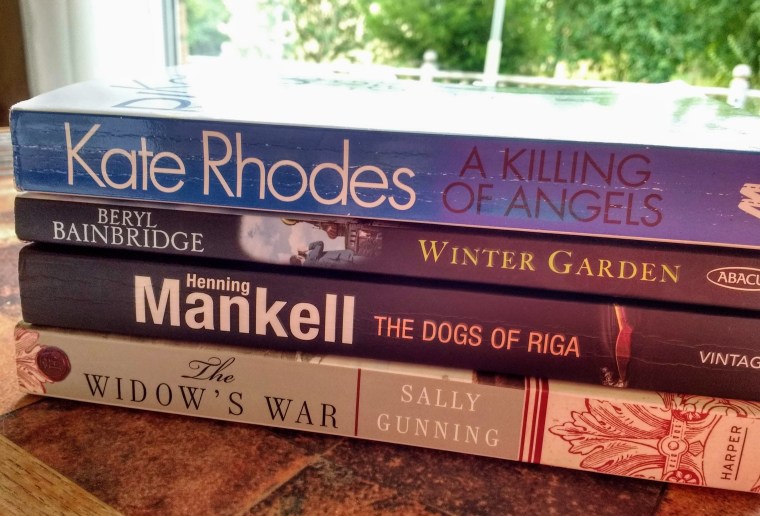
These are the books I brought home:

img_20180829_073215012_hdr


A Killing of Angels by Kate Rhodes (a new-to-me author) – the second book in her Alice Quentin series. I haven’t read the first book but I thought this looks good – it’s a psychological thriller. At the height of a summer heatwave, a killer stalks the City of London.The avenging angel leaves behind a scattering of feathers with each body – but why these victims? What were their sins?

Winter Garden by Beryl Bainbridge – described on the back cover as ‘surreal’ (TLS) and ‘very funny as well as a frightening book’ (Guardian), I’m not sure what I’ll make of this book about a womaniser who begins an extra-marital affair, but I’ve liked other books by Beryl Bainbridge.

The Dogs of Riga by Henning Mankell. I’ve enjoyed a couple of his books before, so this Inspector Wallander book caught my eye. A little raft is washed ashore on a beach in Sweden. It contains two men, shot dead. They’re identified as criminals, victims of a gangland hit. Wallander’s investigation takes him to Latvia.

The Widow’s War by Sally Gunning – another new-to-me author. This is historical fiction set in 1761 about a whaler’s wife in the Cape Cod village of Satucket in Massachusetts, living with the daily uncertainty that her husband Edward will simply not return. And when her worst fear is realised, she finds herself doubly cursed.

Have you read any of these? Do they tempt you too?

The Story Keeper by Anna Mazzola


The Story Keeper

4*

The Story Keeper is historical fiction set on the Isle of Skye in 1857 where Audrey Hart has been employed by Miss Buchanan to collect the folklore and fairy tales of the local community. The Highland Clearances have left their mark on the crofters leaving them suspicious and fearful, unwilling to talk to Audrey as both the clergy and schoolmasters have condemned their practice of the old traditions – the stories are being lost.

The novel stresses the importance of folk tales – stories that have been told to make sense of the world and reflect people’s strengths, flaws, hopes and fears. Such stories are interspersed throughout the book. When one by one young girls go missing from their homes  the locals believe they have been taken by the spirits of the unforgiven dead. For these are not tales of good fairies, but of malign spirits that torment the girls they have stolen, sometimes returning them, ‘sorely changed’.

This is a novel full of family secrets and unfulfilled desires. There is a mystery about Audrey, her background and why she wanted to come to Skye. At first she believes there is a rational explanation to the girls’ disappearance but gradually she comes to fear that there may be something more supernatural behind it – linked maybe to the mystery of her mother’s disappearance years earlier on Skye.

It is beautifully written with vivid descriptions of the island, the flocks of black birds that whirl above the house that stands like an enchanted castle or a fortress on the coast. From a slow start the pace of the book rises to a crescendo in a dramatic and horrific ending combining the supernatural with reality, and tales of cruel fairies with the brutality of human beings. I loved the setting, the characterisation and the mix of history with folklore and fairy stories.

Thank you to the publisher, Tinder Press for my copy of this book for review.

My Friday Post: The House Between Tides by Sarah Maine

Book Beginnings Button

Every Friday Book Beginnings on Friday is hosted by Gillion at Rose City Reader where you can share the first sentence (or so) of the book you are reading, along with your initial thoughts about the sentence, impressions of the book, or anything else the opener inspires.

The book I’m featuring this week is The House Between Tides by Sarah Maine, a book I’m planning to read soon. It’s the story of a crumbling estate in the wilds of Scotland, set in 1910 and 2010.

The House Between Tides


It begins:

2010

The  first bone he had dismissed as dead sheep. There’d been others – ribs decaying amidst rabbit droppings and debris from the collapsing ceilings, or bleached vertebrae. But the next one was a long bone, and he held it, considering a moment, then rocked back on his heels.

This was no sheep.

Also every Friday there is The Friday 56, hosted by Freda at Freda’s Voice.

30879-friday2b56These are the rules:

  1. Grab a book, any book.
  2. Turn to page 56, or 56% on your eReader.
  3. Find any sentence (or a few, just don’t spoil it) that grabs you.
  4. Post it.
  5. Add the URL to your post in the link on Freda’s most recent Friday 56 post.

Page 56:

And she had been drawn to a painting which hung in a corner, away from the others, a painting she now recognised as the view from the foreshore in front of the house. It showed two ill-defined figures walking across the strand, through contrasting patches of light, shadow and mist, walking in parallel, slightly apart from each other, and somehow clearly a man and a woman. But were they coming together or drifting apart?

Description (Amazon)

Following the death of her last living relative, Hetty Deveraux leaves London and her strained relationship behind for Muirlan, her ancestral home in Scotland – now in ruins. As Hetty dives headfirst into the repairs, she discovers a shocking secret protected by the house for a hundred years.

With only whispered rumours circulating among the local villagers and a handful of leads to guide her, Hetty finds the power of the past is still affecting her present in startling ways.

~~~

Sarah Maine is a new-to-me author, so I’m not sure what to expect, but The House Between Tides is described by Kirkus Reviews as ‘ A compelling debut which deftly blends classic suspense with modern themes.’ The reviewer in the Independent is quoted on the front cover – ‘An echo of Daphne du Maurier‘, so I’m hoping I’ll like it.

What about you? Does it tempt you or would you stop reading? 


By Sword and Storm by Margaret Skea

By Sword and Storm (The Munro Scottish Saga Book 3)

Two of the best historical fiction books I’ve read in recent years are Margaret Skea’s Munro Scottish Sagas, Turn of the Tide,  and A House Divided, both of which transported me  back in time to 16th century Scotland and France, specifically to the world of the feuding clans of Cunninghame and Montgomerie.

By Sword and Storm is the third book in the Munro Saga. It stands well on its own but I recommend reading the earlier books to get the whole picture of what happened in the years before. It is now 1598 and the Munro family, Adam, his wife, Kate, and children, Robbie, Maggie and Ellie  are living in France. Adam and Robbie are in the Scots Gardes, serving Henri IV of France: Adam is a colonel  and Robbie is a sergeant.  The Scots Gardes were an elite Scottish regiment whose duties included the provision of a personal bodyguard to the French King.

The story is well grounded in research and based on historical facts, seamlessly interweaving fact and fiction. It is  complex novel with several plot lines, locations and characters, some based on real historical figures and others fictitious, such as the Munro family. There’s a useful list of the main characters and a map at the start of the book and a glossary and historical note at the end.

As the story begins the French Wars of Religion are drawing to an end and the Edict of Nantes has established religious freedom, placating the Catholics whilst making concessions to the Huguenots – but not in Paris or at the French court, where Protestants are still banned from openly practising their religion. When Adam saves Henri’s life as a shot is fired from the crowd, he and his family are summoned to live at the French court, despite their religious beliefs. Life in Paris holds many dangers for the Munros, especially for Robbie when he falls in love with a girl from a Huguenot family.

Back in Scotland some members of the Cunninghame and Montgomerie factions are still feuding, notably Hugh Montgomerie, the Laird of Braidstane and William, the son of the head of the Cunninghame clan, whilst other clan members try to maintain the peace.  James VI has banned duelling but that doesn’t deter Hugh and William. Meanwhile, Hugh’s wife, Elizabeth, pregnant and left on her own in the depths of winter with only her children and a servant for company, faces her own dangers.

There is so much to enjoy in this book – first of all the story itself, expertly narrated, full of tension and surprise, and also the characters. But I also loved the personal touches, revealing what life was like in the 16th century,  how both ordinary people and royalty lived, and the dangers that faced them in their daily lives, particularly for women in childbirth and sickness and for those who dissented from the established religion.

I loved all the details about the French court, in particular about Henri’s mistress and the relationship between her and Kate. As in the earlier books Margaret Skea writes such beautifully descriptive passages, bringing to life the details of the French court and of the landscape in both Scotland and France as well as the dangers of travelling by sea.

This is ostensibly the end of the Munro saga – but Margaret Skea has revealed on her blog that she is hoping to revisit the Munro story at a later date. I hope she does, but if not this is an excellent end to the series.

  • Format: Kindle Edition – also available in paperback
  • File Size: 1339 KB
  • Publisher: Corazon Books (Historical/Saga) (11 July 2018)
  • Source: Advance copy from the publisher
  • My rating 4*