Snow on the Cobbles by Maggie Sullivan


snow on the cobbles

Harper Collins|14 November 2019|344 pages|e-book via NetGalley|Review copy|3*

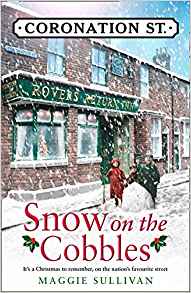
I’ve been watching Coronation Street for years so when I saw Snow on the Cobbles, a Coronation Street story on NetGalley described as ‘perfect for Coronation Street fans’ I requested it. It’s the third book in the Coronation Street series. It’s set in 1945 as the Second World War is coming to an end with some of the familiar Street characters – the main one being a young Hilda Ogden, with minor roles for others such as Elsie Tanner, Albert Tatlock, Ena Sharples and the young Ken Barlow. But there are also other characters who have never appeared in the TV soap.  

The story centres around Hilda Ogden and new characters, Lizzie Doyle, her mother and her brothers, who have recently moved into No. 9 (currently  home to Tyrone Dobbs, his daughter Ruby DobbsFiz Stape and her daughter Hope Stape).  Their new neighbour, Elsie Tanner, tells them that the house is said to have bad luck and they are worried about strange noises from the loft. Lizzie makes friends with Hilda when they both start working at the Pride of Weatherfield, a pub that had recently reopened in competition with the Rovers Return, where Annie Walker is in sole charge whilst her husband Jack is away at the war.

The story is of their daily lives, struggling to make ends meet and their joy and celebrations as the war comes to an end and the men return from the war. Lizzie, however, has a secret that threatens her relationship with Steve, the barman at the Rovers Return. And the new manager at the Pride of Weatherfield is involved in some very dodgy dealings.

I read it quickly and enjoyed it as I liked the setting and the historical details about the end of the war. I also liked the biography of Jean Alexander, who played the role of Hilda Ogden and I think Maggie Sullivan has captured the essence of Hilda in this book.

My thanks to the publishers for my review copy via NetGalley.

Hotel on the Corner of Bitter and Sweet by Jamie Ford

‘He’d do what he always did, find the sweet among the bitter.’

Hotel on the Corner of Bitter and Sweet

Allison & Busby|2013 paperback edition| 396 pages| 5*

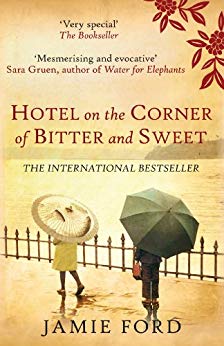
It’s not that often that a book brings tears to my eyes, but reading the ending of Hotel on the Corner of Bitter and Sweet did just that. It is a beautiful book moving between two time periods, the early 1940s and 1986, mainly in Seattle.

Synopsis (Amazon):

1986, The Panama Hotel

The old Seattle landmark has been boarded up for decades, but now the new owner has made a startling discovery in the basement: personal belongings stored away by Japanese families sent to interment camps during the Second World War. Among the fascinated crowd gathering outside the hotel, stands Henry Lee, and, as the owner unfurls a distinctive parasol, he is flooded by memories of his childhood. He wonders if by some miracle, in amongst the boxes of dusty treasures, lies a link to the Okabe family, and the girl he lost his young heart to, so many years ago.

My thoughts:

I had little idea when I began reading this book how much I would enjoy it and how much I would learn from it. It moves at a much slower pace than I would like but this means that I could absorb the detail easily and follow the story without puzzling out the sequence of events. I had no problem at all in moving between the two time periods, as I have in some other books, the characters come across as real people with real lives and real problems. The settings are remarkable, even though I have never been to Seattle, and knew nothing about its history – its Chinatown and the Japan town, Nihonmachi – it came to life as I read on.

In 1942 in Seattle Henry Lee, a 12 year old Chinese American boy meets Keiko Okabe, a Japanese American girl and they become great friends, even though Henry’s father is against the Japanese because of the enmity between China and Japan. He makes Henry wear a badge “I am Chinese” so that people won’t think he is Japanese.

As the war progressed the persecution of Japanese Americans intensified and they were removed from their homes and interned. I knew this had happened after Pearl Harbour, but this book brings home the reality of the situation, of how their lives were uprooted and the prejudice and the terrible conditions that they experienced. Keiko and her family are moved to Camp Harmony, a temporary relocation centre at the Puyallup Fairgrounds, and not allowed to take their belongings with them. Many Japanese families, including Keiko’s, manage to store some in the basement of the Panama Hotel. Henry is devastated, certain he won’t see her again, especially when the families are moved to a permanent relocation centre, Minidoka in Idaho. But his search for Keiko didn’t end there and with the help of his friend Sheldon, a black jazz musician he continued to look for her.

The book is not just about Henry and Keiko it’s also about family relationships, about the importance of communication, of talking and sharing experiences and feelings and about friendships. And it’s a love story – of both a love lost and a love found as Henry and Keiko grow into adulthood. It is a bitter sweet story of commitment and enduring hope and one that I loved.

About the author:

Jamie Ford grew up in Seattle’s Chinatown and Hotel on the Corner of Bitter and Sweet was his debut novel. His second novel, Songs of Willow Frost was published in September 2013. Love and Other Consolation Prizes, was published in September 12, 2017 and is also set in Seattle, inspired by a true story, about a half-Chinese orphan boy whose life is transformed at Seattle’s 1909 World’s Fair. And so one book leads on to yet more books to read …

Six Degrees of Separation: from Sanditon to The Lambs of London

I love doing Six Degrees of Separation, a monthly link-up hosted by Kate at Books Are My Favourite and Best. Each month a book is chosen as a starting point and linked to six other books to form a chain. A book doesn’t need to be connected to all the other books on the list, only to the one next to it in the chain.
Sanditon

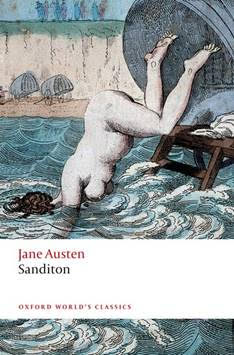
This month the chain begins with December 7, 2019), we’ll begin with Jane Austen’s unfinished manuscript, Sanditon. I read this a few years ago and enjoyed it very much.  It’s the last fiction that Jane Austen wrote, beginning it in January 1817, the year she died. She was ill and the subject of health is one of its themes, but not in a serious or gloomy way. It has a lively, bright and humorous tone, with three of the characters being hypochondriacs, wonderfully satirised by Jane Austen.

My first thought was to link to The Mystery of Edwin Drood, Charles Dickens’ unfinished novel. But I’ve already used it in an earlier Six Degrees post and I don’t like to use the same book twice in these posts, so my first link is to Castle Dor, which Sir Arthur Quiller-Couch had started to write  but had set aside unfinished before his death. His daughter asked Daphne du Maurier to finish it. It retells of the legend of the tragic lovers, Tristan and Isolde, transplanted in time and place to the early 1840s in Cornwall. 

The Last Enchantment by Mary Stewart also retells a legend, that of King Arthur and Merlin. It’s the third book of the Arthurian Saga, a book of myth and legend and about the conflict between good and evil.

My third link is King Arthur in King Arthur’s Bones by the Medieval Murderers, a group of five authors, all members of the Crime Writers’ Association. The book consists of five stories with a prologue and an epilogue tracing the mystery of Arthur’s remains. The legend is that King Arthur is not dead, but sleeping with his knights ready to return to defend his country in a time of great danger. One of the stories is set in the 17th century involving William Shakespeare’s brother Edmund who discovered a long thigh bone and a murder in the Tower of London in one of the compartments of the Lion Tower where the king kept lions and tigers. 

Another of Shakespeare’s brothers, Richard, appears in Fools and Mortals by Bernard Cornwell. It’s 1595 and the players are rehearsing a new play, A Midsummer Night’s Dream. Richard is longing to play a male role, but so far has only been given female roles. There is little brotherly love between the brothers and Richard is tempted to leave the Lord Chamberlain’s Men when Langley, the producer at the Swan in Southwark offers him a job, providing he will steal two of William’s new plays.

This brings me to Peter Ackroyd’s Biography of Shakespeare.  It is full of detail about the theatrical world, how the actors worked, about their patrons and managers, how Shakespeare interacted with other writers, and how his work was received by the public and the monarchy.

And so to my final link, another book by Peter Ackroyd, The Lambs of London, historical fiction based loosely on the lives of Mary and Charles Lamb. It also is a link to Shakespeare as Mary buys  a book from William Ireland, an antiquarian, a book that it is said once belonged to Shakespeare.

My chain is linked by unfinished books, books about legends, Tristan and Isolde and King Arthur, about Shakespeare and his brothers and books by Peter Ackroyd. It includes both crime and historical fiction and a biography.

Next month ( 4 January 2020), we’ll begin with Daisy Jones and The Six by Taylor Jenkins Reid, a book I’ve never heard of before. 

A Single Thread by Tracy Chevalier

 I’ve enjoyed all of Tracy Chevalier‘s books that I’ve read so far, so it was no surprise to me. to find that I loved her latest book, A Single Thread

A single thread

This is historical fiction, a mix of fact and fiction, set mainly in Winchester in the 1930s. It is a a simple straightforward story, beautifully written, with the emphasis on everyday life. The main character is Violet Speedwell, a single woman of 38, regarded by society as a ‘surplus woman’ unlikely to marry  because her fiancé, Laurence was killed in the First World War. The 1921 census revealed that there were 1.75 million more women than men in the UK.  Surplus women were patronised and were expected to stay at home looking after their elderly relatives, but at the age of 38 in 1932 Violet decides to leave her overbearing mother and move on her own to Winchester. There is a lot of information about embroidering cushions and kneelers for the the Choir stalls and Presbytery seats in the Cathedral and about bell-ringing, both of which formed integral parts of the book.

Violet knew nobody in Winchester, but whilst looking round the Cathedral she came across a group of women, calling themselves the Winchester Cathedral Broderers, dedicated to embroidering hassocks and cushions for the seats and benches. She joins the group, led by Miss Louisa Pesel (a real person) and the stern Mrs Biggins and as well as learning to embroider, she makes new friends. One of these friends is Gilda, who introduces her to two of the bell-ringers, Arthur, a older married man and a younger, unmarried man, called Keith.

She is determined to be independent, not relying on her mother or her brother to support her. So she finds a job as a typist and takes a room in house shared with two other women and her landlady, Mrs Harvey, who discourages male visitors other than family. The difficulties of being independent are brought home to Violet as she struggles on her wages to pay for her lodgings, laundry and coal, let alone feed herself. And then her mother is admitted to hospital and she has to decide whether to return home to look after her.

The characters are drawn with fine detail and the descriptions of the settings, particularly in the Cathedral are so clear that I could easily visualise both the building and its interior. I particularly liked the details about the embroidery and the stitches used. As the Nazi Party and Hitler rise to power in Germany, the use of fylfots in the embroidery designs are mistaken for swastikas which are ancient symbols of light and life and good fortune.

The book gives an detailed look at life between the two World Wars. It has a slow gentle pace following Violet’s new life, but there is a sense of change on the horizon as her relationship with Arthur develops.  It gives a lively picture of the difficulties of life for unmarried women, including Gilda and Dorothy’s unconventional relationship that they have to keep secret to avoid the prejudice this would attract. And there is an indication of the sense of unease in society as the threat of another war loomed. 

It is obvious throughout the book that Tracy Chevalier has meticulously carried out her research and in the acknowledgements she lists a number of the many resources she has used, including details of Louisa Pesel’s embroidery work as well as the history of Winchester Cathedral, bell-ringing, 1930s women and life in Britain in the 1930s .

My thanks to the publishers and NetGalley for my copy of this book for review.

  • Format: Kindle Edition
  • File Size: 1382 KB
  • Print Length: 353 pages
  • Page Numbers Source ISBN: 0008153817
  • Publisher: The Borough Press (5 Sept. 2019)
  • Source: Review copy from the publishers via NetGalley
  • My Rating: 4*

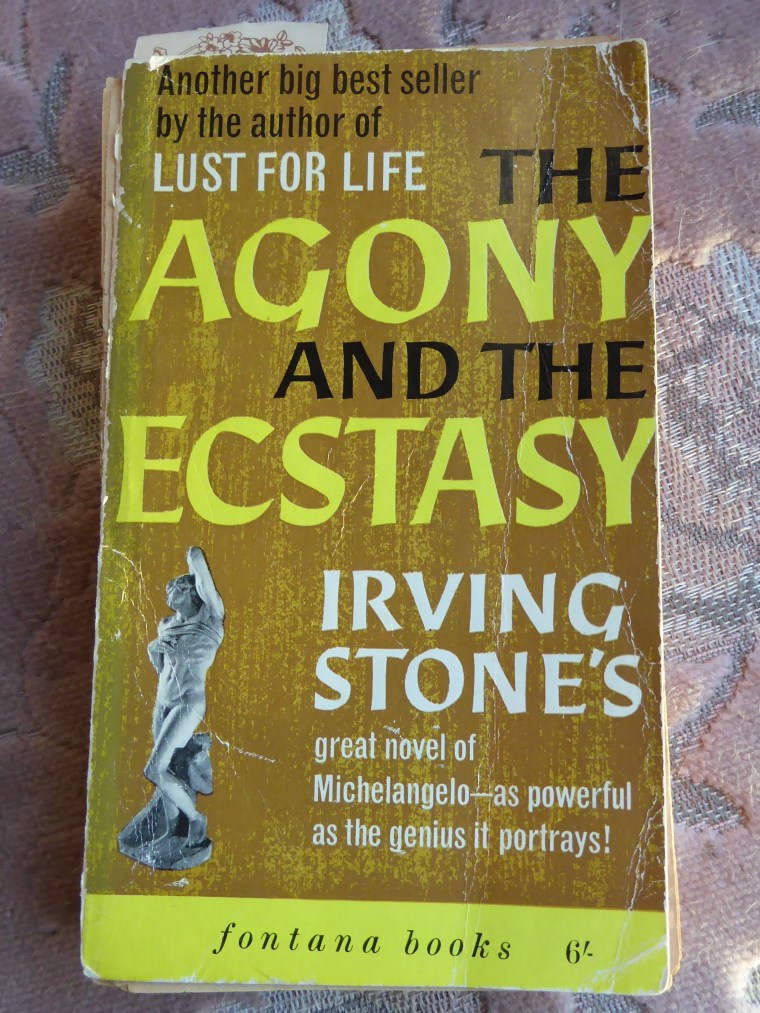
My Friday Post: The Agony and the Ecstasy by Irving Stone

Book Beginnings Button

Every Friday Book Beginnings on Friday is hosted by Gillion at Rose City Reader where you can share the first sentence (or so) of the book you are reading, along with your initial thoughts about the sentence, impressions of the book, or anything else the opener inspires.

Agony & Ecstasy


My old, tatty copy of The Agony and the Ecstasy by Irving Stone has been sitting on my desk for months now, whilst I’ve been wondering about reading it. I bought for 50p more 20 years ago (no idea exactly when or where I bought it). It was old when I first bought it and it’s falling to pieces now, the pages are brown and the font is so small, which is why I’m not reading it. So I think I’ll have to get a new edition.

It’s a biographical novel of Michelangelo.


He sat before the mirror of the second-floor bedroom sketching his lean cheeks with their high bone ridges, the flat broad forehead, and ears too far back on the head, the dark hair curling forward in thatches, the amber-coloured eyes wide set but heavy-lidded.

Also every Friday there is The Friday 56, hosted by Freda at Freda’s Voice.

30879-friday2b56These are the rules:

  1. Grab a book, any book.
  2. Turn to page 56, or 56% on your eReader. If you have to improvise, that is okay.
  3. Find any sentence (or a few, just don’t spoil it) that grabs you.
  4. Post it.
  5. Add the URL to your post in the link on Freda’s most recent Friday 56 post.

Page 56:

Michelangelo went into the yard and sat in the baking sun with his chin resting on his chest. He had made a nuisance of himself.

Have read this book? What did you think about it? And if you haven’t, would you keep on reading?

Six Degrees of Separation: from Three Women to …

I love doing Six Degrees of Separation, a monthly link-up hosted by Kate at Books Are My Favourite and Best. Each month a book is chosen as a starting point and linked to six other books to form a chain. A book doesn’t need to be connected to all the other books on the list, only to the one next to it in the chain.

Three Women


This month the chain begins with Three Women by Lisa Taddeo – a book I haven’t read, or even heard of before. It’s described on Goodreads as Desire as we’ve never seen it before: a riveting true story about the sex lives of three real American women, based on nearly a decade of reporting. I have no desire to read it.

My first link is to one of the books I’m currently reading – a biography of D H Lawrence, a man who believed himself to be an outsider in angry revolt against his class, culture and country, and who was engaged in a furious commitment to his writing and a passionate struggle to live according to his beliefs. He also struggled all his life with his relationships with women, particularly about those with his mother and his wife, Frieda.

Leading on from Lawrence’s biography my second link is to his book, Women in Love,  a book I first read as a teenager. It’s about the relationships of two sisters, Ursula and Gudrun. Ursula falls in love with Birkin (a self portrait of Lawrence) and Gudrun has an affair with Gerald, the son of the local colliery owner. Later on I watched the film version with Glenda Jackson as Gudrun, Oliver Reed as Gerald, Alan Bates as Birkin and Jennie Linden as Ursula. Lawrence considered this book to be his best and the one that clearly showed his ideas of society at the time (1922).

Moving on from a book about sisters, my third link is to a book about brothers. It’s The Lost Man by Jane Harper, set in an isolated part of Australia hundreds of miles from anywhere and revolving around the death of Cameron Bright. There are three Bright brothers – Nathan the oldest, then Cameron and the youngest brother, Bub. They have a vast cattle ranch in the Queensland outback. The book begins with the discovery of Cameron’s body lying at the the base of the headstone of the stockman’s grave – a headstone standing alone, a metre high, facing west, towards the desert, in a land of mirages.

My fourth link is to another book set in Australia – Sarah Thornhill by Kate Grenville, a love story set in 19th century Australia, where the convicts, transported or ‘sent out‘ are  now called ‘old colonists‘. A story about prejudice – some people, those who had ‘come free‘,  thought being ‘sent out‘ meant you were tainted for all time, but for others having money and land overcame their distaste. And then there is the prejudice about the ‘blacks’. When Sarah, the daughter of William Thornhill, an ‘old colonist’ and now a landowner on the Hawkesbury River, falls in love with Jack Langland, whose mother was a native woman, racial prejudice and hatred rear their ugly heads.

Prejudice and racial tension is also uppermost in The Tea Planter’s Wife by Dinah Jefferies, set in Ceylon (now called Sri Lanka) in 1913. It was a time of unrest, with political and racial tension between the Sinhalese and Tamil workers and the British plantation owners. After a whirlwind romance, Gwendolyn Hooper marries a tea planter, Laurence, an older man, and a widower. But this is not the idyllic life she expected – there are secrets, locked doors and a caste system and culture that is alien to her. There is a mystery, too, surrounding the death of Caroline, Laurence’s first wife.

And so to the last link, which is to another book about the death of a wife. It’s The Evidence Against You by Gillian McAllister – Gabe English has been released from prison on parole, having served seventeen years for the murder of his wife, Alexandra. But nobody really knew exactly what had happened the night Alexandra was killed – she simply went missing and then her body was found – she’d been strangled. Gabe’s daughter Izzy thought that her father could never have harmed anybody, let alone her mother. Now, he swears that he is innocent and wants to tell his side of it. He asks her to consider the evidence for herself. But is he really guilty – can she trust her father?

My chain is link by books about women, sisters and brothers, prejudice and racial tension, books set in Australia and about the deaths of wives. It passes from America to Great Britain,  and Sri Lanka, via books of crime fiction, historical fiction and non-fiction.

Next month (November 2, 2019), we’ll begin with Alice’s Adventures in Wonderland – a book I have read and loved.