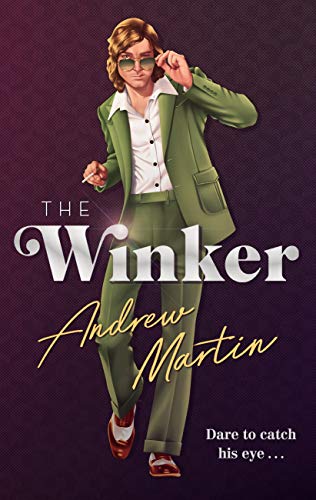
The Winker by Andrew Martin

The Winker

Corsair| 6 June 2019| 272 pages| e-book| review copy via NetGalley|4 stars

I haven’t read anything by Andrew Martin before and as I began reading The Winker I found it decidedly odd and a bit creepy. I don’t like the cover at all and the title didn’t appeal to me either. But the description interested me:

London, 1976.

In Belgravia in the heat of summer, Lee Jones, a faded and embittered rock star, is checking out a group of women through the heavy cigarette smoke in a crowded pub. He makes eye contact with one, and winks. After allowing glances to linger for a while longer, he finally moves towards her.

In that moment, his programme of terror – years in the making – has begun.

Months later, the first of the many chilling headlines to come appears: ‘Police hunting winking killer.’

Meanwhile in France.

Charles Underhill, a wealthy Englishman living in Paris, has good reason to be interested in the activities of the so-called Winking Killer. With a past to hide and his future precarious, Charles is determined to discover the Winker’s identity.

In the overheating cities of London, Oxford, Paris and Nice, a game of cat and mouse develops, and catching someone’s eye becomes increasingly perilous. But if no one dares look, a killer can hide in plain sight . . .

From ‘a master of historical crime fiction’ (The Guardian), The Winker is a gripping thriller that won’t let you look away.

My thoughts:

I like the structure of this book. It is set in 1976 with flashbacks to 1951, in several locations, mainly London and Nice and sometimes in Paris and Oxford. Each time and place is clearly highlighted. The book is largely character-led. Lee Jones, a failed pop singer and psychopath is working on a ‘project’, nothing to do with music, aiming to achieve world-wide fame. He calls it a ‘programme’ and involves something he calls a ‘folder’ and his ‘trademark’. He is living in a fantasy world, accompanied by Abigail a journalist who intermittently interviews Lee. It was all a bit ambiguous at first and it took me a few pages to decide what I thought about Abigail and her role in the book. 

Then there is Charles Underhill, a man of about fifty,  living a self-imposed exile in France, because of an event in Oxford whilst he was a student there. He lives a very routine life in Paris with his mother Syl, except for his annual holiday in Nice. His routine is upset when he receives a postcard with a picture of the river at Oxford showing a boat full of university rowers, but no message on the back. When more unsigned postcards arrive he is worried that they are from Pat Price who was at the university with him in 1951.

In Nice Charles meets Howard Miller, a crime fiction writer. His first novel wasn’t a great success and he is looking for inspiration for his next novel, to prove to his father he wasn’t wasting his time. These three men are now set on a collision course as Charles offers to pay Howard for a couple of days work in Oxford to find out who had sent him the anonymous postcards. From that point onwards everything fell into place for me and I was hooked.

This is psychological crime fiction, you know right from the beginning who the ‘Winker’ is, but the precise method of the murders is not clear (at least not to me) until later in the book. And Charles’ secret is revealed quite early in the book. Neither Lee nor Charles are pleasant characters and this is decidedly a creepy tale, but it’s also a compelling one. Howard, on the other hand, is rather a naive character, who nevertheless gets to the bottom of the mystery. I loved the settings – they are so vivid and evocative of the 1970s; the places, the intense heat of the summer  of 1976, the people, their clothes, the hairstyles, sunglasses, cars, exotic cigarettes, and especially the music of the 70s, bring it all to life in technicolour. I think this is ripe for being made into a film.

Andrew Martin, a former Spectator Young Writer of the Year, grew up in Yorkshire. He has written for the Evening Standard, the Sunday Times, the Independent on Sunday and the Daily Telegraph, among others. His weekly column appears in the New Statesman and he is the author of numerous articles and books – of both fiction and non-fiction. For more information see his website.

I received a copy of this book from the publisher, via NetGalley, for review.
My Friday Post: Women of the Dunes by Sarah Maine

Book Beginnings Button

Every Friday Book Beginnings on Friday is hosted by Gillion at Rose City Reader where you can share the first sentence (or so) of the book you are reading, along with your initial thoughts about the sentence, impressions of the book, or anything else the opener inspires.

Women of the Dunes by Sarah Maine is one of the books I’m thinking I’ll read next. It’s described as: Atmospheric, intoxicating and filled with intrigue, this sweeping novel is an epic story spanning the centuries, that links three women together across history.

Women of the Dunes (1)


Prologue

West coast of Scotland, c.800 A.D., Odrhan

As the sun rose over a pale sea, Odrhan emerged from his dwelling at the end of the headland. Eyes closed, he stretched, reaching his fingertips to the sky, and felt the chill of dawn on his cheek. He offered up a prayer, and a gull’s cry was blown back on the north wind as the sun set the water asparkle.

Then the beginning of Chapter 1 :

Ullaness, 2012, Libby

When Libby Snow finally arrived, darkness was already falling. She decided to park the car anyway and walk out onto the narrow spit of land.

Also every Friday there is The Friday 56, hosted by Freda at Freda’s Voice.

30879-friday2b56These are the rules:

  1. Grab a book, any book.
  2. Turn to page 56, or 56% on your eReader. If you have to improvise, that is okay.
  3. Find any sentence (or a few, just don’t spoil it) that grabs you.
  4. Post it.
  5. Add the URL to your post in the link on Freda’s most recent Friday 56 post.

Page 56:

He stopped again, then asked: ‘How long does it take flesh to disappear in sand?’

From bizarre to macabre. ‘I’ve no idea!’

Blurb:

On the rugged, sea-lashed coast of west Scotland lies Ullaness: home to the Scottish legend of Ulla, a Viking woman who washed up on Scottish shores centuries ago. The legend will bring the stories of three different women together…

In AD 800 there is Ulla, lost in a foreign country after her lover is brutally killed. Ellen, a servant-girl in the 1800s, catches the unwanted attentions of the master of the house’s lascivious son. And, in the present day, there is Libby – an archaeologist who is determined to uncover an age-old mystery.

When a body is excavated from Ullaness – the body of someone who was murdered long ago – the mystery deepens, and the fates of the three women become ever more tightly bound.

~~~

Have you read this book? What did you think?

Hitler’s Secret by Rory Clements

Hitler's secret

Bonnier Zaffre| 23 January 2020| 339 pages| e-book| review copy via NetGalley| 4 stars

Description from the author’s website:

In late autumn 1941, Nazi Germany has conquered most of western Europe and is now laying waste to the Soviet Union with a relentless drive towards the East. But a secret from Hitler’s past life threatens to destabilise the Nazi regime – and there are men who will stop at nothing to prevent it coming out. 

My thoughts

I enjoyed Rory Clements’ first book in his Tom Wilde series, Corpus so much that I decided to look out for more of his books. But somehow I missed the next two books as Hitler’s Secret is the fourth book in the series. Luckily for me, it reads perfectly as a standalone, although at some point I would like to read the books I missed.

This is a complicated novel and I am not going to attempt to describe all the details.  Just before the USA’s entry into the Second World War, Cambridge professor Tom Wilde, an American, is smuggled into Nazi Germany at the instigation of an American intelligence officer to collect a mysterious package from Berlin. He isn’t told what is in the package, but I thought it was obvious from quite early in the book what it was.  I think that increased the tension and suspense throughout the book and at several points in the story, I just couldn’t imagine how Tom would succeed in his mission as he is pursued by numerous people including the powerful Nazi, Martin Borman and his agents. Hermann Goering and his wife Emmy also play an important role in the story as does the internal struggle for power under Hitler, whereas Hitler himself does not appear.

I enjoyed all of it – the somewhat predictable plot, the amazing coincidences, the chase across Germany and the Baltic, the doubtful characters, as well as all the twists and turns and seemingly impossible situations that they encounter. It’s fast paced, full of action, danger, violence and double-cross – a most satisfying and compelling thriller. The ending in England is also intriguing, full of heart stopping moments in scenes that had my head whirling. Needless to say really, but I was gripped by this book and I just had to find out what happened. I think the last final twist about Hitler’s secret was very well done.

WWW Wednesday: 15 January 2020

IMG_1384-0

WWW Wednesday is run by Taking on a World of Words.

The Three Ws are:

What are you currently reading?
What did you recently finish reading?
What do you think you’ll read next?

Currently I’m reading three books:

Charles Dickens oliver twist etcOliver Twist by Charles Dickens, my Classics Club Spin book. It’s one of those books that I think I know the story from watching TV adaptations, but I have never read it. I’ve discovered that I only ‘know’ the beginning of the book up to the part where Oliver is rescued by Mr Brownlow from Fagin’s clutches, only to be snatched back by Nancy. After that the story is totally new to me.

John Lennon LettersI’m also reading The John Lennon Letters edited by Hunter Davies. It includes a brief biography and using almost three hundred of Lennon’s letters and postcards, to relations, friends, fans, strangers, and lovers follows his life more or less chronologically. It’s a large, heavy hardback book, illustrated with photos and reproductions of the letters etc. This is going to be a long-term read for me.

The Windsor StoryThe third book is one I’ve only just started – I’ve been struck by some of the parallels between Edward VIII’s abdication in 1936 in order to marry Wallis Simpson and the current situation of Prince Harry and Meghan in wanting to step back as senior royals, and I remembered I have The Windsor Story by J Bryan III and Charles V Murphy. It looks remarkably comprehensive and is another book that I think will take me a long time to read.

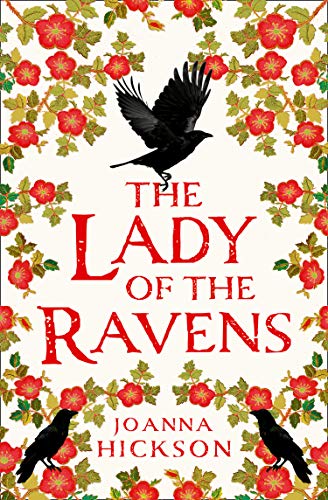
Lady of the ravensThe last book I finished reading is  The Lady of the Ravens by Joanna Hickson, historical fiction about about the early years of Henry’s reign as seen through the eyes of Joan Vaux, a lady in waiting to Elizabeth of York, whose marriage in 1486 to Henry united the Houses of Lancaster and York after the end of the Wars of the Roses.  I found this a fascinating book and posted my review a few days ago.

Tinker tailorI have several books lined up to read next including Tinker, Tailor, Soldier, Spy by John Le Carré because over the Christmas period I watched the film starring Gary Oldman as George Smiley, along with Colin FirthTom HardyJohn Hurt and others. I began reading the book years ago and have a bookmark at page 88, but I’ll have to go back to the beginning now.
A killing kindnessBut I’d also like to start A Killing Kindness, the next Dalziel and Pascoe novel, the 6th one in Reginald Hill’s series. It looks good – about Mary Dinwoodie whose body is found choked in a ditch following a night out with her boyfriend, and a mysterious caller phones the local paper with a quotation from Hamlet.

But knowing how long it could be until I start the next book, it could be something completely different!

Have you read any of these books?  Do any of them tempt you? 

The Lady of the Ravens by Joanna Hickson

Lady of the ravens

Harper Collins|9 January 2020|400 pages|e-book via NetGalley|Review copy|5*

Publishers’ Description:

Elizabeth of York, her life already tainted by dishonour and tragedy, now queen to the first Tudor king, Henry the VII.

Joan Vaux, servant of the court, straining against marriage and motherhood and privy to the deepest and darkest secrets of her queen. Like the ravens, Joan must use her eyes and her senses, as conspiracy whispers through the dark corridors of the Tower.

Through Joan’s eyes, The Lady of the Ravens inhabits the squalid streets of Tudor London, the imposing walls of its most fearsome fortress and the glamorous court of a kingdom in crisis.

My thoughts:

The Lady of the Ravens opens in 1485 just weeks after Henry Tudor had taken the throne to become King Henry VII of England and Lord of Ireland. This is historical fiction about the early years of Henry’s reign as seen through the eyes of Joan Vaux, a lady in waiting to Elizabeth of York, whose marriage in 1486 to Henry united the Houses of Lancaster and York after the end of the Wars of the Roses.

Henry comes across as a competent king, which is really all I knew of his reign before reading this book. I’ve read Joanna Hickson’s earlier book about him, The Tudor Crown, which is about his early life and how he gained the English throne. Joan Vaux also features in a small way in this book. In The Lady of the Ravens he is shown to be determined to hold on to his throne, dealing with several Yorkists’ claims to the throne, in particular those of Lambert Simnel, who claimed to be Edward Plantagenet, 17th Earl of Warwick, Elizabeth’s cousin, and Perkin Warbeck, who claimed to be Richard of Shrewsbury, Duke of York, who was the second son of Edward IV, Elizabeth’s brother, one of the so-called Princes in the Tower. It is also about his family life – his marriage to Elizabeth,,the births of their children (three of them died in childhood), and his concern for his subjects – for example both he and Elizabeth were present at Joan’s wedding and we also see him enjoying dancing at court.

Joan Vaux is also a real historical character – her mother, Katherine was French and had been a lady-in-waiting to the former queen Margaret of Anjou (the wife of Henry VI).. Joan had served Elizabeth as a woman of her bedchamber before Elizabeth’s marriage to Henry and, after her own marriage to Sir Richard Guildford, as a lady-in-waiting. And before that she had been brought up in the household of Lady Margaret Beaufort, Henry’s mother. Joan became a good friend and confidante of Elizabeth, even after her marriage and the birth of her son Henry, known as Hal, who also became a good friend to the young Prince Henry.

The fictional element is in the story of Joan’s fascination for and care of the ravens of the Tower of London firmly believing in the legend that should the ravens leave the Tower for good then the crown will fall and ruin will return to the nation. I came to really like Joan, a warm and caring woman. Joanna Hickson goes into detail describing the traumatic birth of her son and the lives of ordinary people outside the royal court. It is a rich and vibrant novel, full of action and political unrest.

I particularly like the glimpses we see of the ill-fated Prince Arthur and his bride, Katherine of Aragon. And I was especially delighted by the portrait of Prince Henry (who later became Henry VIII) as a young charismatic child of nearly three. His father was  furious about the imposters’ claims to the throne and had decided the best response was to invest his younger son as the trueborn and genuine Duke of York. Little Henry, with his bright red Tudor hair, was mounted on a gleaming black warhorse strapped into a specially made high-backed jousting saddle and escorted by his great-uncles, the Yeoman of the Guard and the King’s Archers as they processed around the streets of London to Westminster.  He was in his element, waving to the crowd who cheered and threw flowers as he went by.

This novel is beautifully written, grounded in its historical context, full of colour and life. I loved all the descriptions of the various settings, especially the Tower of London, and the ravens. My grasp of English history in this period was very hazy and I learned a lot reading this book, especially as the characters came to life on the pages, but most of all I loved the portrayal of Joan Vaux, Lady Guildford. And I see from the Author’s Note at the end of the book that there is more to come about her, including a mystery, her second marriage and her close relationship with Katherine of Aragon and the early years of Henry VIII’s reign. I’m looking forward to reading that!

The Author:

Joanna Hickson became fascinated with history when she studied Shakespeare’s history plays at school. However, having taken a degree in Politics and English she took up a career in broadcast journalism with the BBC, presenting and producing news, current affairs and arts programmes on both television and radio. Now she writes full time. The Lady of the Ravens is her sixth novel. 

My thanks to the publishers for my review copy via NetGalley.

Six Degrees of Separation: from Daisy Jones and The Six to Thirteen

I love doing Six Degrees of Separation, a monthly link-up hosted by Kate at Books Are My Favourite and Best. Each month a book is chosen as a starting point and linked to six other books to form a chain. A book doesn’t need to be connected to all the other books on the list, only to the one next to it in the chain.

Daisy Jones

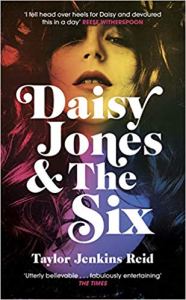
This month the chain begins with Daisy Jones and The Six by Taylor Jenkins Reid,  a novel about the rise and fall of a fictional 70s rock band inspired by Fleetwood Mac.

There are always several ways to go when compiling these Six Degree chains and at first my mind went blank  but looking at the books we got for Christmas I decided that Face It: a Memoir by Debbie Harry was just the right book for my first link, a book about a real rock band. Debbie Harry is the best known face of Blondie; she and the band forged a new sound that brought together the worlds of rock, punk, disco, reggae and hip-hop to create some of the most beloved pop songs of all time.

The Ballad of Jethro Tull: The official illustrated oral history is another book we got for Christmas. It’s Jethro Tull’s story told by Ian Anderson, band members past and present and the people who helped Tull become one of the most successful bands in rock history.

And then I thought my chain needed a change of genre, but sticking with the word ‘ballad’ I thought of Dreamwalker: The Ballad of Sir Benfro: Book 1 by James Oswald, a magical tale of the young dragon, Benfro, inspired by the language and folklore of Wales. It follows the adventures of a young dragon, Sir Benfro, in a land where his kind have been hunted near to extinction by men.

For the next link I turned to crime fiction and to one of James Oswald’s Inspector McLean novels, set in Edinburgh – The Hangman’s Song. It’s a dark, tense novel with elements of the supernatural  and parapsychology thrown in. It’s not a book for the faint-hearted or the squeamish as there are details of some gruesome deaths, murders and beatings that the characters go through. 

James Oswald is a Scottish author and so my last link is to another Scottish author – Chris Brookmyre, who has written The Way of all Flesh, under the pseudonym of Ambrose Parry with his wife, Dr Marisa Haetzman a consultant anaesthetist. It is set in Edinburgh in 1847 as Dr James Young Simpson, a professor of midwifery, discovered the anaesthetic properties of chloroform. It combines fact and fiction most successfully, the social scene, historical and medical facts slotting perfectly into the plot. It was on the Longlist for the 2019 Theakston Old Peculier Crime Novel of the Year.

But the winner was Thirteen by Steve Cavannagh, an Irish author. It’s the fifth book in the Eddie Flynn series of crime thrillers, ‘serving up a delicious twist to the traditional courtroom thriller, where in this instance the real killer is not the one on trial, but a member of the jury!’ I have a copy but haven’t read it yet. And quite by chance I see that it also links back to Daisy Jones and the Six as it has a number in the title.

From a fictional rock band to two real rock bands my chain also links up books of ballads and three crime fiction novels.

Next month (1 February 2020), we’ll begin with Fleishman is in Trouble by Taffy Brodesser-Akner.