A Corruption of Blood by Ambrose Parry

Can’t-Wait Wednesday is a weekly meme hosted by Wishful Endings, to spotlight and discuss the books we’re excited about that we have yet to read. Generally they’re books that have yet to be released.

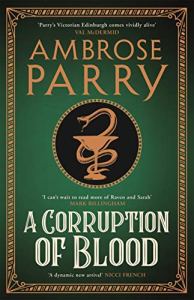
This week I’m featuring A Corruption of Blood by Ambrose Parry, release 19 August 2021. It’s the third in the Will Raven & Sarah Fisher series, following from the McIlvanney prize-shortlisted The Way of All Flesh and The Art of Dying, both of which I thoroughly enjoyed. So, I’m keen to read this one.

Description

Edinburgh. This city will bleed you dry.

Dr Will Raven is a man seldom shocked by human remains, but even he is disturbed by the contents of a package washed up at the Port of Leith. Stranger still, a man Raven has long detested is pleading for his help to escape the hangman.

Back at 52 Queen Street, Sarah Fisher has set her sights on learning to practise medicine. Almost everyone seems intent on dissuading her from this ambition, but when word reaches her that a woman has recently obtained a medical degree despite her gender, Sarah decides to seek her out.

Raven’s efforts to prove his erstwhile adversary’s innocence are failing and he desperately needs Sarah’s help. Putting their feelings for one another aside, their investigations will take them to both extremes of Edinburgh’s social divide, where they discover that wealth and status cannot alter a fate written in the blood.

What upcoming release are you eagerly anticipating?

Circus of Wonders by Elizabeth Macneal

Picador| 13 May 2021| 384 pages|Review copy| 4*

Description

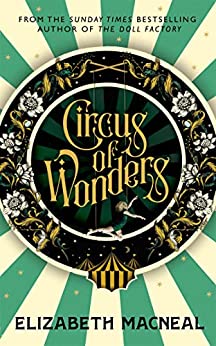
1866. In a coastal village in southern England, Nell picks violets for a living. Set apart by her community because of the birthmarks that speckle her skin, Nell’s world is her beloved brother and devotion to the sea.

But when Jasper Jupiter’s Circus of Wonders arrives in the village, Nell is kidnapped. Her father has sold her, promising Jasper Jupiter his very own leopard girl. It is the greatest betrayal of Nell’s life, but as her fame grows, and she finds friendship with the other performers and Jasper’s gentle brother Toby, she begins to wonder if joining the show is the best thing that has ever happened to her.

In London, newspapers describe Nell as the eighth wonder of the world. Figurines are cast in her image, and crowds rush to watch her soar through the air. But who gets to tell Nell’s story? What happens when her fame threatens to eclipse that of the showman who bought her? And as she falls in love with Toby, can he detach himself from his past and the terrible secret that binds him to his brother.

Moving from the pleasure gardens of Victorian London to the battle-scarred plains of the Crimea, Circus of Wonders is an astonishing story about power and ownership, fame and the threat of invisibility.

I loved Elizabeth Macneal’s first book, The Doll Factory, so I was keen to read her second, Circus of Wonders, set in 1866. I liked the circus setting and the variety of characters. The main character is Nell, the ‘leopard girl’, who is both shunned and ridiculed by the people in her village because of the birthmarks on her face and all over her body. When the travelling circus visits the village her father sells her to Jasper Jupiter’s ‘Circus of Wonders‘ as it includes a ‘freak show’, highlighting the very different attitudes of the times from those of the present day. This makes for uncomfortable reading at times, as Stella, the bearded lady, Brunette, the Welsh Giantess, and Peggy the dwarf who drives a miniature carriage are treated as objects of curiosities, acts to be bought and sold, just as Nell was sold.

It’s narrated from the perspectives of the three main characters, Nell, who became a star as ‘Nellie Moon’ flying high above the circus ring suspended beneath a balloon, Jasper, the ambitious circus owner and Toby his younger, gentler brother. Jasper is the driving force as he is forever looking for new acts to draw the crowds. His ambition is to gain a pitch in London, hoping the Queen might hear of him and want to see his show. He knows that the queen is the ‘freak-fancier par excellence, who has summoned Aztecs, pinheaded people and dwarves to her Palace’.

The brothers had both taken part in the Crimean War, Jasper as a soldier and Toby as a photographer. Toby is haunted by memories of the war and in particular of what happened to Dash, Jasper’s friend, during the siege of Sevastopol. The horror of the war has never left him. Although the circus is the main focus of the novel, it is the mystery of what happened in the Crimea and the relationships between Jasper, Toby and Dash that interested me the most and made me want to read on.

This is a novel that transported me back to the Victorian period, full of the atmosphere of both the circus and of war. It reveals the insecurities, fears and isolation that the characters suffer. It emphasises the exploitation of ‘freaks of nature’, who draw the crowds and the power of illusions. I like the mix of fact and fiction and the way that Macneal interweaves the details of the Crimean War with the circus narrative. However, I don’t think it’s quite as good as The Doll Factory, which totally captivated me with its dark tale of obsession, pulsing with drama, intrigue and suspense.

With thanks to NetGalley and especially to Pan McMillan, Picador for my review copy.
Inland by Téa Obreht

Weidenfeld & Nicolson| 13 August 2019| 386 pages| Review copy| 3*

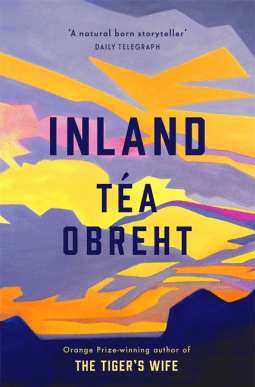
Nora is an unflinching frontierswoman awaiting the return of the men in her life, biding her time with her youngest son – who is convinced that a mysterious beast is stalking the land around their home – and her husband’s seventeen-year-old cousin, who communes with spirits.

Lurie is a former outlaw and a man haunted by ghosts. He sees lost souls who want something from him, and he finds reprieve from their longing in an unexpected relationship that inspires a momentous expedition across the West.

Mythical, lyrical, and sweeping in scope, Inland is grounded in true but little-known history. It showcases all of Téa Obreht’s talents as a writer, as she subverts and reimagines the myths of the American West, making them entirely – and unforgettably – her own.

My thoughts:

Inland by Téa Obreht has had many accolades, including being named one of the best books of the year by The Guardian, Time, Washington Post, Entertainment Weekly, Esquire, Good Housekeeping, and The New York Public Library. I love the cover and the description made me keen to read it. It’s a book that has been on my NetGalley shelf for far too long, I’m sorry to say, mainly because each time I began reading it I struggled to understand what was going on.

It is a book of two halves really, alternating between the two storylines as the blurb outlines. I found the Lurie narrative difficult to follow at first. It’s vague – at times I didn’t know who was who, who was talking, who was a camel and who was a person. I did work it out eventually! Lurie is a former outlaw, who sees and talks to the dead. He is haunted by the spirit of Hobb, a kid of four or five. But Lurie’s story is slow and meanders. I was losing interest, and often the location was unclear as he moved from place to place. However as I got further into his story I did form a clearer picture of his life as he joined the Camel Corps and became a cameleer. (I was fascinated to discover that camels were used in the American West as pack animals.)

But it’s the second story of Nora Lark and her family, which is much clearer and easier for me to understand. It saved the book for me and made me keen to read on. They are living in Arizona in a homestead. There’s been no rain for months and their water supply is nearly exhausted. Emmett, her husband has gone to get more water and has not returned . Her two sons have gone to look for him, and Nora is left at home with her youngest son, Toby, who is terrified by a mysterious beast he sees around their house at night, and Josie, her husband’s seventeen year old ward and cousin, who see spirits. Nora’s daughter, Evelyn died before her sons were born, under mysterious circumstances, and she is constantly in Nora’s mind as she imagines her growing up and having conversations with her.

Several times as the narrative turned from Nora back to Lurie, I was about to give up on the book, but I wanted to know what happened to the Larks and to find out how the two strands would interlink, or if indeed they ever did interlink (they do). As I read on I began to understand more about Lurie and his life, but it was hard work. If I re-read it I think I would enjoy it more, but I don’t feel inclined to right now. But I really liked Nora’s story and the depiction of life in the American West during the mid-to-late 19th century.

In her acknowledgements Téa Obreht explains that Inland is a work of imagination based in part on the journals, letters and reports of the men who were part of at least one aspect of this history and on the work of the historians of the American West.

My thanks to the publishers and NetGalley for my review copy, with apologies for taking so long to read the book.

My Friday Post: The King’s Justice by E M Powell

On Fridays I often join in with two book memes:

Book Beginnings on Fridays hosted by Rose City Reader, where bloggers share the first sentence or more of a current read, as well as initial thoughts about the sentence(s), impressions of the book, or anything else that the opening inspires. 

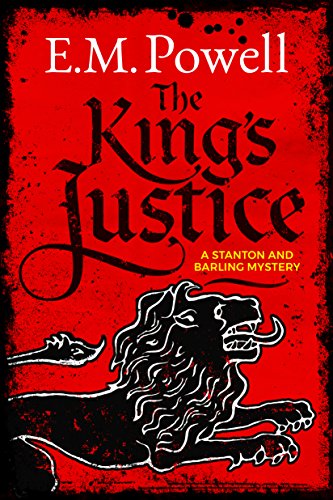
This week I’m featuring The King’s Justice by E M Powell one of my TBRs. It’s the first in her Stanton and Barling medieval murder mystery series, set during the reign of Henry II. Aelred Barling is a senior clerk to the justices of King Henry II, and Hugo Stanton, his assistant are sent to investigate a brutal murder in a village outside York.

The City of York, 12 June 1176

Pit or punishment: Hugo Stanton couldn’t tell which excited the folk of these hot, crammed streets more.

Three men accused of vicious murder but who would not confess. Innocent, they’d claimed to King Henry’s travelling justices, sitting in the court in the high keep of the city’s castle.

The men were to be judged by water: lowered into a pit of water if they sank they were innocent, if they floated they were guilty and strung up on the gallows to die.

Also on a Friday The Friday 56 is hosted by Freda’s Voice, where you grab a book and turn to page 56 (or 56% of an eBook), find one or more interesting sentences (no spoilers), and post them.

Page 56:

‘The glow of the setting sun fell on his face. A glorious evening, one for lying in the long grass with his lost, beautiful love. Not standing facing a circle of angry, shouting people, people who wanted to take a man’s life. And wanted to take it now.

The Royal Secret by Andrew Taylor

Harper Collins UK| 29 April 2021| 476 pages| e-book| Review copy| 4*

Description:

From the No.1 bestselling author of The Last Protector and The Ashes of London comes the next book in the phenomenally successful series following James Marwood and Cat Lovett during the time of King Charles II.

Two young girls plot a murder by witchcraft. Soon afterwards a government clerk dies painfully in mysterious circumstances. His colleague James Marwood is asked to investigate – but the task brings unexpected dangers.
 
Meanwhile, architect Cat Hakesby is working for a merchant who lives on Slaughter Street, where the air smells of blood and a captive Barbary lion prowls the stables. Then a prestigious new commission arrives. Cat must design a Poultry House for the woman that the King loves most in all the world.
 
Unbeknownst to all, at the heart of this lies a royal secret so explosive that it could not only rip apart England but change the entire face of Europe

My thoughts:

I’ve read all of the previous Marwood and Lovett books, set in 17th century England, and thoroughly enjoyed each one, so I was delighted when Rachel Quin at HarperCollins asked me if I’d like a proof copy of  The Royal Secret to review. It is the 5th book in the series and although it does work as a stand-alone book I do think it’s best to read them in sequence to get the full background of the Restoration period and the relationship between James Marwood and Cat Hakesbury (formerly Lovatt).

The year is 1670, two years have passed since the end of the previous book, The Last Protector. Cat Hakesby’s work as an architect continues after her husband’s death and after designing a poultry house for the young daughter of Lord Arlington, the Secretary of State, she gains a commission to design one for Charles II’s sister, ‘Minette,’ the Duchess of Orléans. Meanwhile Marwood is a government clerk clerk to Joseph Williamson and also working for Lord Arlington. They find themselves involved in a complicated situation that is full of danger.

Marwood is instructed to investigate the mysterious death of Richard Abbott, one of Lord Arlington’s men, and retrieve some confidential papers from the victim’s home. Abbott’s step-daughter, Maria and the maid, Hannah have been dabbling in witchcraft and Maria believes she is responsible for his death. Marwood’s investigation brings him into contact with a merchant, Mr Fanshawe (also one of Cat’s clients) and through him with a mysterious Dutch gentleman, Henryke Van Riebeeck. Van Riebeeck just happens to be Anna Abbott’s brother, and Fanshawe’s son was Anna Abbott’s first husband and the father of Maria. After Abbott’s death she and Maria together with Hannah had gone to live in Fanshawe’s house. Fanshawe is an interesting character, who has recently bought a lion, who he named Caliban, a mangy bad-tempered beast that he keeps in the stables at his house in Slaughter Street.

So, Cat and Marwood are both involved with the same people, although in different circumstances. Their relationship is somewhat ambiguous. She is a strong-minded woman, a widow who values her independence in a society where women, although used to running households and dealing with their families’ financial matters, were only just beginning to find a place in society outside the home. And she doesn’t welcome Marwood’s interference in her life. That the two of them are attracted to each other is not acknowledged by either of them – especially, in this book, when Cat finds herself drawn romantically to Van Riebeeck. Her work takes her to the Royal Court in Paris to discuss her designs for the poultry house, although Minette seems more concerned with political matters and Cat wonders what the real reason for her visit is.

This is a well researched historical novel, mixing fact and fiction, bringing the streets of London and the royal court in Paris to life. At the same time it presents a mystery full of political intrigue, danger and conspiracy, involving witchcraft, poisonings, and tricky international relationships. It is only towards the end of the book that the royal secret is revealed – and I had had no idea until then what it was. I do hope there will be a sixth book for Marwood and Lovatt.

My thanks to the publishers and NetGalley for my review copy.

Throwback Thursday: 29 April 2021

This month I’m looking back at my review of The House at Riverton by Kate Morton, which I first posted in August 2007. I loved this book.

These are the first two paragraphs:

It’s with a sense of loss that I finished reading The House at Riverton. I felt as though I’d now lost contact with the characters and the worlds they inhabit. I say worlds because this novel is split into two time zones, so widely different in all aspects that they could be separate worlds.

The novel opens in 1999 (reminiscent of Du Maurier’s Rebecca) with Grace’s dream of the night in 1924 when Robbie Hunter, a poet, committed suicide at Riverton Manor. Grace’s memories are revived after Ursula, an American film director who is making a film of the suicide had asked for her help as the only person involved who was still alive.

Click here to read my full review

Kate Morton is an Australian author, who has written six novels. The House at Riverton and The Secret Keeper are two of my favourite books. The six books are as follows (with links to my posts):

The House at Riverton (2006)
     aka The Shifting Fog
The Forgotten Garden (2008)
The Distant Hours (2010)
The Secret Keeper (2012)
The Lake House (2015)
The Clockmaker’s Daughter (2018)

The next Throwback Thursday post is scheduled for 3 June, 2021.