Prophecy by S J Parris

Harper Collins| 2011| 448p| Library book| 4*

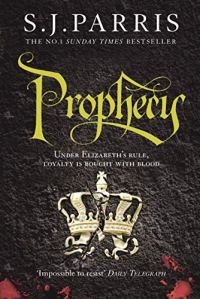
Prophecy by S J Parris (a pseudonym of Stephanie Merritt) is the second book in her Giordano Bruno series of historical thrillers. Giordano Bruno was a 16th century heretic philosopher and spy. On her website Stephanie Merritt has written about how she first discovered him. Her version of Bruno is a fictional creation, though many of the situations he encounters are based on historical fact.

Bruno started out as a Dominican friar in Naples, but fled his order to escape the Inquisition, went on the run through Italy, found work as an itinerant teacher and within three years had ended up in Paris as personal tutor to the King of France. By 1583 he was in England, working for the Queen Elizabeth I’s spymaster Sir Francis Walsingham.

Prophecy begins in the autumn of 1583, when Elizabeth’s throne is in peril, threatened by Mary Stuart’s supporters scheme to usurp the rightful monarch. I wrote about the opening of the book together with an extract from page 56 in this post. After a young maid of honour is murdered, with occult symbols carved into her flesh, Bruno is assigned to infiltrate the plotters and secure the evidence that will condemn them to death.

I think this description on the Fantastic Fiction website summarises the book very well:

It is the year of the Great Conjunction, when the two most powerful planets, Jupiter and Saturn, align – an astrological phenomenon that occurs once every thousand years and heralds the death of one age and the dawn of another. The streets of London are abuzz with predictions of horrific events to come, possibly even the death of Queen Elizabeth.

When several of the queen’s maids of honor are found dead, rumors of black magic abound. Elizabeth calls upon her personal astrologer, John Dee, and Giordano Bruno to solve the crimes. While Dee turns to a mysterious medium claiming knowledge of the murders, Bruno fears that something far more sinister is at work. But even as the climate of fear at the palace intensifies, the queen refuses to believe that the killer could be someone within her own court.

Bruno must play a dangerous game: can he allow the plot to progress far enough to give the queen the proof she needs without putting her, England, or his own life in danger?

In this utterly gripping and gorgeously written novel, S. J. Parris has proven herself the new master of the historical thriller.

I thoroughly enjoyed this book. I felt I was back there in 1583, in the thick of the intrigue and danger that characterised the period. I loved all the details of the court life and the interaction between the various factions, with rivalry between Catholics and Protestants, whilst the involvement of Dr John Dee intrigued me. Bruno, himself, fascinated me and now I want to know more about him and also about Stephanie Merrick’s books as well as those written under her pen name, S J Parris.

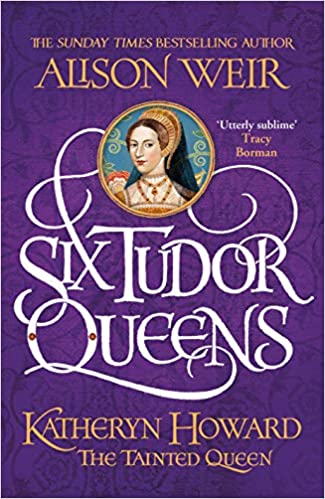
Six Queens: Katheryn Howard the Tainted Queen by Alison Weir

Headline Review| 20 August 2020| 479 pages| Review copy| 2*

I wanted to read this book because I knew very little about Henry VIII’s 5th wife, except that she was beheaded on the grounds that she had committed adultery and treason.

Description

A NAIVE YOUNG WOMAN AT THE MERCY OF HER AMBITIOUS FAMILY.

At just nineteen, Katheryn Howard is quick to trust and fall in love.

She comes to court. She sings, she dances. She captures the heart of the King.

But Henry knows nothing of Katheryn’s past – one that comes back increasingly to haunt her. For those who share her secrets are waiting in the shadows, whispering words of love… and blackmail.

Having read it, I don’t think I know much more, except that Katheryn Howard comes across as a very shallow character, obsessed with sex, with luxury in all its forms, naive and easily manipulated. Alison Weir excels in her descriptive writing, bringing the Tudor court to life in all of its settings, locations, clothes and jewellery.

It has glowing reviews on Amazon full of praise and it is based on extensive research. Clearly other people love this book, but I didn’t. For me it came across as a romance novel, primarily focused on Katheryn’s imagined thoughts, emotions, and sexual encounters. It is simply written, but with too many cliches and modernised text.

Alison Weir’s Author’s Note is much more interesting than her novel, in which she acknowledges her sources, including Dr. Nicola Tallis’ unpublished DPhil thesis, All the Queen’s Jewels, 1445 – 1548, and a number of biographies of Katheryn Howard. She refers to original sources she used as the basis of the book – contemporary writers and wills, portraits showing her rich clothes and jewellery – jewels that have been tentatively identified in Katheryn Howard’s inventory.

She used these sources for the narrative of the book, weaving them into the dialogue and modernising the speech ‘where Tudor English looks out of place in a modern text.’ She states that ‘apart from fictionalising the historical record’ she has invented very little.’ There is also a Dramatis Personae, usefully indicating which characters are fictional and a Timeline, which is also very useful.

I think the Author’s Note is the best part of the book. There is rather too much of ‘fictionalising the historical record’ for me in the novel. I don’t like writing about a book I didn’t enjoy when I know so much work has gone into it and clearly other people have loved it. But this is just my opinion, for what it is worth.

With thanks to NetGalley and to the publishers for my review copy.

Throwback Thursday: 1 July 2021

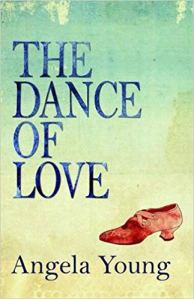
This month I’m looking back at my review of The Dance of Love by Angela Young, which I first posted on 21 July 2014. It is a coming-of-age tale set in the same era as Downton Abbey. It spans two decades of vast historical change (1899-1919).  I read it because I had enjoyed her first book, Speaking of Love.

Here’s the first paragraph:

Angela Young‘s new novel The Dance of Love is historical fiction set at the turn of the twentieth century between 1899 and 1919. It is outstanding and I loved it so much. At times as I read it I could hardly see the pages through my tears – and there have not been many books that have that effect on me.  It’s a brilliant book, both a heart-rending love story and a dramatic story too, as the sinking of the Titanic in 1912 and the devastating and tragic effects of the First World War impact on the characters’ lives.

Click here to read my full review

The next Throwback Thursday post is scheduled for 5  August 2021.

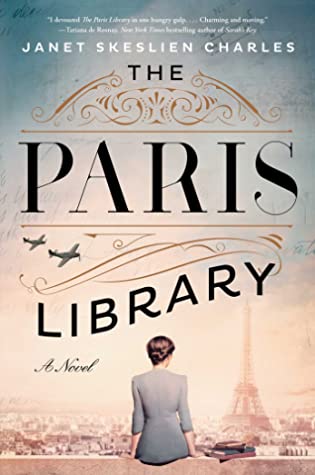
The Paris Library by Janet Skeslien Charles

Two Roads| 9th February 2021| 369 pages| Review copy| 3*

Before I read the summary of the book the title led me to think this was about the Bibliothèque Nationale de France, located in Paris. It’s not, it’s about the American Library in Paris.

PARIS, 1939
Odile Souchet is obsessed with books, and her new job at the American Library in Paris – with its thriving community of students, writers and book lovers – is a dream come true. When war is declared, the Library is determined to remain open. But then the Nazis invade Paris, and everything changes.
In Occupied Paris, choices as black and white as the words on a page become a murky shade of grey – choices that will put many on the wrong side of history, and the consequences of which will echo for decades to come.

MONTANA, 1983
Lily is a lonely teenager desperate to escape small-town Montana. She grows close to her neighbour Odile, discovering they share the same love of language, the same longings. But as Lily uncovers more about Odile’s mysterious past, she discovers a dark secret, closely guarded and long hidden.

As an ex-librarian I had high hopes that I would love The Paris Library. It’s historical fiction, based on the true Second World War story of the librarians at the American Library in Paris. It was established in 1920 by the American Library Association with books and periodicals donated by American libraries to US soldiers serving their allies in World War I. Since then it has developed into the largest English language lending library in Europe.

I liked the details about the Library, and about the work the library staff did during the War, including delivering books by hand to their Jewish subscribers in Paris after they were not allowed to enter the Library.

Charles’ helpful Author’s Note gives a fascinating insight into the background to the novel and explains that she had spent several years researching it. She had worked in the American Library in 2010 and her colleagues had told her the story of the Library during the Second World War and had given her access to documents, correspondence and contacts. She met with some of the staff who had worked there and was able to bring their stories up to date. Odile and Lily are both fictional characters.

Although I enjoyed the factual elements of the novel and the wartime storyline, I didn’t enjoy it as much as I had hoped. I was disappointed with the fictional stories, in particular Lily’s story in Montana in the 1980s. I really didn’t see the point of introducing her character simply to show what happened to Odile after the end of the War. Her story took the novel into the genres of YA and romantic fiction, neither of which hold much appeal for me. Overall I thought it was slow going and towards the end of the book my interest flagged making it a struggle to finish it.

With thanks to NetGalley and to the publishers, Two Roads for my review copy.

Books from the Mobile Library: June 2021

On Tuesday I borrowed three books from the mobile library, all by authors whose books I’ve read and enjoyed. I often can’t decide which books to borrow, but this week I picked these books off the shelves straight away and knew I wanted to read them:

The Glass-Blowers by Daphne du Maurier, one of my favourite authors. The first book of Daphne du Maurier’s that I read was my mother’s copy of Rebecca, which I first read as a young teenager and I loved it. Since then I’ve read most of her books, but there are a few that I haven’t read including this one. It’s a fictionalised reworking of her own family history. She was a descendant of a French master craftsman who settled in England during the French Revolution.

Unsheltered by Barbara Kingsolver, who has been one of my favourite authors ever since I read The Poisonwood Bible. It’s a long book of over 500 pages, so I’m hoping I’ll be able to renew it as I doubt I’ll managed to read it by 13 July. Set in Vineland, New Jersey, this is a dual timeline novel, about two families living in the same house – one in the present century and the other in the nineteenth. Just reading the first two sentences made me to know more – ‘The simplest thing would be to tear it down,’ the man said. ‘The house is a shambles.’

Love Without End: A Story of Heloise and Abelard by Melvynn Bragg. It was reading his Soldier’s Return trilogy that first made me want to read more of his books. This is another novel with a dual timeline. It’s set in Paris in 1117 about the love affair of Heloise and Peter Abelard and nine centuries later about Arthur as he writes a novel about the couple, aiming to bring Heloise out of history’s shadows. I’ve never read the medieval story of Abelard and Heloise, so this will all be new to me.

Have you read any of these books? Are you tempted?

My Friday Post: Mrs England by Stacey Halls

Every Friday Book Beginnings on Friday is hosted by Gillion at Rose City Reader where you can share the first sentence (or so) of the book you are reading. You can also share from a book you want to highlight just because it caught your fancy.

My book this week is Mrs England by Stacey Halls, a book I’ve borrowed from my local library through Borrow Box.

It begins:

Chapter 1

London, August 1904

I took Georgina the usual way home, east through Kensington Gardens towards Hyde Park. She had fallen asleep with a fistful of daisies, and I pushed the pram along the bridleway, nodding at the other nurses.

Also every Friday there is The Friday 56, hosted by Freda at Freda’s Voice. *Grab a book, any book. *Turn to Page 56 or 56% on your  ereader . If you have to improvise, that is okay. *Find a snippet, short and sweet, but no spoilers!

These are the rules:

  1. Grab a book, any book.
  2. Turn to page 56, or 56% on your eReader. If you have to improvise, that is okay.
  3. Find any sentence (or a few, just don’t spoil it) that grabs you.
  4. Post it.
  5. Add the URL to your post in the link on Freda’s most recent Friday 56 post.
  1. Grab a book, any book.
  2. Turn to page 56, or 56% on your eReader. If you have to improvise, that is okay.
  3. Find any sentence (or a few, just don’t spoil it) that grabs you.
  4. Post it.
  5. Add the URL to your post in the link on Freda’s most recent Friday 56 post.

Page 56:

The room was dark; the curtains closed. In the shadows playing at the edge of the light I caught glimpses of iron bedsteads and wooden floorboards, white sheets and lumpen shapes beneath them. In the far corner before the window, at the foot of an empty bed, was a cot, covered by a length of lace suspended like a veil.

Mrs England is historical fiction about Ruby, a Norland nurse who moves to Hardcastle House in Yorkshire to look after the children of Charles and Lilian England, a wealthy couple from a powerful dynasty of mill owners. It’s described as ‘a portrait of an Edwardian marriage, weaving an enthralling story of men and women, power and control, courage, truth and the very darkest deception.’

I think I’m going to enjoy this book. What do you think? Does Mrs England tempt you too?