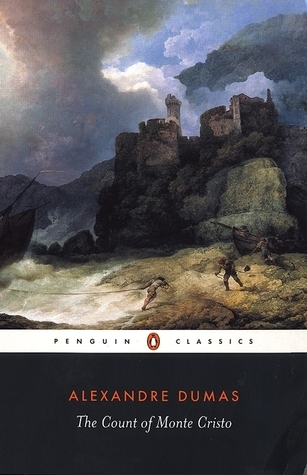
The Count of Monte Cristo by Alexandre Dumas

Penguin| Revised edition 2003| 1313 pages| 4*

I have had a paperback copy of The Count of Monte Cristo for many years. This year I joined in Karen’s Back to the Classics 2021 Reading Challenge, which gave me the incentive to read it now, as it meets the criteria for category five: a classic by a non-white author. It’s also a book on my Classics Club list. Dumas was born in 1802. His father was the illegitimate son of the Marquis de La Pailleterie and Marie Cessette Dumas, a black slave from Haiti. He was a prolific writer, producing 41 novels, 23 plays, 7 historical works and 6 travel books.

The Count of Monte Cristo was first serialised in a French newspaper in 18 parts in 1844 and later translated into English. There have been several translations, editions and abridged versions since then. I really had very little idea of the plot and had not watched any of the film or TV adaptations. As I found it hard to read my paperback version I read an e-book version, so much easier to see!

It begins in 1815 when Edmond Dantès, a sailor, having returned to Marseilles, and celebrating his betrothal to Mercedes is wrongly accused of being a Bonapartist and imprisoned in the Chateau d’If on the Isle of Monte Cristo, for fourteen years. His accusers were Fernand, who was also in love with Mercedes, assisted by Danglars, one of Dantès’ shipmates and Caderousse, a drunkard who went along with the others’ plot to get rid of him. The King’s Attorney, Villefort has his own reasons for condemning Dantès to conceal his father’s involvement with the Bonapartists.

I was quickly drawn into the story with the account of how Dantès survived his imprisonment after meeting the Abbé Faria, who tells him of a great hoard of treasure and offers to share it with him. He educates Dantès in languages, culture, mathematics, chemistry, medicine, and science and together they plan to escape. But the Abbé dies and Dantès ingeniously uses his death to make his own miraculous escape. Whilst in prison Dantès had vowed to get his revenge on the four men responsible for his imprisonment and the rest of the books tells how he went about it. It’s a complicated and elaborate plan that he carries out remorselessly, one that takes him several years to achieve.

It’s a great story, action-packed, and full of high drama and emotion. It’s a love story, a story of revenge and retribution, about justice, intrigue and betrayal. There’s imprisonment and a daring escape, bandits, murder, madness, and suicide. In addition there’s a female poisoner, a scene of torture, an execution, drug-induced sexual fantasies and above all a conflict between good and evil.

But it is very long (Dumas was paid by the line) and a difficult book to review as there is so much in it.There’s a wealth of characters, but the absolute star of the book is the Count of Monte Cristo himself, in his several guises. It’s a theatrical drama, melodramatic in parts, a book I found difficult to put down and it had me turning page after page as I just had to find out what would happen next. There are episodes that really beggar belief, and it has its slow moments where I just wanted Dumas to get on with the story and for Monte Cristo to get his revenge, but it all wove together to make a spectacular whole.

I loved it!

Picnic at Hanging Rock by Joan Lindsay

Picnic at Hanging Rock is one of the best books I’ve read this year. It was first published in 1967 and has since been republished a few times. The copy I read was published by Vintage in 1998. It’s a novella of 189 pages, with a list of characters at the beginning followed by a note, that indicates the truth of the story it tells is in question:

Whether Picnic at Hanging Rock is fact or fiction the readers must decide for themselves. As the fateful picnic took place in the year nineteen hundred, and all the characters who appear in this book are long since dead, it hardly seems important.

On St Valentine’s Day in 1900, a party of nineteen girls accompanied by two schoolmistresses sets off from the elite Appleyard College for Young Ladies, for a day’s outing at the spectacular volcanic mass called Hanging Rock. The picnic, which begins innocently and happily, ends in explicable terror, and some of the party never returned. What happened to them remains a mystery.

I enjoyed it immensely. I love the detailed descriptions of the Australian countryside and the picture it paints of society in 1900, with the snobbery and class divisions of the period. It’s a hot day, the picnic at the base of Hanging Rock shaded from the heat by two or three spreading gums was going well, and while some of the party dozed in the sunshine four of the girls walked to the Rock to get a closer view. As they walked up to the pinnacles and crags the plain below came into sight, but infinitely vague and distant and a rather curious sound was coming up from the plain, like the beating of far off drums. They neared a monolith rising up in front of them and:

Suddenly overcome by an overpowering lassitude, all four girls flung themselves down on the gently sloping rock in the shelter of the monolith, and there fell into a sleep so deep that a horned lizard emerged from a crack to lie without fear in the hollow of Miranda’s outflung arm.

Nobody had noticed that one of the teacher had also left the picnic. The day ended dramatically when one of the girls ran screaming down to the plain, back to the picnic grounds. She had left the other three girls ‘somewhere up there’, but she had no idea where that was. Despite lengthy searches only one girl was found and she couldn’t remember what had happened. It was all very strange. There’s an eerie feeling hanging over the whole event – during the picnic two of the adults found that their watches had stopped at twelve o’clock and they had no idea of the time. It was as though time had been suspended.

It’s a deceptively simple story, but with so many layers and undercurrents, making this mysteriously compelling reading. All the characters are believable people, each with their own backstories, and all their lives are affected and changed by the events of that one day. There’s a dreamlike quality to the mystery and a suspicion of the supernatural surrounding it. I loved the ambiguity of it all.

This is a Novella in November contribution and also qualifies as an entry for AusReading Month 2021.

Top Ten Tuesday: Books to Read If You Love Hilary Mantel’s Wolf Hall Trilogy

Top Ten Tuesday is a weekly meme created by The Broke and the Bookish and now hosted by Jana at That Artsy Reader Girl. For the rules see her blog.

This week’s topic is Books to Read If You Love/Loved X (X can be a genre, specific book, author, movie/TV show, etc.). The Wolf Hall Trilogy by Hilary Mantel tells the story of the rise and fall of Thomas Cromwell in the court of Henry VIII.

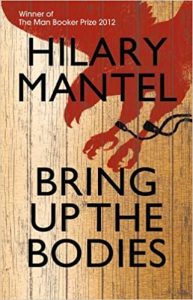
Wolf Hall – England in the 1520s as Henry VIII is seeking a divorce from Katherine of Aragon in order to marry Anne Boleyn. It tells of the rise to power of Thomas Cromwell. Bring Up the Bodies, by 1535, Anne has failed to bear a son and Henry gas fallen in love with Jane Seymour – Anne has to go. This is mainly about Cromwell’s scheming to bring about Anne’s downfall. The Mirror and the Light, the final part, which I’m still reading, set in 1536 – 1540, about Cromwell’s final years.

Here are 10 other historical fiction trilogies/series that I’ve read and loved. I’ve given brief descriptions of the first books for each with links to Goodreads for the details of the rest of the series..

Mathew Shardlake Series by C J Sansom – Mathew Shardlake is a lawyer-detective in the court of Henry VIII. Seven books – I’ve read all of them. The first one Dissolution is closest in time to the third book of Mantel’s trilogy set at the time of the dissolution of the monasteries in 1537. Thomas Cromwell’s Comissioner is found dead, his head severed from his body. Dr Shardlake is sent to uncover the truth behind what has happened.

Marwood and Lovett Series by Andrew Taylor – 17th century London during Charles II reign, who was restored to the throne in 1660 Five books – the first, The Ashes of London is set in 1666 just after the Great Fire. The fathers of both James Marwood and Cat Lovett has fought against Charles and so they are both disgraced. they become involved in investigating the murder of a man is found in the ruins of St Paul’s Cathedral.

Christopher Redmayne Series by Edward Marston – Christopher Redmayne, an architect, and Jonathan Bale, a constable in 1600s London, England. The first book, The King’s Evil is also set in 1666 just after the Great Fire and is also a murder mystery. Redmayne is an architect, working to restore London after the Fire, when he becomes involved in investigating the murder of Sir Ambrose Northcott. whose body was found in the cellars of his partly built new house.

Damian Seeker Series by S G MacLean – historical thrillers set in Oliver Cromwell’s London. Five books – the first is The Seeker, set in 1654. Damian Seeker, Captain of Cromwell’s Guard, works for John Thurloe, Cromwell’s Chief Secretary and spy master. England in 1654 is a Republic in name only, Parliament had been dissolved in 1653 and Cromwell was appointed as Lord Protector – King in all but name.

Raven, Fisher, and Simpson Mystery Series by Ambrose Parry – murder and medical experiments set in 19th century Edinburgh. Three books – the first one is The Way of All Flesh, set in 1847. It begins with the death of Evie, a prostitute in Edinburgh’s Old Town, found by Will Raven, a young medical student about to start his apprenticeship with Dr Simpson. a professor of midwifery, who discovered the anaesthetic properties of chloroform. Sarah Fisher, Dr Simpson’s housemaid is an ambitious and enterprising young woman who would love to have a career in medicine. She and Will join forces to uncover the killer in the depths of Edinburgh’s dark underworld.

Munro Scottish Saga Series by Margaret Skea – set 16th century Scotland. Three books, the first is Turn of the Tide which begins in 1586 in the Scottish Borders in the middle of the centuries-old feud between the Cunninghames and the Montgomeries, with all the drama of their battles, ambushes and schemes to further their standing with the young King James VI. It’s a tale of love, loyalty, tragedy and betrayal.

The Burning Chambers Series by Kate Mosse – 2 books, with a third book in progress. The first is The Burning Chambers, set in Languedoc in the south-west of France in 1562 during the French Wars of Religion. It’s centred on the Joubert family, Catholics living in Carcassonne and Piet Reydon, one of the Huguenot leaders. Bernard Joubert, a bookseller had been imprisoned accused of being a traitor and a heretic after he had let slip information about a secret will. It’s a complicated story of war, conspiracies, love, betrayal, forgery, torture and family secrets.

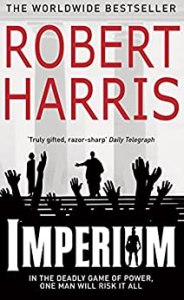
Cicero Series by Robert Harris- set in Ancient Rome – three books. The first is Imperium. Beginning in 79 BC, this book set in the Republican era is a fictional biography of Marcus Tullius Cicero by Tiro, his slave secretary. It is basically a political history, a story filled with intrigue, scheming and treachery in the search for political power as Cicero, a senator, works his way to power as one of Rome’s two consuls.

Theseus Series by Mary Renault – Two books, The King Must Die and The Bull from the Sea. I remember being captivated by these books when I first read them years ago and would so like to re-read them. They retell the life of the mythological Greek hero Theseus, following his adventures from Troizen to Eleusis, where the death in the book’s title is to take place, and from Athens to Crete, where he learns to jump bulls and is named king of the victims. In the second book Theseus defies the Gods’ and claims the throne of Athens a move that culminates in the terrible, fateful destruction of the house of Minos where he slays the Minotaur.

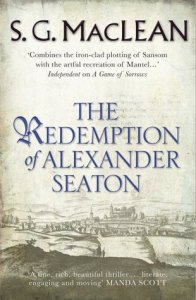
Alexander Seaton Series by Shona MacLean, set in 17th century Scotland. Four books, the first is The Redemption of Alexander Seaton. It is set in the town of Banff, Scotland in the 1620s. One stormy night Patrick Davidson, the local apothecary’s assistant collapses in the street. The next morning he is found dead in the school house of Alexander Seaton, a failed minister, now a schoolteacher. When one of Alexander’s few friends in the town is arrested for the murder, he sets out to prove his innocence.

Recent Loans from the Library

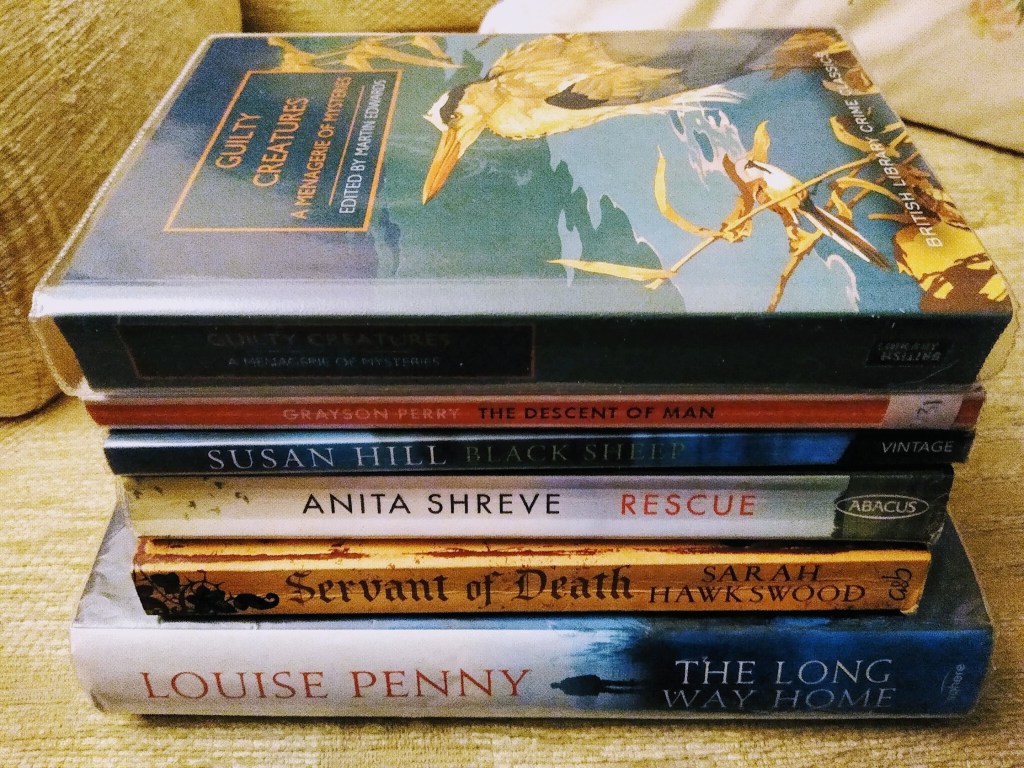
Guilty Creatures: A Menagerie of Mysteries edited and introduce by Martin Edwards. I like these anthologies as much, if not more, for Martin Edwards’ introductions than for the actual stories. I often find that they’re too short for my liking, but I’m hoping there will be some that will prove me wrong. This collection includes stories by Arthur Conan Doyle, G K Chesterton, Edgar Wallace, Josephine Bell and Christianna Brand, among others.

The Descent of Man by Grayson Perry. During the fist lockdown I loved watching Grayson’s Art Club, Channel 4’s documentary series hosted by him and his wife, psychotherapist Philippa Perry. In this book he is looking at masculinity, particularly examining how men dominate much of our world, how men dress and act, how men resort to crime and violence, and how men feel.

Black Sheep by Susan Hill, a novella about a brother an sister who grew up in a coal mining village and yearn to escape. Neither can break free and their decisions result in brutal consequences. It sounds a bit grim!

Rescue by Anita Shreve. The last few books by Anita Shreve I’ve read haven’t been as good as her earlier ones, so I’m hoping this one won’t be disappointing. It’s about a paramedic who rescues a troubled young woman from a car crash. They start a love affair and have a daughter. Eighteen years later he is raising the girl on his own,

Servant of Death by Sarah Hawkswood, historical murder mystery set in the 12th century, the first in the Bradcote and Catchpole mystery series. The Lord Bishop of Winchester’s clerk – is bludgeoned to death in Pershore Abbey and laid before the altar in the attitude of a penitent. Who hated him enough to murder him?

The Long Way Home by Louise Perry. I thought it looked familiar and when I got home and checked my blog I realised I’d borrowed this book before – in 2018! But I took it back unread, thinking I’d try to get the first one. It’s the 10th Chief Inspector Gamache novel – and I still haven’t read any of the previous books, so maybe I’ll read this one this time.

Nonfiction November: Week 2 Book Pairings

Week 2: (November 8-12) – Book Pairing with Katie at Doing DeweyThis week, pair up a nonfiction book with a fiction title. It can be a “If you loved this book, read this!” or just two titles that you think would go well together. Maybe it’s a historical novel and you’d like to get the real history by reading a nonfiction version of the story. 

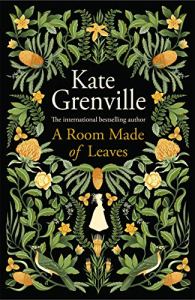
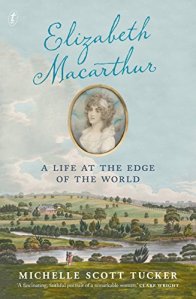
Earlier this year I read the novel A Room Made of Leaves by Kate Grenville and I’m pairing it with Elizabeth Macarthur: A Life at the Edge by Michelle Scott Tucker, which I haven’t read yet.

Kate Grenville is one of my favourite authors, so I was very keen to read A Room Made of Leaves. It’s historical fiction telling the story of the Macarthurs, Elizabeth and John Macarthur, who settled in Australia at the end of the eighteenth century. It’s based on the real lives of the Macarthurs using letters, journals and official documents of the early years of the New South Wales colony. Her writing suits me – historical fiction, with good descriptive writing setting the scenes vividly in their locations. I find her books difficult to put down and they stay in my mind long after I’ve finished reading. This one is no exception.

Whenever I read historical fiction I always want to know how much is fact and how much is fiction, how accurate it is. And so this novel intrigued me because Kate Grenville’s book begins with an editor’s note about ‘the ‘incredible discovery of Elizabeth Macarthur’s secret memoirs’ in a tin box containing old papers, revealing the real person behind the few letters she wrote home to her family and friends and a lot of ‘dull correspondence with her adult children’. Was this true, I wondered. So I turned to the back of the book to read Grenville’s Author’s Note and in that she clarifies that this is not history and, although the extracts from Elizabeth’s letters are from the letters of the real Elizabeth Macarthur, she has ‘taken some liberties in order to shape this work of fiction’. The old documents were Grenville’s ‘inspiration and guide’. In other words you have to bear in mind the epigraph, an actual quotation from one of Elizabeth’s letters: Believe not too quickly, a reminder that this is fiction.

It made me want to know more about the Macarthurs, and what was indeed their history, so I was delighted to find out that Kate Grenville references Michelle Scott Tucker’s biography: Elizabeth Macarthur: A Life at the Edge of the World as the standard biography in her Acknowledgements and I was even more delighted to see that it’s available as a ebook. So it is now in my Kindle and I’m keen to read it as soon as possible. I want to see what Michelle Scott Tucker has made of the same historical sources – history, after all, is an interpretation of the facts from the records, trying to explain what happened and why, dependent on available evidence. Fiction is more flexible and can fill in the gaps where the documentary evidence is lacking.

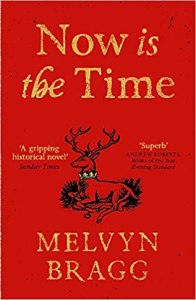
Book Beginnings & The Friday 56: Now is the Time by Melvin Bragg

Every Friday Book Beginnings on Friday is hosted by Gillion at Rose City Reader where you can share the first sentence (or so) of the book you are reading. You can also share from a book you want to highlight just because it caught your fancy.

This week I’m featuring Now is the Time by Melvyn Bragg. I loved his Soldiers Return quartet amongst some of his other books, so I’m hoping this historical fiction set in 1381 at the time of  the Peasants’ Revolt will be as good. Richard II was on the throne of England when a vast force of people led by Wat Tyler and John Ball demanded freedom, and equality.

The Book Begins:

The accused priest stood before the court. He was dressed in the cheapest cloth. From his scuffed and shabby habit, from his spare frame and plainness of manner in the ornately, hierarchically dressed company of the ecclesiastical court, he seemed to be just another casualty of the harsh laws of the Church. But there was about him a self-composure, which threw out the challenge of his independence too arrogantly for the taste of the court.

Also every Friday there is The Friday 56, hosted by Freda at Freda’s Voice. *Grab a book, any book. *Turn to Page 56 or 56% on your  ereader . If you have to improvise, that is okay. *Find a snippet, short and sweet, but no spoilers!

These are the rules:

  1. Grab a book, any book.
  2. Turn to page 56, or 56% on your eReader. If you have to improvise, that is okay.
  3. Find any sentence (or a few, just don’t spoil it) that grabs you.
  4. Post it.
  5. Add the URL to your post in the link on Freda’s most recent Friday 56 post.

Page 56:

Armies in Normandy, Ireland and the north and the English garrisons abroad had not been paid for months. The uprising in Flanders had ruined the rich English wool trade. Aristocrats were accused of corruption and vanity campaigns; Plantagenet heirlooms and jewels had been pawned to city merchants. It was said that it was now the city; not the government, that controlled policy.

Summary (from Amazon):

At the end of May 1381, the fourteen-year-old King of England had reason to be fearful: the plague had returned, the royal coffers were empty and a draconian poll tax was being widely evaded. Yet Richard, bolstered by his powerful, admired mother, felt secure in his God-given right to reign.

Within two weeks, the unthinkable happened: a vast force of common people invaded London, led by a former soldier, Walter Tyler, and the radical preacher John Ball, demanding freedom, equality and the complete uprooting of the Church and state. They believed they were rescuing the King from his corrupt ministers, and that England had to be saved. And for three intense, violent days, it looked as if they would sweep all before them.

Now is the Time depicts the events of the Peasants’ Revolt on both a grand and intimate scale, vividly portraying its central figures and telling an archetypal tale of an epic struggle between the powerful and the apparently powerless.

~~~

I vaguely remember learning about Wat Tyler and the Peasant’s Revolt at school. This book should fill in the gaps in my memory!