Testament of a Witch by Douglas Watt

Testament of a Witch by Douglas Watt is the second book of his that I’ve read. The first one Death of a Chief I read 5 years ago! Both books are set in late 17th century Scotland (1686 and 1687) and feature a Gaelic speaking, Edinburgh lawyer John MacKenzie and his clerk Davie Scougall. I like the way Douglas Watt incorporates the historical background into the narrative without detracting from the story.

In Testament of a Witch MacKenzie investigates the death of Grissell Hay, Lady Lammersheugh accused of witchcraft in a village overwhelmed by superstition, resentment and puritanical religion. Then the same accusations are made against the Euphame, Grissell’s daughter.  I wasn’t too keen on the horrifying and explicit descriptions of how the witch hunter identified and dealt with women accused of being witches, which involved torture and sleep deprivation, but apart from that I enjoyed this book.

I liked the interaction between Mackenzie, a Highlander and Scougall, a Lowland Scot. Scougall is convinced of the reality of witchcraft, whereas Mackenzie has ‘grave doubts about the crime of witchcraft‘, believing ‘it is nothing more than superstition‘. The religious fervour and political unrest are clearly demonstrated in this book, setting the frenzied persecution of those suspected of witchcraft in context. Watts’ Historical Note on The Scottish Witch-hunt at the end of the book gives the background, when Scottish society was in a state of flux.

Change caused anxiety and fear, unleashing frenzies of witch-hunting . … It has been estimated that the Scottish witch-hunt was ten times more deadly than the English one in terms of executions per head of population. Probably more than a thousand men and women were executed for witchcraft in Scotland during the sixteenth and seventeenth centuries.

The witch-hunt could not have occurred without a widespread belief in magic, charming and divination, and the acceptance of Satan as a real presence in the life of the people.

Witch-hunting declined when the revolutionary zeal of the Scottish Reformation ran out of steam in the late seventeenth century. Scotland began to turn its back on persecution and look towards the more tolerant and commercial age of the Enlightenment.

Testament of a Witch is well-researched and although it gets off to a slow start and I didn’t enjoy it quite as much as Death of a Chief, I was immersed into the fascinating and terifying world of the witch-hunt in 17th century Scotland as I was reading. It’s a book that qualifies both for the Read Scotland 2014 Challenge and this year’s R.I.P. Challenge, as well as the Historical Fiction Challenge and the My Kind of Mystery Challenge.

Douglas Watt is a Scottish historian, poet and novelist, who lives in Linlithgow. He has a PhD in Scottish History from Edinburgh University and is the author of The Price of Scotland, a history of Scotland’s Darien Disaster, which won the Hume Brown Senior Prize in Scottish History in 2008. 
Dark Matter by Philip Kerr

Dark Matter by Philip Kerr is a book from my to-be-read piles. I bought it at a library sale a couple of years ago now, attracted by the title. I soon realised that it is not about Newton, the mathematician and physicist because the sub-title is : The Private Life of Sir Isaac Newton. It is actually historical crime fiction, set in 1696 when Newton was the Warden of the Royal Mint at the Tower of London.

Christopher Ellis, the narrator of the book, is sent to the Tower to assist Newton to hunt down counterfeiters during the period of the Recoinage of the currency, when fake gold coins were being forged. This leads to the discovery in the Tower moat of the body of the former clerk of the Mint , followed by yet more murders. Newton at times seems remarkably like Sherlock Holmes in his powers of observation and deduction, as he and Ellis follow the trail of the murderers, involving tales of the missing treasure of the Knights Templars, (was the clue to its whereabouts in a book hidden in the Tower?), a difficult code to decipher, plots against Roman Catholics, astronomy and alchemy all thrown into the mix.

It’s very atmospheric, with shadowy London streets and back alleys; the Tower itself a centre of suspicion and intrigue. I liked the mix of fact and fiction. Titus Oates, Samuel Pepys and Daniel Defoe among others, make brief appearances, there’s the war with France and the mix of religion, science and politics that characterised the late 17th century. But I did find the characters, apart from Newton and Ellis confusing at times, having to backtrack a few times to sort them out. Newton himself is seen through Ellis’s eyes, a person who doesn’t like to speak  ‘anything that is extraneous to my business‘. But at times his sense of humour and wit, his dedication to his work, and his resolution of the science/faith conflict all come through.

I liked Dark Matter and reading it has certainly made me interested to know more about Newton, in particular about his religious beliefs. Although I’m happy to read this as fiction I wonder just how much is based on fact? In his Author’s Note, Philip Kerr explains that much is known about Newton’s work at the Royal Mint and that Christopher Ellis was in fact his assistant, following the mysterious disappearance of the previous clerk. As for his religious beliefs, Kerr writes:

Newton’s interest in alchemy, as well as his dissenting, not to say blasphemous, Arian view, which made him violently opposed to the ruling Trinitarian religious orthodoxy of the day, is also accurate. And anyone wishing to know more should read Richard Westfall’s magisterial biography of Newton, as I have done. But any mistakes in the novel are my own. (page 345)

And I also want to know did he really have a cat, and if so did he call it Melchior?

Although I didn’t read it just to fit in with several reading challenges I’ve joined, it is ideal for several and I’ve indicated those challenges in the Categories listed below this post.

Philip Kerr, is a Scot, born in Edinburgh. ‘He is the author of more than 20 books, including seven Bernie Gunther novels, several standalone thrillers, and six books in the young-adult series Children of the Lamp under the pen name of P.B. Kerr.

In 2009, he won the British Crime Writers’ Association Ellis Peters Historical Fiction Award and Spain’s RBA International Prize for Crime Writing for his Bernie Gunther series. A former advertising copywriter who released his first book in 1989 and in 1993 was named one of Granta magazine’s Best Young British Novelists, he now divides his time between London and Cornwall.’ (copied from his website)

Catching Up With My Reading

Once more I’ve been reading books and moving on without writing about them. Here are just two of the books I’ve read recently:

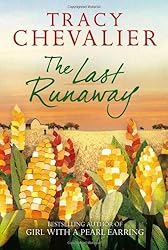
The Last Runaway by Tracy Chevalier – I really liked this book, historical fiction about the life of Honor Bright after she emigrated from Dorset to America in 1850 where she joined a Quaker community in Ohio. It intertwines her story with that of the ‘Underground Railroad’, helping the runaway slaves from the southern states to escape to Canada.

Honor is a quilter, but finds that American quilts are not the same as English ones, just as America is very different from England, both in landscape, temperature and culture. She struggles to fit in, finding it hard to adjust. I thought this was well handled and the sense of period and place is impressive, with a wealth of detail about the land and the struggles of the settlers. She can’t face the journey back across the Atlantic and marries Jack Haymaker, a young farmer whose mother and sister disapprove of her.

The slavery question caused Honor a real dilemma, as she became involved in the Underground Railroad, a network of safe houses and people willing to provide food and shelter for the runaways. Should she abide by the law, or follow her Quaker beliefs about equality, thus putting the rest of her family at risk as well as herself? This is compounded by her relationship with Belle Mills and her disreputable brother Donovan who has taken a liking to Honor, but is also a slave-catcher, ruthless in his pursuit.

I think it’s a very entertaining book, full of colourful characters, although some, like Jack are not as well developed as others. I liked the detail about quilting, even though I have never done any! But it was the account of life on the frontier and the Underground Railroad that made the book for me. Here are Honor’s thoughts about slavery:

She had begun with a clear principle born of a lifetime of sitting in silent expectation: that all people are equal in God’s eyes, and so should not be enslaved to one another. Any system of slavery must be abolished. It had seemed simple in England; yet in Ohio that principle was chipped away at, by economic arguments, by personal circumstances, by deep-seated prejudice that Honor sensed even in Quakers. …

When an abstract principle became entangled in in daily life, it lost its clarity and became compromised and weakened. (page 259)

I borrowed this book from the library.

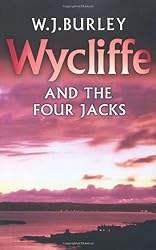
In complete contrast I moved on from The Last Runaway to Wycliffe and the Four Jacks by W J Burley, crime fiction set in Cornwall, featuring Chief Superintendent Wycliffe, who is on holiday but still gets drawn into a murder investigation.
Author David Cleeve, who writes under the pseudonym Peter Stride asks for Wycliffe’s advice about a series of sinister warnings he has received in the form of a playing card – the Jack of Diamonds. Then, a young woman is found dead, an apparently motiveless crime, but, as Wycliffe discovers, it follows a series of crimes, the clues all seeming to centre on an archaeological dig on Cleeve’s land. A further murder helps to pinpoint the culprit.

This is a quick read, with plenty of red herrings, but not too difficult to unravel. I liked it and I liked the personal touches that make Wycliffe a real person, a somewhat irritable man who likes his food, and gets on well with his wife. He is a thoughtful detective:

He was in a strange mood, suddenly everything had become unreal: the bare schoolroom with its peeling green walls, the battered tables, the scratched filing cabinets, his colleagues bending over their reports … He had known such experiences since childhood when, suddenly, everything seemed remarkable, nothing was ordinary any more. His mother would say: ‘Why aren’t you playing with your toys, Charles?’ Later, at school, it was ‘Day-dreaming again, Wycliffe!’ Now DS Lane was watching him and probably thinking, ‘Why dies he just sit there?’ (page 165)

It’s periods like this, however, that help Wycliffe focus his thoughts.

Wycliffe and the Four Jacks was first published in 1985. It’s the 12th in Burley’s series of 22 Wycliffe books.

The Dance of Love by Angela Young

Angela Young‘s new novel The Dance of Love is historical fiction set at the turn of the twentieth century between 1899 and 1919. It is outstanding and I loved it so much. At times as I read it I could hardly see the pages through my tears – and there have not been many books that have that effect on me.  It’s a brilliant book, both a heart-rending love story and a dramatic story too, as the sinking of the Titanic in 1912 and the devastating and tragic effects of the First World War impact on the characters’ lives.

It’s the story of Natalie, the daughter of Sir Thomas Edwardes, a wealthy business man, a self-made man who is socially unsure of himself, but who wants his daughter to be accepted into society. It begins in 1899, a period when young ladies were presented at Court for the London Season, an opportunity to meet their future husbands. Natalie’s friends, the daughters of Lady Bridewell, are looking forward to the London Season. But Natalie has little desire to be presented at Court, relishing the idea that she would be free to live without such restraints and marry for love, someone who will care for her for herself, not because of her family connections. However, she falls in with her father’s wishes and when she meets a handsome artist-soldier, Lieutenant Haffie, it seems her wish for a happy marriage will come true.

What I really liked about this book is the way historical background is seamlessly interwoven with the narrative and how it captures the changes in society as the years went by. Natalie grows from a young, impulsive teenager with passion for romance and dancing into a responsible young woman whose hopes for a happy marriage are in the balance.  The portrait of the Edwardian upper classes, with their lavish life style, glittering balls and all their extravagances is fascinating, contrasting with the enormous changes in society as the War takes its effect.

I liked all the details about paintings as Haffie shows his work to Natalie – Angela Young’s beautiful descriptions draw such vivid full colour images that I could easily visualise the paintings, which Natalie says are ‘mysteries made of light.’  And her portrayal of the settings, whether in London, Devon or the Scottish Highlands are just as vivid, making this a richly descriptive book.

But it is the effect of the War and the effect on the families of those people travelling across the Atlantic on the Titanic that really brought home to me the whole human tragedy that people lived through, much more than any historical account has done. I think it’s seeing these events through the eyes of the people left at home that has the most impact.

I had enjoyed Angela Young’s first novel, Speaking of Love and so was pleased to accept her offer of an uncorrected proof copy of The Dance of Love. I’m so glad I did as it’s a beautifully written, brilliant book that moved me deeply, and one I shall most definitely re-read (always proof of a good book for me).

The Dance of Love will be published on 31 July 2014.

Midnight in St Petersburg by Vanora Bennett

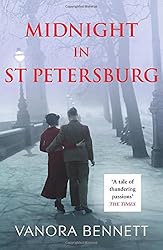
Sometimes I get requests from authors/publishers to review books and occasionally a book just turns up in the post unannounced. Over a year ago now I unexpectedly received a copy of Midnight in St Petersburg by Vanora Bennett and although it appealed to me I put it to one side whilst I finished other books. It has taken me until now to get round to actually reading it.

And I’m glad I did as it is an interesting book – historical fiction beginning in 1911 in pre-revolutionary Russia with Inna Feldman travelling by train to St Petersburg to escape the pogroms in Kiev hoping to stay with her distant cousin, Yasha Kagan. She is welcomed into the Leman family where she and Yasha are apprentices in their violin-making workshop. Inna is a talented, albeit shy, violinist and she falls in love with Yasha through their shared love of music.

The book is split into three sections – September – December 1911, 1916-17 and 1918-19 as Russia enters the First World War and is plunged into Revolution and life becomes increasingly dangerous for them all. Inna is torn between her love for Yasha, wildly rebellious and an activist in the revolution, and the older and more secure Englishman, Horace Wallick who works for the jeweller, Faberge, painting miniatures. It’s a story of survival under extreme conditions.

I liked the way Vanora Bennett intermingled Inna’s personal story with the historical characters of the time, including Father Grigory, Prince Youssoupoff and Lenin. I particularly liked the Father Grigory sections. Inna first met him on the train to St Petersburg when he helped her and I had my suspicions about who he really was, although it was a while before Inna discovered his identity. I also thought the details of violin-making were fascinating and I really liked the sections about Horace and his work for Faberge. What is perhaps even more fascinating is that Horace Wallick was a real person, Vanora Bennett’s great-great-uncle who really did work for Faberge from 1910 to 1919, which makes the story all the more authentic.

However, I thought the pace of the novel wasn’t very well structured as after an attention grabbing opening I thought it dragged a bit in the middle and that it was drawn to a too hasty conclusion. Overall, though I thought this portrayal of the Russian Revolution and the effect it had on ordinary people was well done and I did enjoy it.

This is the second of Vanora Bennett’s books I’ve read – the first was Portrait of an Ordinary Woman the story of Sir Thomas More’s fall from Henry VIII’s favour and that of his adopted daughter Meg Giggs. I shall look out for more of her books.

North Sea Cottage by Dorte Hummelshoj Jakobsen

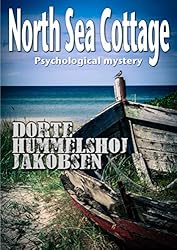
Dorte Hummelshoj Jakobsen’s latest book, North Sea Cottage, is an e-book, a novella set in Denmark. It’s another dual time period book – it seems that each book I’ve read recently is one of these. This one is split between the present day and 1943/4 and it works very well.

I thoroughly enjoyed this book; the cottage in the title is owned by Tora’s aunt, Bergatora. As soon as I began reading I was immediately transported in place away to the other side of the North Sea to Denmark with Tora, and in time back to the Second World War, with her aunt, Bergatora. In just a few words Dorte Hummelshoj Jakobsen draws a vivid picture of the old fisherman’s cottage surrounded by dense sea fog.

Tora is struggling to overcome her own problems when she is faced with a new problem. The old stable next to the cottage catches fire during a thunder storm and in the aftermath of the fire Tora finds a skeleton in the potato cellar under the ruined stable. Who is it who had died in the cellar? Bergatora is reluctant to talk about the war years and her brother, Tora’s father, was too young at the time to help. It was a time when Denmark was under German occupation and a resistance movement was under way. Inspector Thomas Bilgren suspects the victim may have been related to the German occupation.

Tora, helped by Bilgren attempts to discover the truth, but is hampered by the strong character of her aunt and the silence surrounding what happened during the war. I loved this aspect of the book – the delving back into history, the way the narrative switches backwards and forwards, gradually revealing what had happened. North Sea Cottage is only about 90 pages but it has depth both in mystery and in characterisation and the setting is so atmospheric. I was fearful for Tora’s safety as she dug deeper into the mysteries from the past.

Thanks to Dorte Hummelshoj Jakobsen, who kindly sent me a copy of her book. She has a blog – Djskrimiblog and used to be a teacher. She writes both serious mysteries as well as humorous and cosy stories about the Gershwin family in Knavesborough, a fictional village in Yorkshire, publishing in Danish and English. I like her humorous stories but prefer the serious ones like North Sea Cottage and her previous novel, Anna Märklin’s Family Chronicles. She is currently at work on her next novel – Crystal Nights, to be published in 2014/5.