The Black Tulip by Alexandre Dumas

4*

The Black Tulip is historical fiction, a love story, mixing historical characters with fictional ones. It was first published in 1850. I loved The Count of Monte Cristo by Alexandre Dumas, so I was hoping to enjoy The Black Tulip too. I did, but not quite as much. I think it’s because I don’t know much about Dutch history and so I found the early chapters, about the brothers Cornelius and Johan de Witt, a bit difficult to follow. They were Dutch statesmen, accused of treason, who were brutally killed by a mob in the Hague in 1672, during a period of political upheaval, when they escaped from prison.

The story centres on Cornelius von Baerle, the fictional godson of Cornelius de Witt and his desire to grow a black tulip. He became involved in the de Witts’ affairs when Cornelius de Witt left a sealed parcel of his correspondence with the French war minister, with him for safekeeping. He didn’t open the parcel and didn’t know what it contained.

When the Tulip Society of Haarlem offered a prize of a hundred thousand guilders for the development of a tulip ‘without a spot of colour‘, this set the tulip growers into a frenzy of activity, including Van Baerle and his neighbour, Isaac Boxtel. Boxtel spied on Van Baerle’s experiments to grow a black tulip, which were having more success than his own efforts. Indeed Boxtel was obsessed with what Van Baerle was doing, neglecting his own tulips to wither and rot as he observed, through a telescope, what his neighbour was doing both in his garden and in his laboratory.

Whilst observing Van Baerle’s laboratory, Boxtel had seen the meeting between Cornelius de Witt and Van Baerle when he entrusted his papers to his godson. On hearing that the de Witt brothers had been arrested Boxtel realised he could inform against Van Baerle and get him arrested, thus giving himself the opportunity to steal the bulb Van Baerle had produced. And the hundred thousand guilder prize would be his.

And so Van Baerle was thrown into prison, wrongly convicted of treason and under sentence of death. However William of Orange, Stadtholder of Holland granted him his life but condemned him to imprisonment for life. He was sent to the fortress of Loewestein and there kept in solitary confinement. What follows is a dark and somewhat farcical tale, as aided by the jailer’s daughter Rosa he continues to cultivate his tulip bulbs. He and Rosa fall in love, despite all the difficulties that assault them.

It’s a great story, full of drama and emotion. It’s a love story, a story about passion, hatred, jealousy, obsession and injustice. After the difficulties I had with the first four or five chapters (I had to re-read them to work out how the rest of the story was connected) I found it difficult to put down, keen to find out what would happen next. I didn’t love it like I loved The Count of Monte Cristo, but I really liked it.


The Classics Club Spin Result

The spin number in The Classics Club Spin is number …

8

which for me is The Black Tulip by Alexandre Dumas. The rules of the Spin are that this is the book for me to read by 2 June 2024.

Synopsis from Goodreads:

Set at the height of the “tulipomania” that gripped Holland in 17th century, this is the story of Cornelius van Baerle, a humble grower whose sole desire is to grow the perfect specimen of the tulip negra.

When his godfather is murdered, Cornelius finds himself caught up in the deadly politics of the time, imprisoned and facing a death sentence. His jailor’s daughter Rosa, holds both the key to his survival and his chance to produce the ultimate tulip.


I loved The Count of Monte Cristo by Alexandre Dumas so I’m hoping to love this one too.

Did you take part in the Classics Spin? What will you be reading?

The Girl Who Died by Ragnar Jonasson, translated from the Icelandic by Victoria Cribb

Penguin| 3 June 2021| 328 pages| Review Copy| 3*

‘TEACHER WANTED AT THE EDGE OF THE WORLD . . .’

After the loss of her father, Una sees a chance to escape Reykjavík to tutor two girls in the tiny village of Skálar – population just ten – on Iceland’s storm-battered north coast.

But city life hasn’t prepared her for the unforgiving weather nor inhospitable village life. Worse, the creaky old house where she lives is playing on her already fragile mind when she’s convinced she hears the ghostly sound of singing.

Then, at midwinter, a young girl is found dead.

And one of the villagers must have blood on their hands . . .

The Girl Who Died is Icelandic noir, a mix of horror and psychological thriller, with a strong sense of place. Skálar is a close-knit community that doesn’t welcome newcomers, keeping its secrets well hidden. The only person who welcomes Una, to the village is Salka, the mother of Edda, one of the two girls Una is to teach. But even her welcome is short lived.

When Una arrived she had the feeling that it was like being a folk tale, an ominous supernatural tale set in a vague shifting world where nothing was solid or real, almost like a ghost town. The feeling grows stronger when she sees a little girl with long, pale hair in the window of Salka’s house – but Salka tells her that Edda was in bed. Later she discovers that the ghost of a young girl who had died fifty years earlier was said to haunt the house.

The supernatural elements of the story and the dark brooding atmosphere add to the mystery, but it is not quite as creepy or chilling as I’d thought it would be, mainly because of the slow plodding pace. Also I’m in two minds about Una as I really didn’t find her a very interesting character. And I began to care less and less about what was happening to her. Overall I found it a bit disappointing, and I found the ending puzzling.

However, the Author’s Note is interesting. Jonasson explains that Skálar is a real place. But it was abandoned in the mid 1950s, so the setting is real, but the buildings and the characters are fictitious. However, he has tried to give an accurate representation of the history of Skálar that describes in the book. He has also used the folk tales in Sigfús Sigfússon’s collections of Icelandic tales and legends.

My thanks to the publishers for a review copy via NetGalley.

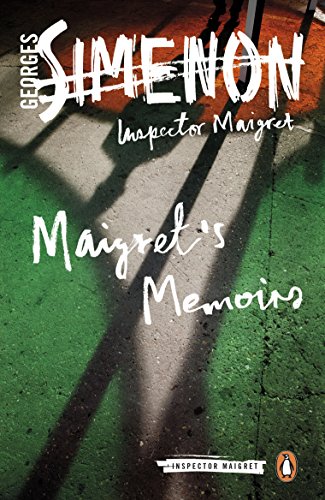
Maigret’s Memoirs by Georges Simenon Translated by Howard Curtis

Week 2 in Novellas in November is Novellas in translation and a Maigret book is an obvious choice for me. But Maigret’s Memoirs is not your usual Maigret mystery. This a memoir written by Simenon writing as his fictional character, Maigret.

Penguin Classics| 2016| 160 pages| My Own Copy| 4*

I can still see Simenon coming into my office the next day, pleased with himself, displaying even more self-confidence, if possible, than before, but nevertheless with a touch of anxiety in his eyes.’

Maigret sets the record straight and tells the story of his own life, giving a rare glimpse into the mind of the great inspector – and the writer who would immortalise him.

‘One of the greatest writers of the twentieth century . . . Simenon was unequalled at making us look inside, though the ability was masked by his brilliance at absorbing us obsessively in his stories’ Guardian

‘A supreme writer . . . unforgettable vividness’ Independent

The original French version of Maigret’s MemoirsLes Mémoires de Maigret, was first published in 1950. An English translation was later published in Great Britain in 1963. It is unlike any of the other Maigret novels. It’s a fictional autobiography by Georges Simenon writing as Maigret, beginning in 1927 or 1928 when Maigret and Simenon, calling himself Georges Sim, first ‘met’. I don’t recommend reading if you haven’t read some of the Maigret mysteries.

I enjoyed it – it’s a quick entertaining read as Maigret looks back to his first ‘meeting’ with Sim. He fills in some of the background of his early life and talks about his father and how he first met his wife, Louise. Simenon had written 34 Maigret novels before this one and Maigret took this opportunity to correct some of Simenon’s inaccuracies. I recognised some of the books – I’ve read 11 of his first 34 books.

One of the things that irritated Maigret the most was Simenon’s habit of mixing up dates, of putting at the beginning of his career investigations that had taken place later and vice versa. He’d kept press cuttings that his wife had collected and he had thought of using them to make a chronology of the main cases in which he’d been involved. And he also considered some details his wife had noted – concerning their apartment on Boulevard Richard Lenoir, pointing out that in several books Simenon had them living on Place des Vosges without explaining why. There were also times when he retired Maigret even though he was still several years away from retirement. Madame Maigret was also bothered by inaccuracies concerning other characters in the books and by Simenon’s description of a bottle of sloe gin that was always on the dresser in their apartment – that was in actual fact not sloe gin but raspberry liqueur given to them every year by her sister-in-law from Alsace.

Simenon drops facts and information piecemeal in his Maigret books and one thing I particularly like in Maigret’s Memoirs is that it is all about Maigret, but I did miss not having a mystery to solve.

Throwback Thursday: An Uncertain Place by Fred Vargas

Today I’m looking back at my post on An Uncertain Place by Fred Vargas. I first reviewed it on June 10, 2017.

My review begins:

I loved An Uncertain Place, a clever and also a confusing book. It’s the sixth in Fred Vargas’ Commissaire Adamsberg series in which he investigates a macabre murder. I say confusing because I got a bit lost in the middle of the book, and looking back I think it’s because Adamsberg is not your normal detective – he works by intuition and I simply hadn’t followed his train of thought. With a bit of concentration I was back on track and caught up with him.

Click here to read my full review

~~~

Fred Vargas was born in Paris in 1957. As well as being a best-selling author in France, she is an historian and archaeologist.

She worked at the French National Centre for Scientific Research (CNRS), which she joined in 1988. She later joined the Institut Pasteur, as a eukaryotic archaeologist.

She mostly writes police thrillers (policiers). They take place in Paris and feature the adventures of Chief Inspector Adamsberg and his team. Her interest in the Middle Ages is manifest in many of her novels, especially through the person of Marc Vandoosler, a young specialist in the period. Seeking Whom He May Devour was shortlisted by the British Crime Writers’ Association for the last Gold Dagger award for best crime novel of the year, and the following year The Three Evangelists won the inaugural Duncan Lawrie International Dagger. She also won the award for the second year-running with Wash This Blood Clean From My Hand.

~~~

The next Throwback Thursday post is scheduled for June 30, 2022.

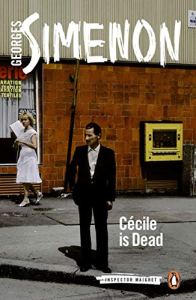
Cécile is Dead by Georges Simenon

Cécile is Dead by Georges Simenon, translated by Anthea Bell, an Inspector Maigret novel.

Synopsis (Amazon)

Poor Cécile! And yet she was still young. Maigret had seen her papers: barely twenty-eight years old. But it would be difficult to look more like an old maid, to move less gracefully, in spite of the care she took to be friendly and pleasant. Those black dresses that she must make for herself from bad paper patterns, that ridiculous green hat!

In the dreary suburbs of Paris, the merciless greed of a seemingly respectable woman is unearthed by her long suffering niece, and Maigret discovers the far-reaching consequences of their actions.

This novel has been published in a previous translation as Maigret and the Spinster.


My thoughts:

This is one of the best Maigret books I’ve read – and it is complicated, remarkably so in a novella of just 151 pages. At first it seems quite straight forward. Cécile has been wanting to see Detective Chief Inspector Maigret for months, sitting patiently in the ‘Aquarium’, as the waiting room at the Police Judiciaire in Paris, is known. She was convinced that someone had been breaking into her aunt’s apartment. But no one takes her seriously and Maigret is always busy, until one day he decides to see her. But she had left the waiting room, so he goes to the apartment where she lives with her elderly aunt, Juliette Boynet, the owner of the apartment building. She wasn’t there, but her aunt was – lying dead on the floor, strangled. Cécile was missing and the title tells you why – she was indeed dead.

And from then on, the mystery became more complex, with several suspects with a variety of motives. Juliette was very wealthy, but also miserly. She had a large family, mostly estranged from her and at odds with each other. They all turn up for her funeral, arguing about who should take precedence in the funeral cortège, and about who should inherit her money and property.

Maigret has to sort it out in his own way – musing over the details and feeling bad that he hadn’t spoken to Cécile earlier, thinking her worry over an intruder who just moved things around the apartment without taking anything was trivial. We see more of how he thinks and works when later in the investigation he is accompanied by an American, a Mr Spencer Oates from the Institute of Criminology of Philadelphia, who had asked if he could study Maigret’s methods.

This is the second time I’ve read Cécile is Dead. I first read it in 2018, but didn’t write about it at that time. Reading it for the second time, I realised I had forgotten all the details – it was like reading a new book. I thoroughly enjoyed it. It is either the 20th or the 22nd Maigret novel – Amazon records it as the 20th, whereas Goodreads has it as the 22nd! Whichever it is, it is a good read.

  • ASIN ‏ : ‎ B00SSKM6OC
  • Publisher ‏ : ‎ Penguin (4 Jun. 2015)
  • Print length ‏ : ‎ 151 pages
  • Source: I bought the e-book
  • My Rating: 4*