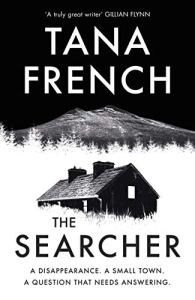
The Searcher by Tana French

Penguin| 5 November 2020| 400 pages| Review copy| 5*

I enjoyed The Searcher very much. For the most part this standalone mystery novel moves quite slowly, but it held my attention right from the beginning. It certainly isn’t a book to rush through, rather it’s one to savour. The main characters are Cal Hooper and thirteen-year old Trey Reddy living in Ardnakelty, a remote Irish village. After twenty five years in the Chicago police force, Cal has recently moved to the village, wanting to build a new life after his divorce. He is a loner and wants a quiet life in which nothing much happens. But he finds himself getting involved in the search for Brendan, Trey’s older brother who had gone missing from home.

Cal is a methodical man, slowly doing up his run-down cottage and getting to know the locals – his neighbour Marty, Noreen who runs the village shop, her sister Lena and above all, Trey. I liked the slow build up to the mystery, and I loved Tana French’s beautiful descriptions of the Irish rural landscape. It’s the sort of book I find so easy to read and lose myself in, able to visualise the landscape and feel as if I’m actually there with the characters, watching what is happening.

But this is no ‘cosy’ crime fiction novel. Trey is like a dog with a bone and won’t let Cal give up when it looks as though they will never discover why Brendan left and what had happened to him. I realised after a while what could have happened to Brendan, but I hadn’t foreseen the twists and turns in this book, one of which really surprised me. The ending is terrific. The tension builds and builds as Cal and Trey find themselves in danger. Above all, it is about family relationships, responsibility and friendship. It is atmospheric, spellbinding, and compelling reading. Tana French is a great storyteller.

Many thanks to the publishers and NetGalley for my review copy.

The Haunting of Hill House by Shirley Jackson

I read The Haunting of Hill House by Shirley Jackson at the end of September and it is one of the books that’s in my ‘to be reviewed pile’, which is getting far too big, as I keep reading book after book without writing about them!

About the book:

It is the story of four seekers who arrive at a notoriously unfriendly pile called Hill House: Dr. Montague, an occult scholar looking for solid evidence of a “haunting”; Theodora, the lighthearted assistant; Eleanor, a friendless, fragile young woman well acquainted with poltergeists; and Luke, the future heir of Hill House. At first, their stay seems destined to be merely a spooky encounter with inexplicable phenomena. But Hill House is gathering its powers—and soon it will choose one of them to make its own. (Goodreads)

This is a horror story, but thank goodness there is no gore. Instead it is macabre and has a chilling atmosphere. It’s more of a psychological study than a horror story and as such I don’t think it’s as good or as terrifying as her later book, We Have Always Lived in the Castle.

Dr. Montague, a doctor of philosophy with a keen interest in the supernatural and psychic manifestations had been looking for a ‘haunted’ house to investigate all his life. So, when he heard the stories about the strange goings on at Hill House he decided he would spend three months living there and see what happened, and he set about finding other people to stay there with him.

Eleanor is the main character in the book, next to the House itself, and what happens is told from Eleanor’s point of view. As a child Eleanor had once seemed to activate a poltergeist, although she doesn’t remember that. As an adult she had spent eleven years looking after her invalid mother and it had left her a lonely, embittered spinster of thirty two. After her mother died she sees Dr. Montague’s invitation to spend the summer at Hill House as something she had been waiting for all her life, an opportunity to change her life. Theodora is not at all like Eleanor – her ‘world was one of delight and soft colors’ and after arguing with her friend with whom she shared an apartment, she accepted Dr. Montague’s invitation too. The third person to accept was Luke, the nephew of the owner of Hill House, who would one day inherit the House. He was a liar and also a thief.

These four people arrived at Hill House where they were met by the Dudleys – Mr Dudley, the surly caretaker and his dour wife, the housekeeper. Neither of them live in the house but having told the guests which rooms they were to sleep in, and the arrangements for meals, they leave them alone at night. They leave before it gets dark.

Eleanor realises she should have turned back at the gate and a voice inside her tells her to ‘get away from here, get away.’ There are stories about the tragedies connected with the house, scandal, madness and a suicide – when a girl hanged herself from the turret in the tower. Dr Montague believes

the evil is in the house itself and that it has enchained and destroyed its people and their lives, it is a place of contained ill will.

Strange things happen, doors open themselves, the walls and floors are at odd angles, the rooms all connect so Eleanor and the others lose their sense of direction and get lost, the rooms they want to find eluding them. There are places where there are ‘cold spots’, and strange noises scare them at night. The tone shifts from the bright sunlight outside to the chill and foreboding of the house. Nothing is what it first appears to be and as I read on I felt I was sinking into the story in an unpleasant way – Eleanor becomes increasingly unstable and I began to realise that she is an unreliable narrator. The story took several ambiguous turns, so that I was not quite sure what was really happening. Was the house really haunted or was it all an effect of what was going on in their minds, or was it all just in Eleanor’s fevered imagination?

The book is well written, full of confusion and misdirection. There are moments of pure fear, a sense of excitement, friendship and even humour with the arrival of Dr Montague’s wife and her pompous friend Arthur Parker, and their ridiculous efforts with a ‘planchette’, a device similar to a Ouija Board. I thought was an odd interlude in the story, and not really necessary. The best parts are, I think, the descriptions of Hill House – the dark horror at the centre of the story.

No human eye can isolate the unhappy coincidence of line and place which suggests evil in the face of a house, and yet somehow a manic juxtaposition, a badly turned angle, some chance meeting of roof and sky turned Hill House into a place of despair, more frightening because the face of Hill House seemed awake, with a watchfulness from the blank windows and a touch of glee in the eyebrow of a cornice. …

It was a house without kindness, never meant to be lived in, not a fir place for people or for love or for hope. Exorcism cannot alter the countenance of a house; Hill House would stay as it was until it was destroyed. (pages 34 – 35)

My Friday Post: Last Bus to Woodstock by Colin Dexter

Every Friday Book Beginnings on Friday is hosted by Gillion at Rose City Reader where you can share the first sentence (or so) of the book you are reading. You can also share from a book you want to highlight just because it caught your fancy.

As I’ve nearly finished reading Daniel Defoe’s A Journal of the Plague Year I’ve been wondering what to read next. I had thought I might read Moon Over Soho by Ben Aaronovitch, which is the second Rivers of London book. But this morning I picked up The Last Bus to Woodstock by Colin Dexter and began reading and just carried on. It’s the first Morse book in which Morse and Lewis first met and worked together. Morse thought they would get on well together.

It begins:

‘Let’s just wait a bit longer please,’ said the girl in dark-blue trousers and the light summer coat. ‘I’m sure there’s one due soon.’

This is a scene at a bus stop where two girls are waiting for the next bus to Woodstock. One of the girls doesn’t want to wait, wanting to hitch a lift and they both left the bus stop – it was the wrong decision.

Also every Friday there is The Friday 56, hosted by Freda at Freda’s Voice. *Grab a book, any book. *Turn to Page 56 or 56% on your  ereader . If you have to improvise, that is okay. *Find a snippet, short and sweet, but no spoilers!

These are the rules:

  1. Grab a book, any book.
  2. Turn to page 56, or 56% on your eReader. If you have to improvise, that is okay.
  3. Find any sentence (or a few, just don’t spoil it) that grabs you.
  4. Post it.
  5. Add the URL to your post in the link on Freda’s most recent Friday 56 post.
  1. Grab a book, any book.
  2. Turn to page 56, or 56% on your eReader. If you have to improvise, that is okay.
  3. Find any sentence (or a few, just don’t spoil it) that grabs you.
  4. Post it.
  5. Add the URL to your post in the link on Freda’s most recent Friday 56 post.

She pointed to a large volume, also lying open on the carpet in front of the TV set. ‘Mary’s started to read it.’ Morse picked it up and looked at the title. Who was Jack the Ripper?

‘Mm.’

‘I’m sure you’ve read that.’

Morse’s moral began to sag again. ‘I don’t think I’ve read that particular account, no.’ (page 56)

Blurb:


The death of Sylvia Kaye figured dramatically in Thursday afternoon’s edition of the Oxford Mail. By Friday evening Inspector Morse had informed the nation that the police were looking for a dangerous man – facing charges of wilful murder, sexual assault and rape.

But as the obvious leads fade into twilight and darkness, Morse becomes more and more convinced that passion holds the key . . .

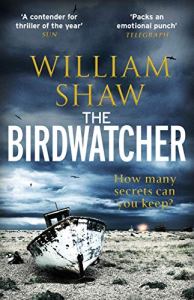
The Birdwatcher by William Shaw

I read The Birdwatcher by William Shaw in the summer and didn’t get round to reviewing it. So, this is a short post summarising what I thought about it.

I enjoyed this book, set in Dungeness on the Kent coast. Sergeant William South is a birdwatcher a methodical and quiet man. Very much a loner, South is not a detective and has always avoided investigating murder. But he does have one friend, a fellow birdwatcher, Bob Rayner and one morning he finds Bob has been brutally beaten to death. DS Alexandra Cupidi, a new CID officer, is leading the investigation and Shaw is reluctantly assigned to her team. Having recently moved from London she relies on William for his knowledge of the area.

Alternating with the present day story is the story of Billy, a thirteen year old living in Northern Ireland during the ‘Troubles’. And hidden within that story is the reason for South’s reluctance to investigate murders. Life becomes uncomfortable for South as Cupidi takes over his house for the base for their investigation and also lands him with the responsibility of entertaining her troubled teenage daughter, Zoe after school – he introduces her to birdwatching.

Shaw is an excellent storyteller and I liked his writing style. This is very much a character-driven mystery as the suspense builds to a climax and his description of Dungeness, with its wind-swept shingle beach close to the Nuclear Power Station and Romney Marsh provides an atmospheric and vivid backdrop. I liked William, and was irritated by Alexandra. So I’m pleased to discover that this is a prequel to Shaw’s DS Alexandra Cupidi series. Currently there are five books, with the sixth to be published next year, so I have plenty more to read.

  • File Size : 3045 KB
  • Print Length : 337 pages
  • Publisher : Riverrun (19 May 2016)
  • Source: I bought it
  • Rating: 5*

My Friday Post: A Journal of the Plague Year by Daniel Defoe

Every Friday Book Beginnings on Friday is hosted by Gillion at Rose City Reader where you can share the first sentence (or so) of the book you are reading. You can also share from a book you want to highlight just because it caught your fancy.

Today my book beginning is from A Journal of the Plague Year: being observations or memorials of the most remarkable occurrences, as well public as private, which happened in London during the last great visitation in 1665 by Daniel Defoe, one of my TBRs. Now would seem to be the right time to read it.

It was about the beginning of September, 1664, that l, among the rest of my neighbours, heard in ordinary discourse that the plague was returned again in Holland; for it had been very violent there, and particularly at Amsterdam and Rotterdam, in the year 1663, whither they say it was brought, some said from Italy, others from the Levant, among goods which were brought home by their Turkish fleet; others said it was brought from Canada; others from Cyprus.

Also every Friday there is The Friday 56, hosted by Freda at Freda’s Voice. *Grab a book, any book. *Turn to Page 56 or 56% on your  ereader . If you have to improvise, that is okay. *Find a snippet, short and sweet, but no spoilers!

These are the rules:

  1. Grab a book, any book.
  2. Turn to page 56, or 56% on your eReader. If you have to improvise, that is okay.
  3. Find any sentence (or a few, just don’t spoil it) that grabs you.
  4. Post it.
  5. Add the URL to your post in the link on Freda’s most recent Friday 56 post.
  1. Grab a book, any book.
  2. Turn to page 56, or 56% on your eReader. If you have to improvise, that is okay.
  3. Find any sentence (or a few, just don’t spoil it) that grabs you.
  4. Post it.
  5. Add the URL to your post in the link on Freda’s most recent Friday 56 post.

On page 56 Defoe is describing the work of the undersexton – the grave digger and bearer of the dead – in the parish of St Stephen, Coleman, who went out along the many alleys and thoroughfares to fetch the bodies a very long way:

Here they went with a kind of hand-barrow and laid dead bodies on it, and carried them to the carts; which work he performed and never had the distemper [the plague] at all, but lived about twenty years after it, and was sexton of the parish to the time of his death. His wife at the same time was a nurse to infected people, and tended many who died in the parish, being for her honesty recommended by the parish officers; yet she was never infected either.

Defoe went on to describe how the sexton and his wife protected themselves against the infection. He held garlic and rue in his mouth and smoked tobacco. His wife’s remedy was to wash her head in vinegar and she sprinkled her head-clothes with vinegar – if the smell was particularly offensive she snuffed vinegar up her nose and held a handkerchief wetted with vinegar to her mouth.

Blurb:

In 1665 the plague swept through London, claiming over 97,000 lives. Daniel Defoe was just five at the time of the plague, but he later called on his own memories, as well as his writing experience, to create this vivid chronicle of the epidemic and its victims. ‘A Journal’ (1722) follows Defoe’s fictional narrator as he traces the devastating progress of the plague through the streets of London. Here we see a city transformed: some of its streets suspiciously empty, some – with crosses on their doors – overwhelmingly full of the sounds and smells of human suffering. And every living citizen he meets has a horrifying story that demands to be heard.

Top Ten Tuesday: Long Book Titles

This week’s top is Long Book Titles. Here are some of the longest book titles I’ve reviewed on this blog. It appears that non-fiction books lend themselves more to long titles than fiction as six of them are non-fiction –

  1. 100 Days on Holy Island: a Writer’s Exile by Peter Mortimer – a record of his experience of living on the island of Lindisfarne.
  2. The Abbess of Whitby: a novel of Hild of Northumbria by Jill Dalladay – Hild was born in 614 and died in 680.
  3. Alive, Alive Oh! And Other Things That Matter by Diana Athill – her memories, thoughts and reflections on her life as she approaches her 100th year (she was born in 1917).
  4. Books, Baguettes and Bedbugs: the Left Bank World of Shakespeare & Co by Jeremy Mercer – a memoir of the author’s refuge at the Paris bookshop, Shakespeare & Co. on the banks of the River Seine opposite Notre Dame. 
  5. Dandy Gilver and the Proper Treatment of Bloodstains by Catriona McPherson – crime fiction set in Edinburgh in 1926.
  6. Our Longest Days: A People’s History of the Second World War by the writers of Mass Observation – absolutely fascinating, this is a collection from diaries kept during the War.
  7. Quiet: The Power of Introverts in a World That Can’t Stop Talking by Susan Cain – I loved this book, an ideal book to read for both introverts and extroverts.
  8. Three Men in a Boat (to say nothing of the dog) by Jerome K Jerome –  a gentle witty book that kept me entertained all the way through.
  9. When the Lights Went Out: Britain in the Seventies by Andy Beckett – an excellent book, using original material such as diaries, letters, personal memoirs as well as books written about the period.
  10. The Woman Who Walked into the Sea by Mark Douglas-Hume – I don’t think this quite lived up to The Sea Detective, the first Cal McGill book. Cal is an oceanographer using his skills in tracking human bodies and sea-borne objects.