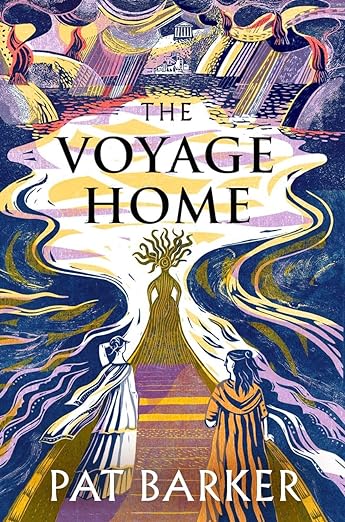
The Voyage Home by Pat Barker

Penguin| 22 August 2024 | 290 pages|e-book | Review copy| 4*

Description on Amazon UK:

After ten blood-filled years, the war is over. Troy lies in smoking ruins as the victorious Greeks fill their ships with the spoils of battle.

Alongside the treasures looted are the many Trojan women captured by the Greeks – among them the legendary prophetess Cassandra, and her watchful maid, Ritsa. Enslaved as concubine – war-wife – to King Agamemnon, Cassandra is plagued by visions of his death – and her own – while Ritsa is forced to bear witness to both Cassandra’s frenzies and the horrors to come.

Meanwhile, awaiting the fleet’s return is Queen Clytemnestra, vengeful wife of Agamemnon. Heart-shattered by her husband’s choice to sacrifice their eldest daughter to the gods in exchange for a fair wind to Troy, she has spent this long decade plotting retribution, in a palace haunted by child-ghosts.

As one wife journeys toward the other, united by the vision of Agamemnon’s death, one thing is certain: this long-awaited homecoming will change everyone’s fates forever.

My thoughts:

This is the third book in Pat Barker’s The Women of Troy trilogy. I loved the first two books, The Silence of the Girls and The Women of Troy both of which are based on Homer’s Iliad and Virgil’s Aeneid, so I was very keen to read The Voyage Home. I wasn’t disappointed but it is slightly different in that this third book is loosely based on the first part of Aeschylus’s Oresteia. The first two books are narrated by Briseis, who had been given to Achilles as a war prize, whereas Ritsa, a fictional character, replaces her as the narrator in the third book, which took me by surprise. I had been anticipating it would be Briseis again.

At the end of the Trojan War the Greeks and their prisoners eventually set sail for home. For King Agamemnon that is Mycenae, where Clytemnestra, his wife is waiting for him. But she is plotting his murder to avenge his sacrifice of her daughter Iphigenia to appease the Gods and gain a fair wind to sail to Troy. After ten years she is still full of grief and rage, her determination to kill Agamemnon is stronger than ever.

Also in the same boat are the captured Trojan women including Cassandra, a princess of Troy, a daughter of Priam and Helen’s half sister. All I knew of her before is that she was a prophetess, whose prophecies were never believed. She’s a strong, beautiful woman but a very fragile character, often ranting and raving. She is demented, and manic, who Ritsa says is ‘as mad as a box of snakes’. Ritsa, her slave calls herself Cassandra’s ‘catch fart’.

The first part of the book covers their voyage to Mycenae and the second part is about what happened when they arrived. Barker doesn’t pull her punches. This is a well written, brutal, bloody tale of revenge told in a modern, colloquial style, and full of grim detail of horror and squalor. Most of the characters are unlikable, with the exception of Ritsa. I think the best book of the trilogy is The Silence of the Girls, but I did enjoy The Voyage Home.

My thanks to NetGalley and Penguin, the publishers for the ARC.

WWW Wednesday: 18 September 2024

WWW Wednesday is run by Taking on a World of Words.

The Three Ws are:

What are you currently reading?
What did you recently finish reading?
What do you think you’ll read next?

Currently I’m reading Regeneration by Pat Barker, the first in her Regeneration Trilogy, set during the First World War.

Description on Goodreads:

Craiglockhart War Hospital, Scotland, 1917, and army psychiatrist William Rivers is treating shell-shocked soldiers. Under his care are the poets Siegfried Sassoon and Wilfred Owen, as well as mute Billy Prior, who is only able to communicate by means of pencil and paper. Rivers’s job is to make the men in his charge healthy enough to fight. Yet the closer he gets to mending his patients’ minds the harder becomes every decision to send them back to the horrors of the front. Pat Barker’s Regeneration is the classic exploration of how the traumas of war brutalised a generation of young men.‘One of the strongest and most interesting novelists of her generation’ Guardian Regeneration is the first novel in Pat Barker’s essential trilogy about the First World War. Discover the whole Regeneration, The Eye in the Door and The Ghost Road

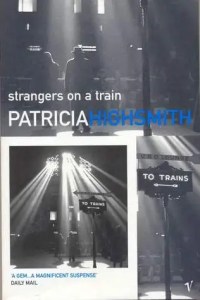
The last book I read was Strangers on a Train by Patricia Highsmith. This is the only book left I didn’t finish reading for my 20 Books of Summer Challenge 2024. It had been on my TBR list for a few years, so I was determined to read it. The reason I haven’t read it before is that I have a paperback copy and I’ve got too used to reading on my Kindle with the ability to enlarge the text.

I had high hopes that this psychological thriller was going to be good as so many people had enthused over it. Could it live up to all the hype? Guy Haines and Charles Anthony Bruno meet on a train. Bruno manipulates Guy into swapping murders with him. “Some people are better off dead,” Bruno remarks, “like your wife and my father, for instance.” It began very slowly and I’m sorry to say that I began to get bored, in fact I almost abandoned it. But I persevered and it did improve towards the end. But it didn’t live up to all the hype for me – maybe the wrong book at the wrong time. I’ll be writing more about this book.

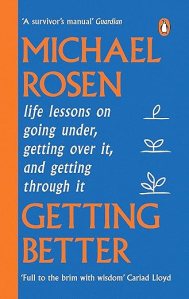
What will I read next? At the moment I’m not at all sure. It could be Getting Better: Life lessons on going under, getting over it, and getting through it by Michael Rosen.

Description on Amazon:

In our lives, terrible things may happen. Michael Rosen has grieved the loss of a child, lived with debilitating chronic illness, and faced death itself when seriously unwell in hospital. In spite of this he has survived, and has even learned to find joy in life in the aftermath of tragedy.

In Getting Better, he shares his story and the lessons he has learned along the way. Exploring the roles that trauma and grief have played in his own life, Michael investigates the road to recovery, asking how we can find it within ourselves to live well again after – or even during – the darkest times of our lives. Moving and insightful, Getting Better is an essential companion for anyone who has loved and lost, or struggled and survived
.

Or it could be something else.

The Grave Tattoo: Book Beginnings & The Friday 56

Every Friday Book Beginnings on Friday is hosted by Gillion at Rose City Reader where you can share the first sentence (or so) of the book you are reading. You can also share from a book you want to highlight just because it caught your fancy.

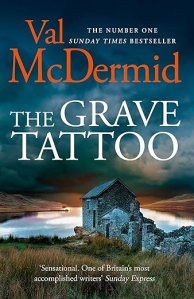
I’m featuring The Grave Tattoo by Val McDermid, a book I’m currently reading.

The Prelude

All landscapes hold their own secrets.

Chapter One:

Jane Gresham stared at what she had written, then with an impatient stroke of her pen crossed it through so firmly the paper tore and split in the wake of a nib. Bloody Jake, she thought angrily.

Also every Friday there is The Friday 56, hosted by Freda at Freda’s Voice, but she is taking a break and Anne at My Head is Full of Books has taken on hosting duties in her absence. You grab a book and turn to page 56 (or 56% of an eBook), find one or more interesting sentences (no spoilers), and post them.

‘The black tattoos. They’re the sort that sailors used to get in the South Seas back in the old days when sailing ships put in at the islands to take on stores and trade with the natives,’ Jake explained.

Description

The award-winning and Number One bestselling Val McDermid crafts an electrifying psychological suspense thriller that mixes history, heritage and heinous crimes.

A 200 year-old-secret is now a matter of life and death.And it could be worth a fortune.

It’s summer in the Lake District and heavy rain over the fells has uncovered a bizarrely tattooed body. Could it be linked to the old rumour that Fletcher Christian, mutinous First Mate on the Bounty, had secretly returned to England?

Scholar Jane Gresham wants to find out. She believes that the Lakeland poet William Wordsworth, a friend of Christian’s, may have sheltered the fugitive and turned his tale into an epic poem – which has since disappeared.

But as she follows each lead, death is hard on her heels. The centuries-old mystery is putting lives at risk. And it isn’t just the truth that is waiting to be discovered, but a bounty worth millions …

My favourite genres are crime fiction and historical fiction. So, the combination of the two really appeals to me. What do you think, does this book appeal to you? What are you currently reading?

Hemlock Bay by Martin Edwards

Head of Zeus — an Aries Book| 12 September 2024 | 372 pages|e-book | Review copy| 4*

Description from Amazon UK:

Basil Palmer has decided to murder a man called Louis Carson. There’s only one he doesn’t know anything about his intended victim, not who he is or where he lives.

Basil learns that Carson owns Hemlock Bay, a resort for the wealthy and privileged. Knowing that his plan will only work if he covers his tracks, he invents a false identity and, posing as Dr Seamus Doyle, journeys to the coast plotting murder along the way.

Meanwhile Rachel Savernake buys an intriguing painting of a place called Hemlock Bay, one that she cannot get out of her head. Macabre and strange, the image shows a shape that seems to represent a dead body lying on the beach.

Convinced that there is something sinister lurking amongst the glamour of the bay, Rachel books a cottage there – where she meets a mysterious doctor called Seamus Doyle…

My thoughts:

This is the 5th Rachel Savernack book, written in the style of the golden age of crime. I loved the first two books in the series but somehow managed to miss the next two. I had high expectations for Hemlock Bay and certainly wasn’t disappointed as I thoroughly enjoyed it.

Like the other two Rachel Savernack books this is also a complex mystery, with several strands and plenty of twists and misdirections. It begins with a Prologue. It is July 1930 as an unnamed couple in a basement room in Temple, London hear a newspaper vendor announce the death of Sir Arthur Conan Doyle. They are discussing death, ending as the man lifts a revolver and squeezes the trigger. Then in January 1931 Basil Palmer makes a New Year resolution – to murder a man he has never met, Louis Carson. But he doesn’t know where he lives, nor what he looks like. This sets in motion a sequence of events, involving numerous people, all with their own agendas, all gathered together in Hemlock Bay.

Hemlock Bay is a seaside resort on the north-west coast of Lancashire. It was originally just ‘a small bay with a splendid beach, flanked by a stretch of sheer cliffs on one side and a tiny secluded cove on the other side of the steep headland‘ and on ‘a treacherous outcrop of rock was an old lighthouse‘. J M W Turner had visited the Bay on a sketching trip and said it was ‘as pretty as Paradise‘. In the past, ships were often wrecked on the shore and contraband was smuggled through a maze of underground passages. But after the end of the First World War it had been developed into a small and select seaside resort. Pleasure Grounds had been built on Hemlock Head, with provision for dancing and all sorts of amusements, known as Paradise, adopting Turner’s description. Jackson, a speculator, and his wife had bought the resort and then opened a new venture, the Hemlock Sun and Air Garden, a nudist club.

Rachel Savernack is intrigued by a surrealist painting of Hemlock Bay depicting a body stretched out below the lighthouse. She and Jacob Flint go to Hemlock Bay, where among others, she meets Virginia Penrhos, the woman who painted the picture, a reclusive doctor named Seamus Doyle, a man named Louis Carson and Basil Palmer under an assumed name. It’s a well plotted novel with interesting characters in a beautiful setting.

Martin Edwards’ Author’s Note at the end of the book is interesting, explaining that although Hemlock Bay is a fictional place it is based on Heysham in Lancashire, overlooking Morecombe Bay (where I enjoyed several holidays as a child). The information in the Heritage Centre in Heysham helped him with the description of Paradise. And the ‘Cluefinder’ at the back of the book listing hints and clues is most enlightening. But I resisted the temptation to read it before I read the book. It is a baffling and most enjoyable murder mystery.

My thanks to NetGalley and Head of Zeus — Aries Fiction, the publishers for the ARC.
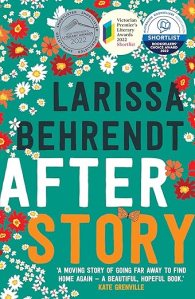
Six Degrees of Separation from  After Story by Larissa Behrendt to The Butterfly Room by Lucinda Riley

It’s time again for Six Degrees of Separation, a monthly link-up hosted by Kate at Books Are My Favourite and Best. Each month a book is chosen as a starting point and linked to six other books to form a chain. A book doesn’t need to be connected to all the other books on the list, only to the one next to it in the chain.

This month starts  After Story by Larissa Behrendt. This is the description on Amazon UK:

When Indigenous lawyer Jasmine decides to take her mother, Della, on a tour of England’s most revered literary sites, Jasmine hopes it will bring them closer together and help them reconcile the past. Twenty-five years earlier the disappearance of Jasmine’s older sister devastated their tight-knit community. This tragedy returns to haunt Jasmine and Della when another child mysteriously goes missing on Hampstead Heath. As Jasmine immerses herself in the world of her literary idols – including Jane Austen, the Brontë sisters and Virginia Woolf – Della is inspired to rediscover the wisdom of her own culture and storytelling. But sometimes the stories that are not told can become too great to bear. Ambitious and engrossing, After Story celebrates the extraordinary power of words and the quiet spaces between. We can be ready to listen, but are we ready to hear?

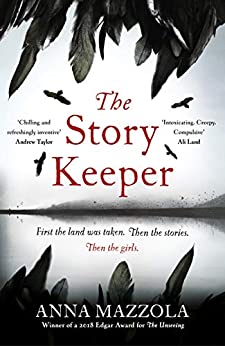
My first link is using the word Story, in the title, and it’s also a book about storytelling – The Story Keeper, set on the Isle of Skye in 1857, by Anna Mazzola. It stresses the importance of folk tales – stories that have been told to make sense of the world and reflect people’s strengths, flaws, hopes and fears. 

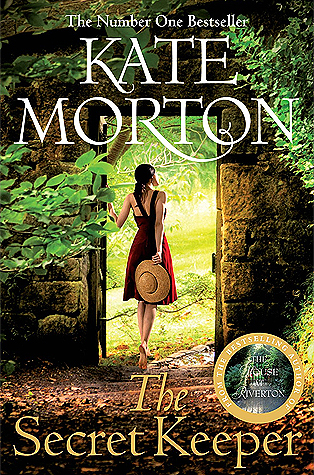
My second link is The Secret Keeper by Kate Morton, a story moving between time periods from 2011, back to the 1960s and also to the 1940s. It begins in 1961 in Suffolk when sixteen-year old Laurel is shocked when she sees her mother stabbing a stranger who had come to their farm. 

In my third link another sixteen year old girl, Nouf ash-Shrawi, disappears from her home in Jeddah, in The Night of the Mi’raj by Zoë Ferraris, just before her arranged marriage. Her body is eventually found in a desert wadi. It appears that her death was an accident and that she died by drowning in the wadi after a sudden storm.

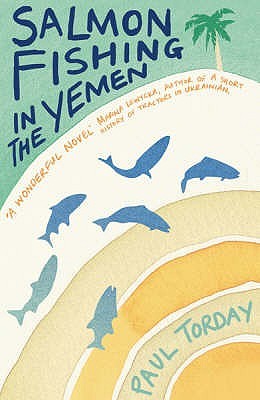
My fourth link is Salmon Fishing in the Yemen by Paul Torday about a project to introduce salmon fishing in the waters of the Wadi Aleyn in the heart of the mountains of Heraz, in Yemen.

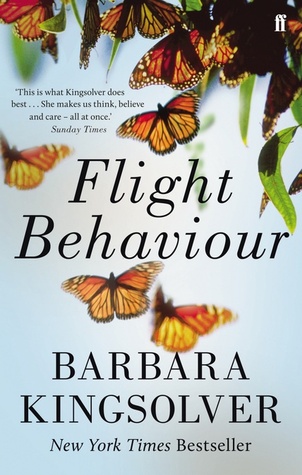
My fifth link takes the chain from the mountains of Heraz to the Appalachian Mountains in Flight Behaviour by Barbara Kingsolver in which a young mother discovers a beautiful and terrible marvel of nature: the monarch butterflies have not migrated south for the winter that year.

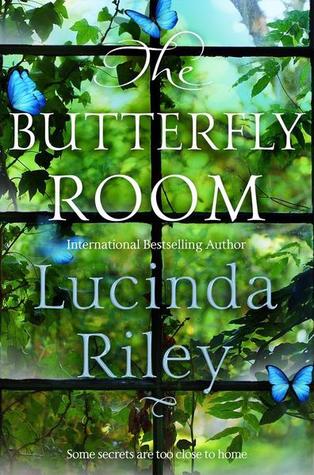
My final link is to The Butterfly Room by Lucinda Riley. The story revolves around Posy Montague and her family home, Admiral House in the Suffolk countryside. Her father encouraged her to draw plants and showed her how to catch butterflies. As a child Posy thought The Butterfly Room in the Folly in the grounds of Admiral House  looked like a fairy-tale castle with its turret made of yellow sandy brick. But the Folly was not the wonderful place she imagined – and there is a dark secret hidden behind its locked door.

The books in my chain are all fiction including historical fiction, mysteries and crime fiction. The chain travels through Australia, the UK, Saudi Arabia, Yemen and the USA,

Next month (October 5, 2024), we’ll start with Colm Tóibín’s Long Island.

WWW Wednesday: 4 September 2024

WWW Wednesday is run by Taking on a World of Words.

The Three Ws are:

What are you currently reading?
What did you recently finish reading?
What do you think you’ll read next?

Currently I’m reading Strangers on a Train by Patricia Highsmith. This is the only book left I didn’t finish reading for my 20 Books of Summer Challenge 2024. It has been on my TBR list for a few years, so I am determined to read it soon. The reason I haven’t read it before now is that I have a paperback copy and I’ve got too used to reading on my Kindle with the ability to enlarge the text.

I have high hope that this psychological thriller will be good – maybe too high as so many people have enthused over this book. Can it live up to all the hype? Guy Haines and Charles Anthony Bruno meet on a train. Bruno manipulates Guy into swapping murders with him. “Some people are better off dead,” Bruno remarks, “like your wife and my father, for instance.” It begins slowly though and so far, I’m doubtful it will.

I’m also reading Now You See Them by Elly Griffiths, the 5th Brighton Mystery novel, also called the DI Edgar Stephens and Max Mephisto series. It’s about three young women who have gone missing in Brighton. Edgar is now a Superintendent and his wife, Emma, formerly a police officer, is now a private detective. Edgar’s friend, magician Max Mephisto, is reinventing himself as a movie star and trying not to envy his daughter Ruby’s television fame. It seems a bit pedestrian so far, maybe too formulaic.

The last book I read was The Tree of Hands by Ruth Rendell, which I think is one of her best books I’ve read. It’s also a psychological thriller and compelling that I just didn’t want to stop reading until I finished it.

Description on Amazon

When Benet was about fourteen, she and her mother had been alone in a train carriage – and Mopsa had tried to stab her with a carving knife.

It has been some time since Benet had seen her psychologically disturbed mother. So when Mopsa arrives at the airport looking drab and colourless in a dowdy grey suit, Benet tries not to hate her.

But when the tragic death of a child begins a chain of deception, kidnap and murder in which three women are pushed to psychological extremes, family ties are strained to the absolute limit…

What will I read next? At the moment I have no idea. Once I’ve finished a challenge that involves reading from a planned list I have this great sense of freedom, that I can just decide on a whim what to read next.