No Stranger to Death by Janet O'Kane

No Stranger to DeathMy thanks to Janet O’Kane for sending me a copy of her book,  No Stranger to Death, which I really enjoyed reading.  Once I’d started it I just wanted to keep on reading. I was surprised by how intricate and complex the plot is, with several sub-plots and a crowd of characters, all of whom are clearly defined. Set in the Scottish Borders, it also has a strong sense of location and it was refreshing to read a Scottish crime novel that is not set in Edinburgh, Glasgow or even in Shetland. It’s a fast-paced novel that kept me on the edge wanting to find out more.

No Stranger to Death begins with recently widowed Dr Zoe Moreland’s discovery of a body in the remains of a Guy Fawkes bonfire. Westerlea, a fictional village, is a place where everybody knows everyone, but even so it seems everyone has something to hide.  Zoe is new to the village, having moved from there from England to join the Health Centre as a GP and with the help of her new friend, Kate Mackenzie, she soon finds herself in the middle of a murder investigation. This is not a police procedural, although Detective Erskine Mather of Police Scotland is in charge of the investigation.

It’s not only the villagers who have secrets, as there is something in Zoe’s background that she wants to keep to herself and getting involved in a murder investigation is the last thing she wanted:

She had gone back to using her maiden name when she came to Scotland, but would that protect her against people whose job it was to dig up the past of anyone remotely connected with a sensational crime? (page 29)

As Zoe and Kate dig deeper quite a few nasty secrets come to light with almost disastrous consequences and Zoe is in fear of her own life. No Stranger to Death touches on some quite dark themes with an ending that took me by surprise.

Janet O’Kane lives in the Scottish Borders and she is currently writing a follow up to No Stranger to Death, again featuring Zoe Moreland. For more information see her blog – Janet O’Kane: Crime Fiction with a Heart and her Facebook page.

As well as being a really good book in its own right, No Stranger to Death meets the criteria for both the Read Scotland 2014 challenge and the My Kind of Mystery challenge.
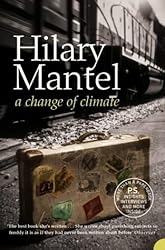
First Chapter First Paragraph: A Change of Climate

Every Tuesday Diane at Bibliophile by the Sea hosts First Chapter First Paragraph Tuesday Intros, where you can share the first paragraph, or a few, of a book you are reading or thinking about reading soon.

Today’s choice is A Change of Climate by Hilary Mantel, a book I’ve borrowed from my local library. It begins:

1970

SAD CASES, GOOD SOULS

One day when Kit was ten years old, a visitor cut her wrists in the kitchen. She was just beginning on this cold, difficult form of death when Kit came in to get a glass of milk.

The woman Joan was sixty years old, and wore a polyester dress from a charity shop. A housewifely type, she had chosen to drip her blood into the kitchen sink. When Kit touched her on the elbow, she threw the knife on to the draining board and attempted with her good hand to cover Kit’s eyes.

By this stage in her life Kit was not much surprised by anything. As she ducked under the woman’s arm she thought that’s our bread-knife, if you don’t mind; but she said, ‘You shouldn’t be doing that Joan, why don’t you come away from the sink, why don’t you sit down on this chair and I’ll get a first-aid kit?’

I haven’t read much more than this but these opening paragraphs have made me want to know more about the ‘Good Souls‘ and the ‘Sad Cases‘.

Hilary Mantel’s work is so diverse with books ranging from  personal memoir and short stories to historical fiction and essays. A Change of Climate is one of her early books, first published in 1994, described on the back cover as ‘a literary family saga’ and ‘a first rate thriller’

At the end of the book there is an About the Author section, which I’ve just glanced over. In answer to one of the interviewer’s questions about the theme of the book, Hilary Mantel replied that there is a central secret, an enormous destructive secret. I didn’t want to spoil the book for myself so I didn’t read any more of her answers. I’ll read the book to find out what that secret is.

What do you think? Would you keep reading?

Classics Club: the May Question


This month the Classics Club question is about which classics we might be avoiding:

Which classic work has caused you to become a master in avoidance? It’s not necessarily because you’re intimidated but maybe there are works out there that just cause you to have the Dracula reaction: cape-covered arm up in front of face with a step back reaction?

To answer this question I’m only considering the books on my Classics Club list. They are all books I own and at one time thought that I’d like to read them but I suppose I am avoiding some of them as they never figure when I’m wondering which book to read next. Why am I avoiding them? I’m not really sure. They are usually long books such as:

Don Quixote by Miguel de Cervantes Saavedra – I’ve started to read this a few times and have given up because the printed copy I have is old in a very small font and I think I’d do better with a different (more modern?) translation. But there are so many to choose from – anyone got any recommendations?

Books by Elizabeth GaskellMary Barton, North and South and Wives and Daughters. I really do want to read these, but each time I think about them my mind glazes over and I pick something else. Again they are long books.

Then there is Three Men in a Boat by Jerome K Jerome – this is shorter, but it’s another book I’ve started a couple of times and put down. People say it’s very funny, but I haven’t found it even amusing so far – I should read on, I suppose.

Sometimes it’s just down to the fact that it’s just not the right time for me to read a book.

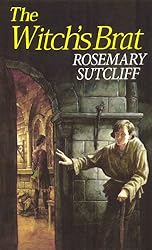
The Witch's Brat by Rosemary Sutcliff

Rosemary Sutcliff was one of my favourite authors when I was a child, but it’s been years since I read any of her books. I came across her children’s book, The Witch’s Brat after reading Mary Delorme’s novel, St Bartholomew’s Man about Rahere, the founder of St Bartholomew’s Hospital. I wanted to know more about Rahere and discovered that he featured in Rosemary Sutcliff’s book set in 12th century England.
The Witch’s Brat, first published in 1971, tells the tale of Lovel, a boy born crippled with a twisted leg and crooked shoulder, but also with a gift for healing. His grandmother was the local Wise Woman whom people feared thinking she was a witch, and after she died he was driven from his village in a shower of stones, both because he was her grandson and because he was a cripple. He is taken in by the monks at a priory and it is here that he meets Rahere, who encourages him to be a healer. This is how Rahere looked when Lovel first met him:

Lovel gazed with his mouth open in awed delight at this mad and magnificent man with the monk’s face and the cool mocking voice and long fantastic legs like a crane fly, who spoke English, but in such splendid and far-off words that much of it was as far beyond his reach as the Norman French spoken by most of the knights and wealthy travellers who passed that way, and by some of the brethren among themselves. (page 29)

It’s a beautifully written little book (112 pages), full of period detail, including herbal lore and vivid imagery. Like St Bartholomew’s Man it’s about the building of St Bartholomew’s Hospital, but seen through Lovel’s eyes instead of through Rahere’s. As well as being historical fiction, this book is about overcoming prejudice and and disability. Rahere is seen as a charismatic character, an inspiration to Lovel, a man who thought there must be more to life than entertaining a king and who vowed to raise an infirmary, a hospital for the poor sick.

This a ‘feel good’ book that is a delight to read.

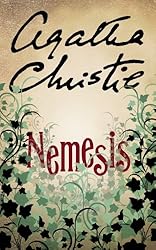
Nemesis by Agatha Christie

Nemesis first published in 1971, is one of Agatha Christie’s later books written in her eighties. It is the last book she wrote about Miss Marple. There are two more books that were published later, but those were written earlier. It’s not among the best of her books, it’s slow moving, lots of dialogue, lots of recapping of events and clues, lots of moralising and social commentary. It follows on, although it is not a sequel to, A Caribbean Mystery in which Miss Marple met Mr Rafiel.

It’s slow moving because for quite a while Miss Marple doesn’t know what the crime is that she has been asked to investigate. Mr Rafiel, who she met in the West Indies, has left her £20,000 in his will on condition she investigates a certain crime, but doesn’t give her any details. He wrote that she had a natural flair for justice leading to a natural flair for crime and reminded her that the code word is Nemesis. Then she is invited to join a tour of Famous Houses and Gardens of Great Britain at Mr Rafiel’s expense. And off she goes.

As Miss Marple remarks:

Murders as reported in the press have never claimed my attention. I have never read books on criminology as a subject or really been interested in such a thing. No, it has just happened that I have found myself in the vicinity of murder rather more often than would seem normal. (page 90)

What an understatement!

Miss Marple has to first of all work out who she can trust.Very gradually through meeting people and talking to them in her usual rather scatty old-lady manner Miss Marple begins to uncover a crime committed years earlier, working largely on intuition. During this process Miss Marple ponders on a number of subjects from wondering how the three witches in Macbeth should be portrayed, during the visit Mr Rafiel had arranged for her with the three sisters at the Old Manor House, to her disapproval of the clothes young women wore. I suspect this was Agatha Christie using Miss Marple as a mouthpiece for her own views – just as this view of rape expressed by  another character, Professor Wanstead, a friend of Mr Rafiel may be her own thoughts too:

Girls you must remember, are far more ready to be raped nowadays than they used to be. Their mothers insist, very often, that they should call it rape. (page 182)

But I wondered about the whole premise of the book – would someone really ask a person to investigate a crime and not give them any details?  It seems highly improbable to me even if Mr Rafiel had wanted Miss Marple to approach the crime with an open mind. And surely if Mr Rafiel really wanted to discover the true facts about the crime he could easily have done so before he died.

I think Nemesis lacks tension and suspense. The characters are rather hard to differentiate, mainly because there are too many, and too many who have no part in the mystery. There are few red herrings to deflect the reader, just unexplained facts that Miss Marple clears up in the last chapters. But I think it is an unusual book and I quite enjoyed it.

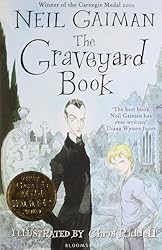
The Graveyard Book by Neil Gaiman

Neil Gaiman is one of those authors I keep reading about on other book blogs and I’ve been meaning to check out one of his books for ages just to see for myself. I didn’t think his books were probably the sort I’d like as I rarely read children’s or Young Adult books. Then recently I saw The Graveyard Book on display in my local library, my eye was caught by the cover, and I was curious enough to find out what makes Gaiman such a popular author, encouraged by the blurb from Diana Wynne Jones declaring: ‘The best book Neil Gaiman has ever written.’

When I began reading I wondered if is this book really is for children – it’s so scary:

There was a hand in the darkness, and it held a knife. The knife had a handle of polished black bone, and a blade finer and sharper than any razor. If it sliced you, you might not even know you had been cut, not immediately.

The knife had done almost everything it was brought to that house to do, and both the blade and the handle were wet. (page 3)

The Graveyard Book won the Newbery Medal and the Booktrust Teenage Book Prize 2009, and was nominated for both the 2010 Carnegie Award and the Kate Greenaway Award.

Intrigued I read on and I was soon hooked into the story of the baby who escapes a murderer (the man Jack) intent on killing his entire family, and who stumbles into the local disused graveyard where he is rescued by ghosts. Think of The Jungle Book but with ghosts looking after the baby rather than animals – and Neil Gaiman acknowledges his debt to Rudyard Kipling’s book. And like The Jungle Book, The Graveyard Book is episodic. The baby, named by the ghosts, Nobody Owens, or Bod for short, grows up looked after by his adoptive parents Master and Mistress Owens who had been dead for a few hundred years and numerous other occupants of the graveyard.

I was fascinated by this fantasy, coming of age novel. Bod is given the Freedom of the Graveyard and educated by the ghosts, learning all sorts of strange and wonderful things, such as the ability to fade from sight. Silas, who is neither dead nor alive appoints himself as his guardian, helped by Miss Lupescu, who is not what she first appears to be. He is only safe if he doesn’t leave the graveyard and of course as he grows up that is what he really longs to do.

It’s creepy, but never gory. There are ghouls as well as ghosts, ancient ghosts predating Christianity, a particularly scary pre-historic tomb guarded by the slithering Sleer awaiting the return of the ‘Master’ and a young witch, Liza buried in the unconsecrated section of the graveyard. Needless to say, Bod has many adventures before his past catches up with him.

Apart from the fantastic characters, all of which I could easily believe to be ‘real’, the graveyard itself is so well described that I had no difficulty imagining what it looked like, so I wasn’t surprised to see in the Acknowledgements that Audrey Niffennegger had shown Gaiman around Highgate Cemetery West.  I like all the details of the epigraphs on the headstones – in particular Mother Slaughter’s headstone. It is so ‘cracked, worn and weathered that all it now said was: LAUGH – which had puzzled the local historians for over a hundred years.

The Graveyard Book is ultimately about life and death, love and friendship, loyalty and the fight between good and evil. There is humour, sadness and suspense. Above all it is about growing up and the excitement and expectations that Bod has about life:

Bod said, ‘I want to see life. I want to hold it in my hands. I want to leave a footprint on the sand of a desert island. I want to play football with people. I want’, he said, and then he paused and he thought. ‘I want everything.’ (page 286)

It is an ideal book for Carl’s Once Upon A Time VIII challenge (my 4th book). I’ll certainly read more of Neil Gaiman’s books.