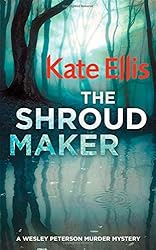
The Shroud Maker by Kate Ellis

When I saw The Shroud Maker by Kate Ellis in the mobile library I thought I’d seen reviews of her books on other blogs, so I borrowed it. It is the eighteenth Wesley Peterson Mystery, but I think it reads well without knowing the background to the main characters. Although I suppose if I went back in the series I’d find that I know things that maybe I shouldn’t.

Summary:

It’s the Palkin Festival in Tradmouth, a town in Devon, when the body of a strangled women is discovered floating out to sea in a dinghy. A year earlier Jenny Bercival had disappeared from the festival and her mother returns to look for her bringing with her anonymous letters claiming she is still alive. DI Wesley Peterson and his boss DCI Gerry Heffernan are investigating the two cases. Are they connected and is there a link to a fantasy website called ‘Shipworld’ which features the 14th century mayor and privateer of Tradmouth, Palkin as a supernatural hero with a sinister, faceless nemesis called the ‘Shroud Maker’?

 When Wesley’s friend, archaeologist Neil Watson finds a skeleton on the site of Palkin’s warehouse, the question is whether an ancient crime has been uncovered, or is it Jenny’s body?

My view:

I liked the way the historical mystery intertwines with the modern one, through the archaelogical evidence, and the extracts from a 19th century biography of John Palkin written by his descendant, Josiah Palkin-Wright and letters from Josiah’s wife to her sister, worried about her marriage and that her sister does not reply. Kate Ellis’s style of writing is deceptively simple, so much so that the locations and characters came to life in my mind, whether it was Tradmouth in the past or the present.

There is plenty of mystery in this novel. I really had to concentrate to keep all the characters, red-herrings, twists and turns, and sub-plots in my mind. I thought I’d followed it as I read it, but now I’m not sure that I can give a clear account of what happened and why. However, as I do like complex mysteries I think I’ll have to look out for the first books in the Wesley Peterson series.

A note on the title:

From the title I thought that the ‘Shroud Maker’ would be a person who makes shrouds ie cloths used to wrap a body for burial, but that is not so in this book. Instead the name of ‘Shroud Maker’ is taken from a rope maker, shrouds being the ropes that support a ship’s masts. He or she is a mysterious figure, who in the Shipworld website appears as a faceless monster, wearing what looks like a white ski mask, a malevolent dark force.

The Author’s Note:

It didn’t take me long reading this book to realise that ‘Tradmouth’ is an inversion of the name of Dartmouth in Devon and Kate Ellis’s note at the end of the book clarifies that. She refers to Geoffrey Chaucer, the author of The Canterbury Tales which features a character called the Shipman, a seaman from ‘Dertemouth’, who like her own invented character, was little better than a pirate. She writes that during the 19th century people were fascinated with the medieval period, perhaps as a reaction against industrialisation and her fictional writings of Josiah Palkin-Wright reflected that interest. And coming up to the present day she reflects that fantasy fiction is as popular today as it ever was, with the influence of J R R Tolkien’s works and fantasy fiction websites.

Reading Challenges: R.I.P. Challenge, the My Kind of Mystery Challenge, and the Historical Fiction Reading Challenge.
Sunday Selection

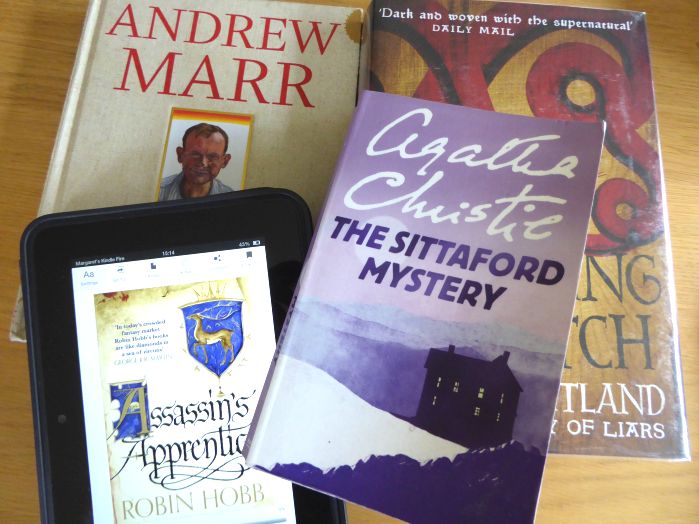
I’m currently reading The Brief History of the Dead by Kevin Brockmeier and Almost Invincible: a biographical novel of Mary Shelley.  But I like to think about the books I’ve got waiting to be read. They are:

  • The Sittaford Mystery by Agatha Christie – set in a remote house in the middle of Dartmoor, a group of six people gather round a table for a séance. The spirits spell out a chilling message of murder. This is an early Agatha Christie book, first published in 1931 and is one I’ve been looking for, for ages.
  • A Short Book about Drawing by Andrew Marr. This is a library book and I have already flipped through it and read little bits. It has colour photos of his paintings along with his ideas about the differences between fine art and drawing, the mechanics of drawing and how drawing and painting can help us to think and see the world differently and so on. It looks fascinating and I’ll read this very soon I think.
  • Assassin’s Apprentice by Robin Hobb – this is free on Kindle at the moment. I know that other book bloggers like Robin Hobbs’ books and I’ve been thinking of trying one myself. This one is the first in the Farseer Trilogy. I’m not sure what to expectIf you’ve read it what do you think?
  • The Vanishing Witch by Karen Maitland. Another library book I’ve borrowed – this one from the mobile library. I loved Company of Liars and The Owl Killers, so I’m expecting great things from this book – I hope I won’t be disappointed. It’s set in the reign of Richard II, the time of the Peasants Revolt, a time of murder and mayhem and when suspicions of witchcraft were high as people started to die unnatural deaths.

The thing is that I want to read them all right now!

The Brimstone Wedding by Barbara Vine

I’ve had The Brimstone Wedding by Barbara Vine sitting on my unread shelves for a while and when the R.I.P. IX Challenge came up I thought it would be a good book to include in the challenge, because the cover blurbs describe it as a ‘horrifying mystery’, ‘chilling’ and with a ‘horrible climax’.

Brimstone wedding

My copy is a second-hand paperback, which is no longer in print, but The Brimstone Wedding is available as an e-book.

Jenny Warner is a carer at a retirement home, Middleton Hall where she meets Stella Newland, who is dying of lung cancer. At first Stella never mentions her husband or her past life, but gradually she confides in Jenny, telling her things she has never said to her son and daughter – things about her life she doesn’t want them to know. 

Their stories intertwine, some narrated by Jenny and some by Stella as she records events in her life on a tape recorder which she leaves to Jenny.  They have more in common than Jenny initially thought and as Stella slowly reveals her past the tension in the book begins to mount.

The atmosphere is mysterious, a house isolated in the fens, seems to hold the key to the past. The description of the house is superb, set in an overgrown garden, with clothes still hanging in the wardrobe, food and champagne still sitting in the fridge and a red Ford Anglia locked in the garage. It’s all very subtle at first with tantalising hints about what had really happened in Stella’s past, but the full horror is left to the end, which by that time I was itching to find out if it was what I suspected it was. I was not disappointed; it’s not horrific in the overblown graphic sense, but in a sinister, psychological way that really is ‘chilling’ and inexpressibly sad.

Ruth Rendell, writing as Barbara Vine, writes beautifully and powerfully yet in a controlled manner, nothing is left out but there are no superfluous characters or sub-plots. Everything ties in well and the subtle horror of what I was reading gripped me. It is indeed a ‘chilling’ book. It’s about love, hate and indifference, about relationships between couples and families, and about obsession, deceit and betrayal.

Here are just a few quotations that I noted as I read. The opening sentences, set the scene and illustrate Jenny’s superstitious nature. Throughout the book there are numerous examples of her beliefs:

The clothes of the dead don’t wear long. They fret for the person who owned them. Stella laughed when I said that. She threw back her head and laughed in the surprisingly girlish way she had. I was telling her Edith Webster had died in the night and left cupboards full of clothes behind her, and she laughed and said she’d never known anyone as superstitious as me. (page 3)

and

When you deceive people you make fools of them. You make them act stupidly, act as if things which are aren’t and things which aren’t are. And that’s what fools do or people who are mentally disturbed and we look down on them for it or if we’re unkind we laugh at them. (page 17)

She is also aware of ill omens – a bird dying in your hand means your hands will shake for ever, it also means a death in the family and red and white flowers mixed are the worst possible omen at a funeral meaning there will be another death. I was wondering what significance the title has: Jenny has been married for thirteen years, which according to her mother is a ‘Brimstone Wedding’ anniversary. Jenny thinks:

Maybe because it’s explosive or because it’s hard and dark like a burning stone, which is what brimstone means. (page 231)

I think The Brimstone Wedding is one of the best of Barbara Vine’s books that I’ve read – nearly as good as A Dark-Adapted Eye and writing under her real name, Ruth Rendell, A Judgement in Stone. It certainly qualifies not only for the R.I.P. Challenge, but also for the Mount TBR Challenge 2014 and the My Kind of Mystery Challenge.

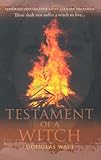
Testament of a Witch by Douglas Watt

Testament of a Witch by Douglas Watt is the second book of his that I’ve read. The first one Death of a Chief I read 5 years ago! Both books are set in late 17th century Scotland (1686 and 1687) and feature a Gaelic speaking, Edinburgh lawyer John MacKenzie and his clerk Davie Scougall. I like the way Douglas Watt incorporates the historical background into the narrative without detracting from the story.

In Testament of a Witch MacKenzie investigates the death of Grissell Hay, Lady Lammersheugh accused of witchcraft in a village overwhelmed by superstition, resentment and puritanical religion. Then the same accusations are made against the Euphame, Grissell’s daughter.  I wasn’t too keen on the horrifying and explicit descriptions of how the witch hunter identified and dealt with women accused of being witches, which involved torture and sleep deprivation, but apart from that I enjoyed this book.

I liked the interaction between Mackenzie, a Highlander and Scougall, a Lowland Scot. Scougall is convinced of the reality of witchcraft, whereas Mackenzie has ‘grave doubts about the crime of witchcraft‘, believing ‘it is nothing more than superstition‘. The religious fervour and political unrest are clearly demonstrated in this book, setting the frenzied persecution of those suspected of witchcraft in context. Watts’ Historical Note on The Scottish Witch-hunt at the end of the book gives the background, when Scottish society was in a state of flux.

Change caused anxiety and fear, unleashing frenzies of witch-hunting . … It has been estimated that the Scottish witch-hunt was ten times more deadly than the English one in terms of executions per head of population. Probably more than a thousand men and women were executed for witchcraft in Scotland during the sixteenth and seventeenth centuries.

The witch-hunt could not have occurred without a widespread belief in magic, charming and divination, and the acceptance of Satan as a real presence in the life of the people.

Witch-hunting declined when the revolutionary zeal of the Scottish Reformation ran out of steam in the late seventeenth century. Scotland began to turn its back on persecution and look towards the more tolerant and commercial age of the Enlightenment.

Testament of a Witch is well-researched and although it gets off to a slow start and I didn’t enjoy it quite as much as Death of a Chief, I was immersed into the fascinating and terifying world of the witch-hunt in 17th century Scotland as I was reading. It’s a book that qualifies both for the Read Scotland 2014 Challenge and this year’s R.I.P. Challenge, as well as the Historical Fiction Challenge and the My Kind of Mystery Challenge.

Douglas Watt is a Scottish historian, poet and novelist, who lives in Linlithgow. He has a PhD in Scottish History from Edinburgh University and is the author of The Price of Scotland, a history of Scotland’s Darien Disaster, which won the Hume Brown Senior Prize in Scottish History in 2008. 

Two R.I.P. IX Books

So far I’ve read five books that fit into the R.I.P. Challenge categories of Mystery, Suspense, Thriller, Dark Fantasy, Gothic, Horror, or Supernatural. As I’m behind with writing about these books here are just a few notes on two of them:

Wycliffe and the House of Fear by W J Burley. Like the other Wycliffe books this is set in Cornwall. Detective Superintendent Wycliffe is on holiday recuperating from an illness when he meets the intriguing Kemp family and visits Kellycoryk, their decaying ancestral home.  The Kemps’ behaviour is odd to say the least and when Roger Kemp’s second wife, Bridget disappears people remember  that his first wife had also disappeared in what had been assumed was a boating accident. Wycliffe is inevitably drawn into the investigation.

I have yet to read a Wycliffe book and be disappointed and this one is no exception. It’s a complex story with sinister undercurrents and good depiction of a dysfunctional family. It kept me guessing almost to the end. This fits into the ‘Mystery’ category.

The next one I read is the short story (just 27 pages), The Yellow Wallpaper by Charlotte Perkins Gilman, which is definitely a suspense story of a young woman slowly but surely losing her mind – or is it a case of a woman suffering from post-natal depression most cruelly treated by her doctor husband? Her husband believes she has just a ‘slight hysterical tendency‘ and prescribes rest and sleep, scoffing at what he considers are her fantasies.
The un-named woman has just had a baby, which she is unable to bear to be near her. She spends most of her time in an attic bedroom, with barred windows and a bed fixed to the floor. The walls are covered in a hideous yellow wallpaper which has been torn off in places. It’s not a beautiful yellow like buttercups but it makes her think of old, foul bad yellow things – and it smells.  The pattern is tortuous and she sees a woman trapped behind the wallpaper as though behind bars, crawling and shaking the pattern attempting to escape. Definitely a creepy and disturbing story!

It reminded me of Marghanita Laski’s The Victorian Chaise-Longue with a similar sense of claustrophobia and helplessness. But The Yellow Wallpaper is much more horrific and by the end I began to question just what was real and what was imagination – it’s psychologically scary!

These two are both books from my to-be-read piles.

Still Catching Up

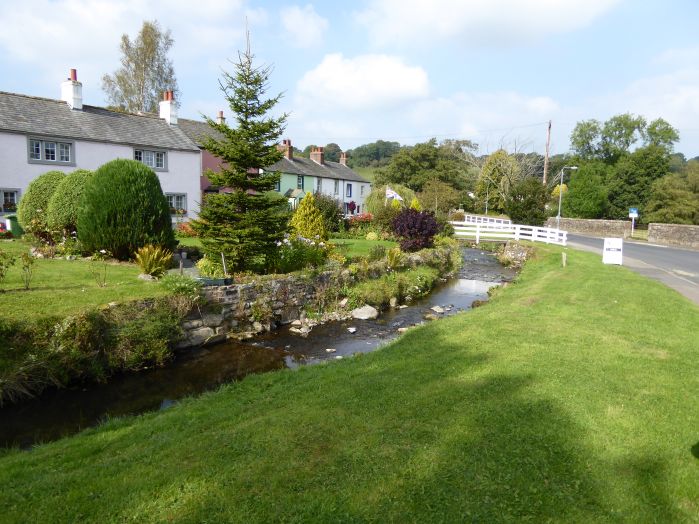
I’ve been missing from my blog for most of September, but I’ve still been reading. We’ve just returned from a  few days in the Lake District – such a beautiful part of the UK!

Caldbeck P1010042
Caldbeck Cumbria

I managed to squeeze in some reading time as well as walking in the fells near Caldbeck and visiting the Pencil Museum in Keswick, Castlerigg Stone Circle, the Honister Pass, Ullswater and Aira Force. I’ll post some photos later on.

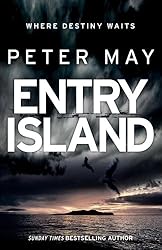
I took two books with me that I had already begun reading and finished one of them – Entry Island by Peter May. I’ve previously read May’s Lewis Trilogy – The Blackhouse, The Lewis Man and The Chessmen all of which I loved and whilst I did enjoy Entry Island I don’t think it quite lives up to the Lewis books. However, as I discovered when I came home this weekend Entry Island has been awarded the third annual Deanston Scottish Crime Book of the Year Award at the Bloody Scotland Crime Writing Festival.

Entry Island is set in present day Magdalen Islands, part of the province of Quebec, in the Gulf of St Lawrence, and in the nineteenth century on the Isle of Lewis at the time of the Highland Clearances.  It mixes together two stories and two genres, crime fiction and historical fiction. It has a strong sense of place in both locations and beautiful descriptions of the landscape as for example in this passage:

It was another ten minutes before the ferry slipped out of the harbour, gliding past the outer breakwater on a sea like glass, to reveal Entry Island in the far distance, stretched out on the far side of the bay, the sun only now rising above a gathering of dark morning cloud beyond it. The island drew Sime’s focus and held it there, almost trancelike, as the sun sent its reflection careening towards him, creating what was almost a halo effect around the island itself. There was something magical about it. Almost mystical. (page 14)

The characters are convincing – Detective Sime Mackenzie, based in Montreal is part of the team sent to Entry Island to investigate the death of the wealthy businessman, James Cowell found stabbed to death. His wife, Kirsty is the obvious suspect. Sime is suffering from insomnia, a situation made worse by the fact that his ex-wife is also on the investigating team. Sime is convinced that he knows Kirsty, although they have never met before and he doubts that she is the culprit. Running parallel to this crime fiction element is the historical one, linked by Sime’s ancestor, also called Sime who was a crofter’s son on the Isle of Lewis and whose love for the laird’s daughter seemed doomed from the start. The story of life on Lewis and the harsh treatment the crofters received during the potato famine, followed by the terrible conditions they endured during their transportation to Canada is powerfully and emotionally portrayed.

The two stories are linked together well, but I found the present day investigation not too convincing and rather contrived as the team seemed to jump to conclusions without much thought or thorough investigation of the evidence. And I thought that the historical element was dominant at the expense of the modern day crime story making the book a little unbalanced. However, as I said I liked the book, which is an entertaining read that held my interest to the end.

Peter May is a prolific author. He was born and brought up in Scotland, but he now lives in France. As well as The Lewis Trilogy he has also written The Enzo Files, a series of seven books featuring Scottish forensic scientist, Enzo MacLeod, who lives in France, teaches at a university in Toulouse, and is working on solving seven of France’s most famous cold cases by applying the latest scientific techniques and The China Thrillers, a series of six books featuring Beijing detective Li Yan and Margaret Campbell, forensic pathologist from Chicago. He has also had a successful career as a television writer, creator, and producer. 

I still have three other books to write about, including my first book for this year’s R.I.P. Challenge, Testament of a Witch, which like Entry Island also qualifies for the Read Scotland 2014 Challenge. Will I ever catch up with myself?