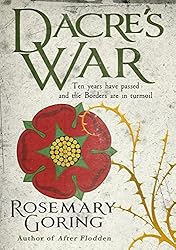
Dacre’s War by Rosemary Goring

Dacre’s War is compelling reading, a  thoroughly absorbing and beautifully written novel set in the Scottish and English Borders and London between 1523 – 1525 some ten years after the events described in Rosemary Goring’s earlier book, After Flodden. I wondered as I began reading whether it could equal After Flodden, a book I loved when I read it two years ago – it did. I think it even surpasses it.

I loved Dacre’s War and keen as I was to read to the end I didn’t want to leave the characters. Once again I was swept away by the story, re-living the scenes through Rosemary Goring’s vivid descriptions and the drama of the characters’ lives, people who came to life in the pages of this book.

Dacre’s War describes how Adam Crozier, the head of his clan, plots to take revenge on Lord Thomas Dacre, the Warden General of the English Marches and the Keeper of Carlisle, who had brought about the death of Adam’s father. Ten years after the Battle of Flodden, Dacre is the most powerful man in the north of England, but the Marches are a constant battlefield, dangerously out of control, and a hotbed of thieves and killers in thrall to the Warden. Without him Henry VIII believes the situation would be much worse.

It is against this background that Crozier forms an alliance with Dacre’s enemies, both English and Scots to inform Henry of Dacre’s crimes and bring about his downfall.

There are some remarkable scenes in this book, and amongst them are the scenes in the Star Chamber where Dacre is brought to answer the charges against him in front of Cardinal Wolsey and his imprisonment in the Fleet Prison. I felt as though I was there, watching, breathing the same air – not a pleasant experience. Similarly with Crozier, I could visualise his home, Crozier’s Keep, sense the tension and fear as his wife, Louise, is left at home, pregnant and in danger of losing the baby.

There is so much packed in this book, political intrigue, personal conflict and vengeance, and spies, manipulators and double crossers abound. It is impossible to write more without revealing the plot and the eventual ending. It’s a brilliant book.

Dacre’s War is due to be published in June 2015. My copy is a pre-publication review copy courtesy of www.lovereading.co.uk.

  • Hardcover: 352 pages
  • Publisher: Polygon (16 June 2015)
  • Language: English
  • ISBN-10: 1846973112
  • ISBN-13: 978-1846973116

Rosemary Goring was born in Dunbar and studied social and economic history at the University of St Andrews; and, after graduation, worked at W&R Chambers as a reference editor. Rosemary was the literary editor of Scotland on Sunday, followed by a brief spell as editor of Life & Work, the Church of Scotland’s magazine, before returning to newspapers as literary editor of the Herald, and later also of the Sunday Herald. In 2007 she published Scotland: The Autobiography: 2000 Years of Scottish History By Those Who Saw it Happen, which has since been published in America and Russia.

Reading Challenges: Read Scotland, Historical Fiction Challenge.

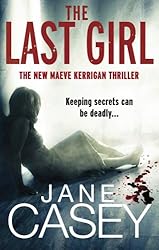
The Last Girl by Jane Casey

I liked the first two Maeve Kerrigan books by Jane Casey, The Burning and The Reckoning and the third, The Last Girl is just as good. I liked it mainly because Maeve is such an interesting character, and the book is fast paced and well written, with a multi-layered plot.

Maeve, a detective constable, is the youngest member of the Met Murder Squad investigating the murders of Vita Kennford and her daughter, Laura, age 14.  Lydia , Laura’s twin sister had found their bodies. Philip her father had walked in on the killer, received a blow to the head and was unconscious.  There are no clues at the scene of the crime and as Lydia was outside swimming at the time she neither saw nor heard anything. Philip is a defence QC known for getting his clients off even if they are guilty and at first Maeve and her boss D I Josh Derwent concentrate their investigations on people who hold a grudge against him. Any one of them seems to have good cause to have taken revenge on his family.

Unlike the earlier books, The Last Girl is narrated throughout by Maeve, so we see the events unfolding entirely through her perspective. Much of the novel centres on the Kennfords and their relationships. They are not a happy family.  Philip is an unreliable husband, regularly  unfaithful, not the sort who liked to be tied down to one woman. He is estranged from Savannah, his daughter from his first marriage. She refuses to speak to him and  Lydia seems withdrawn, reluctant to speak to anyone. Maeve is sure they are all keeping secrets.

And there is a sub-plot that harks back to the second book, The Reckoning,  as the team is also investigating a number of gangland murders. Although this book does stand well on its own I think it helps if you read them in order particularly to follow the development of  Maeve’s relationship with her boyfriend, Rob, also a policeman, now working in a different section – things between them are not going very smoothly and Maeve is having doubts. Meanwhile her working relationships with Derwent and Superintendent Godley are beginning to change as Derwent, a male chauvinist shows his softer side and she challenges Godley’s methods.

Maeve has her suspicions about the culprit, but after a while I began to think she could be  on the wrong lines as I had my doubts about the truthfulness of one particular character. And then it was fairly easy to work out who the culprit was.

I thoroughly enjoyed this book and am looking forward to the next one in the series, The Stranger You Know.

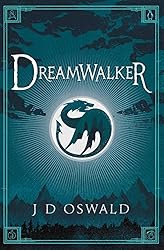
Dreamwalker: The Ballad of Sir Benfro Book 1

Dreamwalker

I read  Dreamwalker: The Ballad of Sir Benfro by James Oswald on my Kindle.  It has since been published by Penguin as Dreamwalker by J D Oswald.

So far there are three books in the series and there will eventually be five books published by Penguin. See James Oswald’s website for more information.

Synopsis from Amazon UK:

In a small village, miles from the great cities of the Twin Kingdoms, a young boy called Errol tries to find his way in the world. He’s an outsider – he looks different from other children and has never known his father. No one, not even himself, has any knowledge of his true lineage.

Deep in the forest, Benfro, the young male dragon begins his training in the subtle arts. Like his mother, Morgwm the Green, he is destined to be a great Mage. No one could imagine that the future of all life in the Twin Kingdoms rests in the hands of these two unlikely heroes.

But it is a destiny that will change the lives of boy and dragon forever …

My view:

I enjoyed this book, inspired by Welsh folklore. It’s very readable, each time I picked it up I just wanted to carry on reading this magical tale of the young dragon, Benfro and the young boy, Errol, born on the same day. I was drawn into their fantasy world.

But I wasn’t prepared for the ending – when you get to the end of the book it is not the end – it’s only the end of the first instalment! The tension builds throughout the book as both Benfro and Errol approach their fourteenth birthdays, Benfro in the dragon community, learning their magical powers and Errol,growing up thinking his mother was the village healer and then taken from his home by Melyn, the Inquisitor to train to be one of the warrior priest. Then there is the wicked Princess Beaulah, who is keeping her father the king alive until she reaches her 21st birthday.

And as the tension built I was eager to find out how it would end, only to be faced with the words ‘To be continued in The Ballad of Sir Benfro -Volume Two‘. I was so frustrated, as it just came to a full stop after a catastrophic event, that I couldn’t really believe had happened – a real cliff-hanger! I wish I’d realised before so that I’d been prepared – it was a complete let-down. So, if you are going to read it be warned!

Dreamwalker is followed by The Rose Cord and The Golden Cage. J. D. Oswald is also the author of the Detective Inspector McLean series of crime novels under the name James Oswald. In his spare time James runs a 350-acre livestock farm in North East Fife, where he raises pedigree Highland Cattle and New Zealand Romney Sheep.

Read more about Dreamwalker on the Penguin website.

Reading ChallengesDreamwalker is the perfect choice for Once Upon a Time IX. As it’s been on my Kindle since 2012 it’s also perfect for the Mount To Be Read Challenge and as James Oswald lives in Scotland it fits into the Read Scotland Challenge too.

The Interpretation of Murder by Jed Rubenfeld

I was looking forward to reading The Interpretation of Murder by Jed Rubenfeld. It had sat on my shelves for nearly 8 years and I decided it was time to read it this year, including it in my TBR Pile Challenge list of books. It’s historical fiction – a mixture of murder mystery and psychoanalysis with an interpretation of ‘˜Hamlet‘˜ thrown in.

It began well as Sigmund Freud and Carl Jung arrived in New York in 1909 to give a series of lectures and to receive an honorary degree from Clark University. That much is fact, but this book is a work of fiction as Rubenfeld makes clear in his Author’s Note and most of the characters are fictional.

There are some things that I did think were well done, for example the descriptions of New York as the city grew, its architecture and streets, the building of the Manhattan Bridge; and as I mentioned earlier the interpretation of ‘Hamlet‘. But as I read on I began to lose interest and at times I felt it was slowed down too much by psychological exposition and debate. Rubenfeld is no doubt well grounded in Freud – as a Princeton undergraduate he wrote his senior thesis on Freud – and also in Shakespeare, which he studied at the Juilliard School of Drama. I found his ideas on interpreting ‘Hamlet‘ most interesting. But I was less enamoured with the dialogue between Freud and Jung, which as Rubenfeld explained is drawn from their own letters, essays and statements, which whilst being factually accurate, doesn’t come across as real conversation.

I thought the murder mystery was unconvincing and too convoluted. Briefly, the morning after Freud’s arrival a young woman is found brutally murdered and later a second, Nora Acton, is attacked in a similar fashion but she survives, although unable to speak. Freud is asked to help by psychoanalysing Nora and asks his young American colleague, Dr Stratham Younger to carry out the analysis. To cut a long story short Younger is helped in his investigations by Detective Jimmy Littlemore and together they discover what really happened.

Maybe I was expecting too much from this book, which is described in the blurb as’Spectacular … fiendishly clever‘, and a ‘thrilling heart-in-the-mouth read … Once you start reading, it’s impossible to put down.’  It jumps about a bit too much for my liking, between narrators and sub-plots, some of the characters came over a bit flat and I didn’t find it either ‘fiendishly clever‘ or ‘impossible to put down‘.

The Wonderful Wizard of Oz by L Frank Baum

The Wonderful Wizard of Oz has been on my shelves for a few years and as I’m taking part in the Once Upon a Time event hosted by Carl at Stainless Steel Droppings I decided it was time I read it. It’s a complete change of genre for me as I rarely read children’s books.

It was first published in 1900, made into a Broadway Musical in 1902 and a film in 1939. I’ve seen the film and also a stage version in a local amateur dramatic society production some years ago.

I enjoyed this entertaining story, pure escapism, which I would have loved as a child, following Dorothy’s adventures in the Land of Oz after the cyclone whisked her house high in the air out of Kansas and set it down on top of the Wicked Witch of the East, thus killing her. Dorothy and her little dog, Toto, are very anxious to get back home to Kansas and they set out on the yellow brick road leading to the Emerald City to ask the Wizard of Oz to help them. On the way she meets the Scarecrow, the Tin Man and the Cowardly Lion, who go with her as they want the Wizard to give them brains, a heart and courage respectively.

Their journey is interrupted in various places and by a variety of creatures, some very dangerous indeed; as in most fairy tales, there is a fair amount of violence in the book, as Dorothy and her friends combat the Wicked Witch of the East. I was fascinated by the Winged Monkeys, who can grant three wishes, the Fighting Trees, the Dainty China Country and its pretty little, fragile people and by the Quadlings with their flat hammer heads.

There are several interpretations* of the story that I’ve come across, but the simple message of the story is, of course, that you have to use your brains yourself, after all the Scarecrow can think, he just doesn’t realise that he can and he came up with lots of ingenious ideas along the way; courage comes from facing danger even when you are afraid – it comes from within and the Lion does that without realising he already has courage. As for the Tin Man, again he truly did have a heart – his desire for one shows his kindness and goodness.

And by the way Dorothy’s shoes are silver and not red as in the film.

*On Goodreads there are several reviews that draw parallels with the economics of America in the late 19th century and the political climate of the time.

And I found this interesting article in The New York Times Scarecrow, Lion, Tin Man and Freud, Too by Janet Maslin discussing this book: The Real Wizard of Oz, The Life and Times of L. Frank Baum by Rebecca Loncraine. Baum apparently drew on his own experiences in writing his book – images of the Civil War amputees led to the Tin Man, bizarre sights such as displayed by PT Barnum, the Chicago World Fair and so on. It sounds a fascinating book! I am constantly finding reading one book leads on to wanting to read yet more books – and I hadn’t realised before that there are more Oz books that Baum wrote!

Dorothy L Sayers: Strong Poison & Gaudy Night

I’m no longer attempting  to write about every book I read but I do want to record a few of my thoughts on two of Dorothy L Sayers’ books that I’ve read recently because they are both such good books. However, I doubt very much that I can do justice to either of these books.

Dorothy Leigh Sayers (1893-1957) was born at Christchurch Cathedral School, Oxford, where her father was the headmaster. She learned Latin and French at the age of seven, went to Somerville College, Oxford and in 1915 she graduated with a first class honours degree in modern languages. She is best known as the creator of Lord Peter Wimsey, but as well as writing crime fiction she also wrote poems, plays, essays, books on religion and was a translator – most notably of Dante’s Divine Comedy.

The two of her books I’ve read recently are Strong Poison (first published in 1930) and Gaudy Night (first published in 1935), both featuring Harriet Vane, a crime fiction novelist, and her relationship with Lord Peter Wimsey, the aristocratic amateur detective.

The two first meet in Strong Poison, when Harriet is on trial for the murder of her former lover, Philip Boyes. Wimsey, attending the trial, is convinced she is innocent and sets out to prove it … and falls in love with her.

From the back cover:

The Crown’s case is watertight. The police are adamant that the right person is on trial. The judge’s summing up is also clear. Harriet Vane is guilty of killing her lover and Harriet Vane must hang. But the jury disagrees.

Well, actually one member of the jury won’t agree that she is guilty – that is Miss Climpson, an elderly spinster, who just happens to run what Wimsey calls ‘My Cattery’, ostensibly a typing bureau, but actually an amateur detective/enquiry agency. Wimsey decides that Harriet is innocent, Boyes, who died poisoned by arsenic, either committed suicide or was murdered by someone else. It is Miss Climpson and her employees, mainly spinsters with small fixed incomes, or no incomes, widows without families, or women deserted by their husband, who do the investigations. This involves Miss Climpson posing as a medium and Miss Murchison learning how to pick a lock.

To sum up – this is a delightful book, full of strong characters, a mystery to solve, superbly written with humour as well as ingenuity.

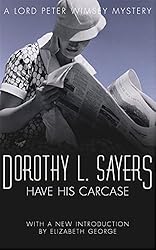
And then there is Gaudy Night, which is even better than Strong Poison. I loved the setting in this book – Shrewsbury College, a fictional all female college, at Oxford University (based on Somerville College, Sayers’ own college). The action of the book takes place in 1935, five years after Harriet’s trial in Strong Poison. During those five years Harriet and Wimsey have had an ongoing ‘relationship’ in which he annually asks her to marry him and she refuses. They had also worked together on a murder at Wilvercombe, as told in Have His Carcase, a book I have yet to read.

Gaudy Night begins as Harriet decides to go back to Shrewsbury College to attend the Shrewsbury Gaudy (a college reunion involving a celebratory dinner), not sure she can face meeting her fellow students and the dons. It doesn’t go well – there are poison pen letters, nasty graffiti and vandalism causing mayhem and upset. Harriet is asked to investigate, under pretence of helping one of the dons to rewrite her manuscript that had been destroyed in one of the nightly attacks and researching the life and works of Sheridan Lefanu. Struggling to discover the culprit and afraid it will end in murder she asks Wimsey for help.

This is a complex novel, with many characters, some of whom I found difficult to visualise, whereas others were vividly depicted, their thoughts, actions and feelings clearly evident. I had no idea who the writer of the poison pen letters etc could be and I was completely absorbed in the mystery.

But what gives both books so much depth is the portrayal of life between the two world wars, the exploration of the role of women in society, particularly with regard to education and marriage and the importance of truth and honesty; not forgetting, the ongoing relationship between Harriet and Lord Peter Wimsey. Of the two books I preferred Gaudy Night, but both are excellent and a pleasure to read.