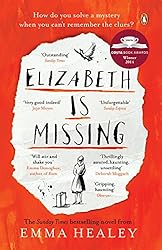
Elizabeth is Missing by Emma Healey

The events in that unfold in Emma Healey’s debut novel, Elizabeth is Missing are seen through Maud’s eyes. But Maud is an unreliable narrator – she can’t help it though as she has dementia.

Emma Healey’s depiction of dementia is convincing showing the confusion and bewilderment that Maud must have felt. It’s heart-rending, as she knows that Elizabeth, her friend, is missing, but doesn’t know where she is and no one seems to be listening to her when she talks about her – her own daughter and Elizabeth’s son just don’t answer her questions. And she asks them over and over again. As Maud continues her search for Elizabeth, she also recalls the search for her sister, Sukey, who disappeared in 1946.

It is not a book that I can say I ‘enjoyed’, even though it’s well written and with convincing characters. I thought it was over long and maybe would have been better as a novella. Inevitably, because the narrator has dementia there is much repetition – too much for me. I was disappointed with the plot too, because the ending became predictable quite early on in the book. Overall then a depressing book.

First Chapter First Paragraph: The Ghost Riders of Ordebec

First chapterEvery Tuesday Diane at Bibliophile by the Sea hosts First Chapter First Paragraph Tuesday Intros, where you can share the first paragraph, or a few, of a book you are reading or thinking about reading soon.

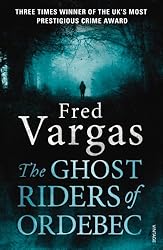
My book this week is a library book that I’m thinking about reading soon. It’s The Ghost Riders of Ordebec by Fred Vargas, translated from the French by Sian Reynolds.

It begins:

A trail of tiny crumbs led from the kitchen into the bedroom, as far as the spotless sheets where the old woman lay dead, her mouth open. Commissaire Adamsberg looked down at the crumbs in silence, pacing to and fro, wondering what kind of Tom Thumb – or what ogre in this case – might have dropped them there. He was in a small, dark, ground-floor apartment, with just three rooms, in the eighteenth arrondissement, in northern Paris.

Blurb:

‘˜People will die,’ says the panic-stricken woman outside police headquarters.

She refuses to speak to anyone besides Commissaire Adamsberg. Her daughter has seen a vision: ghostly horsemen who target the most nefarious characters in Normandy. Since the middle ages there have been stories of murderers, rapists, those with serious crimes on their conscience, meeting a grisly end following a visitation by the riders.

Soon after the young woman’s vision a notoriously vicious and cruel man disappears. Although the case is far outside his jurisdiction, Adamsberg agrees to investigate the strange happenings in a village terrorised by wild rumours and ancient feuds.

What do you think? Would you keep on reading?

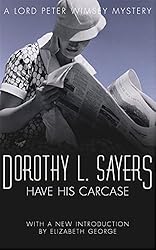
Have His Carcase by Dorothy L Sayers

Have His Carcase, first published in 1932, is another brilliant book – completely different from the last book I wrote about (see my previous post) but just as fascinating and absorbing. It’s crime fiction from the **Golden Age (see the note below), that is between the First and Second World Wars, and is the second of Dorothy L Sayer’s books featuring Harriet Vane, a crime fiction writer, and the seventh featuring Lord Peter Wimsey. They first met in Strong Poison, in which Harriet was on trial charged with the murder of her former lover.

In Have His Carcase Harriet is on a walking holiday when she comes across a dead man, his throat cut from ear to ear, lying on the top of a rock, called locally the Flat-Iron, on a deserted beach. Fortunately she has her camera with her and takes several photos, which come in very useful as by the time that she can alert the police the body has been washed out to sea. It appears that he committed suicide. Wimsey arrives soon after and he and Harriet they set out first of all to identify the body and then to prove that it was murder.

It is an example of the puzzle type of crime fiction – incredibly complicated and seemingly impossible to solve. It involves numerous characters who are not who they first appear, complete with alibis, disguises and false trails. Sayers, helpfully included a schedule of things that Harriet and Wimsey noted about the victim and the suspects, which I found useful as this is a long novel that took me several days to read; with so much information I just couldn’t remember it all as I read the book.

It all hinges on the timing of the discovery of the body and the movement of the tides. As in The Nine Tailors (and in fact in all the books by Dorothy L Sayers that I’ve read) there is a lot of detail, all of which is essential to the plot; detail about the body, how it was found, how the throat was cut , and what the blood was like when Harriet found the body. In the hands of another writer this could have been too graphic for me, but I had no difficulty reading such detail at all!

Also added into the mix are Bolsheviks, rumours of aristocratic connections, spies and a secret code to be deciphered. There are jealous lovers, itinerant hairdressers, a schoolteacher with Communist sympathies, taciturn locals, an antagonistic future son-in-law and  gigolos and dagos. (Written in the early 1930s this is not a politically correct novel.)

An underlying theme is the relationship between Harriet and Wimsey as he is constantly proposing marriage and she rejects him each time. Although at one point, as they walked along the beach together in search of clues, it did look briefly that her resolve was weakening:

She suddenly saw Wimsey in a new light. She knew him to be intelligent, clean, courteous, wealthy, well-read, amusing and enamoured, but he had not so far produced in her that crushing sense of utter inferiority which leads to prostration and hero-worship. But she now realised that there was, after all, something godlike about him. (pages 213-4)

and then she came to her senses and laughed. Earlier she had noted his physique as they inspected the Flat-Iron in the sea:

‘And he strips better than I should have expected,’ she admitted candidly to herself. ‘Better shoulders than I realised, and, thank Heaven, calves to his legs,’ (page 104)

Here are some more of my favourite quotations:

I question this first one!:

To be tried for murder is a fairly good advertisement for a writer of detective fiction. (page 1)

and on seeing what appears to be a man asleep Harriet says:

Now, if I had any luck, he’d be a corpse, and I should report him and get my name in the papers. That would be something like publicity. “Well-known Woman Detective-Writer Finds Mystery Corpse on Lonely Shore.” But these things never happen to authors. (page 7)

Well, she got her wish.

Next, here is Wimsey remarking on his use of quotations, which he does throughout the book:

I always have a quotation for everything – it saves original thinking. (page 58)

and Wimsey to Harriet after she apologised for being ‘a rotten dancer’:

Darling if you danced like an elderly elephant with arthritis, I would dance the sun and moon into the sea with you. I have waited a thousand years to see you dance in that frock. (page 157)

I loved the complexity, the details, and the various solutions Wimsey and Harriet considered. It kept me guessing throughout the book right from the start – just who was the victim, even when he was identified there was more to it, who murdered him, why was he murdered and above all just how and when was he murdered. It’s brilliant!
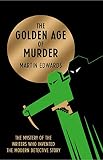
**Note: I must get a copy of Martin Edwards’ new book The Golden Age of Murderinvestigating how Agatha Christie and colleagues in the Detection Club transformed crime fiction, writing books casting new light on unsolved murders whilst hiding clues to their authors’ darkest secrets.

It’s due to be published on 7 May.
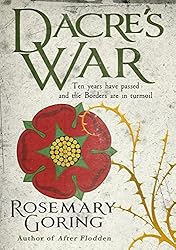
Dacre’s War by Rosemary Goring

Dacre’s War is compelling reading, a  thoroughly absorbing and beautifully written novel set in the Scottish and English Borders and London between 1523 – 1525 some ten years after the events described in Rosemary Goring’s earlier book, After Flodden. I wondered as I began reading whether it could equal After Flodden, a book I loved when I read it two years ago – it did. I think it even surpasses it.

I loved Dacre’s War and keen as I was to read to the end I didn’t want to leave the characters. Once again I was swept away by the story, re-living the scenes through Rosemary Goring’s vivid descriptions and the drama of the characters’ lives, people who came to life in the pages of this book.

Dacre’s War describes how Adam Crozier, the head of his clan, plots to take revenge on Lord Thomas Dacre, the Warden General of the English Marches and the Keeper of Carlisle, who had brought about the death of Adam’s father. Ten years after the Battle of Flodden, Dacre is the most powerful man in the north of England, but the Marches are a constant battlefield, dangerously out of control, and a hotbed of thieves and killers in thrall to the Warden. Without him Henry VIII believes the situation would be much worse.

It is against this background that Crozier forms an alliance with Dacre’s enemies, both English and Scots to inform Henry of Dacre’s crimes and bring about his downfall.

There are some remarkable scenes in this book, and amongst them are the scenes in the Star Chamber where Dacre is brought to answer the charges against him in front of Cardinal Wolsey and his imprisonment in the Fleet Prison. I felt as though I was there, watching, breathing the same air – not a pleasant experience. Similarly with Crozier, I could visualise his home, Crozier’s Keep, sense the tension and fear as his wife, Louise, is left at home, pregnant and in danger of losing the baby.

There is so much packed in this book, political intrigue, personal conflict and vengeance, and spies, manipulators and double crossers abound. It is impossible to write more without revealing the plot and the eventual ending. It’s a brilliant book.

Dacre’s War is due to be published in June 2015. My copy is a pre-publication review copy courtesy of www.lovereading.co.uk.

  • Hardcover: 352 pages
  • Publisher: Polygon (16 June 2015)
  • Language: English
  • ISBN-10: 1846973112
  • ISBN-13: 978-1846973116

Rosemary Goring was born in Dunbar and studied social and economic history at the University of St Andrews; and, after graduation, worked at W&R Chambers as a reference editor. Rosemary was the literary editor of Scotland on Sunday, followed by a brief spell as editor of Life & Work, the Church of Scotland’s magazine, before returning to newspapers as literary editor of the Herald, and later also of the Sunday Herald. In 2007 she published Scotland: The Autobiography: 2000 Years of Scottish History By Those Who Saw it Happen, which has since been published in America and Russia.

Reading Challenges: Read Scotland, Historical Fiction Challenge.

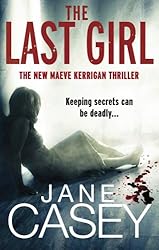
The Last Girl by Jane Casey

I liked the first two Maeve Kerrigan books by Jane Casey, The Burning and The Reckoning and the third, The Last Girl is just as good. I liked it mainly because Maeve is such an interesting character, and the book is fast paced and well written, with a multi-layered plot.

Maeve, a detective constable, is the youngest member of the Met Murder Squad investigating the murders of Vita Kennford and her daughter, Laura, age 14.  Lydia , Laura’s twin sister had found their bodies. Philip her father had walked in on the killer, received a blow to the head and was unconscious.  There are no clues at the scene of the crime and as Lydia was outside swimming at the time she neither saw nor heard anything. Philip is a defence QC known for getting his clients off even if they are guilty and at first Maeve and her boss D I Josh Derwent concentrate their investigations on people who hold a grudge against him. Any one of them seems to have good cause to have taken revenge on his family.

Unlike the earlier books, The Last Girl is narrated throughout by Maeve, so we see the events unfolding entirely through her perspective. Much of the novel centres on the Kennfords and their relationships. They are not a happy family.  Philip is an unreliable husband, regularly  unfaithful, not the sort who liked to be tied down to one woman. He is estranged from Savannah, his daughter from his first marriage. She refuses to speak to him and  Lydia seems withdrawn, reluctant to speak to anyone. Maeve is sure they are all keeping secrets.

And there is a sub-plot that harks back to the second book, The Reckoning,  as the team is also investigating a number of gangland murders. Although this book does stand well on its own I think it helps if you read them in order particularly to follow the development of  Maeve’s relationship with her boyfriend, Rob, also a policeman, now working in a different section – things between them are not going very smoothly and Maeve is having doubts. Meanwhile her working relationships with Derwent and Superintendent Godley are beginning to change as Derwent, a male chauvinist shows his softer side and she challenges Godley’s methods.

Maeve has her suspicions about the culprit, but after a while I began to think she could be  on the wrong lines as I had my doubts about the truthfulness of one particular character. And then it was fairly easy to work out who the culprit was.

I thoroughly enjoyed this book and am looking forward to the next one in the series, The Stranger You Know.

Dreamwalker: The Ballad of Sir Benfro Book 1

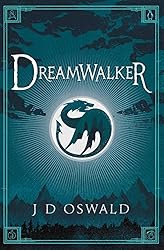
Dreamwalker

I read  Dreamwalker: The Ballad of Sir Benfro by James Oswald on my Kindle.  It has since been published by Penguin as Dreamwalker by J D Oswald.

So far there are three books in the series and there will eventually be five books published by Penguin. See James Oswald’s website for more information.

Synopsis from Amazon UK:

In a small village, miles from the great cities of the Twin Kingdoms, a young boy called Errol tries to find his way in the world. He’s an outsider – he looks different from other children and has never known his father. No one, not even himself, has any knowledge of his true lineage.

Deep in the forest, Benfro, the young male dragon begins his training in the subtle arts. Like his mother, Morgwm the Green, he is destined to be a great Mage. No one could imagine that the future of all life in the Twin Kingdoms rests in the hands of these two unlikely heroes.

But it is a destiny that will change the lives of boy and dragon forever …

My view:

I enjoyed this book, inspired by Welsh folklore. It’s very readable, each time I picked it up I just wanted to carry on reading this magical tale of the young dragon, Benfro and the young boy, Errol, born on the same day. I was drawn into their fantasy world.

But I wasn’t prepared for the ending – when you get to the end of the book it is not the end – it’s only the end of the first instalment! The tension builds throughout the book as both Benfro and Errol approach their fourteenth birthdays, Benfro in the dragon community, learning their magical powers and Errol,growing up thinking his mother was the village healer and then taken from his home by Melyn, the Inquisitor to train to be one of the warrior priest. Then there is the wicked Princess Beaulah, who is keeping her father the king alive until she reaches her 21st birthday.

And as the tension built I was eager to find out how it would end, only to be faced with the words ‘To be continued in The Ballad of Sir Benfro -Volume Two‘. I was so frustrated, as it just came to a full stop after a catastrophic event, that I couldn’t really believe had happened – a real cliff-hanger! I wish I’d realised before so that I’d been prepared – it was a complete let-down. So, if you are going to read it be warned!

Dreamwalker is followed by The Rose Cord and The Golden Cage. J. D. Oswald is also the author of the Detective Inspector McLean series of crime novels under the name James Oswald. In his spare time James runs a 350-acre livestock farm in North East Fife, where he raises pedigree Highland Cattle and New Zealand Romney Sheep.

Read more about Dreamwalker on the Penguin website.

Reading ChallengesDreamwalker is the perfect choice for Once Upon a Time IX. As it’s been on my Kindle since 2012 it’s also perfect for the Mount To Be Read Challenge and as James Oswald lives in Scotland it fits into the Read Scotland Challenge too.