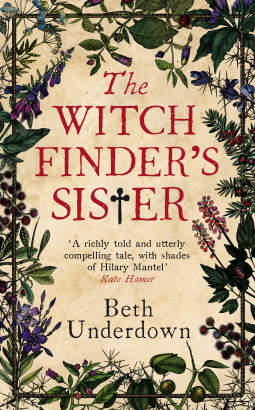
The Witchfinder’s Sister by Beth Underdown

‘The number of women my brother Matthew killed, so far as I can reckon it, is one hundred and six…’
1645. When Alice Hopkins’ husband dies in a tragic accident, she returns to the small Essex town of Manningtree, where her brother Matthew still lives.

But home is no longer a place of safety. Matthew has changed, and there are rumours spreading through the town: whispers of witchcraft, and of a great book, in which he is gathering women’s names.

To what lengths will Matthew’s obsession drive him?
And what choice will Alice make, when she finds herself at the very heart of his plan?

Based on the true story of the man known as the Witchfinder General, this exquisitely rendered novel transports you to a time and place almost unimaginable, where survival might mean betraying those closest to you, and danger lurks outside every door.

My thoughts:

When I read the description of The Witchfinder’s Sister by Beth Underdown I was immediately drawn to the story based on the life of the 1640s witchfinder Matthew Hopkins. As well as a good story it is a fascinating look at life in England during the Civil War, set in 1645, a time of great change and conflict in politics, religion and philosophical ideas, coinciding with a growth in the belief in witchcraft.

I enjoyed it immensely. It’s historical fiction that combines fact and fiction, told through the eyes of Matthew’s sister, Alice, a fictional character. Beth Underdown has researched and used the historical sources so well. What is so chilling about this book is that the events it describes really did happen.

There is a glossary at the end of the book describing, among other terms, the methods used to investigate women accused of being witches, such as ‘searching‘ where their bodies were inspected for ‘teats’, ‘swimming‘, an ordeal by water in which women were bound and lowered into a pond or river; they were innocent if they sank, and ‘watching‘ in which a suspected woman would be tied to a stool in the middle of a room, kept awake and observed for hours. Women were treated in this way if they were accused of causing harm to their neighbours for such things as the death of a neighbour’s horse or for the unexplained deaths of children. For the superstitious every sudden death, or accident, every miscarriage or illness, was considered to be caused by witchcraft.

There is a pervading sense of fear and terror as Alice discovers what Matthew is doing, intensified when he forces her to help with his investigations, travelling throughout Essex. She tries to stop him, but fearful of him accusing her mother-in-law, Bridget, she has to go along with him. She also discovers family secrets about their parents and Matthew’s birth. The witch hunts escalated as grief-stricken and angry women accused other women and their names were added to Matthew’s list. After his investigations the women were then sent to prisons to await their trials.

It is clear that the women accused were vulnerable, often widows living isolated lives, some suffering with what we would consider to be a mental illness, with no male family members to keep them safe from persecution. Matthew’s own mother showed signs of mental illness, subject to many strange habits and obsessive compulsive behaviour. But Matthew is unable to accept the facts and grows ever more fanatical.

It all hangs together as a piece of fiction, with clearly described and defined characters, making their feelings and actions perfectly believable – even Matthew comes across as a well-rounded character – and set against the background of a country in the midst of civil war. It makes harrowing reading and I found it deeply moving.

I grew very fond of Alice and her maid Grace but was appalled by the final twist at the end of the book.

Beth Underdown lectures in Creative Writing at the University of Manchester. The Witchfinder’s Sister is her first novel.

My thanks to the publishers and NeGalley for my copy of this book. It is to be published on 2 March 2017.

  • Format: Kindle Edition
  • File Size: 6546 KB
  • Print Length: 361 pages
  • Page Numbers Source ISBN: 0241978033
  • Publisher: Penguin (2 Mar. 2017)

Library Loot

The mobile library came yesterday and I borrowed three books:

Liby-bks-Feb-2017

You Are Dead by Peter James – this is the 11th in his Roy Grace series. I’ve only read two (the first and the third) of the earlier books. I know I should probably read them in order but sometimes you have to take what’s available at the time and fill in the gaps later. I’m hoping it reads well as a stand-alone.

It’s set in Brighton and it’s about current cases of missing women and the discovery of the remains of women who went missing in the past. Are these events connected and if so how?

Duchess of Death: the Unauthorised Biography of Agatha Christie by Richard Hack, drawing on over 5000 unpublished letter, documents and notes. I’m not at all sure I shall actually read this book, but I thought I’d borrow it just to have more time to look at it. I’ve read Agatha Christie’s Autobiography, which is an excellent book that took her 15 years to write, and a few other biographies about her, some better than others.

I don’t like the title, Duchess of Death, which I suppose Hack chose for its alliteration. The jacket cover blurb says it is ‘as full of romance, travel, wealth and scandal as any whodunit she crafted.’ I have a feeling this will not be one of the better biographies.

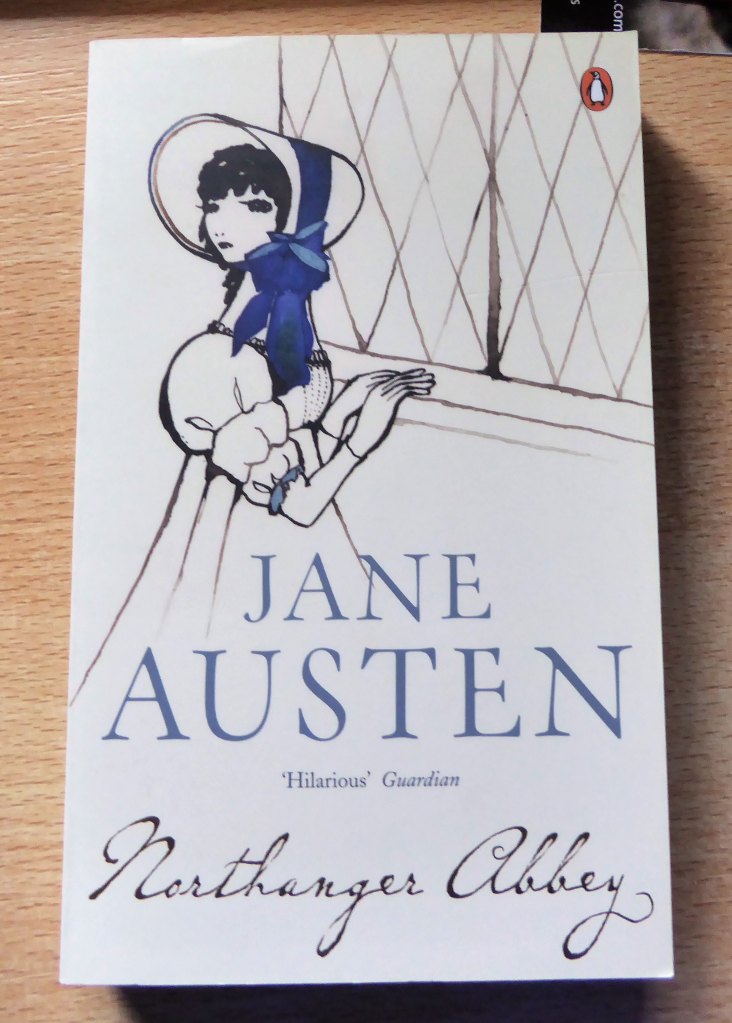
And finally I borrowed Northanger Abbey by Val McDermid, one of the Austen Project series (in which six bestselling contemporary authors write their own take on Jane Austen’s novels). I’ve been wondering whether to read any of these books for some time now and also meaning to read Val McDermid’s books, so when I saw this sitting on the mobile library’s shelves I thought why not at least have a proper look at it.

I first read Jane Austen’s Northanger Abbey many years ago (it could have been in the second year at Grammar School) and as far as I remember, despite loving Pride and Prejudice, I wasn’t too taken with it. I’ve been thinking of reading it again for some while now. I didn’t watch the TV adaptation a few years back, so I’m coming to both books with fresh eyes.

This is my copy with its awful cover:

Northhanger-Austen

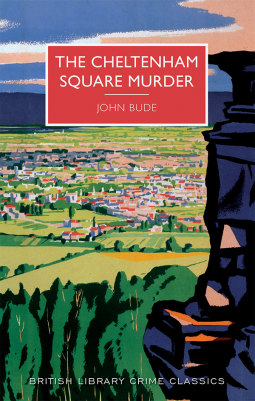
The Cheltenham Square Murder by John Bude

A Golden Age Murder Mystery

Blurb:

In the seeming tranquillity of Regency Square in Cheltenham live the diverse inhabitants of its ten houses. One summer’s evening, the square’s rivalries and allegiances are disrupted by a sudden and unusual death ‘“ an arrow to the head, shot through an open window at no. 6.

Unfortunately for the murderer, an invitation to visit had just been sent by the crime writer Aldous Barnet, staying with his sister at no. 8, to his friend Superintendent Meredith. Three days after his arrival, Meredith finds himself investigating the shocking murder two doors down. Six of the square’s inhabitants are keen members of the Wellington Archery Club, but if Meredith thought that the case was going to be easy to solve, he was wrong’¦

The Cheltenham Square Murder is a classic example of how John Bude builds a drama within a very specific location. Here the Regency splendour of Cheltenham provides the perfect setting for a story in which appearances are certainly deceiving.

My thoughts:

The Cheltenham Square Murder by John Bude was first published in 1937. Previously I’ve read John Bude’s second book- The Lake District Murder, a police procedural, showing in intricate detail how detectives investigated a crime, particularly in rural areas in the mid 1930s, in which I found his calculations of the times and distribution of petrol deliveries a bit difficult to follow.

But by the time he wrote The Cheltenham Square Murder Bude’s style had become more refined and I found it much easier to follow, whilst still writing in detail about the suspects and how the crime could have been and was committed. It is quite complicated, a real puzzle to solve, first of all just how the murder was carried out and secondly who out of the several suspects was the murderer.

There is a plan of the fictional Regency Square showing the layout of the ten houses and their occupants. Bude describes the residents giving a good idea of their personalities and relationships. As in all communities, they don’t all get on, ‘outwardly harmonious yet privately at loggerheads’. Those who belong to the Wellington Archery Club are keen, even fanatically keen archers, so immediately they are suspects.

It is fortunate for the local police that Superintendent Meredith from the Sussex County Constabulary is staying in the Square and helps Inspector Long unravel the mystery, but not before another there is a second victim, again murdered with an arrow in the head.

It’s a slow-paced mystery, both Meredith and Long spend much time working out how the murder was committed and Bude drops in several red herrings to confuse matters as first one then another of the residents comes under suspicion. I enjoyed trying to work it out, but although I had an idea about the guilty person I couldn’t see how the murders had been achieved until the method was revealed.

Martin Edward’s introduction gives a brief biography of John Bude, whose real name was Ernest Carpenter Elmore (1901 – 1957). For a time he was a games master at St Christopher School in Letchworth where archery was one of the pupils’ activities.

My thanks to the publishers, Poisoned Pen Press in association with the British Library, and NetGalley for my copy of this book which has an introduction by Martin Edwards.

  • Amazon link to the paperback edition to be published on 7 March 2017
  • Amazon link to the Kindle edition
  • My rating – 4 stars

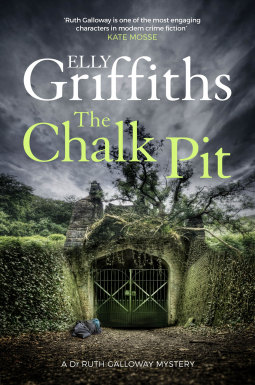
The Chalk Pit by Elly Griffiths

Blurb:

Something evil is waiting in the dark tunnels under Norwich – forensic archaeologist Dr Ruth Galloway had better watch her step

Boiled human bones have been found in Norwich’s web of underground tunnels. When Dr Ruth Galloway discovers they were recently buried, DCI Nelson has a murder enquiry on his hands. The boiling might have been just a medieval curiosity – now it suggests a much more sinister purpose.

Meanwhile, DS Judy Johnson is investigating the disappearance of a local rough sleeper. The only trace of her is the rumour that she’s gone ‘underground’. This might be a figure of speech, but with the discovery of the bones and the rumours both Ruth and the police have heard that the network of old chalk-mining tunnels under Norwich is home to a vast community of rough sleepers, the clues point in only one direction. Local academic Martin Kellerman knows all about the tunnels and their history – but can his assertions of cannibalism and ritual killing possibly be true?

As the weather gets hotter, tensions rise. A local woman goes missing and the police are under attack. Ruth and Nelson must unravel the dark secrets of The Underground and discover just what gruesome secrets lurk at its heart – before it claims another victim.

My thoughts:

The Chalk Pit is the 9th in Elly Griffiths’ Ruth Galloway books. It’s written in the present tense which I find somewhat jarring (strange because in other books such as Eyes Like Mine, which I reviewed in this post, I hardly noticed the tense). But I did enjoy this book because of the characters, in particular Ruth, her daughter, Kate (now nearly 6 years old), DCI Harry Nelson and his wife Michelle, DS Clough, DS Judy Johnson and Cathbad, the part-time druid, who now looks after their two young children. I also like the archaeological investigations, although in The Chalk Pit that is not the main focus.

It centres on the plight of homeless people and the maze of tunnels under Norfolk. The bones are found during the excavations when an underground restaurant in one of the tunnels is proposed. One of the homeless women, Barbara, disappears and there are rumours that she has ‘gone underground‘. It becomes a murder mystery when two more of the homeless, ‘Aftershave Eddie’ and then ‘Bilbo’ are found dead, both stabbed. Then two local women go missing – Sam who has four children and Cassandra, Clough’s partner (they have one child). And it soon becomes clear that all these events are linked.

There is a Who’s Who of the main characters at the end of the book giving their backstories which helps if you haven’t read the earlier books. But I think it really helps to read the Ruth Galloway books in order as the recurring characters’ lives progress with each one, making it difficult to write much more about The Chalk Pit without giving away spoilers. I’ll just add that one of my favourite characters, Cathbad, doesn’t have a large role, which disappointed me. And I really would prefer if Elly Griffiths had written this in the past tense as she has in her Stephens and Mephisto series, which I prefer.

My thanks to the publishers and NetGalley for an ARC of this book which will be published on 23 February 2017.

  • Format: Kindle Edition
  • File Size: 2490 KB
  • Print Length: 384 pages
  • Publisher: Quercus (23 Feb. 2017)
  • My rating: 3.5 stars (rounded up to 4 stars on Goodreads)

Harriet Said by Beryl Bainbridge

Disquiet and dread permeate this novel

Harriet Said...

Blurb (from Amazon):

A girl returns from boarding school to her sleepy Merseyside hometown and waits to be reunited with her childhood friend, Harriet, chief architect of all their past mischief. She roams listlessly along the shoreline and the woods still pitted with wartime trenches, and encounters ‘the Tsar’ – almost old, unhappily married, both dangerously fascinating and repulsive.

Pretty, malevolent Harriet finally arrives – and over the course of the long holidays draws her friend into a scheme to beguile then humiliate the Tsar, with disastrous, shocking consequences. A gripping portrayal of adolescent transgression, Beryl Bainbridge’s classic first novel remains as subversive today as when it was written.

My thoughts:

Harriet Said is a dark story that turns child abuse on its head. It is an unsettling and chilling book, beginning as Harriet and her friend, an unnamed 13 year-old girl, run home screaming to tell their parents what had happened. Harriet says:

When I say run, you start to run. When I say scream, you scream. Don’t stop running. just you keep going. (page 2)

It is one of those books that, although it is well written and makes compulsive reading, can’t be said to be enjoyable and the characters are not at all likeable.

It is set just after the Second World War in the Formby sand dunes on the outskirts of Liverpool.  During their school holidays the two girls make their way to the beach each evening, where they become friends with a group of lonely, dispirited middle-aged men.  They are not naive or innocent, but neither are they fully aware of the consequences of their actions as they set out to manipulate the men, the ‘Tsar’ in particular. They want to gather ‘experience’, which they record in Harriet’s diary:

A year ago to be called a Dirty Little Angel would have kept us going for months. Now it was not enough; more elaborate things had to be said; each new experience had to leave a more complicated tracery of sensations; to satisfy us every memory must be more desperate than the last.

… We took to going long walks over the shore, looking for people who by their chosen solitariness must have something to hide. We learnt early that it was the gently resigned ones who had the most to tell; the frantic and voluble were no use. (pages 39 and 40)

It is Harriet who decides their actions and dictates what to write in the diary.

They peek through the windows of the Tsar’s house and watch as he ‘lay pinned like a moth on the sofa‘ underneath his wife as she ‘poisoned him slowly, rearing and stabbing him convulsively. This sickens the 13 year-old, who wants to be loved by the Tsar, but Harriet decides that he is weak and submissive, saying that he likes being a victim and must be punished in a way he doesn’t like. From that point onwards events move rapidly to a shocking conclusion.

I’ve read a few of Beryl Bainbridge’s books and each one has kept me engrossed. Harriet Said is the first one she wrote, based on a real event, and although she submitted it for publication in 1958 it wasn’t published until 1972 because of its subject matter – ‘What repulsive little creatures you have made the central characters, repulsive almost beyond belief!‘ wrote one editor. I found it a disturbing story as the manipulation escalated and everything began to spiral out of the girls’ control as childhood fled from them.

  • Paperback: 192 pages
  • Publisher: Virago (6 Dec. 2012)
  • Language: English
  • ISBN-10: 184408860X
  • ISBN-13: 978-1844088607
  • Source: a library book
  • My rating: 3.5 stars (rounded up to 4 stars on Goodreads)

The Good People by Hannah Kent

A heart-wrenching and beautiful novel.

I loved The Good People by Hannah Kent. It’s an intensely moving and beautifully written tale of Irish rural life in the early 19th century.

The Good People

Blurb:

County Kerry, Ireland, 1825.

Nóra bereft after the sudden death of her beloved husband, finds herself alone and caring for her young grandson Micheál. Micheál cannot speak and cannot walk and Nóra is desperate to know what is wrong with him. What happened to the healthy, happy grandson she met when her daughter was still alive?

MARY arrives in the valley to help Nóra just as the whispers are spreading: the stories of unexplained misfortunes, of illnesses, and the rumours that Micheál is a changeling child who is bringing bad luck to the valley.

NANCE’s knowledge keeps her apart. To the new priest, she is a threat, but to the valley people she is a wanderer, a healer. Nance knows how to use the plants and berries of the woodland; she understands the magic in the old ways. And she might be able to help Micheál.

As these three women are drawn together in the hope of restoring Micheál, their world of folklore and belief, of ritual and stories, tightens around them. It will lead them down a dangerous path, and force them to question everything they have ever known.

Based on true events and set in a lost world bound by its own laws, The Good People is Hannah Kent’s startling new novel about absolute belief and devoted love. Terrifying, thrilling and moving in equal measure, this long-awaited follow-up to Burial Rites shows an author at the height of her powers.

My thoughts:

I grew up reading fairy stories but The Good People gives a frighteningly realistic view of what belief in fairies meant to people dealing with sickness, disease, evil and all the things that go wrong in our lives. It’s set in 1825/6, a long gone world of people living in an isolated community, a place where superstition and a belief in fairies held sway. People talk of others being ‘fairy-swept’ or ‘away with the fairies’, and kept with the music and lights, dancing under the fairy hill.

Nóra is overcome with grief when her husband, Martin, died, feeling as though she was drowning and abandoned, completely unable to cope with Micheál, her four-year old grandson. There is talk that he is ‘fairy-struck’, unable to walk or talk and screaming uncontrollably when he is in pain or upset. She needed someone else to help her and so she hired Mary to look after Micheál. But Micheál did not improve and soon she comes to believe that he is a changeling. After both the doctor and the priest are unable to cure Micheál, Nóra appeals to Nance, the valley’s ‘handy woman’ for help.

This is a beautifully written book. It is not a fairy story, but one in which their existence is terrifyingly real to the people of the valley. The villagers believe that the fairies live in Piper’s Grave, ‘the lurking fairy fort’, at the end of the valley, a place where few people went, a neglected and wild place. People see lights there, glowing near a crooked whitethorn tree that stood in a circle of stone. Nance lives in a cabin in front of the wood a short distance from Piper’s Grave and not far from the river. She was the woman they wanted to help them bring their babies into the world, and who was the ‘gatekeeper’ at the end of their lives, the ‘keener’ when they died. She is the person Nance went to believing she could help bring back the little boy she loved.

I loved everything about The Good People, Hannah Kent is an excellent storyteller. The characters all spring to life, Nóra, Nance and Mary in particular. It’s not a world I know and yet I felt I did, with its mix of characters, old Peg O’Shea, Nóra’s nearest neighbour who helps when she can and the younger men and women who gossip and are quick to blame Micheál for bringing bad luck to the valley and to condemn Nance, who whilst they go to her for cures, also frightens them.

It is a heart breaking story and as it drew to its inevitable end I was really moved by the effect of fear, ignorance and superstition that brought about such a tragedy. The Author’s Note at the end of the book  explains that she drew on a real event from 1826 in writing The Good People. She has researched and listed many works of both fiction and non-fiction and also consulted many historians, curators and academics whilst writing the book.

Many thanks to the publishers and NetGalley for a review copy.

  • Format: Kindle Edition
  • File Size: 3007 KB
  • Print Length: 400 pages
  • Publisher: Picador; Main Market Ed. edition (9 Feb. 2017)