Killing Me Gently by Hazel McHaffie

Killing me gently

VelvetEthics Press|1 July 2019|390 pages|Review copy|4*

I’ve read two of Hazel McHaffie’s books in the past – Over My Dead Body and Inside of Me. In both books I was impressed by the way she weaves facts into her fiction so seamlessly that it doesn’t detract from the story. So, I was pleased when she asked if I would like to read her latest book, Killing Me Gently, her 11th published novel set in the world of medical ethics.

The story begins with a dramatic scene – in the middle of the night, in February, in complete darkness as Anya, feeling desperate and close to breaking point, runs alongside a fast flowing river:

Mud sucked greedily at her boots, branches tangled in her hair, exposed roots snaked across her path. The vicious swirl of the river drew her like a magnet down into the thick darkness, the dank odour of slowly decomposing vegetation.

Anya had no notion of time, only all-consuming compulsion to get as far away as possible from her tormentor. Several times she skidded wildly, once finding herself at the very brink, one false move away from those unforgiving rocks.

I was immediately drawn in – what has happened to make her so desperate? Who is she running from and who is tormenting her? Will she fall in – or is she trying to kill herself? I had to know.

The blurb expands more on Anya’s situation without giving away any spoilers: 

Blurb:

Anya Morgan has it all – beauty, brains, dream home, handsome husband, and now to complete the picture, a new baby. But Gypsy Lysette doesn’t conform to Anya’s criteria for perfection. Sleep deprived and insecure, she searches for solace and reassurance.

Leon Morgan is torn between supporting his paranoid wife and the demands of his job. Increasingly stressed, he starts to make mistakes, big mistakes, threatening the future of the family firm, jeopardising their marriage.

Tiffany Corrigan to the rescue; qualified nurse, mother of three, a fount of practical wisdom. She’s a shoulder to lean on when the crises escalate … when Gypsy is admitted to hospital … when the fingers start pointing … when suspicion and jealousy widen the rift between Anya and Leon.

Then inexplicable things start to happen. Frightening things. Baby Gypsy’s life as well as Anya’s sanity are under threat. Who is responsible? And will the professionals act in time to save this family from devastating loss?

It is an intense, emotional and dramatic psychological thriller. Hazel McHaffie trained as a nurse and a midwife, gained a PhD in Social Sciences and was Deputy Director of Research in the Institute of Medical Ethics and her expertise is reflected in this book. Her writing successfully conveys the stress Anya was under and the damage to their relationship that Anya and Leon experienced as their baby became ill and was admitted to hospital. Right from the first page I was completely gripped by the mystery – what was the cause of Gypsy’s illness and was it Anya’s fault?

It is so tense and at first it was hard to decide who could be trusted. The tension rises, so much so that I was convinced of the danger of the situation and I feared the worst. And even when I thought I had worked out what was actually happening to Gypsy, my heart was in my mouth as I read on. 

Killing me Gently raises ethical and moral questions about childcare and the relationship between the medical practitioners, social workers and parents, looking at it on a personal level. It is by no means a comfortable read, because it is both emotional and disturbing. However I was completely absorbed by the drama of it all.

Hazel McHaffie’s other novels cover medical ethic issues such as Alzheimer’s and the right to die. Her non-fiction books are about life and death decisions. For more details see her website. She also writes a most interesting blog.

My thanks to Hazel McHaffie for a copy of her book for review.
Murder by Matchlight (British Library Crime Classics ) by E C R Lorac

A Golden Age Mystery

Murder by Matchlight

Poisoned Pen Press|5 March 2019|288 pages|e-book |Review copy|5*

My Friday Post: The Agony and the Ecstasy by Irving Stone

Book Beginnings Button

Every Friday Book Beginnings on Friday is hosted by Gillion at Rose City Reader where you can share the first sentence (or so) of the book you are reading, along with your initial thoughts about the sentence, impressions of the book, or anything else the opener inspires.

Agony & Ecstasy


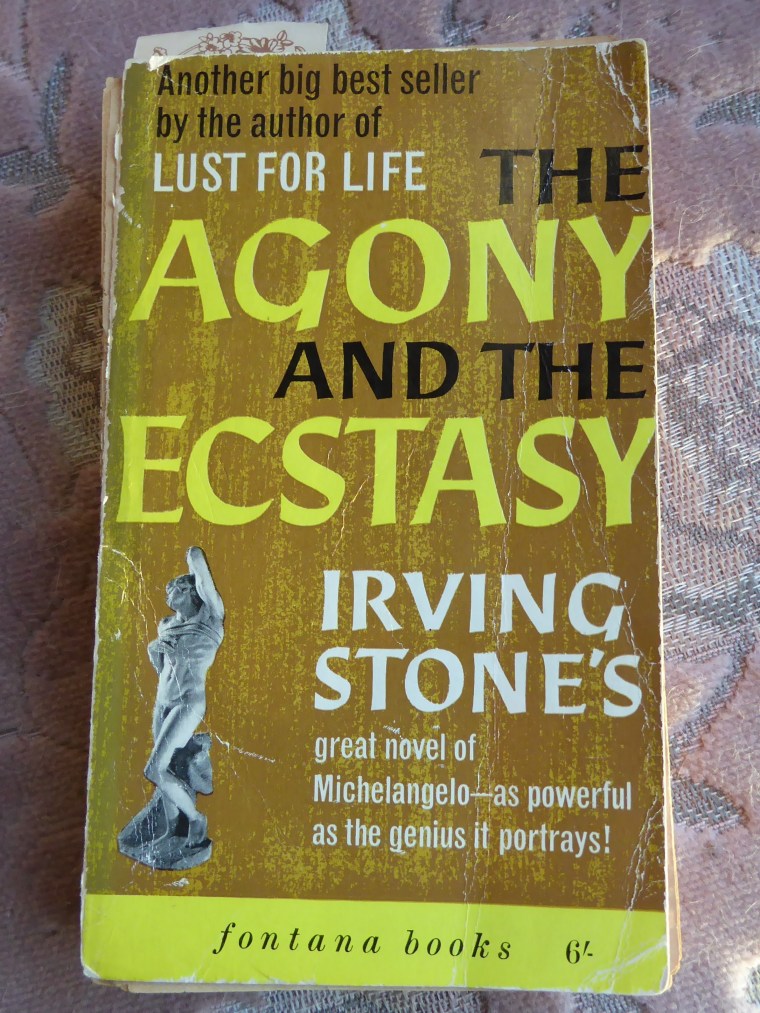
My old, tatty copy of The Agony and the Ecstasy by Irving Stone has been sitting on my desk for months now, whilst I’ve been wondering about reading it. I bought for 50p more 20 years ago (no idea exactly when or where I bought it). It was old when I first bought it and it’s falling to pieces now, the pages are brown and the font is so small, which is why I’m not reading it. So I think I’ll have to get a new edition.

It’s a biographical novel of Michelangelo.


He sat before the mirror of the second-floor bedroom sketching his lean cheeks with their high bone ridges, the flat broad forehead, and ears too far back on the head, the dark hair curling forward in thatches, the amber-coloured eyes wide set but heavy-lidded.

Also every Friday there is The Friday 56, hosted by Freda at Freda’s Voice.

30879-friday2b56These are the rules:

  1. Grab a book, any book.
  2. Turn to page 56, or 56% on your eReader. If you have to improvise, that is okay.
  3. Find any sentence (or a few, just don’t spoil it) that grabs you.
  4. Post it.
  5. Add the URL to your post in the link on Freda’s most recent Friday 56 post.

Page 56:

Michelangelo went into the yard and sat in the baking sun with his chin resting on his chest. He had made a nuisance of himself.

Have read this book? What did you think about it? And if you haven’t, would you keep on reading?

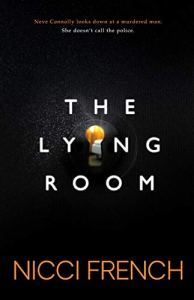
The Lying Room by Nicci French

Lying Room


Simon and Schuster UK|3 October 2019|432 pages|e-book |Review copy|3.5*

Six Degrees of Separation: from Three Women to …

I love doing Six Degrees of Separation, a monthly link-up hosted by Kate at Books Are My Favourite and Best. Each month a book is chosen as a starting point and linked to six other books to form a chain. A book doesn’t need to be connected to all the other books on the list, only to the one next to it in the chain.

Three Women


This month the chain begins with Three Women by Lisa Taddeo – a book I haven’t read, or even heard of before. It’s described on Goodreads as Desire as we’ve never seen it before: a riveting true story about the sex lives of three real American women, based on nearly a decade of reporting. I have no desire to read it.

My first link is to one of the books I’m currently reading – a biography of D H Lawrence, a man who believed himself to be an outsider in angry revolt against his class, culture and country, and who was engaged in a furious commitment to his writing and a passionate struggle to live according to his beliefs. He also struggled all his life with his relationships with women, particularly about those with his mother and his wife, Frieda.

Leading on from Lawrence’s biography my second link is to his book, Women in Love,  a book I first read as a teenager. It’s about the relationships of two sisters, Ursula and Gudrun. Ursula falls in love with Birkin (a self portrait of Lawrence) and Gudrun has an affair with Gerald, the son of the local colliery owner. Later on I watched the film version with Glenda Jackson as Gudrun, Oliver Reed as Gerald, Alan Bates as Birkin and Jennie Linden as Ursula. Lawrence considered this book to be his best and the one that clearly showed his ideas of society at the time (1922).

Moving on from a book about sisters, my third link is to a book about brothers. It’s The Lost Man by Jane Harper, set in an isolated part of Australia hundreds of miles from anywhere and revolving around the death of Cameron Bright. There are three Bright brothers – Nathan the oldest, then Cameron and the youngest brother, Bub. They have a vast cattle ranch in the Queensland outback. The book begins with the discovery of Cameron’s body lying at the the base of the headstone of the stockman’s grave – a headstone standing alone, a metre high, facing west, towards the desert, in a land of mirages.

My fourth link is to another book set in Australia – Sarah Thornhill by Kate Grenville, a love story set in 19th century Australia, where the convicts, transported or ‘sent out‘ are  now called ‘old colonists‘. A story about prejudice – some people, those who had ‘come free‘,  thought being ‘sent out‘ meant you were tainted for all time, but for others having money and land overcame their distaste. And then there is the prejudice about the ‘blacks’. When Sarah, the daughter of William Thornhill, an ‘old colonist’ and now a landowner on the Hawkesbury River, falls in love with Jack Langland, whose mother was a native woman, racial prejudice and hatred rear their ugly heads.

Prejudice and racial tension is also uppermost in The Tea Planter’s Wife by Dinah Jefferies, set in Ceylon (now called Sri Lanka) in 1913. It was a time of unrest, with political and racial tension between the Sinhalese and Tamil workers and the British plantation owners. After a whirlwind romance, Gwendolyn Hooper marries a tea planter, Laurence, an older man, and a widower. But this is not the idyllic life she expected – there are secrets, locked doors and a caste system and culture that is alien to her. There is a mystery, too, surrounding the death of Caroline, Laurence’s first wife.

And so to the last link, which is to another book about the death of a wife. It’s The Evidence Against You by Gillian McAllister – Gabe English has been released from prison on parole, having served seventeen years for the murder of his wife, Alexandra. But nobody really knew exactly what had happened the night Alexandra was killed – she simply went missing and then her body was found – she’d been strangled. Gabe’s daughter Izzy thought that her father could never have harmed anybody, let alone her mother. Now, he swears that he is innocent and wants to tell his side of it. He asks her to consider the evidence for herself. But is he really guilty – can she trust her father?

My chain is link by books about women, sisters and brothers, prejudice and racial tension, books set in Australia and about the deaths of wives. It passes from America to Great Britain,  and Sri Lanka, via books of crime fiction, historical fiction and non-fiction.

Next month (November 2, 2019), we’ll begin with Alice’s Adventures in Wonderland – a book I have read and loved.

My Friday Post: Black Water Lilies by Michel Bussi

Book Beginnings Button

Every Friday Book Beginnings on Friday is hosted by Gillion at Rose City Reader where you can share the first sentence (or so) of the book you are reading, along with your initial thoughts about the sentence, impressions of the book, or anything else the opener inspires.

Last week I bought Black Water Lilies by Michel Bussi and I can’t resist starting it even though there are plenty of books in my TBR piles that I ‘should’ be reading. 
 
Black water lilies

Three women lived in a village.

The first was mean, the second a liar, and the third was an egoist.

Their village bore the pretty name of a garden, Giverny.

Also every Friday there is The Friday 56, hosted by Freda at Freda’s Voice.

30879-friday2b56These are the rules:

  1. Grab a book, any book.
  2. Turn to page 56, or 56% on your eReader. If you have to improvise, that is okay.
  3. Find any sentence (or a few, just don’t spoil it) that grabs you.
  4. Post it.
  5. Add the URL to your post in the link on Freda’s most recent Friday 56 post.

Pages 56 -7:

He used to be an art teacher in the United States, he tells her. He never stops saying that she talks all the time, and even though she’s very gifted, she needs to be able to concentrate more. Like Monet did.

I’ve read one other book by Michel Bussi, Time is a Killer, which I really enjoyed and so I thought I’d like this one. It’s the story of a mystery, of thirteen days that begin with one murder and end with another. Jérôme Morval, a man whose passion for art was matched only by his passion for women, has been found dead in the stream that runs through the gardens at Giverny, where Monet did his famous paintings.

Have read this book? What did you think about it? And if you haven’t, would you keep on reading?