Murder by Matchlight (British Library Crime Classics ) by E C R Lorac

A Golden Age Mystery
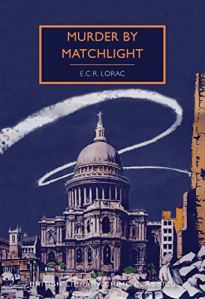
Murder by Matchlight

Poisoned Pen Press|5 March 2019|288 pages|e-book |Review copy|5*

My Friday Post: The Agony and the Ecstasy by Irving Stone

Book Beginnings Button

Every Friday Book Beginnings on Friday is hosted by Gillion at Rose City Reader where you can share the first sentence (or so) of the book you are reading, along with your initial thoughts about the sentence, impressions of the book, or anything else the opener inspires.

Agony & Ecstasy


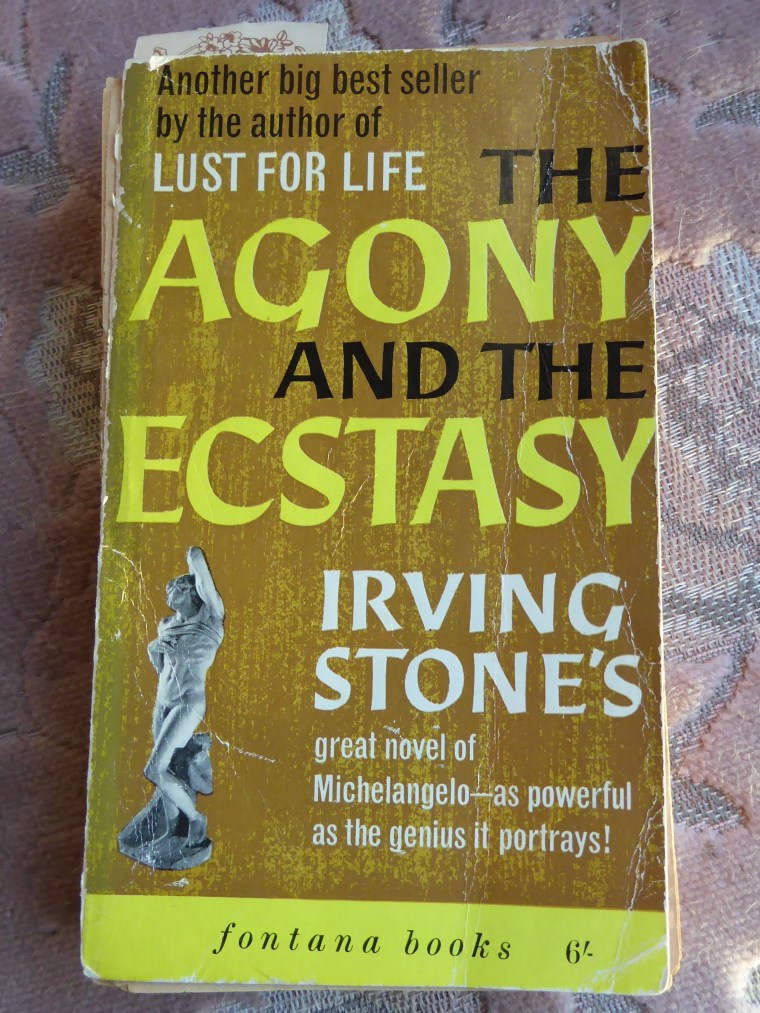
My old, tatty copy of The Agony and the Ecstasy by Irving Stone has been sitting on my desk for months now, whilst I’ve been wondering about reading it. I bought for 50p more 20 years ago (no idea exactly when or where I bought it). It was old when I first bought it and it’s falling to pieces now, the pages are brown and the font is so small, which is why I’m not reading it. So I think I’ll have to get a new edition.

It’s a biographical novel of Michelangelo.


He sat before the mirror of the second-floor bedroom sketching his lean cheeks with their high bone ridges, the flat broad forehead, and ears too far back on the head, the dark hair curling forward in thatches, the amber-coloured eyes wide set but heavy-lidded.

Also every Friday there is The Friday 56, hosted by Freda at Freda’s Voice.

30879-friday2b56These are the rules:

  1. Grab a book, any book.
  2. Turn to page 56, or 56% on your eReader. If you have to improvise, that is okay.
  3. Find any sentence (or a few, just don’t spoil it) that grabs you.
  4. Post it.
  5. Add the URL to your post in the link on Freda’s most recent Friday 56 post.

Page 56:

Michelangelo went into the yard and sat in the baking sun with his chin resting on his chest. He had made a nuisance of himself.

Have read this book? What did you think about it? And if you haven’t, would you keep on reading?

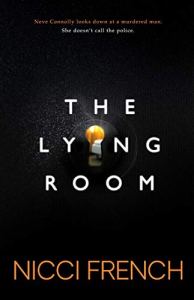
The Lying Room by Nicci French

Lying Room


Simon and Schuster UK|3 October 2019|432 pages|e-book |Review copy|3.5*

Six Degrees of Separation: from Three Women to …

I love doing Six Degrees of Separation, a monthly link-up hosted by Kate at Books Are My Favourite and Best. Each month a book is chosen as a starting point and linked to six other books to form a chain. A book doesn’t need to be connected to all the other books on the list, only to the one next to it in the chain.

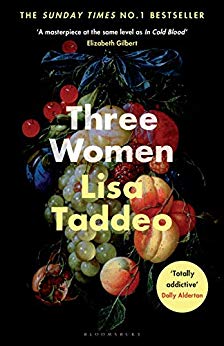
Three Women


This month the chain begins with Three Women by Lisa Taddeo – a book I haven’t read, or even heard of before. It’s described on Goodreads as Desire as we’ve never seen it before: a riveting true story about the sex lives of three real American women, based on nearly a decade of reporting. I have no desire to read it.

My first link is to one of the books I’m currently reading – a biography of D H Lawrence, a man who believed himself to be an outsider in angry revolt against his class, culture and country, and who was engaged in a furious commitment to his writing and a passionate struggle to live according to his beliefs. He also struggled all his life with his relationships with women, particularly about those with his mother and his wife, Frieda.

Leading on from Lawrence’s biography my second link is to his book, Women in Love,  a book I first read as a teenager. It’s about the relationships of two sisters, Ursula and Gudrun. Ursula falls in love with Birkin (a self portrait of Lawrence) and Gudrun has an affair with Gerald, the son of the local colliery owner. Later on I watched the film version with Glenda Jackson as Gudrun, Oliver Reed as Gerald, Alan Bates as Birkin and Jennie Linden as Ursula. Lawrence considered this book to be his best and the one that clearly showed his ideas of society at the time (1922).

Moving on from a book about sisters, my third link is to a book about brothers. It’s The Lost Man by Jane Harper, set in an isolated part of Australia hundreds of miles from anywhere and revolving around the death of Cameron Bright. There are three Bright brothers – Nathan the oldest, then Cameron and the youngest brother, Bub. They have a vast cattle ranch in the Queensland outback. The book begins with the discovery of Cameron’s body lying at the the base of the headstone of the stockman’s grave – a headstone standing alone, a metre high, facing west, towards the desert, in a land of mirages.

My fourth link is to another book set in Australia – Sarah Thornhill by Kate Grenville, a love story set in 19th century Australia, where the convicts, transported or ‘sent out‘ are  now called ‘old colonists‘. A story about prejudice – some people, those who had ‘come free‘,  thought being ‘sent out‘ meant you were tainted for all time, but for others having money and land overcame their distaste. And then there is the prejudice about the ‘blacks’. When Sarah, the daughter of William Thornhill, an ‘old colonist’ and now a landowner on the Hawkesbury River, falls in love with Jack Langland, whose mother was a native woman, racial prejudice and hatred rear their ugly heads.

Prejudice and racial tension is also uppermost in The Tea Planter’s Wife by Dinah Jefferies, set in Ceylon (now called Sri Lanka) in 1913. It was a time of unrest, with political and racial tension between the Sinhalese and Tamil workers and the British plantation owners. After a whirlwind romance, Gwendolyn Hooper marries a tea planter, Laurence, an older man, and a widower. But this is not the idyllic life she expected – there are secrets, locked doors and a caste system and culture that is alien to her. There is a mystery, too, surrounding the death of Caroline, Laurence’s first wife.

And so to the last link, which is to another book about the death of a wife. It’s The Evidence Against You by Gillian McAllister – Gabe English has been released from prison on parole, having served seventeen years for the murder of his wife, Alexandra. But nobody really knew exactly what had happened the night Alexandra was killed – she simply went missing and then her body was found – she’d been strangled. Gabe’s daughter Izzy thought that her father could never have harmed anybody, let alone her mother. Now, he swears that he is innocent and wants to tell his side of it. He asks her to consider the evidence for herself. But is he really guilty – can she trust her father?

My chain is link by books about women, sisters and brothers, prejudice and racial tension, books set in Australia and about the deaths of wives. It passes from America to Great Britain,  and Sri Lanka, via books of crime fiction, historical fiction and non-fiction.

Next month (November 2, 2019), we’ll begin with Alice’s Adventures in Wonderland – a book I have read and loved.

My Friday Post: Black Water Lilies by Michel Bussi

Book Beginnings Button

Every Friday Book Beginnings on Friday is hosted by Gillion at Rose City Reader where you can share the first sentence (or so) of the book you are reading, along with your initial thoughts about the sentence, impressions of the book, or anything else the opener inspires.

Last week I bought Black Water Lilies by Michel Bussi and I can’t resist starting it even though there are plenty of books in my TBR piles that I ‘should’ be reading. 
 
Black water lilies

Three women lived in a village.

The first was mean, the second a liar, and the third was an egoist.

Their village bore the pretty name of a garden, Giverny.

Also every Friday there is The Friday 56, hosted by Freda at Freda’s Voice.

30879-friday2b56These are the rules:

  1. Grab a book, any book.
  2. Turn to page 56, or 56% on your eReader. If you have to improvise, that is okay.
  3. Find any sentence (or a few, just don’t spoil it) that grabs you.
  4. Post it.
  5. Add the URL to your post in the link on Freda’s most recent Friday 56 post.

Pages 56 -7:

He used to be an art teacher in the United States, he tells her. He never stops saying that she talks all the time, and even though she’s very gifted, she needs to be able to concentrate more. Like Monet did.

I’ve read one other book by Michel Bussi, Time is a Killer, which I really enjoyed and so I thought I’d like this one. It’s the story of a mystery, of thirteen days that begin with one murder and end with another. Jérôme Morval, a man whose passion for art was matched only by his passion for women, has been found dead in the stream that runs through the gardens at Giverny, where Monet did his famous paintings.

Have read this book? What did you think about it? And if you haven’t, would you keep on reading?

My Friday Post: Maigret’s Holiday by Georges Simenon

Book Beginnings Button

Every Friday Book Beginnings on Friday is hosted by Gillion at Rose City Reader where you can share the first sentence (or so) of the book you are reading, along with your initial thoughts about the sentence, impressions of the book, or anything else the opener inspires.

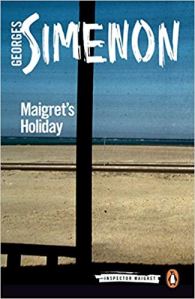
Maigret’s Holiday by Georges Simenon is one of my TBRs, the 28th Inspector Maigret novel in which Maigret’s wife falls ill whilst on their seaside holiday at Les Sables d’Olonne and  a visit to the hospital sends him on an unexpected quest to find justice for a young girl.

Maigret's Holiday


The street was narrow, like all the streets in the old quarter of Les Sables d’Olonne, with uneven cobblestones and pavements so narrow that you had to step off to let another person pass.

Also every Friday there is The Friday 56, hosted by Freda at Freda’s Voice.

30879-friday2b56These are the rules:

  1. Grab a book, any book.
  2. Turn to page 56, or 56% on your eReader. If you have to improvise, that is okay.
  3. Find any sentence (or a few, just don’t spoil it) that grabs you.
  4. Post it.
  5. Add the URL to your post in the link on Freda’s most recent Friday 56 post.

Page 56:

‘I was very fond of that girl, but I repeat that my feelings for her were purely fraternal. I am aware that things are often otherwise. A man can easily be in love with two sisters, especially if they are both living under his roof. That is not the case  and besides, Lili was not in love with me. I’ll go further. I was the exactly the opposite of what she loved. She found me cold and cynical. She often said I had no heart.’

I’ve been reading the Maigret books as I come across them – so, totally out of order of publication. It doesn’t seem to matter. Maigret’s Holiday was originally published in 1948

Have read this book? What did you think about it? And if you haven’t, would you keep on reading?