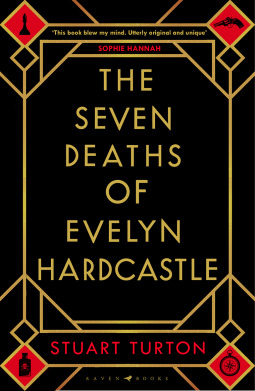
My Friday Post: The Seven Deaths of Evelyn Hardcastle by Stuart Turton

Book Beginnings Button

Every Friday Book Beginnings on Friday is hosted by Gillion at Rose City Reader where you can share the first sentence (or so) of the book you are reading, along with your initial thoughts about the sentence, impressions of the book, or anything else the opener inspires.

At least two of my blogging friends, Cleo and Helen, have written reviews of The Seven Deaths of Evelyn Hardcastle, which have tempted me to at least have a look at this book. I hesitate because it’s written in the present tense, which often irritates me. So I decided to borrow a copy from the library and I collected it yesterday.


The Seven Deaths of Evelyn Hardcastle

Day One

I forget everything between footsteps.

‘Anna!’ I finish shouting, snapping my mouth shut in surprise.

My mind has gone blank. I don’t know who Anna is or why I’m calling her name. I don’t even know how I got here. I’m standing in a forest, shielding my eyes from the spitting rain. My heart’s thumping, I reek of sweat and my legs are shaking. I must have been running but I can’t remember why.

Blurb:

‘Somebody’s going to be murdered at the ball tonight. It won’t appear to be a murder and so the murderer won’t be caught. Rectify that injustice and I’ll show you the way out.’

It is meant to be a celebration but it ends in tragedy. As fireworks explode overhead, Evelyn Hardcastle, the young and beautiful daughter of the house, is killed.

But Evelyn will not die just once. Until Aiden – one of the guests summoned to Blackheath for the party – can solve her murder, the day will repeat itself, over and over again. Every time ending with the fateful pistol shot. 

The only way to break this cycle is to identify the killer. But each time the day begins again, Aiden wakes in the body of a different guest. And someone is determined to prevent him ever escaping Blackheath…

Also every Friday there is The Friday 56, hosted by Freda at Freda’s Voice. These are the rules:

  1. Grab a book, any book.
  2. Turn to page 56, or 56% on your eReader.
  3. Find any sentence (or a few, just don’t spoil it) that grabs you.
  4. Post it.
  5. Add the URL to your post in the link on Freda’s most recent Friday 56 post.

Page 56:

How can I explain that a strange chap in a plague doctor costume warned me to keep an eye out for a footman – a name that means nothing to me, and yet fills me with a crippling fear every time I hear it?

‘I’m sorry, Evie,’ I say, shaking my head ruefully. ‘There’s more I need to tell you, but not here and not quite yet.’

~~~

The endpapers show a plan of Blackheath House and the various cottages in the grounds, together with plans showing the locations of the rooms and where each guest is staying. It reminds me a bit of the game Cluedo.

What do you think – should I carry on reading – or not?


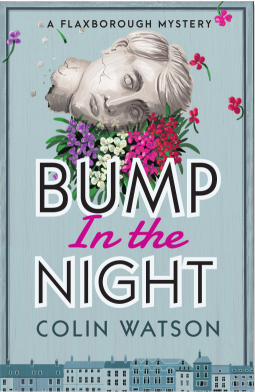
Bump in the Night by Colin Watson

Farrago| 18 March 2018|244 p|e-book|Review copy|4.5*

Description


My Friday Post: The Tenderness of Wolves by Stef Penney

Book Beginnings Button

Every Friday Book Beginnings on Friday is hosted by Gillion at Rose City Reader where you can share the first sentence (or so) of the book you are reading, along with your initial thoughts about the sentence, impressions of the book, or anything else the opener inspires.

I am at the stage where I just don’t know what to read next – there are so many books I want to read but I keep picking one up, putting it down, picking up yet more books not sure which one is the right one for me right now.

But yesterday I wrote about some of my TBRs including The Tenderness of Wolves by Stef Penney and as three of my blogging friends, Cath, Sandra and Leah all said how much they had enjoyed it, I’m going to start reading it today.

The Tenderness of Wolves


The last time I saw Laurent Jammet, he was in Scott’s store with a dead wolf over his shoulder.

Also every Friday there is The Friday 56, hosted by Freda at Freda’s Voice. These are the rules:

  1. Grab a book, any book.
  2. Turn to page 56, or 56% on your eReader.
  3. Find any sentence (or a few, just don’t spoil it) that grabs you.
  4. Post it.
  5. Add the URL to your post in the link on Freda’s most recent Friday 56 post.

Page 56

I have brought a knife in my pocket, which I am now holding, rather more tightly than is necessary. It’s not really that I think for a moment the murderer would come back – for what? – but I creep on, one hand on the cabin wall, until I can listen by the window for sounds within.

Blurb:

Canada, 1867. A young murder suspect flees across the snowy wilderness. Tracking him is what passes for the law in this frontier land: trappers, sheriffs, traders and the suspect’s own mother, desperate to clear his name. As the party pushes further from civilisation, hidden purposes and old obsessions are revealed. One is seeking long-lost daughters; another a fortune in stolen furs; yet another is chasing rumours of a lost Native American culture. But where survival depends on cooperation, their fragile truce cannot afford to be broken, nor their overriding purpose – to find justice for a murdered man – forgotten.

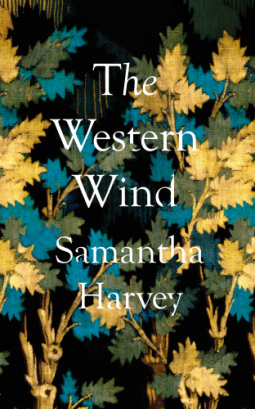
The Western Wind by Samantha Harvey

Jonathan Cape, Vintage Digital| 1 March 2018|304 p|Review copy|4.5*

Description

Six Degrees from The Beauty Myth to The Labours of Hercules

I love doing Six Degrees of Separation, a monthly link-up hosted by Kate at Books Are My Favourite and Best. Each month a book is chosen as a starting point and linked to six other books to form a chain. A book doesn’t need to be connected to all the other books on the list, only to the one next to it in the chain.

This month the chain begins with The Beauty Myth by Naomi Wolf.

The Beauty Myth

This book is described on Goodreads as the bestselling classic that redefined our view of the relationship between beauty and female identity.  I haven’t read it  and most probably won’t read it. So the first link in my chain is to a book about a mythical woman known for her beauty and for being the cause of the fall of Troy. It is

Helen of Troy

Helen of Troy by Margaret George, a modern retelling of the ancient myth of Helen, Paris and the Trojan War. Coincidentally we’ve been watching the BBC’s Troy: Fall of a City I’m never sure I really want to watch film or TV adaptations and yet I find myself drawn to them. This leads me on to

Mythos: A Retelling of the Myths of Ancient Greece

Mythos: The Greek Myths Retold by Stephen Fry, although he hasn’t included the details of the Trojan War – he begins at the beginning where the poets captured the stories told by the Greeks of their gods, monsters and heroes – but doesn’t end at the end.

But Fry does include the story of King Tantalus, who was punished for his crimes by being made to stand in a pool of water beneath a fruit tree with low branches, with the fruit ever eluding his grasp, and the water always receding before he could take a drink. A modern re-working of the story is in my next chain link:

Tantalus: the sculptor's story by [Westwell, Jane]

Jane Westwell’s novel, Tantalus is the story of two lovers are separated not by barriers of race, class or creed, but by something much more devastating  – by time. They can see and can talk to each other  but can never touch. Theirs is an impossible love as each is trapped in their own time and space.

Another modern version of one of the Greek myths is that of Penelope and Odysseus in


The Penelopiad

Margaret Atwood’s The Penelopiad: The Myth of Penelope and Odysseus, described by Mary Beard in the Guardian as ‘exploring the very nature of mythic story-telling.’ This is one of the Canongate Myth series of books – retelling Homer’s account in the Odyssey. It also links to Helen of Troy as she is Penelope’s cousin. Atwood’s version explores what Penelope was really up to whilst Odysseus was away for twenty years.

My next link is to another book in the Canongate series:

Weight: The Myth of Atlas and Heracles


Weight: the Myth of Atlas and Heracles by Jeanette Winterson. Atlas, the guardian of the Garden of Hesperides and its golden apples, leads a rebellion against the Olympian gods and incurs divine wrath. For this the gods force him to bear the weight of the earth and the heavens for eternity. When Heracles, for one of his twelve labours, seeks to steal the golden apples he offers to shoulder the world temporarily if Atlas will bring him the fruit.

This brings me to yet another re-working of the Greek myths, about another Heracles – also known as Hercules, and his twelve labours:

The Labours of Hercules by Agatha Christie is a collection of 12 short stories featuring Hercule Poirot, first published in 1947. The stories were all first published in periodicals between 1939 and 1947.

The labours of Hercules were set for the classical Greek hero by King Eurystheus of Tiryns as a penance. On completing them he was rewarded with immortality. Hercule Poirot is a very different figure from the Greek hero, Hercules, but there is one way in which they are alike – Christie writes: ‘Both of them, undoubtedly, had been instrumental in ridding the world of certain pests … Each of them could be described as a benefactor to the Society he lived in … ‘

Poirot has set himself the task of solving twelve cases corresponding to the Twelve Labours of Hercules, including The Apples of the Hesperides, in which Poirot’s apples are emeralds on a tree around which a dragon is coiled, on a missing Italian renaissance goblet. It seems that Poirot may have to go on a world tour to investigate locations in five different parts of the globe in order to retrieve the goblet.

My chain this month has the same link running through the book – that of myths. From the modern obsession with beauty back to ancient myths and their modern versions and ending with a collection of short stories of crime fiction based on the Greek myths.

Next month  (April 7, 2018), we’ll begin with Arthur Golden’s bestseller, Memoirs of A Geisha.

My Week in Books: 28 February 2018

This Week in Books is a weekly round-up hosted by Lypsyy Lost & Found, about what I’ve been reading Now, Then & Next.

IMG_1384-0

A similar meme,  WWW Wednesday is run by Taking on a World of Words.

Now:

51IBFwYPBfLMunich by Robert Harris, set in 1938, beginning in September as Hitler is determined to start a war and Chamberlain is desperate to preserve the peace. I’ve read about half the book and am finding it fascinating.

Blurb

As Chamberlain’s plane judders over the Channel and the Führer’s train steams relentlessly south from Berlin, two young men travel with secrets of their own. 

Hugh Legat is one of Chamberlain’s private secretaries; Paul Hartmann a German diplomat and member of the anti-Hitler resistance. Great friends at Oxford before Hitler came to power, they haven’t seen one another since they were last in Munich six years earlier. Now, as the future of Europe hangs in the balance, their paths are destined to cross again. 

When the stakes are this high, who are you willing to betray? Your friends, your family, your country or your conscience?

Bookworm: A Memoir of Childhood Reading by Lucy Mangan, due to be published tomorrow, 1 March 2018. This is a delightful book taking me back to the books of my childhood as Lucy Mangan describes the books she loved. I’ve nearly finished it, so I’ll post my review soon.

Blurb

The Cat in the Hat? Barbar? The Very Hungry Caterpillar? Whoever it was for you, it’s very hard to forget the vivid intensity of your first encounter with a book.

As a bespectacled young bookworm, Lucy Mangan devoured books: from early picture books, to Swallows and Amazons, Enid Blyton to Little Women, and from trashy teen romances to her first proper ‘grown-up’ novels. In Bookworm, she revisits this early enthusiasm; celebrating the enduring classics, and disinterring some forgotten treasures.

This is a love letter to the joys of childhood reading, full of enthusiasm and wit, telling the colourful story of our best-loved children’s books, the extraordinary people who created them, and the thousand subtle ways they shape our lives. It also comes packed with brilliant recommendations to inspire the next generation of bookworms and set them on their way.

This impassioned book will bring the unforgettable characters of our collective childhoods back to life – prompting endless re-readings, rediscoveries, and, inevitably, fierce debate. It will also act as an invaluable guide to anyone looking to build a children’s library and wondering where to start, or where to go next.

Then:

The last book I finished is Dry Bones in the Valley by Tom Bouman. This book has won several awards: Los Angeles Times Book Prize for Mystery/Thriller (2014), Edgar Award for Best First Novel (2015), Strand Critics Award Nominee for Best First Novel (2014). I really enjoyed it. My review will be up soon.

Blurb

When an elderly recluse discovers a corpse on his land, Officer Henry Farrell follows the investigation to strange places in the countryside, and into the depths of his own frayed soul.

In Wild Thyme, Pennsylvania, secrets and feuds go back generations. The lone policeman in a small township on the sparse northern border, Henry Farrell expected to spend his mornings hunting and fishing, his evenings playing old-time music. Instead, he has watched the dual encroachment of fracking companies and drug dealers bring money and troubles to the area. As a second body turns up, Henry’s search for the killer opens old wounds and dredges up ancient crimes which some people desperately want to keep hidden.

With vivid characters and flawless pacing, Tom Bouman immerses readers in this changing landscape. In these derelict woods, full of whitetail deer and history, the hunt is on…

Next:

The Western Wind by Samantha Harvey, also due to be published tomorrow, 1 March 2018.

Blurb (Amazon):

15th century Oakham, in Somerset; a tiny village cut off by a big river with no bridge. When a man is swept away by the river in the early hours of Shrove Saturday, an explanation has to be found: accident, suicide or murder? The village priest, John Reve, is privy to many secrets in his role as confessor. But will he be able to unravel what happened to the victim, Thomas Newman, the wealthiest, most capable and industrious man in the village? And what will happen if he can’t?

Moving back in time towards the moment of Thomas Newman’s death, the story is related by Reve – an extraordinary creation, a patient shepherd to his wayward flock, and a man with secrets of his own to keep. Through his eyes, and his indelible voice, Harvey creates a medieval world entirely tangible in its immediacy.

Have you read any of these books?  Do any of them tempt you?