The Living and the Dead by Christoffer Carlsson

Penguin| 8 January 2026| 428 pages| e-book| Review copy| 4*

Description

On a cold, snowy winter’s night in 1999, Sander and Killian leave a house party together, in a small town in rural Sweden. The very best of friends, they imagine they will remain so forever.

The next morning, each is a key suspect in a murder. Each has something they want to conceal from the police. And from the other.

The hunt for Mikael Söderström’s killer will take over twenty years. It will see a detective leave the force forever. And it won’t end until a second body is found, and the tight-knit community’s secrets are finally brought to light . . .

My thoughts

The Living and the Dead by Christoffer Carlsson, is translated from the Swedish by Rachel Willson Broyles.

This has a slow start. It has a tense atmosphere and a great sense of place, set in Skavböke, a small town in rural Sweden. .There are many characters and it took me quite some time to sort them out – who were related, who were friends and who were police, although the list of characters at the beginning of the book does help. The narrative is told from the different characters’ perspectives, which was also confusing until I had them sorted in my mind and I had to re-read several passages for a while. It’s not a book to read quickly!

By the time I got to the second half of the book and the action picked up pace it was much more satisfying to read. It kept me guessing what was going on and who the culprit was all the way through. I enjoyed all the twists and turns, which took me by surprise. It’s a dark, bleak thriller with plenty of suspense as secret relationships, rumours and rivalries abound in the small town. I particularly enjoyed Carlsson’s description of the Swedish landscape and characterisation.

I didn’t know until after I’d read this book that it is the third book in Carlsson’s Hallandssviten Series. I’ll certainly be looking out for more of his books.

Christoffer Carlsson was born in 1986 on the west coast of Sweden. He holds a PhD in criminology from the University of Stockholm and is one of Sweden’s leading crime experts. Carlsson is the youngest winner of the Best Swedish Crime Novel of the Year, voted by the Swedish Crime Writers’ Academy, and has won the prestigious Glass Key award for The Living and the Dead, given to the best Scandinavian crime novel of the year. He’s also won the Best Swedish Crime Novel twice.

My thanks to the publishers, Penguin and NetGalley for a review copy.

WWW Wednesday 28 January 2026

WWW Wednesday is run by Taking on a World of Words.

The Three Ws are:

What are you currently reading?
What did you recently finish reading?
What do you think you’ll read next?

Currently I’m reading The Inheritance of loss by Kiran Desai, the winner of several prizes including the 2006 Booker Prize. It’s a book I bought in 2007 and meant to read long before now. I’m reading this slowly and so far it’s looking good.

This is set in the Himalayas where a judge and his granddaughter live in a dilapidated mansion. The judge, broken by a world too messy for justice, is haunted by his past. His orphan granddaughter has fallen in love with her handsome tutor, despite their different backgrounds and ideals. The cook’s heart is with his son, who is working in a New York restaurant, mingling with an underclass from all over the globe as he seeks somewhere to call home.

I’m also reading The Unicorn by Iris Murdoch, another book I’ve had and left on the shelves for far too long. I’ve read just a few opening chapters and think I’m going to enjoy this book. It’s set in Ireland, where a young woman goes to work as a governess in the remote Gaze Castle only to find there are no children. She is confronted with a number of weird mysteries and involved in a drama she only partly understands.

The last book I read Quite Ugly One Evening by Chris Bookmyre which will be published in May, so I’ll write about it later. It’s crime fiction set on the Atlantic.

Description from Amazon:

An Atlantic voyage. A family at war. A secret worth killing over.

Reporter Jack Parlabane thrives on chasing stories in unlikely places, and where could be less likely than a fan convention on a cruise liner celebrating a contentious Sixties TV series? But unlike the media family exploiting their show’s renewed relevance, he’s not there to stoke controversy: he’s there to solve a murder.

Already in deep water with his employer, Jack desperately needs a win, and solving this decades-old mystery could be it. Problem is, he’s in the middle of the Atlantic, and someone onboard has already killed once to keep their secret.

And that’s not even the tricky part. No, the tricky part is definitely the dead body locked in a stateroom with him, covered in his blood. Now Jack has to solve two murders, otherwise the only way he’s getting off this ship is in handcuffs – or in a body bag.recalling the unforgettable experience he cannot take to his grave.

What will I read next? It could be Birnam Wood by Eleanor Catton

Like her previous novel The Luminaries, which I loved, this book is set in a fictionalised New Zealand, primarily in and around a national park in the South Canterbury region. The title is taken from a line in Macbeth. It follows members of a guerilla gardening collective, Birnam Wood as, with the help of a charismatic tech billionaire, they undertake a new project on abandoned farmland.

But when the time comes to start another book it could be something completely different.

Top Ten Tuesday: New-To-Me Authors I Read in 2025

Top Ten Tuesday is a weekly meme created by The Broke and the Bookish and now hosted by Jana at That Artsy Reader Girl.

The rules are simple:

Each Tuesday, Jana assigns a new topic. Create your own Top Ten list that fits that topic – putting your unique spin on it if you want. Everyone is welcome to join but please link back to Jana in your own Top Ten Tuesday post. Add your name to the Linky widget on that day’s post so that everyone can check out other bloggers’ lists. Or if you don’t have a blog, just post your answers as a comment.

The topic this week is Bookish Discoveries I Made in 2025 (New-to-you authors you discovered, new genres you learned you like, new bookish resources you found, friends you made, local bookshops you found, a book club you joined, etc.)

I decided to list 10 of the 24 New-to me- authors I read last year. I’ll be looking out for more books by these authors.

Gordon Corera – The Spy in the Archive, nonfiction about Vasili Mitrokhin, a KGB archivist who defected to Britain in 1992. Mitrokhin, a quiet, introverted and determined man, was a reluctant defector, because whilst he loved Russia he came to hate the KGB and the Soviet system.

Sarah Freethy – The Seeker of Lost Paintings, historical fiction set in two timelines, one in the 1940s in Italy and the other in 1997 in London and Italy, about the mystery surrounding a lost painting by Carravagio. 

William Horwood – The Boy With No Shoes: a Memoir, (the author of the Duncton Chronicles, which I haven’t read). This is a long and detailed book. It is beautifully written and as he tells the story of his very early life there are many times when it moved me to tears. His writing is so clear that the places and people he describes spring to life as you read. I loved it, one of the best books I read last year!

Alex Howard – The Ghost Cat, a novella and historical fantasy fiction about Grimalkin’s nine lives from 1887 to 2022. As well as the main story there are Grimalkin’s observations and notes explaining various events and technological changes that had taken place in each period.

Ruth Jones – By Your Side, an emotionally charged book as Linda Standish takes on her last case for the Council’s Unclaimed Heirs Unit, tracking down Levi Norman’s next of kin.

Jess Kidd – Murder at Gull’s Nest, crime fiction set in the 1950s in a seaside town. At times it feels like a cosy crime mystery, but it’s also rather dark and foreboding, whereas at other times there’s some humour and also a hint of a romance.

Rhiannon Lewis – My Beautiful Imperial, historical fiction set in the 19th century in both Wales and Chile. It begins in Wales in March 1865 with Davy Davies, a young teenager who is at the age when he must decide whether to work at the mill or to be a sailor like father. It’s based on the actual events of the Civil War in Chile and the experiences of the author’s ancestor, Captain David Jefferson Davies. 

Hannah Richell – One Dark Night, crime fiction, with a spooky, tense atmosphere about the police investigation into the body of a young woman is discovered in the woods the morning after Halloween. I loved it, one of the best books I read last year.

Lynda Rutledge – West With Giraffes, historical fiction with a colourful cast of characters, about the twelve-day road trip in a custom truck to deliver Southern California’s first giraffes to the San Diego Zoo. It conjures up a vivid picture of America in 1938 during the Great Depression and the Great Hurricane of 1938, the most destructive storm to strike New England in recorded history until 2012’s Hurricane Sandy.

Owen Sheers – Resistance. I love historical fiction, but this is different – it is alternate history. Sheers speculates upon how the course of history might have been altered if Germany had won the Second World War and invaded and occupied Great Britain, an alarming prospect. The plot centres on the inhabitants of the isolated Olchon valley in the Black Mountains of south-east Wales close to Hereford and the border between Wales and England.

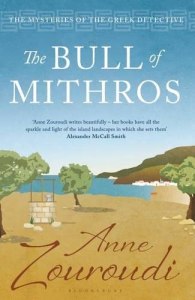
The Feast of Artemis by Anne Zouroudi

Bloomsbury| 2014| 288 pages| paperback| library book| 4 stars

Description

The olive harvest is drawing to a close in the town of Dendra, and when Hermes Diaktoros arrives for the celebratory festival he expects an indulgent day of food and wine. But as young men leap a blazing bonfire in feats of daring, one of them is badly burned. Did he fall, or was he pushed? Then, as Hermes learns of a deep-running feud between two families, one of their patriarchs dies. Determined to find out why, Hermes follows a bitter trail through the olive groves to reveal a motive for murder, and uncovers a dark deed brought to light by the sin of gluttony.

This is the seventh in Anne Zouroudi’s unique series of award-winning books featuring the enigmatic and courteous investigator Hermes Diaktoros, a man as much a mystery as the cases he solves. Who dispatches him to where he’s needed? And on whose authority does he act?

Hermes’s uncertain origins bring an additional level of bafflement to these much-loved stories. Perfect for fans of well-written crime thrillers and armchair travellers alike, they combine compelling suspense with touching portraits of Greek life far away from the tourist hotspots most visitors to Greece know.

‘Firmly in the delicious subgenre of crime-cum-gastroporn pioneered by Andrea Camilleri . . . Essentially gloriously sunny escapism, the perfect holiday read’ – Daily Telegraph

This book is the 7th in Anne Zouroudi’s series about Hermes Diaktoros of Athens, the Greek Detective. Each of the books in the series features one of the Seven Deadly Sins – in this one it is the sin of gluttony. It is set in the town of Dendra, where two families of olive growers, the Papayiannis and the Kapsis, are continuing a long standing feud. It begins on the day the town is celebrating the annual feast day, a festival that replaced an ancient feast in honour of the goddess Artemis. But the feast ends in disaster, when a young boy, Dmitris Kapsis is badly burned jumping a bonfire, either through being pushed or by slipping. The Kapsis family immediately blame the Papayiannis.

Hermes is a detective with a difference. Just who he is and who he works for is never explained. He’s most definitely not a policeman and when asked he says he works for the ‘highest Authorities, whose interests lie in justice where there’s been none. I act on their behalf, in the capacity of what you might call an investigator’ (page 161) . He’s described as ‘the fat man‘:

His owlish glasses gave him an air of academia; under his raincoat, his bark-brown suit was subtly sheened, and expertly tailored to flatter his generous stomach. His pale green polo shirt had a crocodile on the chest, and on his feet he wore white shoes, old fashioned canvas shoes of the type once used for tennis; in his hand was a sportsman’s hold-all in black leather, painted in gold with the emblem of the rising sun. (page 14)

Hermes stays in Dendra, investigating what had happened, together with the death of the head of the Papayiannis family, and the deaths of several townspeople from poisoning, allegedly after eating ice cream from the local gelateria. There are many characters to keep in mind, but this is made easier, by the Dramatis Personae at the beginning of the book. And with so much to investigate there are many twists and turns, but Hermes manages to get to the bottom of all the mysteries and along the way we meet his half-brother Dino, an unkempt and dissolute character, with wine-stained teeth and the smell of alcohol seeping through his pores and the flaking skin on his dry lips black from the wine – an interesting version of the god Dionysus.

I did enjoy reading The Feast of Artemis, following Hermes both as he investigates, enjoys all the Greek foods, learns about the impact of technology on the traditional methods of olive oil production, and interacts with the local people. I loved the descriptions of the Greek town and the surrounding countryside. All in all, a most enjoyable book.

Top Ten Tuesday: Most Recent Additions to My Bookshelf

Top Ten Tuesday is a weekly meme created by The Broke and the Bookish and now hosted by Jana at That Artsy Reader Girl. For the rules see her blog.

The topic today is Most Recent Additions to My Bookshelf.

The Crow’s Inn Tragedy by Annie Haynes

Rating: 3 out of 5.

I have just finished reading is The Crow’s Inn Tragedy by Annie Haynes, originally published in 1927 and republished by Dean Street Press in 2015. I read this for the 2025 Dean Street December challenge hosted by Liz @ Adventures in Running, Reading and Working from Home.

Description from Amazon UK:

“I cannot understand why Mr. Bechcombe apparently offered no resistance. His hand-bell, his speaking-tube, the telephone—all were close at hand. It looks as though he had recognized his assassin and had no fear of him.”

The corner house of Crow’s Inn Square was the most dignified set of solicitors’ chambers imaginable. But this monument to law and order nonetheless becomes the scene of murder – when the distinguished lawyer Mr. Bechcombe, despite giving strict instructions not to be disturbed, is strangled in his own office.

Inspector Furnival of Scotland Yard has to wrestle with fiendish clues, unearth priceless gems and tangle with a dangerous gang before he can solve this case, his third and final golden age mystery. Originally published in 1927, this new edition is the first printed in over 80 years, and features an introduction by crime fiction historian Curtis Evans.

My thoughts:

I hadn’t heard of Annie Haynes (1865 – 1929), but she was a contemporary of Agatha Christie and wrote a series of detective novels between 1923 and 1930. She was born in Ashby de-la-Zouch in Leicestershire, growing up with her mother and younger brother when her parents separated, in her grandparents’ cottage at Coleorton Hall, the seat of the Beaumont baronets. After her mother’s death in 1905, she moved to London and lived with her friend Ada Heather-Bigg, a journalist, philanthropist and feminist. In 1914, at the age of 50, she began suffering from debilitating rheumatoid arthritis that left her in constant pain. She died of heart failure, aged 64, on 30 March 1929. According to crime fiction historian Curtis Evans in his Introduction, it was reported in the press that ‘many people well-known in the literary world’ attended her funeral at St Michael and All Angels in Paddington‘. But by the time Ada Heather-Bigg died in 1944 her mysteries were forgotten until the Dean Street Press republished them.

The Crow’s Inn Tragedy was her third Inspector Furnival Mystery. As you can tell from the description above this is a complicated murder mystery. When solicitor Luke Bechombe is found murdered in his office Inspector Furnival is called in. With the help of Mr Steadman, a barrister and cousin of Luke’s wife they investigate his death. It is far from simple. The Reverend James Collyer, Luke’s brother-in-law, had called to see him about his son, Tony, wanting to raise money to pay his debts. Luke tells him that the emeralds on the family heirloom, the Collyer cross are fake and that there is a regular gang in London stealing jewels, known as the Yellow Gang, under the leadership of the Yellow Dog. Luke’s chief clerk, Amos Thompson, and a mysterious visitor to the office are the chief suspects. Also involved in the mystery are Luke’s secretary Cecily Hoyle, who is in love with Tony and who is obviously hiding some secret, an American couple, Cyril B Carnthwaite and his wife, Luke’s nephew Aubrey Todmarsh, who is a conscientious objector, and who runs a settlement for ex-prisoners called the Community of St Philip .

I thought the setting in the aftermath of the First World War was well done, with details of the hardships and poverty of the returning service men. Tony, for example, who was gassed and wounded during the War had not been able to find a job, and the League of Nations is mentioned scathingly by Luke Bechombe:

“Damn the League of Nations!’ uttered the solicitor, banging his fist upon the writing-pad with an energy that rattled his inkstand. … I look to a largely augmented Air force with plenty of practice in bomb-throwing as my hope for the future. It will be worth fifty of that rotten League of Nations. (page 7)

I enjoyed it for the most part but I think the ending was a bit of a let down becoming too melodramatic and far-fetched for my liking. It reminded me of Agatha Christie’s The Big Four, (also published in 1927) in that it involves a gang of international criminals, and brings in some of the elements of the sensation novel. Inspector Furnival and  Mr Steadman find themselves in danger of certain death as they try to track down the Yellow Gang in an unconvincing twist (to me at any rate) as the book comes to a fast paced conclusion.