The Black Tulip by Alexandre Dumas

4*

The Black Tulip is historical fiction, a love story, mixing historical characters with fictional ones. It was first published in 1850. I loved The Count of Monte Cristo by Alexandre Dumas, so I was hoping to enjoy The Black Tulip too. I did, but not quite as much. I think it’s because I don’t know much about Dutch history and so I found the early chapters, about the brothers Cornelius and Johan de Witt, a bit difficult to follow. They were Dutch statesmen, accused of treason, who were brutally killed by a mob in the Hague in 1672, during a period of political upheaval, when they escaped from prison.

The story centres on Cornelius von Baerle, the fictional godson of Cornelius de Witt and his desire to grow a black tulip. He became involved in the de Witts’ affairs when Cornelius de Witt left a sealed parcel of his correspondence with the French war minister, with him for safekeeping. He didn’t open the parcel and didn’t know what it contained.

When the Tulip Society of Haarlem offered a prize of a hundred thousand guilders for the development of a tulip ‘without a spot of colour‘, this set the tulip growers into a frenzy of activity, including Van Baerle and his neighbour, Isaac Boxtel. Boxtel spied on Van Baerle’s experiments to grow a black tulip, which were having more success than his own efforts. Indeed Boxtel was obsessed with what Van Baerle was doing, neglecting his own tulips to wither and rot as he observed, through a telescope, what his neighbour was doing both in his garden and in his laboratory.

Whilst observing Van Baerle’s laboratory, Boxtel had seen the meeting between Cornelius de Witt and Van Baerle when he entrusted his papers to his godson. On hearing that the de Witt brothers had been arrested Boxtel realised he could inform against Van Baerle and get him arrested, thus giving himself the opportunity to steal the bulb Van Baerle had produced. And the hundred thousand guilder prize would be his.

And so Van Baerle was thrown into prison, wrongly convicted of treason and under sentence of death. However William of Orange, Stadtholder of Holland granted him his life but condemned him to imprisonment for life. He was sent to the fortress of Loewestein and there kept in solitary confinement. What follows is a dark and somewhat farcical tale, as aided by the jailer’s daughter Rosa he continues to cultivate his tulip bulbs. He and Rosa fall in love, despite all the difficulties that assault them.

It’s a great story, full of drama and emotion. It’s a love story, a story about passion, hatred, jealousy, obsession and injustice. After the difficulties I had with the first four or five chapters (I had to re-read them to work out how the rest of the story was connected) I found it difficult to put down, keen to find out what would happen next. I didn’t love it like I loved The Count of Monte Cristo, but I really liked it.

Hamlet, Revenge! by Michael Innes

A Golden Age Mystery

Hamlet, Revenge! by Michael Innes has been languishing on my TBR shelves for 9 years, mainly because it is in such a small font making it difficult for me to read. It was first published in 1937. My copy was published in 1961 in paperback with the cover shown in the photo above.

Synopsis:

A Scotland Yard detective probes a high-society house party for someone rotten when a government official is murdered in this classic British mystery.

Preparations are underway for a grand party at Scamnum Court, the sweeping English country estate of the fabulously wealthy Duke of Horton. Some of the nation’s elite are invited for dinner, and some are even set to star in a semi-amateur production of Hamlet on an authentic Elizabethan stage in the banqueting hall. No expense is spared, but one guest soon pays with his life. Before the play ends, a shot is fired, and the actor playing Polonius―Lord Auldearn, the Lord Chancellor of England―is dead.

With war looming on the horizon, suspicions arise over the possibility of espionage. Therefore, the prime minister sends Insp. John Appleby not only to investigate, but to also find a confidential government document. Appleby is lucky there’s a mystery novelist eager to lend a hand with the extensive guest list at Scamnum Court. He will need all the help he can get if he hopes to prevent the killer from making an encore performance . . .

My thoughts

This is the second Inspector John Appleby book. And like the first, Death at the President’s Lodging (my review) it is a most complex mystery. When Lord Auldearn, Lord Chancellor of England is murdered on stage during an amateur production of Hamlet at Scamnum Court the Prime Minister asks Appleby to investigate. Because there’s a possibility that espionage is involved, the PM tells Appleby not to trust anybody. It’s all very vague. The PM tells him there’s a document concerning

… the organization of large industrial interests on an international basis, in the event of a certain international situation. The general drift towards the matter such a document embodies cannot, you realize, well be secret; nothing big can be secret. But the details may be. And this document might be useful in two ways: the detailed information might be useful to one powerful interest or another: and accurate possession of the details, as circumstantial evidence of something already known in general terms, might be useful to an unfriendly government.

…War? said Appleby … (pages 83,84)

The book begins with a Prologue.which is is longer than most prologues. It sets the scene, describing Scamnum Court in detail. It’s the family seat of the Crispin family, described as ‘a big place: two counties away it has a sort of little brother in Blenheim Palace.’ All the characters are introduced, including Giles Gott, who was also in Death at the President’s Lodging. An eminent Elizabethan scholar, he is the director of the play. The other characters are also introduced; Lord Auldearn, the Lord Chancellor of England, who plays Polonius, and numerous other family members, guests and members of the Scamnum Court staff.

There are thirty people involved in the play, actors and those behind the scenes, plus twenty seven in the audience. I found this section too long (74 pages in my copy) and it took me more than a while to identify who was who! My attention was drooping as I read pages of long meandering, descriptive paragraphs and I wondered when there would be a murder. And there is a lot of information about the staging of the play and numerous Shakespearean references. Before the performance the murderer delivered a number of warning messages about revenge, so everybody is on edge.

Appleby doesn’t appear until the second section and then the pace picks up considerably as he and Gott question the suspects. It gets more complicated when a second murder, that of Mr Bose, the prompter who was on stage and who could possibly have seen who shot Lord Auldearn. I was puzzled for much of the time as I read – it’s a book that you can’t read quickly and it requires concentration. I had no idea who the culprit was as Appleby and Gott tried to eliminate the suspects and answer numerous questions, such as why was Lord Auldearn shot and not stabbed as Polonius the character he played was, why did the murderer come onto the stage to shoot him and risk being seen by Bose, why did he send the mysterious messages about revenge – what revenge was being sought, and was the possible espionage plot the reason behind the shooting? Or was the reason a personal one?

From being confused and overwhelmed by the puzzle I became thoroughly absorbed by the mystery and was eagerly turning the pages to find out all the answers. It’s a book I really need to re-read to get to grips with it – I’m sure I missed so much. My post falls far short of doing justice to the book!

Close to Death: Book Beginnings & The Friday 56

Every Friday Book Beginnings on Friday is hosted by Gillion at Rose City Reader where you can share the first sentence (or so) of the book you are reading. You can also share from a book you want to highlight just because it caught your fancy.

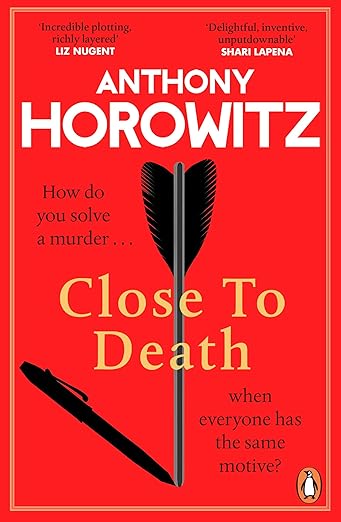
I’m featuring Close to Death by Anthony Horowitz, book 5 in the Hawthorne and Horowitz murder mystery series. It’s on my 20 Books of Summer list.

Book Beginning:

It was four o’clock in the morning, that strange interval between night and morning when both seem to be fighting each other for control of the day ahead.

Also every Friday there is The Friday 56, hosted by Freda at Freda’s Voice, but she is taking a break and Anne at My Head is Full of Books has taken on hosting duties in her absence. You grab a book and turn to page 56 (or 56% of an eBook), find one or more interesting sentences (no spoilers), and post them.

‘We’re not going to let them get away with it,’ Roderick exclaimed. ‘Someone should do something about him! Someone should … I don’t know! Ever since he came here, he’s been nothing but trouble.’

Synopsis from Goodreads:

In New York Times–bestselling author Anthony Horowitz’s ingenious fifth literary whodunit in the Hawthorne and Horowitz series, Detective Hawthorne is once again called upon to solve an unsolvable case—a gruesome murder in an idyllic gated community in which suspects abound

Riverside Close is a picture-perfect community. The six exclusive and attractive houses are tucked far away from the noise and grime of city life, allowing the residents to enjoy beautiful gardens, pleasant birdsong and tranquility from behind the security of a locked gate.

It is the perfect idyll until the Kenworthy family arrives, with their four giant, gas-guzzling cars, a gaggle of shrieking children and plans for a garish swimming pool in the backyard. Obvious outsiders, the Kenworthys do not belong in Riverside Close, and they quickly offend every last one of their neighbours.

When Giles Kenworthy is found dead on his own doorstep, a crossbow bolt sticking out of his chest, Detective Hawthorne is the only investigator that can be called on to solve the case.

Because how do you solve a murder when everyone is a suspect?

~~~

What do you think, does it appeal to you? What are you currently reading?

Book Beginnings on Friday & The Friday 56: The Square of Sevens by Laura Shepherd-Robinson

Every Friday Book Beginnings on Friday is hosted by Gillion at Rose City Reader where you can share the first sentence (or so) of the book you are reading. You can also share from a book you want to highlight just because it caught your fancy.

I’m featuring The Square of Sevens by Laura Shepherd-Robinson, the last book I bought. It’s set in 18th century England, beautifully written, and it’s weird and wonderful!

Book Beginning:

People like to say they seek the truth. Sometimes they even mean it. The truth is they crave the warm embrace of a lie.

Also every Friday there is The Friday 56, hosted by Freda at Freda’s Voice, but she is taking a break and Anne at My Head is Full of Books has taken on hosting duties in her absence. You grab a book and turn to page 56 (or 56% of an eBook), find one or more interesting sentences (no spoilers), and post them.

Page 56:

The De Lacy family swiftly became my new obsession. I spent many hours up in the attic in that autumn of 1739, wedged between a moth-eaten crocodile, a broken astrolabe, and the tusk of a narwhale, curiosities banished here by Mrs Freemantle.

Description from Amazon:

Laura Shepherd-Robinson’s The Square of Sevens is an epic and sweeping mystery set in Georgian high society, a dazzling story offering up intrigue, heartbreak, and audacious twists.

A girl known only as Red, the daughter of a Cornish fortune-teller, travels with her father making a living predicting fortunes using the ancient method: the Square of Sevens. When her father suddenly dies, Red becomes the ward of a gentleman scholar.

Now raised as a lady amidst the Georgian splendour of Bath, her fortune-telling is a delight to high society. But she cannot ignore the questions that gnaw at her soul: who was her mother? How did she die? And who are the mysterious enemies her father was always terrified would find him?

The pursuit of these mysteries takes her from Cornwall and Bath to London and Devon, from the rough ribaldry of the Bartholomew Fair to the grand houses of two of the most powerful families in England. And while Red’s quest brings her the possibility of great reward, it also leads her into grave danger . . .

~~~

What do you think, does it appeal to you? What are you currently reading?

Spell the Month in Books – April 2024

Spell the Month in Books is a linkup hosted by Jana on Reviews From the Stacks on the first Saturday of each month. The goal is to spell the current month with the first letter of book titles, excluding articles such as ‘the’ and ‘a’ as needed. That’s all there is to it! Some months there are optional theme challenges, such as “books with an orange cover” or books of a particular genre, but for the most part, any book you want to use is fair game!

This month’s theme is Poisson d’Avril – The French version of April Fool’s Day involves fish, so let’s look for books related to fish, bodies of water, or comedy. But, I looked and didn’t come up with any ideas to fit the theme.

So, this month the books I’ve chosen are all books I’ve read.

A is for Alibi by Sue Grafton 4*


Sue Grafton is the author of the alphabet- titled series of books featuring Kinsey Millhone, a private investigator. The books are set in and around the fictional town of Santa Teresa, California, based on Santa Barbara.

 Kinsey is a likeable, strong character. In this first book she comes across as a loner. She’s 32, twice divorced with no children or pets, or indeed any ties, although she does have plenty of friends and contacts who help out with her investigations and she goes jogging – a lot. There are  some cameos of characters, who I suspect feature in the later books. There is her landlord Henry Pitts, a former baker aged 81 who makes a living devising crossword puzzles. Kinsey is ‘halfway in love’ with Henry.

It’s a fast-paced book, easy to read and with no gory details, which I have to skim read in other books (the equivalent of watching the TV  behind my fingers). I liked it but haven’t read any of the other books in the series.

P is for The Private Patient by P D James 4*

When the notorious investigative journalist Rhoda Gradwyn books into Mr Chandler-Powell’s private clinic in Dorset for the removal of a disfiguring and long-standing scar, she has every prospect of a successful operation by a distinguished surgeon, a week’s peaceful convalescence in one of Dorset’s most beautiful manor houses, and the beginning of a new life. She was never to leave Cheverell Manor alive. Commander Adam Dalgleish and his team are called to the Manor to investigate her death. 

R is for Restless Dolly Maunder by Kate Grenville 4*

This is the fictionalised life story of Kate Grenville’s maternal grandmother, Sarah Catherine Maunder, known as Dolly. She was the sixth child of Thomas and Sarah Maunder, born in Currabubula, New South Wales, Australia in 1881. She was not only restless but also clever and determined – she knew what she wanted and she did her best to achieve it.

Restless Dolly Maunder casts light not just on Dolly’s life but also on life in Australia for most of the 20th century. The book has a relentless pace as it tells her life story as she propels herself from place to place and from business to business, enjoying success whilst it lasted and enduring all else, not stopping to pause breath in her restless pursuit of what came next.

I is for Imperium by Robert Harris, historical fiction set in Ancient Rome. 4*

Beginning in 79 BC, this book set in the Republican era is a fictional biography of Marcus Tullius Cicero by Tiro, his slave secretary. Tiro was a real person who did write a biography of Cicero, which has since been lost in the collapse of the Roman Empire. Tiro is credited with the invention of shorthand. Harris has based Imperium on, among other sources, Cicero’s letters, which Tiro had recorded, successfully interweaving Cicero’s own words with his own imagination.  It is basically a political history, a story filled with intrigue, scheming and treachery in the search for political power as Cicero, a senator, works his way to power as one of Rome’s two consuls.

L is for The Luminaries by Eleanor Catton 4*

This is a long and detailed book, written with such intricate plotting and numerous characters that it bewildered me at times. It’s historical fiction set in New Zealand in the 1860s, during its gold rush and it has everything – gold fever, murder, mystery and a ghost story too.

I loved the pictures it builds up of the setting in New Zealand, the frontier town and its residents from the prospectors to the prostitutes, and the obsessive nature of gold mining. And I did become fully absorbed in the story during the week it took me to read.

The next link up will be on May 4, 2024 when the optional theme will be Nature.

WWW Wednesday: 10 April 2024

WWW Wednesday is run by Taking on a World of Words.

The Three Ws are:

What are you currently reading?
What did you recently finish reading?
What do you think you’ll read next?

Currently I’m reading The Case of the Gilded Fly by Edmund Crispin, written while Crispin was an undergraduate at Oxford.I wrote about its beginning and an extract from page 56 in my Book Beginnings post here. It’s the first Gervase Fen Mystery, a locked room mystery, first published in 1944.

Edmund Crispin was the pseudonym of (Robert) Bruce Montgomery (1921-1978). His first crime novel and musical composition were both accepted for publication while he was still an undergraduate at Oxford. After a brief spell of teaching, he became a full-time writer and composer (particularly of film music. He wrote the music for six of the Carry On films. But he was also well known for his concert and church music). He also edited science fiction anthologies, and became a regular crime fiction reviewer for The Sunday Times. (from Goodreads)

The last book I read was Nero by Conn Iggulden, an Advanced Reader Copy via NetGalley; the expected publication date is 23 May 2024. It’s the first in a new trilogy, historical fiction set in Ancient Rome, telling of Nero’s birth and early years, so it’s more about his mother Agrippina than about Nero. It doesn’t shy away from the brutality of the age, particularly those of Tiberius, Caligula and Claudius, who was easily as ruthless as his predecessors. I read and watched the TV series I Claudius and Claudius the God years ago and this book is making me want to re-read those books. I find the period absolutely fascinating. I’ll be writing more about nearer to its publication.

I’m never sure what I’ll be reading next but it could be: Enemies and Neighbours: Arabs and Jews in Palestine and Israel, 1917-2017 by Ian Black because I want to understand more about the conflict between Palestine and Israel.

Synopsis from Amazon UK

A century after Britain’s Balfour Declaration promised a Jewish ‘national home’ in Palestine, veteran Guardian journalist Ian Black has produced a major new history of one of the most polarising conflicts of the modern age.

Drawing on a wide range of sources – from declassified documents to oral testimonies and his own decades of reporting – Enemies and Neighbours brings much-needed perspective and balance to the long and unresolved struggle between Arabs and Jews in the Holy Land.

Beginning in the final years of Ottoman rule and the British Mandate period, when Zionist immigration transformed Palestine in the face of mounting Arab opposition, the book re-examines the origins of what was a doomed relationship from the start. It sheds fresh light on critical events such as the Arab rebellion of the 1930s; Israel’s independence and the Palestinian catastrophe (Nakba in Arabic) of 1948; the watershed of the 1967 war; two Intifadas; the Oslo Accords and Israel’s shift to the right. It traces how – after five decades of occupation, ever-expanding Jewish settlements and the construction of the West Bank ‘separation wall’ – hopes for a two-state solution have all but disappeared, and explores what the future might hold.

Yet Black also goes beyond the most newsworthy events – wars, violence and peace initiatives – to capture thereality of everyday life on the ground in Jerusalem and Hebron, Tel Aviv,Ramallah, Haifa and Gaza, for both sides of an unequal struggle. Lucid, timelyand gripping, Enemies and Neighbours illuminates a bitter conflict that shows no sign of ending – which is why it is so essential that we understand it.

Although this is a weekly meme I’m only taking part occasionally.