Elizabeth is Missing by Emma Healey

The events in that unfold in Emma Healey’s debut novel, Elizabeth is Missing are seen through Maud’s eyes. But Maud is an unreliable narrator – she can’t help it though as she has dementia.

Emma Healey’s depiction of dementia is convincing showing the confusion and bewilderment that Maud must have felt. It’s heart-rending, as she knows that Elizabeth, her friend, is missing, but doesn’t know where she is and no one seems to be listening to her when she talks about her – her own daughter and Elizabeth’s son just don’t answer her questions. And she asks them over and over again. As Maud continues her search for Elizabeth, she also recalls the search for her sister, Sukey, who disappeared in 1946.

It is not a book that I can say I ‘enjoyed’, even though it’s well written and with convincing characters. I thought it was over long and maybe would have been better as a novella. Inevitably, because the narrator has dementia there is much repetition – too much for me. I was disappointed with the plot too, because the ending became predictable quite early on in the book. Overall then a depressing book.

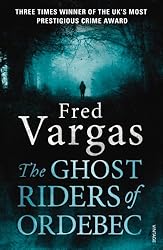
First Chapter First Paragraph: The Ghost Riders of Ordebec

First chapterEvery Tuesday Diane at Bibliophile by the Sea hosts First Chapter First Paragraph Tuesday Intros, where you can share the first paragraph, or a few, of a book you are reading or thinking about reading soon.

My book this week is a library book that I’m thinking about reading soon. It’s The Ghost Riders of Ordebec by Fred Vargas, translated from the French by Sian Reynolds.

It begins:

A trail of tiny crumbs led from the kitchen into the bedroom, as far as the spotless sheets where the old woman lay dead, her mouth open. Commissaire Adamsberg looked down at the crumbs in silence, pacing to and fro, wondering what kind of Tom Thumb – or what ogre in this case – might have dropped them there. He was in a small, dark, ground-floor apartment, with just three rooms, in the eighteenth arrondissement, in northern Paris.

Blurb:

‘˜People will die,’ says the panic-stricken woman outside police headquarters.

She refuses to speak to anyone besides Commissaire Adamsberg. Her daughter has seen a vision: ghostly horsemen who target the most nefarious characters in Normandy. Since the middle ages there have been stories of murderers, rapists, those with serious crimes on their conscience, meeting a grisly end following a visitation by the riders.

Soon after the young woman’s vision a notoriously vicious and cruel man disappears. Although the case is far outside his jurisdiction, Adamsberg agrees to investigate the strange happenings in a village terrorised by wild rumours and ancient feuds.

What do you think? Would you keep on reading?

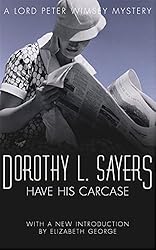
Have His Carcase by Dorothy L Sayers

Have His Carcase, first published in 1932, is another brilliant book – completely different from the last book I wrote about (see my previous post) but just as fascinating and absorbing. It’s crime fiction from the **Golden Age (see the note below), that is between the First and Second World Wars, and is the second of Dorothy L Sayer’s books featuring Harriet Vane, a crime fiction writer, and the seventh featuring Lord Peter Wimsey. They first met in Strong Poison, in which Harriet was on trial charged with the murder of her former lover.

In Have His Carcase Harriet is on a walking holiday when she comes across a dead man, his throat cut from ear to ear, lying on the top of a rock, called locally the Flat-Iron, on a deserted beach. Fortunately she has her camera with her and takes several photos, which come in very useful as by the time that she can alert the police the body has been washed out to sea. It appears that he committed suicide. Wimsey arrives soon after and he and Harriet they set out first of all to identify the body and then to prove that it was murder.

It is an example of the puzzle type of crime fiction – incredibly complicated and seemingly impossible to solve. It involves numerous characters who are not who they first appear, complete with alibis, disguises and false trails. Sayers, helpfully included a schedule of things that Harriet and Wimsey noted about the victim and the suspects, which I found useful as this is a long novel that took me several days to read; with so much information I just couldn’t remember it all as I read the book.

It all hinges on the timing of the discovery of the body and the movement of the tides. As in The Nine Tailors (and in fact in all the books by Dorothy L Sayers that I’ve read) there is a lot of detail, all of which is essential to the plot; detail about the body, how it was found, how the throat was cut , and what the blood was like when Harriet found the body. In the hands of another writer this could have been too graphic for me, but I had no difficulty reading such detail at all!

Also added into the mix are Bolsheviks, rumours of aristocratic connections, spies and a secret code to be deciphered. There are jealous lovers, itinerant hairdressers, a schoolteacher with Communist sympathies, taciturn locals, an antagonistic future son-in-law and  gigolos and dagos. (Written in the early 1930s this is not a politically correct novel.)

An underlying theme is the relationship between Harriet and Wimsey as he is constantly proposing marriage and she rejects him each time. Although at one point, as they walked along the beach together in search of clues, it did look briefly that her resolve was weakening:

She suddenly saw Wimsey in a new light. She knew him to be intelligent, clean, courteous, wealthy, well-read, amusing and enamoured, but he had not so far produced in her that crushing sense of utter inferiority which leads to prostration and hero-worship. But she now realised that there was, after all, something godlike about him. (pages 213-4)

and then she came to her senses and laughed. Earlier she had noted his physique as they inspected the Flat-Iron in the sea:

‘And he strips better than I should have expected,’ she admitted candidly to herself. ‘Better shoulders than I realised, and, thank Heaven, calves to his legs,’ (page 104)

Here are some more of my favourite quotations:

I question this first one!:

To be tried for murder is a fairly good advertisement for a writer of detective fiction. (page 1)

and on seeing what appears to be a man asleep Harriet says:

Now, if I had any luck, he’d be a corpse, and I should report him and get my name in the papers. That would be something like publicity. “Well-known Woman Detective-Writer Finds Mystery Corpse on Lonely Shore.” But these things never happen to authors. (page 7)

Well, she got her wish.

Next, here is Wimsey remarking on his use of quotations, which he does throughout the book:

I always have a quotation for everything – it saves original thinking. (page 58)

and Wimsey to Harriet after she apologised for being ‘a rotten dancer’:

Darling if you danced like an elderly elephant with arthritis, I would dance the sun and moon into the sea with you. I have waited a thousand years to see you dance in that frock. (page 157)

I loved the complexity, the details, and the various solutions Wimsey and Harriet considered. It kept me guessing throughout the book right from the start – just who was the victim, even when he was identified there was more to it, who murdered him, why was he murdered and above all just how and when was he murdered. It’s brilliant!
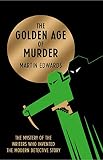
**Note: I must get a copy of Martin Edwards’ new book The Golden Age of Murderinvestigating how Agatha Christie and colleagues in the Detection Club transformed crime fiction, writing books casting new light on unsolved murders whilst hiding clues to their authors’ darkest secrets.

It’s due to be published on 7 May.
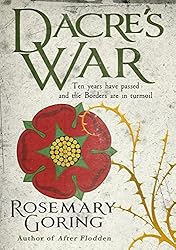
Dacre’s War by Rosemary Goring

Dacre’s War is compelling reading, a  thoroughly absorbing and beautifully written novel set in the Scottish and English Borders and London between 1523 – 1525 some ten years after the events described in Rosemary Goring’s earlier book, After Flodden. I wondered as I began reading whether it could equal After Flodden, a book I loved when I read it two years ago – it did. I think it even surpasses it.

I loved Dacre’s War and keen as I was to read to the end I didn’t want to leave the characters. Once again I was swept away by the story, re-living the scenes through Rosemary Goring’s vivid descriptions and the drama of the characters’ lives, people who came to life in the pages of this book.

Dacre’s War describes how Adam Crozier, the head of his clan, plots to take revenge on Lord Thomas Dacre, the Warden General of the English Marches and the Keeper of Carlisle, who had brought about the death of Adam’s father. Ten years after the Battle of Flodden, Dacre is the most powerful man in the north of England, but the Marches are a constant battlefield, dangerously out of control, and a hotbed of thieves and killers in thrall to the Warden. Without him Henry VIII believes the situation would be much worse.

It is against this background that Crozier forms an alliance with Dacre’s enemies, both English and Scots to inform Henry of Dacre’s crimes and bring about his downfall.

There are some remarkable scenes in this book, and amongst them are the scenes in the Star Chamber where Dacre is brought to answer the charges against him in front of Cardinal Wolsey and his imprisonment in the Fleet Prison. I felt as though I was there, watching, breathing the same air – not a pleasant experience. Similarly with Crozier, I could visualise his home, Crozier’s Keep, sense the tension and fear as his wife, Louise, is left at home, pregnant and in danger of losing the baby.

There is so much packed in this book, political intrigue, personal conflict and vengeance, and spies, manipulators and double crossers abound. It is impossible to write more without revealing the plot and the eventual ending. It’s a brilliant book.

Dacre’s War is due to be published in June 2015. My copy is a pre-publication review copy courtesy of www.lovereading.co.uk.

  • Hardcover: 352 pages
  • Publisher: Polygon (16 June 2015)
  • Language: English
  • ISBN-10: 1846973112
  • ISBN-13: 978-1846973116

Rosemary Goring was born in Dunbar and studied social and economic history at the University of St Andrews; and, after graduation, worked at W&R Chambers as a reference editor. Rosemary was the literary editor of Scotland on Sunday, followed by a brief spell as editor of Life & Work, the Church of Scotland’s magazine, before returning to newspapers as literary editor of the Herald, and later also of the Sunday Herald. In 2007 she published Scotland: The Autobiography: 2000 Years of Scottish History By Those Who Saw it Happen, which has since been published in America and Russia.

Reading Challenges: Read Scotland, Historical Fiction Challenge.

Stacking the Shelves

STSmall 

Stacking The Shelves is all about sharing the books you are adding to your shelves. This means you can include ‘˜real’ and ‘˜virtual’ books (ie physical and ebooks) you’ve bought, books you’ve borrowed from friends or the library, review books, and gifts.

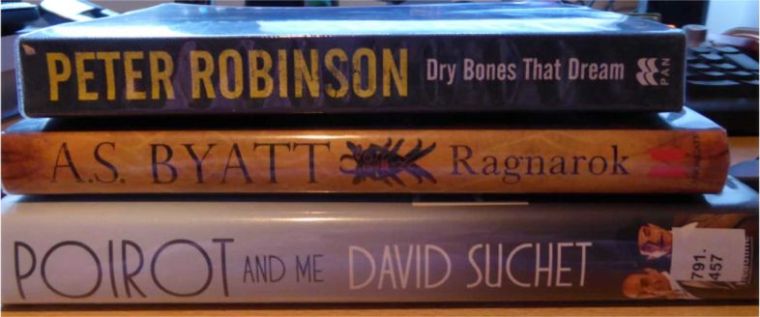
This week I borrowed these books from the library:

Ragnarok 01

Ragnarok by A S Byatt – I first came across this book a few years ago on a book blog (not sure now which one) and thought it looked interesting.

Blurb:

Recently evacuated to the British countryside and with World War Two raging around her, one young girl is struggling to make sense of her life. She is given a book of ancient Norse legends and her inner and outer worlds are transformed…

The Ragnarok myth, otherwise known as the Twilight of the Gods, plays out the endgame of Norse mythology. It is the myth in which the gods Odin, Freya and Thor die, the sun and moon are swallowed by the wolf Fenrir, and the serpent Midgard eats her own tail as she crushes the world and the seas boil with poison. This epic struggle provided the fitting climax to Wagner’s Ring Cycle; Byatt has taken this remarkable finale and used it as the underpinning of a highly personal and politically charged retelling.

Dry Bones that Dream by Peter Robinson, the 7th Inspector Banks book. I’m reading these books totally out of order, just as I find them.

Blurb:

It was 2.47am when Chief Inspector Alan Banks arrived at the barn and saw the body of Keith Rothwell for the first time. Only hours earlier two masked men had walked the mild-mannered accountant out of his farmhouse and clinically blasted him with a shotgun.

Clearly this is a professional hit ‘“ but Keith was hardly the sort of person to make deadly enemies. Or was he? For the police investigation soon raises more questions than answers. And who, exactly, is Robert Calvert?

The more Banks scratches the surface, the more he wonders what lies beneath the veneer of the apparently happy Rothwell family. And when his old sparring partner Detective Superintendent Richard Burgess arrives from Scotland Yard, the case takes yet another unexpected twist . . .

Poirot and Me by David Suchet – an absolute must read for me. David Suchet was Poirot!

From the book cover:

Through his television performance in TV’s Agatha Christie’s Poirot, David Suchet has become inextricably linked with the ‘little Belgian’, a man whom he has grown to love dearly through an intimate relationship lasting more than twenty years. …

In Poirot and Me, he shares his many memories of creating this iconic television series and reflects on what the detective has meant to him over the years.

Also new this week is an advance proof copy of The Lost Garden by Katharine Swartz, due to be published in May:

Blurb:

Marin Ellis is in search of a new start after her father and his second wife die in a car accident, and at thirty-seven she is made guardian of her fifteen-year-old half-sister Rebecca. They leave Hampshire for the picturesque village of Goswell on the Cumbrian coast, and settle into Bower House on the edge of the church property. When a door to a walled garden captures Rebecca’s interest, Marin becomes determined to open it and discover what is hidden beneath the bramble inside. She enlists the help of local gardener Joss Fowler, and together the three of them begin to uncover the garden’s secrets.

I’d better get reading!

Anthony Trollope: Bicentenary

Today it is the bicentenary of Anthony Trollope’s birth on April 24th 1815. The Trollope Society is a great source of information about Trollope and his books and there are many events scheduled to celebrate his life and work.

I’ve read the first two books in his Chronicles of  Barchester series, which I enjoyed, so it’s time I got on with reading the next one, which is Doctor Thorne.

Writing about Doctor Thorne in his Autobiography, Trollope wrote that he believed it was the most popular book he had written, taking the sales as proof of comparative popularity. He, himself, thought it wasn’t good, although he said that it has a good plot, which to his own feeling ‘is the most insignificant part of a tale‘. He was surprised by the success of Doctor Thorne! I’m wondering what I will think …