Corvus: A Life With Birds by Esther Woolfson

Corvus by Esther Woolfson is a remarkable book about the birds she has has had living with her; birds that were found out of the nest that would not have survived if she had not taken them in.

‘Corvus’ is a genus of birds including jackdaws, ravens, crows, magpies and rooks. The specific birds Esther Woolfson has looked after are a rook, called Chicken (short for Madame Chickieboumskaya), a young crow, a cockatiel, a magpie, two small parrots and two canaries. But it all started with doves, which live in an outhouse, converted from a coal store into a dove-house, or as they live in Aberdeen in Scotland, a doo’cot.

Although the book is mainly about the rook, Chicken, Esther Woolfson also writes in detail about natural history, the desirability or otherwise of keeping birds, and a plethora of facts about birds, their physiology, mechanics of flight, bird song and so on. As with all good non-fiction Corvus has an extensive index, which gives a good idea of the scope of the book. Here are just a few entries for example under ‘birds’ the entries include – aggression in, evolution of, navigation, in poetry, speeds of, vision, wildness of, wings’

It’s part memoir and part nature study and for me it works best when Esther Woolfson is writing about Chicken and the other birds living in her house, how she fed them, cleared up after them, and tried to understand them. Although at times I had that feeling I get when I visit a zoo – these are wild birds kept captivity and I’m not very comfortable with that, I am reassured by Esther Woolfson’s clarification that reintroducing these birds to the wild was unlikely to be successful and indeed they lived longer than they would have done in the wild. Though Chicken and Spike (and the other birds) live domesticated lives they are still wild birds:

I realise that if ‘wild’ was once the word for Chicken, it still is, for nothing in her or about her contains any of the suggestions hinted at by the word ‘tame’. Chicken, Spike, Max, all the birds I have known over the years, live or lived their lives as they did by necessity or otherwise, but were and are not ‘tame’. They are afraid of the things they always were, of which their fellow corvids are, judiciously, sensibly; of some people, of hands and perceived danger, of cats and hawks, of things they do not know and things of which I too am afraid. ‘Not tamed or diminished’. (pages 115-6)

At times, where Esther Woolfson goes into intricate detail, for example in the chapter on ‘Of Flight and Feathers‘ I soon became completely out of my depth, lost in the infinity of specialised wing shapes and the complexities of the structure of feathers. But that is a minor criticism, far out weighed by her acute observations of the birds, her joy in their lives and her grief at their deaths – her description of Spike’s unexpected death and her reaction is so moving:

I wept the night he died. Sitting in bed, filled with the utter loss of his person, I felt diminished, bereft. I talked about him, but not very much, in the main to members of the family, who felt the same, but to few others.

It’s the only way, this compact and measured grief, for those of us who are aware that there has to be proportion in loss and mourning; we laugh at ourselves for our grief, trying to deal with this feeling that is different in quality, incomparable with the loss of a human being.

We felt – we knew – that something immeasurable had gone. (page 209)

Anyone who has lived through the death of a loved animal can recognise that sense of loss.

Corvus is a beautiful book and I have learned so much by reading it. I must also mention the beautiful black and white illustrations by Helen Macdonald – I think this is the Helen Macdonald who was awarded the 2014 Samuel Johnson Prize for Non-Fiction for H is For Hawk.

Esther Woolfson was brought up in Glasgow and studied Chinese at the Hebrew University of Jerusalem and Edinburgh University. Her acclaimed short stories have appeared in many anthologies and have been read on Radio 4. She has won prizes for both her stories and her nature writing and has been the recipient of a Scottish Arts Council Travel Grant and a Writer’s Bursary. Her latest book, Field Notes from a Hidden City (Granta Books), was shortlisted for the 2014 Thwaites Wainwright Prize for Nature and Travel Writing. She lives in Aberdeen. For more information see her website.
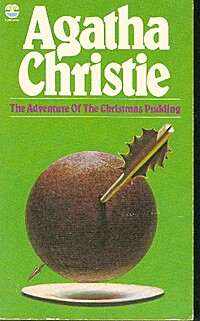
The Adventure of the Christmas Pudding by Agatha Christie

It seemed the right time of year to read The Adventure of the Christmas Pudding and a Selection of Entrées by Agatha Christie. It’s a collection of six short stories but only the first one, the title story, has any Christmas connection.
As Agatha Christie explained in her Foreword this story was an ‘indulgence‘, recalling the Christmases of her youth, spent at Abney Hall:

The Christmas fare was of gargantuan proportions. I was a skinny child, appearing delicate, but actually of robust health and perpetually hungry! The boys of the family and I used to vie with each other as to who could eat the most on Christmas Day. Oyster Soup and Turbot went down without undue zest, but then came Roast Turkey, Boiled Turkey and an enormous Sirloin of Beef. The boys and I had two helpings of all three! We then had Plum Pudding, Mince-Pies, Trifle and every kind of dessert. During the afternoon we ate chocolates solidly. We neither felt, nor were sick! How lovely to be eleven years old and greedy!

But I don’t think this story reflects her own Christmas experience apart from the setting, that is, for this is a collection of crime fiction! Poirot is invited to spend ‘a good old-fashioned Christmas in the English countryside’ in a 14th century English manor house, a prospect that fills him with apprehension, only agreeing to go when he hears there is oil-fired central heating in the house. There is of course a reason for inviting him – for a discreet investigation into the theft of a priceless ruby stolen from a Far Eastern prince. The Christmas Pudding in question is a ‘large football of a pudding, a piece of holly stuck in it and glorious flames of blue and red rising round it’. For a short story this is really complicated with several twists for Poirot to work through.

Four of the other stories feature Poirot, with the last one, Greenshaw’s Folly being a Miss Marple mystery, which I read last year in Miss Marple and Mystery.  Greenshaw’s Folly is a house, an architectural monstrosity, visited by Raymond West (Miss Marple’s nephew) and Horace Bindler, a literary critic. Later, Miss Greenshaw having drawn up a new will, is found murdered.

The remaining four stories concern the murder of a man found a Spanish chest (The Mystery of the Spanish Chest), a widow who is convinced her nephew had not killed her husband despite all the evidence against him (The Under Dog), a man who has inexplicable changed his eating habits is found dead (Four and Twenty Blackbirds), and a man who has the same dream night after night that he shoots himself is found dead (The Dream).

I enjoyed reading these stories. They are of varying length and are all cleverly done, if a little predictable.

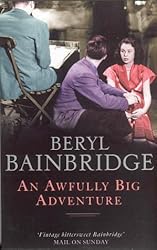
An Awfully Big Adventure by Beryl Bainbridge

It’s trite to say that Beryl Bainbridge’s An Awfully Big Adventure is ‘awfully good’ – but it is!
First published in 1989 and shortlisted for the Booker Prize, this is set in 1950, as a Liverpool repertory theatre company are rehearsing its Christmas production of Peter Pan. The story centres around Stella, a teenager and an aspiring actress who has been taken on as the assistant stage manager.

It’s semi-autobiographical based on Beryl Bainbridge’s own experience as an assistant stage manager in a Liverpool theatre. On the face of it this is a straight forward story of the theatre company but underneath it’s packed with emotion, pathos and drama. And it’s firmly grounded in a grim post-war 1950s England, food rationing still in operation and bombed buildings still in ruins overgrown with weeds.

Stella lives with her Uncle Vernon and Aunt Lily, who run a boarding house. To a large extent Stella escapes real life, living in the world of her own imagination. Her mother is not on the scene, but Stella secretly phones her from a public phone box to talk about her life – her mother just says ‘the usual things’ to her. She’s an innocent, naive and impressionable, she’s troubled and confused, wanting to grow up quickly. She’s ready to fall in love and becomes obsessed by Meredith Potter, the company director, not realising he is simply not interested in her.

After playing a cameo role in Caesar and Cleopatra in the next production, Peter Pan, she ‘manages’ Tinkerbell, shining a torch and ringing a little handbell. The title is taken from Peter Pan, the play about the boy who never grew up, whose attitude to death was ‘To die will be an awfully big adventure.’ Bainbridge’s use of Peter Pan emphasises the themes of reality versus imagination, the loss of childhood innocence, and the quest for love. Stella, whose mother had abandoned her, is most upset by the scene in the play where Peter tells Wendy how his mother had forgotten him when he tried to go back home – the windows were barred and another little boy was in his bed. It’s her mother’s apparent lack of love for Stella that is perhaps the initial cause of what eventually happens.

Love in its various guises is a prominent theme running through the book. When Meredith asks her what she thinks J.B. Priestley’s play Dangerous Corner is about, she says: €˜Love. People loving people who love somebody else.’ And, indeed, An Awfully Big Adventure is about people who are in love with somebody else and they all have secrets to hide.

I was a bit confused by the opening chapter and it was only when I reached the end that I understood it, when the truth that had been hinted at became obvious. It really is an awfully good book.

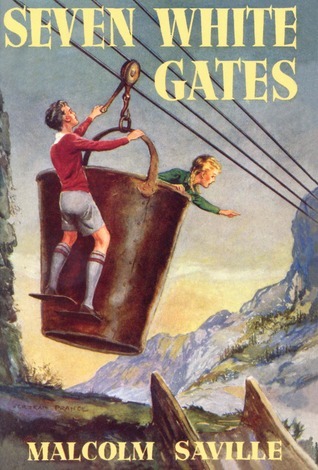
Seven White Gates by Malcolm Saville

Once more I’m behind with writing reviews – I blame it on the season! So to catch up I’m going to write some shortish posts with just a few thoughts on the books I’ve been reading.

Seven White Gates by Malcolm Saville is the second in his Lone Pine series. I first read some of his books when I was a child, but none of this series. But even so this was a nostalgic read for me and I would have really loved it if I’d read it years ago. It was first published in 1944. The Lone Pine books are about a group of children who formed a secret society in wartime Shropshire.

I particularly like the setting of Seven White Gates, in Shropshire not far from the border with Wales, an area rich in folklore and legend. It begins at the beginning of the Easter holidays, when Peter (Petronella) Stirling, who is fifteen, discovers that she cannot spend them at home with her father at Hatchholt, as he has to go away. Instead she is to stay with her unknown aunt and uncle, near Barton Beach, whose farm is under the Stiperstones mountain crested by the Devil’s Chair. The Stiperstones range lies within the Shropshire Hills Area of Outstanding Natural Beauty and is now on my wishlist of places to visit and the Devil’s Chair is really there:

The Devil’s Chair – Photo from Wikimedia Commons

She invites the other members of the Lone Pine club, David Morton, aged sixteen and his younger brother and sister, the annoying twins, Dickie and Mary, who are nine to stay at the farm with her. She meets a family of gypsies and makes a new friend, Jenny at Barton Beach, who all tell her the terrifying legends about the Stiperstones and the Devil’s Chair. Reuben warns her:

Remember, Petronella, our friend, never to be seen near the Stiperstones on the longest night of the year, for then all the ghosts in Shropshire and all the counties beyond meet on the summit – right on and around the Chair they meet – to choose their king … And any who venture out on that night and see the ghosts of all the years dead from hereabouts are stricken with fear and often do not live the year … (page 31)

What follows is an exciting adventure story. Peter’s Uncle Micah is a strange character, a forbidding. gloomy, unhappy man missing his son Charles who had left home some years earlier. It’s fast paced and full of danger for Peter and her friends as they explore the Stiperstones and its secrets.

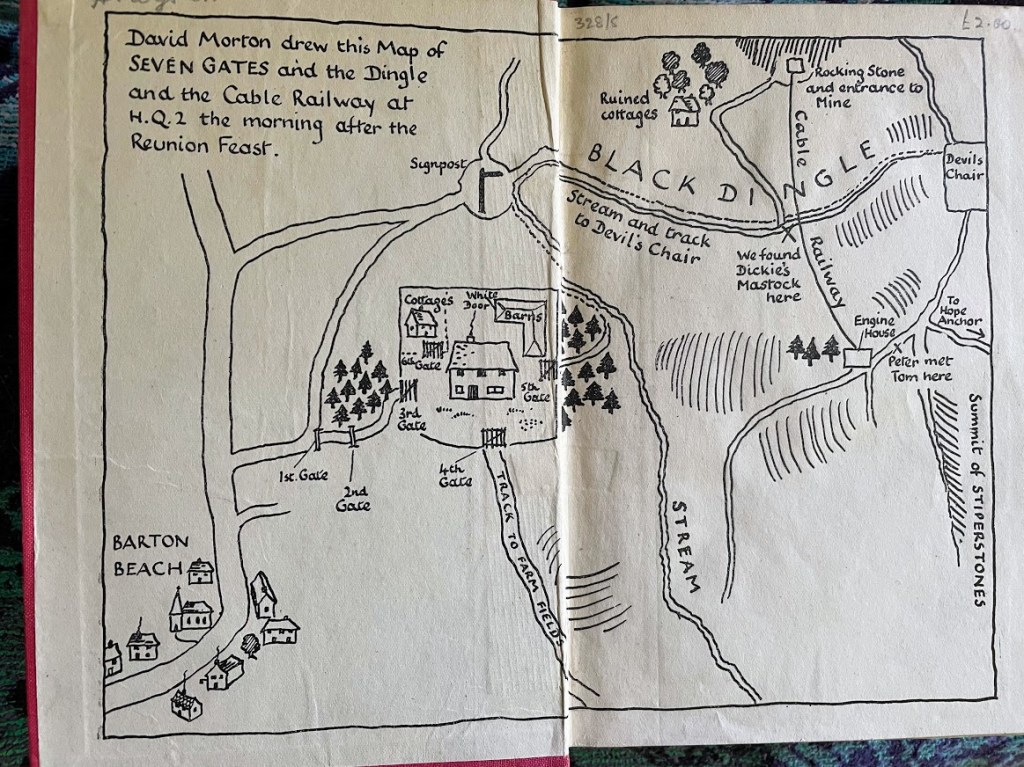
The book is illustrated with full page black and white drawings and a plan of Seven Gates, which I found very useful in following the action!

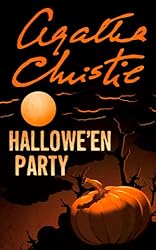
Hallowe'en Party by Agatha Christie

Hallowe’en Party begins with the party given by Mrs Drake for teenagers. One of the guests, Joyce Reynolds, a boastful thirteen-year old, who likes to draw attention to herself, announces that once she’d witnessed a murder. It seems nobody believed her and yet later on she is found dead, drowned in the tub used for the bobbing for apples game – someone had believed her and had killed her. Mrs Ariadne Oliver was at the party and she asks Poirot to help in finding the murderer.

This is one of Agatha Christie’s later books, first published in 1969, when she was approaching 80, and although I did like it for the most part, it is certainly not one of her best. It’s not terribly coherent and it lacks focus in parts as several characters, not sharply defined, are introduced along with a lot of detail and repetition. The plot, as usual in Agatha Christie’s murder mysteries is convoluted with lots of red herrings and loose ends. I thought the revelation of one of the character’s parenthood at the end was just too contrived to be believable. There are meandering and critical conversations about the ‘young people today’ and the state of the mental health service, with overcrowded mental homes, which so many of the characters thought must be the cause of the murder.

… so doctors say “Let him of her lead a normal life. Go back and live with his relatives, etc. And then the nasty bit of goods, or the poor afflicted fellow, whichever way you like to look at it, gets the urge again and another young woman goes out walking and is found in a gravel pit, or is silly enough to take lifts in a car. (page 37)

So it is down to Poirot to discover the real motive, but not before there is another murder. He investigates the possibility that Joyce was telling the truth and asks retired Superintendent Spence, living in the area with his sister, for details of any local deaths and disappearances over the past few years.

Even though I found this book less satisfying than many of Christie’s other books there are things in it that I liked. The relationship between Ariadne Oliver and Poirot for one – Poirot has to have a sip of brandy to fortify himself for the ‘ordeal’ of talking to her:

‘It’s a pity,’ he murmured to himself, ‘that she is so scatty. And yet she has originality of mind. It could be that I am going to enjoy what she is coming to tell me. It could be -‘ he reflected a minute ‘- that it may take a great deal of the evening and that it will all be excessively foolish. Eh bien, one must take one’s risks in life.’ (page 20)

And for another there is the description of a beautiful garden in a sunken quarry,  a well designed garden with the appearance of being perfectly natural. There are several pages lyrically describing this garden, which seemed to me to reflect Agatha Christie’s own interest in gardens, particularly the gardens at her house in Devon, Greenway. Seeing this garden sends Poirot into an almost mystical state of mind as he absorbed the atmosphere:

It had qualities  of magic, of enchantment, certainly of beauty, bashful beauty, yet wild. Here, if you were staging a scene in the theatre, you would have your nymphs, your fauns, you would have Greek beauty, you would have fear too. Yes, he thought, in this sunk garden there is fear. (page 93)

Overall, there are some vivid descriptions in this book – the Hallowe’en party and some of the descriptions of the teenagers ’60s style clothing for example as well as the beauty of the sunken garden, which for me compensated for its flaws. But if you haven’t read any of Agatha Christie’s books I wouldn’t recommend that you start with this one.

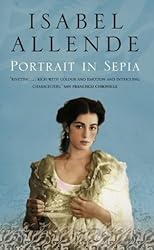
Portrait in Sepia by Isabel Allende

I picked up Portrait in Sepia up in a bookshop four years ago. As I knew nothing about it or the author it joined the other to-be-read books until just recently.

The opening pages of this historical novel grabbed my attention, about Aurora del Valle’s birth in 1880 in San Francisco in the Chinese quarter and referring to family secrets:

I have come to know the details of my birth rather late in life, but it would have been worse not to discover them at all, they could have been lost forever in the cracks and crannies of oblivion. There are so many secrets in my family that I may never have time to unveil them all: truth is short-lived, watered down by torrents of rain. (page 3)

Portrait in Sepia is part of a trilogy, with The House of the Spirits and Daughter of Fortune, and maybe it would have helped if I’d read the other two books, but I thought there was plenty of background history to the characters and I had no problem in following the story and distinguishing the characters.

Summary from the back cover:

After her mother dies in childbirth, Aurora del Valle is raised by her grandmother in San Francisco, but despite growing up in this rich and privileged environment, Aurora is unhappy. Haunted by terrible nightmares and the inexplicable absence of many of her childhood memories, and finding herself alone at the end of a love affair, she decides to travel to Chile to discover what it was, exactly, all those years ago, that had such a devastating effect on her young life. 

Aurora is the narrator and this the story of her family and after giving details of her birth, Aurora goes back to 1862 beginning her story with details about her grandparents. This is not a book you read quickly as there is a lot of detail, a lot of 19th century history of Chile, its mix of nationalities, politics and wars – at first I felt I was drowning in detail, but once I settled into the rhythm of the writing I began to appreciate Allende’s style. It takes you right into the characters, seeing them through Aurora’s eyes – her Chinese grandfather, Tao Chi’en, her uncle Severo and her two grandmothers, Paulina and Eliza, who both play a large role in her life. And there are many other colourful characters and momentous events in this book.

It’s a book about love, loss, identity, betrayal and about family relationships. It’s a portrayal of the strengths and weaknesses of the characters and their struggle to survive. Aurora tells her family’s story through looking at photographs, snapshots in time, through her own disjointed, incomplete and vague memories of her childhood and through conversations with her family members. Whilst she was still very young her two grandmothers decided her future, thinking that time would erase the memory of the traumatic events she had seen, never realising that the scenes would live forever in her nightmares.

Portrait in Sepia explores the nature of memory, how each moment of our lives is so transitory and how the past becomes confused as we try to recapture the moments we’ve lived through. Through photographs we can keep memories alive. As Aurora discovered:

Every instant disappears in a breath and immediately becomes the past; reality is ephemeral and changing, pure longing. With these photographs and pages I keep memories alive; they are my grasp on a truth that is fleeting , but truth none the less; they prove that these events happened and that these people passed through my destiny. Thanks to them I can revive my mother who died at my birth, my stalwart grandmothers, and my wise Chinese grandfather, my poor father, and other links in the long chain of my family, all of mixed and ardent blood. (pages 303-4)

Reading a book like this inevitably leads me on to yet more books, because now I want to read the other two books in the trilogy.