The Black Tulip by Alexandre Dumas

4*

The Black Tulip is historical fiction, a love story, mixing historical characters with fictional ones. It was first published in 1850. I loved The Count of Monte Cristo by Alexandre Dumas, so I was hoping to enjoy The Black Tulip too. I did, but not quite as much. I think it’s because I don’t know much about Dutch history and so I found the early chapters, about the brothers Cornelius and Johan de Witt, a bit difficult to follow. They were Dutch statesmen, accused of treason, who were brutally killed by a mob in the Hague in 1672, during a period of political upheaval, when they escaped from prison.

The story centres on Cornelius von Baerle, the fictional godson of Cornelius de Witt and his desire to grow a black tulip. He became involved in the de Witts’ affairs when Cornelius de Witt left a sealed parcel of his correspondence with the French war minister, with him for safekeeping. He didn’t open the parcel and didn’t know what it contained.

When the Tulip Society of Haarlem offered a prize of a hundred thousand guilders for the development of a tulip ‘without a spot of colour‘, this set the tulip growers into a frenzy of activity, including Van Baerle and his neighbour, Isaac Boxtel. Boxtel spied on Van Baerle’s experiments to grow a black tulip, which were having more success than his own efforts. Indeed Boxtel was obsessed with what Van Baerle was doing, neglecting his own tulips to wither and rot as he observed, through a telescope, what his neighbour was doing both in his garden and in his laboratory.

Whilst observing Van Baerle’s laboratory, Boxtel had seen the meeting between Cornelius de Witt and Van Baerle when he entrusted his papers to his godson. On hearing that the de Witt brothers had been arrested Boxtel realised he could inform against Van Baerle and get him arrested, thus giving himself the opportunity to steal the bulb Van Baerle had produced. And the hundred thousand guilder prize would be his.

And so Van Baerle was thrown into prison, wrongly convicted of treason and under sentence of death. However William of Orange, Stadtholder of Holland granted him his life but condemned him to imprisonment for life. He was sent to the fortress of Loewestein and there kept in solitary confinement. What follows is a dark and somewhat farcical tale, as aided by the jailer’s daughter Rosa he continues to cultivate his tulip bulbs. He and Rosa fall in love, despite all the difficulties that assault them.

It’s a great story, full of drama and emotion. It’s a love story, a story about passion, hatred, jealousy, obsession and injustice. After the difficulties I had with the first four or five chapters (I had to re-read them to work out how the rest of the story was connected) I found it difficult to put down, keen to find out what would happen next. I didn’t love it like I loved The Count of Monte Cristo, but I really liked it.

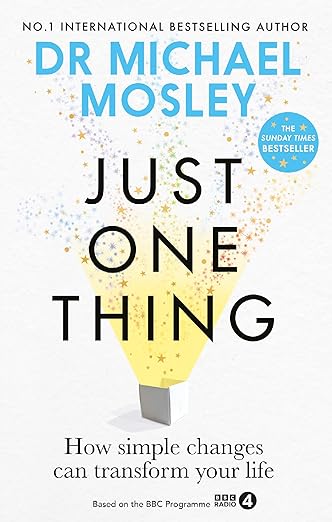
Just One Thing by Michael Mosley

Octopus Publishing Short Books| 22 October 2022|206 pages| E-book review copy| 5*

I was keen to read Just One Thing by Michael Mosley because I’ve enjoyed his TV programmes and I wasn’t disappointed. I think it’s an excellent source of information about improving your health. He picked 30 of his favourite things that you could fit into your life and explains the benefits of each one. He divides the day into periods – morning, mid morning, lunch time, afternoon and evening, giving examples of things to try throughout the day.

I’ve highlighted just a few in this post. S0me of them I already knew about, like doing exercise, doing squats and lunges, drinking water, meditation, spending time outdoors, taking a break to reduce stress, deep breathing, and so on. And I was very pleased to see that reading fiction for 30 minutes a day is a whole brain workout!

Other ideas that were new to me are things like drinking coffee, which lowers the risk of strokes, heart disease, cancer and dementia, and eccentric exercise – which involves walking downhill, down stairs and lowering weights, which have been shown to be more effective than running uphill, up stairs and lifting weights.

I knew about eating an apple a day, but not about the benefits of eating beetroot (which I love) two to three times a week. One thing that really pleased me is finding out that eating two squares of dark chocolate a day instead of eating sweet treats, lowers blood pressure and boosts your brain. In fact most of the ideas improve your mood and sleep, how your brain functions, and reduce anxiety, stress, fatigue and depression and so on. Standing on one leg, for example improves your balance, improves your core strength, and posture which reduces the likelihood of falling and breaking bones. Singing loudly for 5 minutes a day not only boosts your mood, and reduces anxiety, but can also relieve chronic pain.

It’s an inspiring book to read for making small changes, and some not so small changes, to improve your health and well-being. I’ve already started to stand on one leg whilst brushing my teeth and doing squats/lunges whilst waiting for the kettle to boil and will be trying more of the ideas too.

Many thanks to the publishers for a review copy via NetGalley.

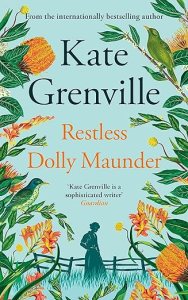
Restless Dolly Maunder by Kate Grenville

Canongate Books| 2 November 2023|257 pages| Review copy| 4*

Synopsis

Dolly Maunder is born at the end of the nineteenth century, when society’s long-locked doors are just starting to creak ajar for determined women. Growing up in a poor farming family in rural New South Wales, Dolly spends her life doggedly pushing at those doors. A husband and two children do not deter her from searching for love and independence.

Restless Dolly Maunder
 is a subversive, triumphant tale of a pioneering woman working her way through a world of limits and obstacles, who is able – despite the cost – to make a life she could call her own.

My thoughts:

Kate Grenville is one of my favourite authors, so I was looking forward to reading Restless Dolly Maunder. I was not disappointed.

This is the fictionalised life story of Kate Grenville’s maternal grandmother, Sarah Catherine Maunder, known as Dolly. She was the sixth child of Thomas and Sarah Maunder, born in Currabubula, New South Wales, Australia in 1881. She was not only restless but also clever and determined – she knew what she wanted and she did her best to achieve it.

As a child she longed to be a pupil-teacher but in a world where women were subservient to men she had to obey her father who wouldn’t allow it. She could marry or be a spinster. Eventually she married Bert Russell and began a life away from the farm and her family, moving from place to place and from one business to the next to better herself and her family – a shop, a boarding house, a pub, and a grand hotel.. But she was a difficult person, not easy to like and unable to show love. Hers was a success story but also a tragedy as her wanderlust impelled her to keep striving for more and better things in life.

Restless Dolly Maunder casts light not just on Dolly’s life but also on life in Australia for most of the 20th century. The book has a relentless pace as it tells her life story as she propels herself from place to place and from business to business, enjoying success whilst it lasted and enduring all else, not stopping to pause breath in her restless pursuit of what came next.

Many thanks to the publishers for a review copy via NetGalley.

I can recommend all of Kate Grenville’s books. One of my favourites is One Life:My Mother’s Story, her biography of Nance Russell, Dolly’s daughter. Hers was a happier and more fulfilled life.

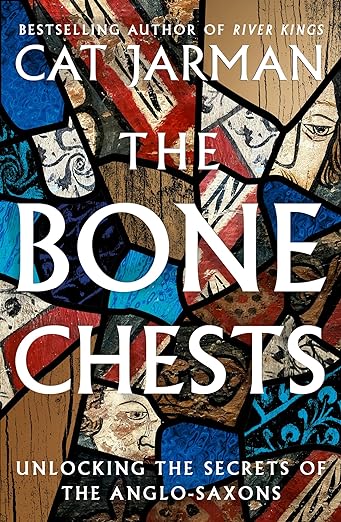
The Bone Chests by Cat Jarman

A history of the making of England as a nation, told through six bone chests, stored for over a thousand years in Winchester Cathedral.

William Collins| 14 September 2023| 400 pages| Review copy| 4*

The front cover shows a section of the Great West Window of Winchester Cathedral, made up of mosaics created after 1660 from the glass that had been smashed during the Civil War in 1642. I think it is just beautiful.

Description:

In December 1642, during the Civil War, Parliamentarian troops stormed the magnificent cathedral, intent on destruction. Reaching the presbytery, its beating heart, the soldiers searched out ten beautifully decorated wooden chests resting high up on the stone screens.

Those chests contained some of England’s most venerated, ancient remains: the bones of eight kings, including William Rufus and Cnut the Great – the only Scandinavian king to rule England and a North Sea empire; three bishops ; and a formidable queen, Emma of Normandy. These remains belong to the very people who witnessed and orchestrated the creation of the kingdom of Wessex in the seventh century, who lived through the creation of England as a unified country in response to the Viking threat, and who were part and parcel of the Norman conquest.

On that day, the soldiers smashed several chests to the ground, using the bones as missiles to shatter the cathedral’s stained glass windows. Afterwards, the clergy scrambled to collect the scattered remains.

In 2012, the six remaining chests were reopened. Using the latest scientific methods, a team of forensic archaeologists attempted to identify the contents: they discovered an elaborate jumble of bones, including the remains of two forgotten princes. In The Bone Chests, Cat Jarman builds on this evidence to untangle the stories of the people within. It is an extraordinary and sometimes tragic tale, and one of transformation. Why these bones? Why there? Can we ever really identify them? In a palimpsest narrative that runs through more than a millennium of British history, it tells the story of both the seekers and the sought, of those who protected the bones and those who spurned them; and of the methods used to investigate.

My knowledge of the Anglo-Saxons from school history lessons is very basic – little more than Alfred the Great on the run from the Vikings and letting the cakes burn, and King Canute, sitting in his throne placed at the water’s edge and trying unsuccessfully to forbid the waves from advancing and wetting his feet.

So I was looking forward to learning more in The Bone Chests: Unlocking the Secrets of the Anglo-Saxons. In her Author’s Note Cat Jarman clarifies that her intention with this book is to tell the stories of the chests, and of the tumultuous times that they and the people interred in them, lived through. She has concentrated on the south and south-west of England to consider why Wessex and Winchester took on such significance in the history of England in the early medieval period. So, the main emphasis in this book is on the history, on the kings and politics of the period rather than on the forensic archaeology and the modern scientific techniques.

Having said that there is enough about the use of DNA and isotopic analysis of teeth to investigate the diet and origins of the owners of the bones for me as a non scientist to understand. I found it all fascinating even though in places I was left wondering what century I was in, having moved from the 11th to the 21st century (when Richard III’s remains were discovered under a Leicester car park), via various Viking raids and the 17th century. At times I had to keep reminding myself which chest was being described.

The mortuary, or bone chests, themselves, are most interesting and I would love to visit Winchester Cathedral to see them for myself. There are six chests, painted wooden caskets which are displayed high on stone screen walls on either side of the high altar area. The bones are the remains of many kings and bishops who were originally buried in the Anglo-Saxon cathedral known as Old Minster, north of the present cathedral.

Jarman describes the chests in, vaguely, chronological order and has relied on the Mortuary Chests Project, a research project led by archaeologists from Bristol University in collaboration with Winchester Cathedral that began in 2012. She is not involved in the Project but has incorporated details of the team’s partial results released in May 2019 in her book.

The book is very detailed and well researched and I learned so much, bringing the medieval period to life as I read. I had never heard of Queen Emma and the details about her life stand out for me. She was the daughter of Richard I, Duke of Normandy, wife of two Anglo- Saxon kings – Æthelred the Unready and Cnut (Canute) – and the mother of Edward the Confessor and Harthacnut of Denmark. She was given the name Ælfgifu and in 1017 she married Cnut. I was fascinated to read that the Project team has put together a set of bones that they confidently determine to be a female that could be the body of Emma. (See – details of an exhibition at Winchester Cathedral, Kings and Scribes: the birth of a nation. This includes a 3D model of the female skeleton thought to be Queen Emma).

The last section of the book is made up of Notes of the sources used, an extensive Bibliography, and an Index. There is also a List of Illustrations; the illustrations were not included in my review copy.

Many thanks to the publishers for a review copy via NetGalley.

Dr Cat Jarman is a bioarchaeologist and field archaeologist specialising in the Viking Age, Viking women, and Rapa Nui. She uses forensic techniques like isotope analysis, carbon dating, and DNA analysis on human remains to untangle the experiences of past people from broader historical narratives. Dr Jarman has contributed to numerous TV documentaries as both an on-screen expert and historical consultant, including programmes for the BBC, Channel 4, History, Discovery, and more.

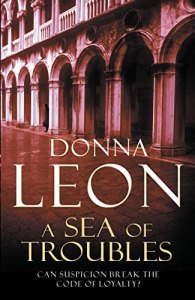
A Sea of Troubles by Donna Leon

A Sea of Troubles is Donna Leon’s 10th Commissario Guido Brunetti novel. I’ve been reading them out of order of publication on and off for several years now and this book is the earliest one in the series that I’ve read. Her books are crime fiction, but also discuss various social and cultural issues and A Sea of Troubles is no exception. 

Brunetti is one of my favourite detectives. He is happily married with two children. He doesn’t smoke or drink to excess and often goes home for lunch to his beautiful wife Paolo, who is a wonderful cook – in this book she treats him to a delicious apple cake made with lemon and apple juice and ‘enough Grand Marnier to permeate the whole thing and linger on the tongue for ever.’ (page 238)

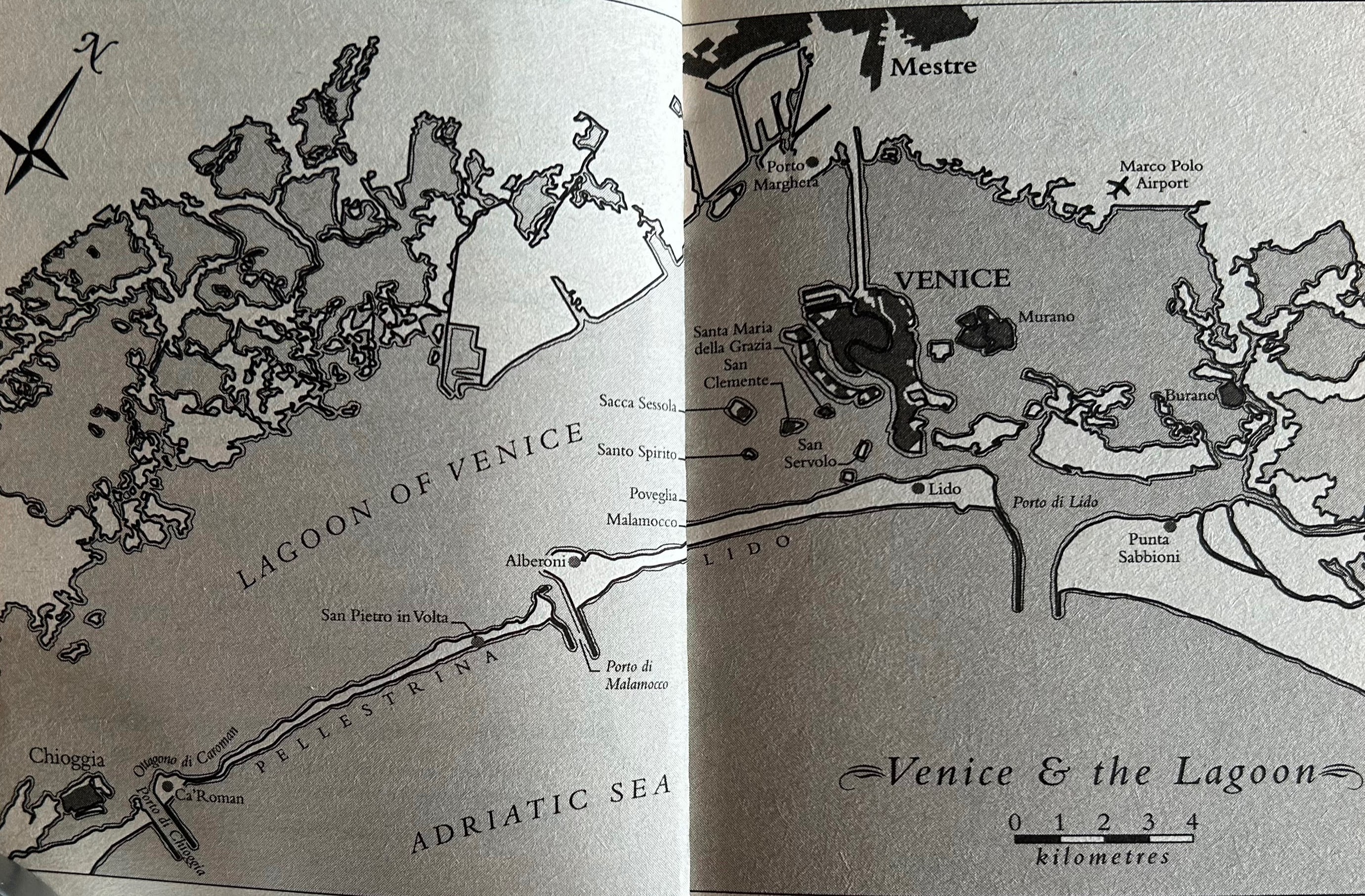
I read it eagerly, keen to get to the bottom of the mystery surrounding the deaths of two clam fishermen, father and son, off the island of Pellestrina, south of the Lido on the Venetian lagoon, when their boat suddenly exploded. As well as the mystery the issues Leon highlights in this book are concerning pollution and the overfishing of clams that is destroying the clam beds.

I was fascinated by the island, never having heard of it before. It’s a long and narrow island (11 km long, and 25 to 210 metres wide) that separates the Venetian Lagoon from the Adriatic Sea. Fishing is the primary source of income and alongside the inner side of the thin peninsular are scores of vongolari, the clam fishing boats.

Pellestrina is a closely knit community, the islanders bound together by a code of loyalty and a suspicion of outsiders. Brunetti is finding it difficult to penetrate their silence, as even though he is a Venetian, he is regarded by the islanders as an outsider, a foreigner. So when his boss’s secretary, the ever-resourceful Signorina Elettra, volunteers to visit her cousin who lives in the village there to see what she can find out, he lets her go. And then is most concerned when she falls for a young man on the island. And Paola begins to question why he is so interested in Elettra, having noticed that he had thought about little else than her for over a week. He then realises his feelings for Elletra are not so straightforward after all.

However, the crime still needs resolving and Brunetti finds himself in a web of political intrigue, corruption and secrets. From a slow start the ending is dramatic and action packed with Brunetti and Elletra in danger of their lives.

  • Publisher ‏ : ‎ Arrow; 1st edition (26 Feb. 2009)
  • Language ‏ : ‎ English
  • Paperback ‏ : ‎ 336 pages
  • Source: I bought it
  • My rating: 5*

The Midnight Hour by Elly Griffiths

Brighton, 1965

When theatrical impresario Bert Billington is found dead in his retirement home, no one suspects foul play. But when the postmortem reveals that he was poisoned, suspicion falls on his wife, eccentric ex-Music Hall star Verity Malone.

Frustrated by the police response to Bert’s death and determined to prove her innocence, Verity calls in private detective duo Emma Holmes and Sam Collins. This is their first real case, but as luck would have it they have a friend on the inside: Max Mephisto is filming a remake of Dracula, starring Seth Billington, Bert’s son. But when they question Max, they feel he isn’t telling them the whole story.

Emma and Sam must vie with the police to untangle the case and bring the killer to justice. They’re sure the answers must lie in Bert’s dark past and in the glamorous, occasionally deadly, days of Music Hall. But the closer they get to the truth, the more danger they find themselves in…

The Midnight Hour is the sixth book in the DI Edgar Stephens and Max Mephisto series. Known as the ‘Magic Men’ they had been part of a top-secret espionage unit during the War. These books are historical crime fiction, beginning with The Zig Zag Girl set in 1950. Now, with The Midnight Hour, fifteen years have gone by and DI Stephens’ wife, Emma formerly a policewoman is now a private detective working with Sam (Samantha) Collins, formerly an investigative reporter.

There’s a lot going on as both Edgar’s team and Emma and Sam investigate Bert’s death, at first in competition and then they combine forces. Bert’s son Aaron thinks his mother, Verity, killed Bert, who has a very shady past, with plenty of affairs with other women. And there are other suspects with a motive to want him dead.

It provides an insight into what life was like in the mid 1960s, particularly for women. There was plenty of sexism, with, for example, married women being forced to retire from the police force. Married women were not allowed to drive panda cars, and were largely employed to make tea and do the paperwork. Women were expected to stay at home looking after the home and their children.

I enjoy the Dr. Ruth Galloway series, with the forensic archaeological details, despite wishing they weren’t written in the present tense. I also find the theatrical elements of this series fascinating and much prefer the fact that they are written in the past tense. I really liked the glimpses of Max and Seth Bellington, Bert’s son, filming a remake of Dracula in Whitby.

You can read this as a standalone as there is a guide to the main characters and their back stories at the end of the book, but it helps if you read at least some of the earlier books to have a sense of who everyone is and the character progression.

Rating: 4 out of 5.