Fell Murder: a Lancashire Mystery by E C R Lorac (British Library Crime Classics)

‘…this crime is conditioned by the place. To understand the one you’ve got to study the other.’
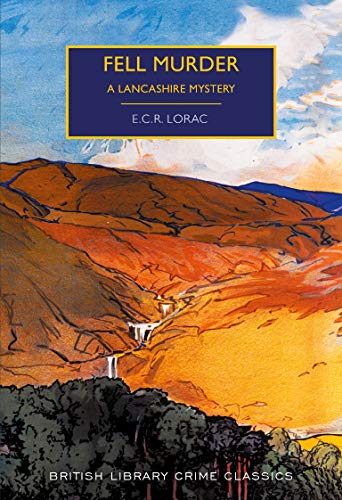
Fell Murder

Poisoned Pen Press|6 January 2020|223 pages|e-book |Review copy|4.5*

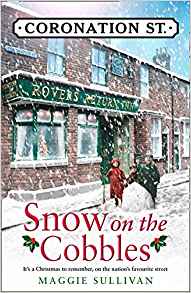
Snow on the Cobbles by Maggie Sullivan


snow on the cobbles

Harper Collins|14 November 2019|344 pages|e-book via NetGalley|Review copy|3*

I’ve been watching Coronation Street for years so when I saw Snow on the Cobbles, a Coronation Street story on NetGalley described as ‘perfect for Coronation Street fans’ I requested it. It’s the third book in the Coronation Street series. It’s set in 1945 as the Second World War is coming to an end with some of the familiar Street characters – the main one being a young Hilda Ogden, with minor roles for others such as Elsie Tanner, Albert Tatlock, Ena Sharples and the young Ken Barlow. But there are also other characters who have never appeared in the TV soap.  

The story centres around Hilda Ogden and new characters, Lizzie Doyle, her mother and her brothers, who have recently moved into No. 9 (currently  home to Tyrone Dobbs, his daughter Ruby DobbsFiz Stape and her daughter Hope Stape).  Their new neighbour, Elsie Tanner, tells them that the house is said to have bad luck and they are worried about strange noises from the loft. Lizzie makes friends with Hilda when they both start working at the Pride of Weatherfield, a pub that had recently reopened in competition with the Rovers Return, where Annie Walker is in sole charge whilst her husband Jack is away at the war.

The story is of their daily lives, struggling to make ends meet and their joy and celebrations as the war comes to an end and the men return from the war. Lizzie, however, has a secret that threatens her relationship with Steve, the barman at the Rovers Return. And the new manager at the Pride of Weatherfield is involved in some very dodgy dealings.

I read it quickly and enjoyed it as I liked the setting and the historical details about the end of the war. I also liked the biography of Jean Alexander, who played the role of Hilda Ogden and I think Maggie Sullivan has captured the essence of Hilda in this book.

My thanks to the publishers for my review copy via NetGalley.

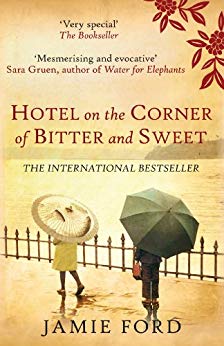
Hotel on the Corner of Bitter and Sweet by Jamie Ford

‘He’d do what he always did, find the sweet among the bitter.’

Hotel on the Corner of Bitter and Sweet

Allison & Busby|2013 paperback edition| 396 pages| 5*

It’s not that often that a book brings tears to my eyes, but reading the ending of Hotel on the Corner of Bitter and Sweet did just that. It is a beautiful book moving between two time periods, the early 1940s and 1986, mainly in Seattle.

Synopsis (Amazon):

1986, The Panama Hotel

The old Seattle landmark has been boarded up for decades, but now the new owner has made a startling discovery in the basement: personal belongings stored away by Japanese families sent to interment camps during the Second World War. Among the fascinated crowd gathering outside the hotel, stands Henry Lee, and, as the owner unfurls a distinctive parasol, he is flooded by memories of his childhood. He wonders if by some miracle, in amongst the boxes of dusty treasures, lies a link to the Okabe family, and the girl he lost his young heart to, so many years ago.

My thoughts:

I had little idea when I began reading this book how much I would enjoy it and how much I would learn from it. It moves at a much slower pace than I would like but this means that I could absorb the detail easily and follow the story without puzzling out the sequence of events. I had no problem at all in moving between the two time periods, as I have in some other books, the characters come across as real people with real lives and real problems. The settings are remarkable, even though I have never been to Seattle, and knew nothing about its history – its Chinatown and the Japan town, Nihonmachi – it came to life as I read on.

In 1942 in Seattle Henry Lee, a 12 year old Chinese American boy meets Keiko Okabe, a Japanese American girl and they become great friends, even though Henry’s father is against the Japanese because of the enmity between China and Japan. He makes Henry wear a badge “I am Chinese” so that people won’t think he is Japanese.

As the war progressed the persecution of Japanese Americans intensified and they were removed from their homes and interned. I knew this had happened after Pearl Harbour, but this book brings home the reality of the situation, of how their lives were uprooted and the prejudice and the terrible conditions that they experienced. Keiko and her family are moved to Camp Harmony, a temporary relocation centre at the Puyallup Fairgrounds, and not allowed to take their belongings with them. Many Japanese families, including Keiko’s, manage to store some in the basement of the Panama Hotel. Henry is devastated, certain he won’t see her again, especially when the families are moved to a permanent relocation centre, Minidoka in Idaho. But his search for Keiko didn’t end there and with the help of his friend Sheldon, a black jazz musician he continued to look for her.

The book is not just about Henry and Keiko it’s also about family relationships, about the importance of communication, of talking and sharing experiences and feelings and about friendships. And it’s a love story – of both a love lost and a love found as Henry and Keiko grow into adulthood. It is a bitter sweet story of commitment and enduring hope and one that I loved.

About the author:

Jamie Ford grew up in Seattle’s Chinatown and Hotel on the Corner of Bitter and Sweet was his debut novel. His second novel, Songs of Willow Frost was published in September 2013. Love and Other Consolation Prizes, was published in September 12, 2017 and is also set in Seattle, inspired by a true story, about a half-Chinese orphan boy whose life is transformed at Seattle’s 1909 World’s Fair. And so one book leads on to yet more books to read …

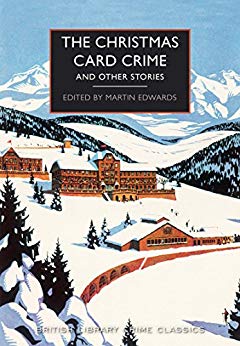
The Christmas Card Crime and Other Stories edited by Martin Edwards (British Library Crime Classics)

Here is another collection of short stories from the Golden Age of Murder edited by Martin Edwards: The Christmas Card Crime and Other Stories.

Christmas Card Crime

Poisoned Pen Press, in association with the British Library|1 October 2019|Print length 240 pages|e-book |Review copy|4*

There are eleven stories all set during the Christmas season in this collection and an introduction by Martin Edwards. In it he points out the differences between a short story and a novel. It’s not just the length, but it is also the fact that in a short story there is little space to develop the characters in depth or for lengthy descriptions, so ‘every word must be made to earn its keep‘. He has also prefaced each story with a biographical note, which I found useful as some of the authors were new to me.

The mysteries range in date of publication from 1909 up to 1965. I’ve read stories by some of the authors before, such as Baroness Orczy, John Dixon Carr, Ronald Knox, E C R Lorac, John Bude and Julian Symons, but others were new to me. The ones I enjoyed the most are:

The Motive  Ronald Knox. This story first appeared in The London Illustrated News in November 1937 and is about an attempted murder in a smart hotel on the English Riviera, by a character named ‘Westmacott’ (a pen name used by Agatha Christie).. On Christmas Day after a party the guests decided to play a version of ‘blind man’s buff’ in the swimming pool, which didn’t go as planned.

Another version of ‘blind man’s buff‘, this time called ‘blind man’s bluff‘, is played in the next story also with disastrous consequences.

Blind Man’s Hood by John Dickson Carr writing as Carter Dickson. This first appeared in the Christmas edition of The Sketch in 1937 and is a story inspired by the unsolved Peasonhall murder case of 1902. It is a strange tale about a young couple arriving to spend Christmas with friends, only to find the house empty – except that is for a young woman carrying a white bag, who tells them about a game of ‘Blind Man’s Bluff’ that went very wrong, years ago. It’s a variation on a locked room mystery, with a touch of the supernatural.

Crime at Lark Cottage by John Bingham – this first appeared in the 1954 Christmas Number of The London Illustrated News. Bingham was the 7th Earl of Clanmorris, a journalist who was recruited into MI5, where he worked with David Cornwell, who later wrote spy novels under the name of John Le Carré. This story and the next are my two favourites in the book. It is the story of an escaped convict and an isolated country cottage occupied by a young woman and her little daughter one snowy Christmas. Very atmospheric and tense with an unexpected ending. I’d like to read more of John Bingham’s work.

‘Twixt the Cup and the Lip by Julian Symons – this first appeared in Ellery Queen’s Mystery Magazine in January 1965). Longer than the other stories in this collection it is the tale of Mr Rossiter Payne, a meticulous bookseller who plans a perfect robbery – to steal the jewels, that had once belonged to the Russian royal family, on display in a London department store at Christmas. But Mr Payne had made an uncharacteristic error …

Overall, I enjoyed reading this collection, with a mix of excellent short stories and some that I thought  were too short and had disappointing or predictable endings.

My thanks to the publishers for my review copy via NetGalley.

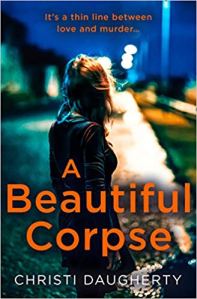
A Beautiful Corpse by Christi Daugherty

a beautiful corpse

Harper Collins|March 2019|384 pages|e-book via NetGalley|Review copy|5*

I saw A Beautiful Corpse by Christi Daugherty on NetGalley and thought I would like it from the description, but not expecting to enjoy it as much as I did. I didn’t realise that it’s the 2nd in the Harper McClain series but I think it works very well as a standalone.

I liked a lot about it – it is well written, has a fast-paced plot, but not at the expense of the characters, and it’s set in Savannah, with its historic buildings, parks and ancient oak trees covered in Spanish moss.

Harper McLain is a crime reporter with the Savannah Daily News. The book begins late one evening as she is playing pool in the Library Bar with her friend and bartender, Bonnie. The crime photographer rings her, telling her about a murder on downtown River Street, a narrow cobblestoned lane between the old wharves and warehouses and the Savannah River. And she is shocked to discover that the young woman sprawled on the uneven cobbles is Naomi, a law student, who had worked with Bonnie at the Library Bar. She had been shot dead.

There are three men who are all suspects, but her current boyfriend Wilson Shepherd is the prime suspect. The Library Bar owner, Fitz, is also a suspect especially as no one has seen him after the shooting. And then there is her ex-boyfriend Peyton Anderson, the powerful DA’s son. The police are convinced that Wilson is the killer, but after Harper talked to him, she just can’t believe that it was him. There were no witnesses to the shooting and when Harper talks to Jerrod, Naomi’s father, she realises that Peyton’s alibi may not be as solid as the police maintain it to be. 

This a story of obsession and jealousy and the tension rises as the killer’s focus shifts on to Harper herself. She is a strong determined character, determined to find out the truth. But as well as the murder investigation Harper has her own personal problems to contend with. Her job as a reporter is under threat, someone is breaking into her apartment and her personal relationship with Detective Luke Walker seems about to be revived, but she is wary where it will end. On top of all that she is desperate to find out who had killed her mother twelve years earlier. 

I loved it and it has made me eager to read the first book, The Echo Killing, to find out more about Harper and her background and also to read the next book in the series – Revolver Road due to be published in March next year – to find out what happens next.

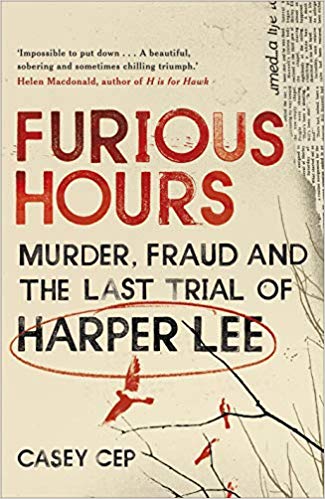
Furious Hours by Casey Cep

The stunning story of an Alabama serial killer and the true-crime book that Harper Lee worked on obsessively in the years after To Kill a Mockingbird

Furious hours

Cornerstone|May 2019|311 pages|e-book via NetGalley|Review copy|4*

In the first half of the book Casey Cep tells the story of the Reverend Willie Maxwell, who murdered members of his own family in the 1970s and held his rural community in Alabama, in fear and dread as they believed he was practising voodoo. He was shot dead at the funeral of his step-daughter by a relative, Robert Burns. Maxwell’s lawyer, Tom Radney, who had successfully defended Maxwell for years, then defended Burns, who confessed to the shooting, on the grounds of temporary insanity.

The second half is about the author, Harper Lee, who decided to write a book about all three men. In doing so Cep has written a remarkable biography of Harper Lee, her friendship with Truman Capote, her part in writing his book, In Cold Blood and her attempts to follow up the success of her book, To Kill a Mockingbird.

My favourite part of the book is without doubt the part about Harper Lee. All I knew about her before is that she wrote To Kill a Mockingbird, thought to be her only book until Go Set a Watchman was published in 2015. Cep explains that Watchman was an early version of Mockingbird, that Lee hadn’t edited or revised, and although it appears to be a sequel it isn’t  – it is the story she wrote first.

The section on Lee’s work in helping Capote  research his ‘nonfiction novel’ set in Kansas, In Cold Blood is equally as fascinating. They had lived next door to each other in Monroeville and as Cep phrased it ‘before Nelle was out of toddlerhood, she and Truman had become partners in crime and just about everything else.‘ (‘Nelle’ is her first name, the name she was known by for the first thirty-four years of her life, pronounced Nell, not Nellie.) Once they ran out of stories to read they started writing them. Cep goes into detail about the development of crime writing, and how Capote applied the techniques of fiction to nonfiction. Not everyone was happy with this novelisation of crime, not did they believe that Capote’s book was strictly factual, accusing him of  producing a sensational novel. Harper Lee minded very much about his fabrications, although she never objected publicly and this caused a rift between them.

So, this presented her with a challenge when it came to writing her book about Maxwell and his crimes, determined it would be based strictly on facts and she spent many years researching and writing her book, provisionally called The Reverend, but never finished it.

The sheer detail of Furious Hours made it quite a difficult book to read in some parts, digressing from the bare bones of the story into details such as the history of insurance, for example. But I was impressed by that detail and by Cep’s meticulous research. The book has an extensive Acknowledgements section, Notes and Bibliography, citing numerous books, journal articles and documentary films. And it has made me keen to read Go Set a Watchman, which although I bought a copy I have not read yet fearing it would spoil my love of To Kill a Mockingbird. I also must get round to reading Capote’s In Cold Blood, which I bought earlier this year, without knowing of Harper Lee’s involvement in the book.

My thanks to Cornerstone for an e-book review copy via NetGalley