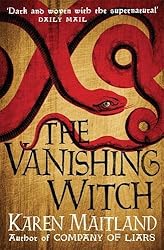
The Vanishing Witch by Karen Maitland

I found The Vanishing Witch by Karen Maitland a little slow at the beginning, although it’s full of interesting and well drawn characters, set in Lincoln during the reign of Richard II. It’s the time of the Peasants Revolt, a time of murder and mayhem and when suspicions of witchcraft were high as people started to die unnatural deaths, but it just didn’t have the magic spark that I’d enjoyed in her other books that I’ve read – The Company of Liars and The Owl Killers. It’s a long book of nearly 500 pages and it’s not just the beginning that’s slow, but it picks up towards the end.

The story revolves around Robert of Bassingham, a rich wool merchant, and his family – wife Edith and sons, Jan and Adam. All is fine until Robert meets Catlin, a wealthy widow, who comes to him for advice. Catlin is, of course, not as kind and good as Robert thinks she is and Robert’s family soon suffers because of his involvement with her. There are many other characters, including Gunter and his family. Gunter is a river boatman, struggling to make a living, burdened by heavy taxes he can’t pay. His life goes from bad to worse.

I liked the elements of the supernatural and suspicions of witchcraft in this book and the historical setting. There are several narrators, including a ghost and each chapter is headed by weather-lore, anti-witchcraft charms and spells taken from medieval ecclesiastical writings, recorded British folklore and from medieval spell books known as grimoires. For example this is the heading for Chapter 2:

If you fear that you are in the presence of a witch, clench both your hands into fists with the thumbs tucked under your fingers. Then she cannot enchant your mind.

Now that advice could be useful!
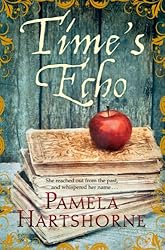
Time's Echo by Pamela Hartshorne


As I wrote in a First Chapter post  Time’s Echo mixes time as Grace Trewe is drawn into Hawise Aske’s life, four and a half centuries earlier in York, 1577. I saw this book in the library and although I hadn’t heard of Pamela Hartshorne I thought the title was interesting, and from the description on the back cover and the opening paragraphs, I thought it was worth borrowing.

It’s a good choice for Carl’s R.I.P. IX challenge, a time-slip story with an element of mystery and suspense in both time periods. Grace is staying in York to sort out the sale of her late godmother’s house when she experiences unnerving episodes in which she appears to be reliving the traumatic events in Hawise’s life beginning in 1577.  Grace likes to travel and although she survived the Boxing Day tsunami she is suppressing her memories of what happened. 

I think the suspense is somewhat diluted because right from the opening chapter it’s revealed that Hawise was drowned on All Hallows’ Eve, with her thumb tied to her toe – ie as a witch. But as Grace’s episodes continue she learns what happened in Hawise’s life to bring her to her dramatic death and this is interwoven with events in Grace’s life. It gets to the point where she dreads slipping out of current time into not only Hawise’s past but also into her own as what happened to her in the tsunami breaks through her mind.

What does add to the suspense is the unpredictability of the time-slips and the sense of malice and evil. So much so that the sceptic in me was unable to decide whether this was a question of whether Grace was suffering from post-traumatic stress disorder or was she really being “possessed” by Hawise, as she believed, feeling Hawise clamouring to be let into her mind. I found the historical sections more interesting than the modern story, which I think often happens when I read time-slip stories.

Pamela Hartshorne explains how she came to write this book in the Author’s Note at the end of the book. It grew out of her research on the wardmote-court returns of early modern York. These records dealt primarily with nuisances, things that affected the quality of life for the neighbourhood – such as noisy neighbours, blocked sewers. potholed streets etc (I note that local life hasn’t changed much over the centuries!). Some of the minor characters were real people, but this book is a work of fiction and Hartshorne is not intending this to be an accurate historical account, although she has tried to make it as convincing and as authentic as she could – I think she succeeded.

I thought the book was rather drawn out in parts, slowing the story down a bit too much for my liking. But, I like the fact that the book has a factual background, even though there are some liberties with the evidence – eg there was no plague in York in the 1570s or 1580s as featured in the book. So, on the whole I enjoyed Time’s Echo primarily because of its historical elements and I’ll look out for more books by Pamela Hartshorne. I see from her website that she has just published another time-slip book, The Memory of Midnight.

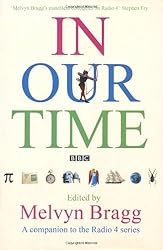
In Our Time edited by Melvyn Bragg

I began reading In Our Time, A Companion to the Radio 4 series back in August and I’ve been reading short sections on most days since then, finally finishing it this morning. It is long book and I didn’t want to read it quickly.

Melvyn Bragg has selected episodes on a wide variety of subjects encompassing the history of ideas – philosophy, physics, history, religion, literature and science. This book contains transcripts of 26 programmes, a selection from hundreds of programmes broadcast over eleven years. The benefit of having it in book form means that it’s easy to pause, think, or re-read to make sure I was understanding the subject as much as possible.

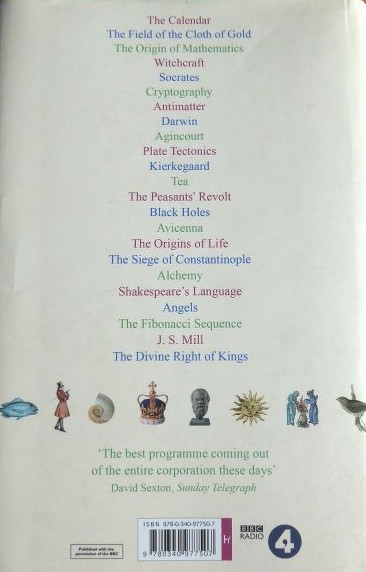
The programmes are listed on the back cover – Darwin was covered by four programmes:

In Our Time P1010233

With such a wide range of subjects it’s not so surprising that I found some more interesting than others, but I was surprised that some that didn’t appeal from the titles were actually fascinating and I now know more about black holes and antimatter than before – how much I can remember is another matter! I’m not alone in this, as Bragg said in the Afterword, his:

… only regret is that in the more testing subject areas he finds that his memory after the programme will not retain some or even much of what made the programme intriguing. (pages 573-4)

But it’s there in print, so I can refresh my memory at any time! I liked the fact that these are transcripts, not formal lectures, so that it comes across as conversations between experts with Bragg, every now and then asking the questions that someone like me, not knowing much about the subject, would want to ask. An ideal book for an eclectic reader!

It’s not easy to pick out highlights as there are so many that fascinated me. As Halloween is approaching I’m remembering the chapter on ‘Witchcraft’, but others as diverse as ‘Tea’, ‘Socrates’ and the four ‘Darwin’ programmes also stand out. And where else could you go from ‘Agincourt’ to ‘Plate Tectonics’?

In Our Time is broadcast each Thursday at 9am on BBC Radio 4. This week’s episode was ‘Rudyard Kipling’. This and all the other programmes are available as downloads.

  • Hardcover: 608 pages
  • Publisher: Hodder & Stoughton (17 Sep 2009)
  • Language: English
  • ISBN-10: 0340977507
  • ISBN-13: 978-0340977507
  • Source: my own copy

Sunday Selection

I’m currently reading The Brief History of the Dead by Kevin Brockmeier and Almost Invincible: a biographical novel of Mary Shelley.  But I like to think about the books I’ve got waiting to be read. They are:

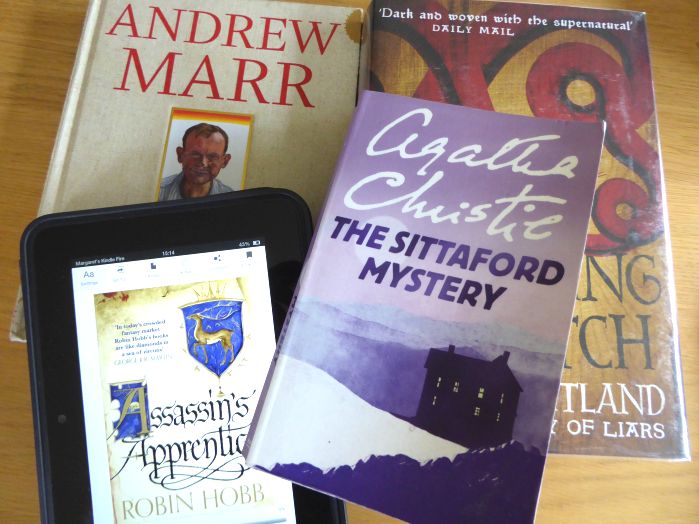
  • The Sittaford Mystery by Agatha Christie – set in a remote house in the middle of Dartmoor, a group of six people gather round a table for a séance. The spirits spell out a chilling message of murder. This is an early Agatha Christie book, first published in 1931 and is one I’ve been looking for, for ages.
  • A Short Book about Drawing by Andrew Marr. This is a library book and I have already flipped through it and read little bits. It has colour photos of his paintings along with his ideas about the differences between fine art and drawing, the mechanics of drawing and how drawing and painting can help us to think and see the world differently and so on. It looks fascinating and I’ll read this very soon I think.
  • Assassin’s Apprentice by Robin Hobb – this is free on Kindle at the moment. I know that other book bloggers like Robin Hobbs’ books and I’ve been thinking of trying one myself. This one is the first in the Farseer Trilogy. I’m not sure what to expectIf you’ve read it what do you think?
  • The Vanishing Witch by Karen Maitland. Another library book I’ve borrowed – this one from the mobile library. I loved Company of Liars and The Owl Killers, so I’m expecting great things from this book – I hope I won’t be disappointed. It’s set in the reign of Richard II, the time of the Peasants Revolt, a time of murder and mayhem and when suspicions of witchcraft were high as people started to die unnatural deaths.

The thing is that I want to read them all right now!

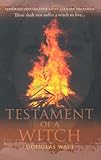
Testament of a Witch by Douglas Watt

Testament of a Witch by Douglas Watt is the second book of his that I’ve read. The first one Death of a Chief I read 5 years ago! Both books are set in late 17th century Scotland (1686 and 1687) and feature a Gaelic speaking, Edinburgh lawyer John MacKenzie and his clerk Davie Scougall. I like the way Douglas Watt incorporates the historical background into the narrative without detracting from the story.

In Testament of a Witch MacKenzie investigates the death of Grissell Hay, Lady Lammersheugh accused of witchcraft in a village overwhelmed by superstition, resentment and puritanical religion. Then the same accusations are made against the Euphame, Grissell’s daughter.  I wasn’t too keen on the horrifying and explicit descriptions of how the witch hunter identified and dealt with women accused of being witches, which involved torture and sleep deprivation, but apart from that I enjoyed this book.

I liked the interaction between Mackenzie, a Highlander and Scougall, a Lowland Scot. Scougall is convinced of the reality of witchcraft, whereas Mackenzie has ‘grave doubts about the crime of witchcraft‘, believing ‘it is nothing more than superstition‘. The religious fervour and political unrest are clearly demonstrated in this book, setting the frenzied persecution of those suspected of witchcraft in context. Watts’ Historical Note on The Scottish Witch-hunt at the end of the book gives the background, when Scottish society was in a state of flux.

Change caused anxiety and fear, unleashing frenzies of witch-hunting . … It has been estimated that the Scottish witch-hunt was ten times more deadly than the English one in terms of executions per head of population. Probably more than a thousand men and women were executed for witchcraft in Scotland during the sixteenth and seventeenth centuries.

The witch-hunt could not have occurred without a widespread belief in magic, charming and divination, and the acceptance of Satan as a real presence in the life of the people.

Witch-hunting declined when the revolutionary zeal of the Scottish Reformation ran out of steam in the late seventeenth century. Scotland began to turn its back on persecution and look towards the more tolerant and commercial age of the Enlightenment.

Testament of a Witch is well-researched and although it gets off to a slow start and I didn’t enjoy it quite as much as Death of a Chief, I was immersed into the fascinating and terifying world of the witch-hunt in 17th century Scotland as I was reading. It’s a book that qualifies both for the Read Scotland 2014 Challenge and this year’s R.I.P. Challenge, as well as the Historical Fiction Challenge and the My Kind of Mystery Challenge.

Douglas Watt is a Scottish historian, poet and novelist, who lives in Linlithgow. He has a PhD in Scottish History from Edinburgh University and is the author of The Price of Scotland, a history of Scotland’s Darien Disaster, which won the Hume Brown Senior Prize in Scottish History in 2008. 

Two R.I.P. IX Books

So far I’ve read five books that fit into the R.I.P. Challenge categories of Mystery, Suspense, Thriller, Dark Fantasy, Gothic, Horror, or Supernatural. As I’m behind with writing about these books here are just a few notes on two of them:

Wycliffe and the House of Fear by W J Burley. Like the other Wycliffe books this is set in Cornwall. Detective Superintendent Wycliffe is on holiday recuperating from an illness when he meets the intriguing Kemp family and visits Kellycoryk, their decaying ancestral home.  The Kemps’ behaviour is odd to say the least and when Roger Kemp’s second wife, Bridget disappears people remember  that his first wife had also disappeared in what had been assumed was a boating accident. Wycliffe is inevitably drawn into the investigation.

I have yet to read a Wycliffe book and be disappointed and this one is no exception. It’s a complex story with sinister undercurrents and good depiction of a dysfunctional family. It kept me guessing almost to the end. This fits into the ‘Mystery’ category.

The next one I read is the short story (just 27 pages), The Yellow Wallpaper by Charlotte Perkins Gilman, which is definitely a suspense story of a young woman slowly but surely losing her mind – or is it a case of a woman suffering from post-natal depression most cruelly treated by her doctor husband? Her husband believes she has just a ‘slight hysterical tendency‘ and prescribes rest and sleep, scoffing at what he considers are her fantasies.

The un-named woman has just had a baby, which she is unable to bear to be near her. She spends most of her time in an attic bedroom, with barred windows and a bed fixed to the floor. The walls are covered in a hideous yellow wallpaper which has been torn off in places. It’s not a beautiful yellow like buttercups but it makes her think of old, foul bad yellow things – and it smells.  The pattern is tortuous and she sees a woman trapped behind the wallpaper as though behind bars, crawling and shaking the pattern attempting to escape. Definitely a creepy and disturbing story!

It reminded me of Marghanita Laski’s The Victorian Chaise-Longue with a similar sense of claustrophobia and helplessness. But The Yellow Wallpaper is much more horrific and by the end I began to question just what was real and what was imagination – it’s psychologically scary!

These two are both books from my to-be-read piles.