The Man in the Wooden Hat and Last Friends by Jane Gardam

These are companion novels to Old Filth, which I read years ago. The Man in the Wooden Hat is written from the perspective of Old Filth’s wife, Betty.

Blurb:

Filth (Failed In London, Try Hong Kong) is a successful lawyer when he marries Elisabeth in Hong Kong soon after the War. Reserved, immaculate and courteous, Filth finds it hard to demonstrate his emotions. But Elisabeth is different – a free spirit. She was brought up in the Japanese Internment Camps, which killed both her parents but left her with a lust for survival and an affinity with the Far East. No wonder she is attracted to Filth’s hated rival at the Bar – the brash, forceful Veneering. Veneering has a Chinese wife and an adored son – and no difficulty whatsoever in demonstrating his emotions . . .

How Elisabeth turns into Betty and whether she remains loyal to stolid Filth or is swept up by caddish Veneering, makes for a page-turning plot in a perfect novel which is full of surprises and revelations, as well as the humour and eccentricities for which Jane Gardam’s writing is famous.

I suppose you could read this book without reading Old Filth first, but it certainly helps to know what happens in the first book from the husband’s point of view. Both books follow the lives of husband and wife over 50 years, but as The Man in the Wooden Hat is told from Betty’s point of view I got a totally different view of events, particularly of the couple’s relationship with Old Filth’s arch rival in Hong Kong, fellow lawyer Terry Veneering.
Last Friends revisits the same events telling Terry Veneering’s story from Dulcie Williams’ perspective. Dulcie is the widow of “Pastry Willy” Williams, a judge who was also in the foreign service with Old Filth and Veneering. She provides the back stories of these characters, and throws yet more light on the events told in the first two books.

Blurb:

Old Filth and The Man in the Wooden Hat told with bristling tenderness and black humour the stories of that Titan of the Hong Kong law courts, Old Filth QC, and his clever, misunderstood wife Betty. Last Friends, the final volume of this trilogy, picks up with Terence Veneering, Filth’s great rival in work and – though it was never spoken of – in love.

Veneering’s were not the usual beginnings of an establishment silk: the son of a Russian acrobat marooned in northeast England and a devoted local girl, he escapes the war to emerge in the Far East as a man of panache, success and fame. But, always, at the stuffy English Bar he is treated with suspicion: where did this blond, louche, brilliant Slav come from?

Veneering, Filth and their friends tell a tale of love, friendship, grace, the bittersweet experiences of a now-forgotten Empire and the disappointments and consolations of age.

The three books together form a memorable trilogy, of love and life, humour and heartbreak in colonial Hong Kong and the contrasting setting of the English countryside. Maybe Old Filth is the outstanding book, but maybe that is because I read it first and loved it so much, that the others don’t quite live up to it.

I’ve had both these books for a couple of years, so both qualify for the Mount TBR Reading Challenge 2015, and The Man in the Wooden Hat for the 10 Books of Summer Challenge and the Colour Coded Challenge (the dominant colour of the  cover is white) too.
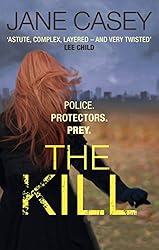
The Kill by Jane Casey: Book Notes

Yet again I’m reading faster than I’m reviewing, so this post is not a full review but a few thoughts on The Kill by Jane Casey. Unless I write about a book straight after I finish reading it gets pushed to the back of my mind and sadly that is what has happened in this case, which is a shame as it’s a brilliant book, the fifth in her DC Maeve Kerrigan series and I fully agree with the quotation from the Sunday Times that ‘Jane Casey’s police procedurals go from strength to strength.’

The book begins in Richmond Park in London at 00.43 where a couple are badger-watching but to their horror are witnesses, albeit at a distance, to a murder.

The victim is a police officer. But this is just the first murder and yet more police officers are killed. Maeve and her boss, DI Josh Derwent are part of the Met’s team assigned to investigate. They have no idea about the motive for the murders as the attacks seem to be random, from the first victim alone in his car (why was he there at that time anyway?), to the officers of the Territorial Support Unit killed as they patrolled the Maudling Estate – is it a reaction to the police killing a young and innocent black teenager? The MP, Geoff Armstrong thinks so.

This is a fast-paced novel, with an intriguing and complex plot and featuring characters that have appeared in the earlier books, developing their relationships. Some issues look as though they have been resolved, such as Superintendent Godley’s guilty secret, and others such as Maeve’s relationship with her boyfriend Rob, also a police officer come to a head, whereas Derwent and Maeve continue to have a confrontational working relationship and the interaction between them and DCI Una Burt gets even worse. I suppose it’s possible to read this as a standalone, but because of the back stories I think it is better to read them in order.

I found it absolutely compelling reading.

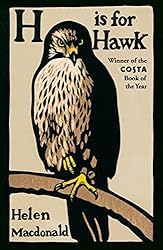
H is for Hawk by Helen Macdonald

I really wanted to love H is for Hawk by Helen Macdonald, which  won the 2014 Samuel Johnson Prize for Non-Fiction, as well as the 2014 Costa Book of the Year but I found it difficult to read and draining, despite some richly descriptive narrative.  It’s really three  books in one – one about herself, her childhood and her intense grief at the sudden death of her father, one about training a goshawk and another about T H White and his book, The Goshawk in which he describes his own struggle to train a hawk.

When her father died she bought Mabel, a ten week old goshawk and became obsessed with training her. It is the training that made this book so difficult for me to read. I am not comfortable with keeping wild creatures in captivity and in my naivete I hadn’t realised just what training a hawk entailed. Even though Helen Macdonald tells her friend’s husband that it had not been a battle training Mabel because ‘she’s a freakishly calm hawk‘, it came across to me that it had been a battle of wills, as she kept Mabel indoors in a darkened room, in a hood, on a perch or restrained on a leash for much of the time. It was a physical battle too that evoked rage, violence and frustration.

I found it difficult too because it is so personal as she exposed just how bereft she was, how she suffered the loss of her father and became depressed almost to the state of madness:

It was about this time that a kind of madness drifted in. Looking back, I think I was never truly mad. More mad north-north-west. I could tell a hawk from a handsaw always but sometimes it was striking to me how similar they were. I knew I wasn’t mad mad because I’d seen people in the grip of psychosis before, and that was madness as obvious as the taste of blood in the mouth. The kind of madness I had was different. It was quiet, and very, very dangerous. It was a madness designed to keep me sane. My mind struggled to build across the gap, make a new and inhabitable world. (location 219)

This a book unlike any other that I’ve read, about wildness, grief and mourning, and obsession, which made it heavy reading for me.

  • Format: Kindle Edition
  • File Size: 1875 KB
  • Print Length: 322 pages
  • Page Numbers Source ISBN: 0802123414
  • Publisher: Vintage Digital (31 July 2014)
  • Source: I bought it

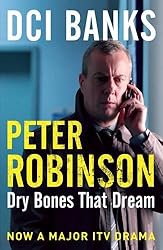
Dry Bones That Dream by Peter Robinson: Book Notes

I read Peter Robinson’s DCI Banks books set in the Yorkshire Dales, every now and then, so I’m reading them totally out of order. It doesn’t seem to matter. Dry Bones That Dream is the 7th book in the series and the cover of my copy shows  Stephen Tompkinson as Banks. I don’t remember seeing this one on ITV, but I probably did as I see from the list of episodes in Wikipedia that it was broadcast in 2012.
Dry Bones That Dream was first published in the UK in 1995 and in the US later in as Final Account.

Summary from Peter Robinson’s website:

One May evening, two masked gunmen tie up Alison Rothwell and her mother, take Keith Rothwell, a local accountant, to the garage of his isolated Yorkshire Dales farmhouse, and blow his head off with a shotgun. Why? This is the question Detective Chief Inspector Alan Banks has to ask as he sifts through Rothwell’s life. Rothwell was generally known in the area as a mild-mannered, dull sort of person, but even a cursory investigation raises more questions than answers. When Banks’s old sparring partner, DS Richard ‘Dirty Dick’Burgess, turns up from the Yard, the case takes yet another unexpected twist, and Banks finds himself racing against time as the killers seem to be dogging his footsteps. Only after he pits his job against his sense of justice does he discover the truth. And the truth leads him to one of the most difficult decisions of his career.

My Thoughts:

I read this quite quickly, even though it’s just over 350 pages, in between mammoth gardening sessions (more about that later maybe). It really centres around identity and unearthing the secrets the characters have kept hidden from their family and friends. There’s also money-laundering and international and political shenanigans involved.

Much of the book revolves around Banks and his relationships, with family, colleagues and the people he interviews in connection with Keith Rothwell. Banks seems to be at a pivotal moment in his personal life. As usual with the DCI Banks books  we are told what music Banks listens to which got a bit monotonous for me and the descriptions of what each character looked like and the clothes they were wearing didn’t add anything to the plot. I did have an inkling about the truth about Rothwell’s murder but thought I was being too fanciful and that it was an unlikely scenario – it wasn’t. But I did enjoy reading it anyway even with these drawbacks.

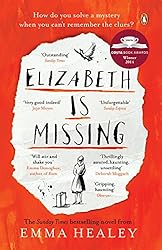
Elizabeth is Missing by Emma Healey

The events in that unfold in Emma Healey’s debut novel, Elizabeth is Missing are seen through Maud’s eyes. But Maud is an unreliable narrator – she can’t help it though as she has dementia.
Emma Healey’s depiction of dementia is convincing showing the confusion and bewilderment that Maud must have felt. It’s heart-rending, as she knows that Elizabeth, her friend, is missing, but doesn’t know where she is and no one seems to be listening to her when she talks about her – her own daughter and Elizabeth’s son just don’t answer her questions. And she asks them over and over again. As Maud continues her search for Elizabeth, she also recalls the search for her sister, Sukey, who disappeared in 1946.

It is not a book that I can say I ‘enjoyed’, even though it’s well written and with convincing characters. I thought it was over long and maybe would have been better as a novella. Inevitably, because the narrator has dementia there is much repetition – too much for me. I was disappointed with the plot too, because the ending became predictable quite early on in the book. Overall then a depressing book.

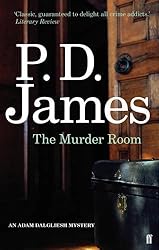
The Murder Room by P D James

The Murder Room by P D James is one of the last of the Adam Dalgleish books, first published in 2003 . Although I’ve not read many of the books I’ve watched most (if not all) of the TV adaptations, but I don’t remember watching this one.

The Murder Room itself is in the Dupayne Museum, displaying the most notorious murder cases of the 1920s and 30s, with contemporary newspaper reports of the crimes and trials, photographs and actual exhibits from the scenes of the murders. These were actual crimes and not fictional cases made up by P D James.

The novel  begins, as Commander Adam Dalgleish visits the Dupayne in the company of his friend Conrad Ackroyd who is writing a series of articles on murder as a symbol of its age. A week later the first body is discovered at the Museum and Adam and his colleagues in Scotland Yard’s Special Investigation Squad are called in to investigate the killing, which appears to be a copycat murder of one of the 1930s’ crimes.

The Murder Room is not a quick read. It begins slowly with a detailed description of the main characters and it is only after 150 or so pages that the first murder occurs, so by that time I had a good idea of who might be killed but not of the culprit as many of the characters could all have had the motive and opportunity. There are two more killings before Dalgleish reveals the culprit.

More used to fast paced murder mysteries initially I was impatient with this slow start but soon settled into P D James’ approach and appreciated the depth of the intricate plot. The setting is fascinating and the characters are convincing, so much so that I was hoping the second victim wouldn’t be one of my favourite characters.

The lease on the Museum is up for renewal and not everyone wants it to continue – as one of the characters says:

It’s the past … it’s about dead people and dead years … we’re too obsessed with our past, with hoarding and collecting for the sake of it.

There is the Dupayne family – Marcus and Caroline both actively involved in running the Museum, and their brother Nigel, who is a psychiatrist, and his daughter Sarah; the Museum staff – Muriel Godby in charge of the Museum’s day to day running, Tally Clutton the housekeeper, James Calder-Hale, the curator who used to work for MI5; Marie Strickland, a volunteer calligraphist; and Ryan Archer, the handyman and gardener.

I liked the interaction between Dalgleish and D I Kate Miskin, and between Dalgleish and Emma Lavenham who is finding their relationship increasingly frustrating. I enjoyed the book and found it absorbing and testing of both my powers of deduction and vocabulary.