The Silent Wife by Karin Slaughter

Description

The gripping No. 1 Sunday Times crime thriller She runs

A woman runs alone in the woods. She convinces herself she’s safe. He watches

But a predator is watching from the shadows. Waiting for the perfect moment to attack.He waits

They thought they caught him. But another victim has just been found.

The hunt has only just begun. And the killer is ready to strike again…

I hadn’t read any of Karin Slaughter’s books, but I thought I’d try this one when I saw it on NetGalley, as I know they are very popular. But for a number of reasons I did not enjoy The Silent Wife at all! First of all I hadn’t realised this was part of a series until I started reading it, but once I did I hoped it would read well as a standalone – but it doesn’t. Then it’s a serial killer story and I’m never keen on that.

But the main reason is that it is very graphic, very dark, extremely disturbing with rapes and murders described in great detail, and just far too gruesome for me. I was really struggling to make myself read it – so I gave up and didn’t finish it!

Thanks to NetGalley for my review copy, anyway.

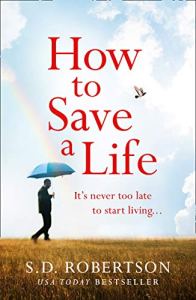
How to Save a Life by S D Robertson

Description

You can’t have a rainbow, without a little rain…

When a stranger saves Luke’s life, he knows he’s been given a second chance. He’s going to make it count – and, determined to live each day to its fullest, he starts by saying yes to everything life has to offer.

Slowly but surely, Luke learns that a little bit of blue-sky thinking can go a long way, and things start to look up.

But when Luke’s new resolve is tested, will he return to his old ways? Or can one fateful moment truly save a life.

A life-affirming story about a man who is given a second chance, perfect for fans of Mike Gayle and Imogen Clark.

How to Save a Life is one of the oldest books on my NetGalley shelf. It has sat there far too long, since 2020. It’s the second book I’ve read by S D Robertson (the first was If Ever I Fall), which is why I requested it. It’s an emotional story, character driven, narrated solely by Luke, a barber, with a pessimistic outlook on life. His parents died in a tragic accident, then just a fortnight before Christmas his wife told him she’d been having an affair and left him. He is wallowing in misery, living alone with his cat, Alfred. Until he meets Iris. They were both sheltering from a sudden storm under scaffolding when a violent gust brought the building and scaffolding down on them – Luke survived, but Iris didn’t. She had saved his life, pushing him out of the way as the scaffolding collapsed.

Iris’s death has a powerful effect on Luke, especially when he learns what a wonderful person she was – a doctor who was passionate about volunteering her services for a charity scheme in Africa. He felt guilty that he had survived and vowed to change his outlook and his life, trying to be more like Iris.

This book is not my usual choice of genre, but I think it is an interesting book that did give me food for thought. I liked the setting in Manchester’s Northern Quarter, and I could easily visualise Luke’s barber’s shop and its surroundings. However, it is repetitive as Luke analyses his feelings and actions over and over again, and it’s slow paced because of that. He has several setbacks as things don’t all turn out how he had hoped, but it is a heart-warming story, if a little predictable.

My thanks to Avon, the publishers for a review copy via NetGalley.

  • ASIN: ‎ B07Z4BBBF9
  • Publisher ‏: ‎ Avon (11 Jun. 2020)
  • Print length: 397 pages
  • Review copy
  • My rating : 3*

Six Degrees of Separation from Passages to The Private Patient

It’s time again for Six Degrees of Separation, a monthly link-up hosted by Kate at Books Are My Favourite and Best. Each month a book is chosen as a starting point and linked to six other books to form a chain. A book doesn’t need to be connected to all the other books on the list, only to the one next to it in the chain.

The starting book this month is Passages: Predictable Crises of Adult Life by Gail Sheehy, a self help book that shows how to use each life crisis as an opportunity for creative change — to grow to your full potential. It’s described as ‘a brilliant road map of adult life shows the inevitable personality and sexual changes we go through in our 20s, 30s, 40s, and beyond’. I haven’t read this book.

My First link is to another self-help book, The Road Less Travelled by M Scott Peck, a book I read many years ago. Sub-titled The New Psychology of Love, Traditional Values and Spiritual Growth this book is a guide through the difficult, painful times in life by showing us how to confront our problems through the key principles of discipline, love and grace.

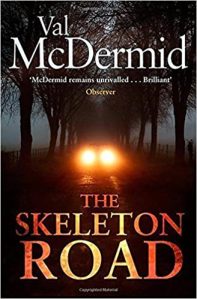
My Second Link is to The Skeleton Road by Val McDermid. Investigating the identity of the skeleton found, with a bullet hole in its skull, on the rooftop of a crumbling, gothic building in Edinburgh takes Detective Chief Inspector Karen Pirie and her Historic Cases Unit into a dark world of intrigue and betrayal during the Balkan Wars in the 1990s. Dr River Wilde a forensic anthropologist, discovers that the skeleton is a male, he’d been dead between five and ten years and his dental work shows he was originally from one of the Eastern bloc countries.

And so my Third Link is to another character with the name of Wilde in Nemesis, the third book in Rory Clements’s Tom Wilde series. It’s historical fiction set at the beginning of World War Two when Wilde, on his honeymoon in France, rescues his student Marcus Marfield. This is an intricately plotted spy thriller in which Wilde finds himself in great personal danger. For just who is Marcus Marfield? And where does his loyalty lie?

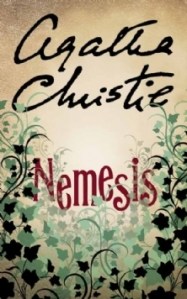
My Fourth Link is via the title of another book called Nemesis – by Agatha Christie. Mr Rafiel, who Miss Marple met in the West Indies, has left her £20,000 in his will on condition she investigates a certain crime, but doesn’t give her any details. He wrote that she had a natural flair for justice leading to a natural flair for crime and reminded her that the code word is Nemesis. 

Agatha Christie was in her eighties when she wrote Nemesis and it was the last book she wrote about Miss Marple.

My Fifth Link is P D James’s The Private Patient another book written by an author in her eighties. It’s set in a private nursing home for rich patients being treated by the famous plastic surgeon George Chandler-Powell. One of the patients is investigative journalist Rhoda Gradwyn. She was looking forward to a week’s peaceful convalescence and the beginning of a new life. But she was never to leave Cheverell Manor alive. Commander Adam Dalgliesh and his team are called in to investigate her murder.

Another character called Rhoda is my Sixth Link, Past Encounters by Davina Blake. This is a thought provoking book about love, loyalty, betrayal and forgiveness. Rhoda Middleton is convinced her husband, Peter, is having an affair. In essence this is a story of a marriage that has drifted, so that Rhoda and Peter no longer talk to each other about the things that matter in their lives. And they both have secrets from each other – big secrets!

My chain is made up of self help books and crime fiction novels, linked by genre, their titles, characters’ names, and two authors writing in their eighties.

Next month (1 April 2023), we’ll start with Bruce Springsteen’s autobiography, Born to Run.

Book Beginnings & The Friday 56: The Summer That Never Was by Peter Robinson

Every Friday Book Beginnings on Friday is hosted by Gillion at Rose City Reader where you can share the first sentence (or so) of the book you are reading. You can also share from a book you want to highlight just because it caught your fancy.

One of the books I’m currently reading is The Summer That Never Was by Peter Robinson, the 13th Inspector Banks book, following on from Aftermath. I am really enjoying it, so far, which is a relief as I really disliked Aftermath.

My Book Beginning:

Trevor Dickinson was hung over and bad-tempered when he turned up for work on Monday morning

Also every Friday there is The Friday 56, hosted by Freda at Freda’s Voice, where you grab a book and turn to page 56 (or 56% of an eBook), find one or more interesting sentences (no spoilers), and post them.

Page 56:

‘Did he have many friends?’

‘He made quite a few around here,’ Joan answered. She looked at her mother. ‘Who was there Mum?’

‘Let me remember. There was the Banks lad, of course, they were very close, and David Grenfell and Paul Major. And Steven Hill.’

Blurb

A skeleton has been unearthed. Soon the body is identified, and the horrific discovery hits the headlines.

Fourteen-year-old Graham Marshall went missing during his paper round in 1965. The police found no trace of him. His disappearance left his family shattered, and his best friend, Alan Banks, full of guilt.

That friend has now become Detective Chief Inspector Alan Banks, and he is determined to bring justice for Graham. But he soon realizes that in this case, the boundary between victim and perpetrator, between law-guardian and law-breaker, is becoming more and more blurred.

What do you think, does it appeal to you? What are you currently reading?

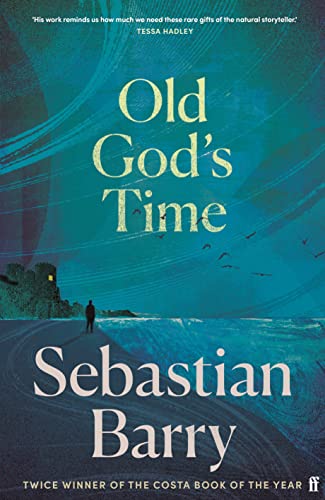
Old God’s Time by Sebastian Barry

Rating: 4 out of 5.

Faber and Faber Ltd| 2 March 2023 | 228 pages|e-book |Review copy|4*

Synopsis:

Have you ever been the custodian of a story no one else believed?’
‘Oh yes,’ he said.
‘You have?’
‘Yes,’ he said.
‘Then I can tell you.’

Recently retired policeman Tom Kettle is settling into the quiet of his new home, a lean-to annexed to a Victorian castle overlooking the Irish Sea. For months he has barely seen a soul, catching only glimpses of his eccentric landlord and a nervous young mother who has moved in next door. Occasionally, fond memories return, of his family, his beloved wife June and their two children.

But when two former colleagues turn up at his door with questions about a decades-old case, one which Tom never quite came to terms with, he finds himself pulled into the darkest currents of his past.

A beautiful, haunting novel, in which nothing is quite as it seems, Old God’s Time is about what we live through, what we live with, and what may survive of us.

My thoughts:

I’ve enjoyed all Sebastian Barry’s books and Old God’s Time is no exception. It’s set in Dalkey, a small coastal town south of Dublin, where Tom, a recently retired policeman is living in a tiny flat annexed to a Victorian castle. One afternoon he was sitting in a sun-faded wicker chair, enjoying a cigarillo, listening to the sound of the sea below. He was quite content to just gaze out, watching the cormorants on the rocks to the left of Dalkey Island, when two of his former colleagues disturbed his peaceful afternoon, asking for his help on a cold case he had worked on. He doesn’t want to, knowing it will open up painful memories he would rather forget.

So this appears to be a detective story, but the main focus is Tom, himself as the narrative reveals in streams of consciousness. It soon becomes clear that his memories are unreliable and for a while I was confused, not knowing what was going on, whether Tom was remembering, or imagining what had happened in his life. It is beautifully written, showing the beauties of the landscape. It takes us right inside Tom’s mind, highlighting the horrors that Tom had experienced both in his childhood and family life as well as in his professional life. The past had not been kind to him. But now it was as though enough time had gone by and it was as if it had never happened; it had receded away into ‘old God’s time’, and Tom didn’t want to reach back into those memories. They were locked away, preserved in the long-ago.

It is a tragic story, not shying away from describing the horrific details of child abuse, nor the despair and sadness as the details of Tom’s family life are gradually revealed. It is a harrowing book, made even more so as I had to read it slowly making sure I fully understood what I was reading, even going back to re-read some passages. It is bleak, but Tom’s story is also one of love and immeasurable happiness, of strength and goodness, alongside grief and pain.

Top Ten Tuesday: Fantasy Novels

Top Ten Tuesday is a weekly meme created by The Broke and the Bookish and now hosted by Jana at That Artsy Reader Girl. For the rules see her blog.

The topic this week is a Genre Freebie and I’ve chosen the following ten fantasy novels, all of which I’ve read. There are many more I could have included – these are just the ones that came to my mind at the moment, not necessarily the top ten, but ten that I have enjoyed.

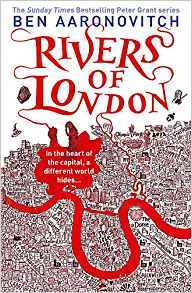
  • Rivers of London – urban fantasy set in the real world of London. It’s a mix of reality and the supernatural, a magical reading experience, and a fast-paced police procedural of a very different kind. 
  • A Game of Thrones (A Song of Ice and Fire,1) by George R R Martin, an epic fantasy novel  set in a grim and violent world full of tragedy, betrayals and battles; a tale of good versus evil in which family, duty, and honour are in conflict.
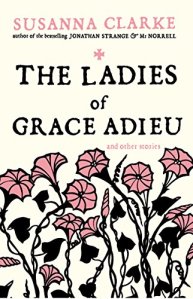
  • The Ladies of Grace and Adieu and Other Stories by Susanna Clarke as fantastical as Jonathan Strange and Mr Norrell, a collection full of fantasy stories of deep dark woods, paths leading to houses that seemingly move locations, ladies who are never what they appear to be, princesses, owls, and above all fairies, including the Raven King.
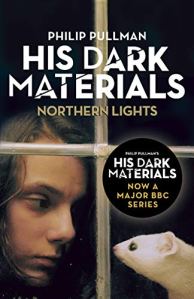
  • Northern Lights by Philip Pullman, the first book in his trilogy His Dark Materials, set in a universe similar to ours, but different. It’s all so beautifully described that you are convinced of the reality of this universe. 
  • The Library of the Dead by T L Huchu set in a future or alternative Edinburgh, with a wealth of dark secrets in its underground. 
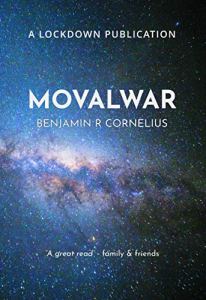
  • Movalwar by Benjamin Cornelius who is my friend’s great-nephew (aged 11 when he wrote his book). It’s about two eleven year-old boys, Alfie and Ben and their exciting and dangerous journey to save the fate of two worlds.
  • The Toymakers by Robert Dinsdale, an extraordinary, magical and wonderful book that captivated me, a book set mainly in 1917 whilst the First World War was taking its toll of humanity, leaving despair and tragedy in its wake. It’s a blend of historical fiction and magic realism.
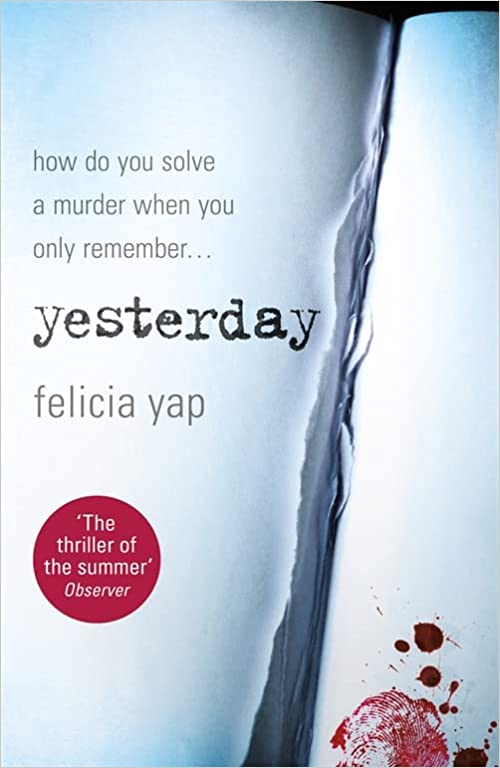
  • Yesterday by Felicity Yap about a world where memory for everyone over the age of eighteen is limited for 70% of people to just one day (the Monos) whilst the rest (the Duos) have two days of memory. Each day everyone has to write down their actions, thoughts and feelings in their iDiaries and then memorise the ‘facts’. But are these ‘facts’ reliable?
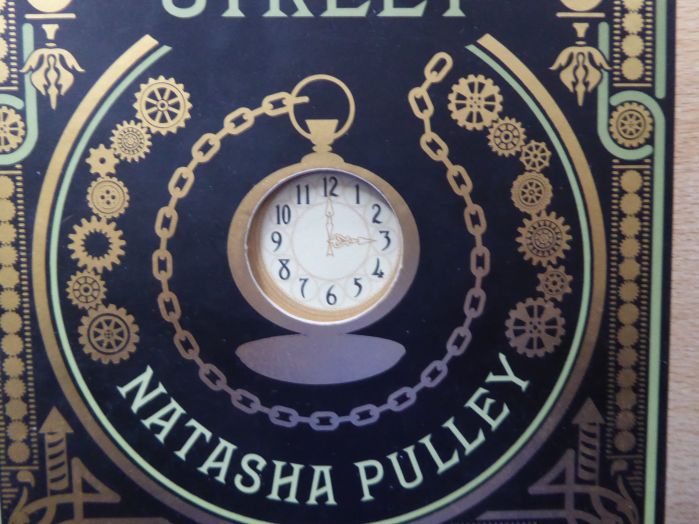
  • The Watchmaker of Filigree Street by Natasha Pulley, that blends historical events with flights of fancy to plunge readers into a strange and magical past, where time, destiny, genius ‘and a clockwork octopus’ collide.
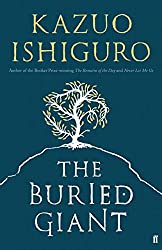
  • The Buried Giant by Kazuo Ishiguro. There are ogres, deadly pixies,  evil monks who keep a dreadful beast underground, Saxons – Wistan, a warrior and a young boy, and Sir Gawain entrusted by King Arthur to slay Querig, a she-dragon roaming the land, who by her breath has spread the mist of forgetfulness.