Appointment with Death by Agatha Christie

Agatha Christie’s Appointment with Death, set in the Middle East was first published in 1938 after her final pre-war visit to the area. It seemed right to read this book straight after I’d finished reading Come, Tell Me How You Live in which Agatha Christie wrote about her life on archaeological expeditions in Syria with her husband Max Mallowan.

The novel begins in Jerusalem where the Boyton family are sightseeing. There are two stepsons, one is married, a daughter and a step daughter. Mrs Boynton is a malignant and malicious tyrant who enjoyed exercising her power over her family, who all hated and yet obeyed her. Dr Gerard, a French psychologist, also a tourist remarks that

… she rejoices in the infliction of pain – mental pain, mind you, not physical. That is very much rarer and very much more difficult to deal with. She likes to have control of other human beings and she likes to make them suffer.

The Boyntons and Dr Gerard travel on through the Judean desert to Petra. Also in the group are Jonathan Cope, a family friend, Sarah King, a newly qualified doctor, Lady Westholme, a member of Parliament and Miss Annabel Pierce, a former nursery governess. The beginning of the book is taken up with relating their journey to Petra and the complicated relationships between the characters. It comes to a climax when Mrs Boynton is found dead.

The remainder of the book covers the investigation into her death. Colonel Carbury is in charge and although it appears that Mrs Boynton, who suffered from heart trouble had died overcome by the heat and strain of travelling, he is not satisfied and he has an idea that the family killed her. He enlists the help of Hercule Poirot, who was also in Jerusalem at the same time as the Boyntons and had overheard part of a conversation, ‘You do see, don’t you, that she’s got to be killed.’ He was sure he would recognise that voice again – and he did.

Poirot is his usual confident (arrogant) self, convinced he can solve the mystery and he does through questions, analysis and psychological reasoning. I didn’t work it out myself though.

This is a quick, easy read, with a lot of dialogue in a relatively short book (less than 200 pages). I enjoyed it, although it’s not one of my favourite Agatha Christie books.

I’m including it in Bev’s Color Coded Challenge as the main colour of the cover of my copy is brown. It’s one of the remaining few novels I have left to read for Kerrie’s Agatha Christie Reading Challenge.

THE CLASSICS SPIN RESULT ‘¦

‘¦ it’s NUMBER 5

which on my list is The Old Curiosity Shop by Charles Dickens.

I have until October 23, 2015 to read it  – but it could easily take me much longer than that as in the mean time I have George Eliot’s Adam Bede to read for my local book group for our next meeting at the end of September. I can see that my reading is going to be a lot slower than normal.

I have started reading Adam Bede, but each time I’ve picked it up I’ve nodded off to sleep (and it wasn’t even bedtime!) I just hope The Old Curiosity Shop won’t have the same effect on me. I have a feeling that I might find it a bit too sentimental for my liking – this is the book in which Little Nell suffers a melodramatic death. And that’s as much as I know about it.

If you’re in the Spin too which book did you get?

The Classics Spin: My List

The Classics ClubThe Classics Club has been so quiet for a while now that I was beginning to think it had folded – but no!

It’s time for another Classics Spin for any who are interested. By next Monday, August 24, list your choice of any twenty books you’ve left to read from your Classics Club list ‘” in a separate post. Next Monday morning, The Classics Club will announce a number and that is the book for you to read by October 23.

This is my list:

  1. Moll Flanders by Daniel Defoe
  2. Nicholas Nickleby by Charles Dickens
  3. Little Dorrit by Charles Dickens
  4. Martin Chuzzlewit by Charles Dickens
  5. The Old Curiosity Shop by Charles Dickens
  6. Oliver Twist by Charles Dickens
  7. The Mill on the Floss by George Eliot
  8. Romola by George Eliot
  9. Parade’s End by Ford Maddox Ford
  10. Mary Barton by Elizabeth Gaskell
  11. North and South by Elizabeth Gaskell
  12. Wives and Daughters by Elizabeth Gaskell
  13. Far from the Madding Crowd by Thomas Hardy
  14. The Return of the Native by Thomas Hardy
  15. Love in the Time of Cholera by Gabriel Garcia Marquez
  16. One Hundred Years of Solitude by Gabriel Garcia Marquez
  17. Doctor Thorne  (Barsetshire Chronicles, #3) by Anthony Trollope
  18. The Color Purple by Alice Walker
  19. The Age of Innocence by Edith Wharton
  20. The Voyage Out by Virginia Woolf

I don’t mind which one of these comes up in the Spin, but I’m half hoping it will be one of the Hardy books and I’m not sure about reading The Voyage Out as I’ve started this in the past and put it back on the shelf unfinished.

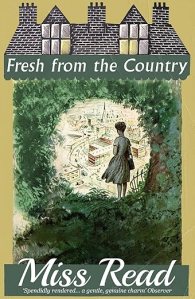
Fresh from the Country by Miss Read

I loved Miss Read’s Fairacre and Thrush Green novels when I read them years ago.  ‘Miss Read’ is a pseudonym for Dora Jessie Saint (1913 – 2012) who wrote over 30 gentle books of English country and village life  for adults and children.

Set in the 1950s, Fresh from the Country is a stand-alone novel telling the story of Anna Lacey, a newly qualified teacher, as she spends her first year teaching in Elm Hill, a new suburb in London. It is a little disappointing, because although Miss Read successfully conveys Anna’s  dislike of the new suburb in comparison to her love of life in the countryside where she grew up, I found it a bit over done and dispiriting and the comparison is repeated several times in different ways throughout the book.

But there are some lovely descriptions of the everyday lives of the teachers and children at Elm Hill school in this book alongside some interesting comparisons between town and country. One example is the ‘flabby wrapped slices of bread‘ her landlady provides compared to the ‘fat cottage loaves with a generous dimple in their crusty tops‘. Another example, a ‘wild lovely bouquet’ of ‘sprays of bright yellow hornbeam and rose hips‘ compared to ‘faded artificial daffodils‘. Anna decides that the difference between her home and her lodgings in town is that ‘one was genuine, wholesome and homely – the real thing‘. The other was ‘false and artificial.

Despite my slight disappointment I did like this book, which transported me back to the 1950s, when children were taught in large classes and the pace of life was slower than today. It was a bit disconcerting to read that Anna enjoyed smoking, but then the dangers of cigarettes were not emphasised in those days and many people did smoke.

There are interesting comments on enjoying the simple pleasures of life, on the nature of happiness, the virtues of truthfulness and neighbourliness, being useful in the community and how ambition is a

… two-edged weapon which ‘could provide a motive, an interest, a spur. It could be the means of living in a perpetual state of hope. … But, on the other hand it could lead to self-aggrandisement and self-deception.’ (page 107)

By the end of the year Anna feels more settled at the school. She is looking forward to moving out of Mrs Flynn’s house to more comfortable lodgings with the hospitable and friendly Mrs Armstrong. But she thought that  in the ‘misty future there might be a country school‘ and a ‘little house of her own set in quiet fields’. I don’t think that Miss Read wrote any more books about Anna, but I like to think that a little village school did materialise for her.

Reading Challenges:  this is the 25th book I read towards the Mount TBR Reading Challenge and the 4th book for the TBR Pile Reading Challenge.

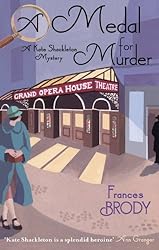
A Medal for Murder by Frances Brody

Last year I read and enjoyed Dying in the Wool, the first of Frances Brody’s series of historical crime fiction books set in 1920s Yorkshire and featuring Kate Shackleton. The second book, A Medal for Murder is even better and I was thoroughly immersed in the mystery.

A pawn shop robbery brings Kate and her assistant Jim Sykes, an ex-policeman,  their second case. It leads on to her discovery of a dead body, that of Lawrence Milner, outside a Harrogate theatre where Kate had been watching a production of a dramatisation of Arnold Bennett’s novel, Anna of the Five Towns. Then Captain Wolfendale, a Boer War veteran asks Kate to find his granddaughter, Lucy, who had starred in the play, as she has disappeared and he had received a ransom note. The murder  brings Kate into contact again with Inspector Marcus Charles of Scotland Yard (she had first met him in Dying in the Wool).

The book is told from the different characters’ perspective, but mainly from Kate’s, with flashbacks to the Boer War at the turn of the century. This is a detailed, complex plot which kept me guessing almost to the end about the identity of the murderer.  What is Captain Wolfendale hiding in his attic that he doesn’t want Kate to see? Just what is his relationship with Lawrence Milner who had also fought in the Boer War? How/is the pawn shop robbery connected to the murder? Will Lucy be rescued? And why doesn’t Dan Root, a watch maker, who also rents a room in the Captain’s house want to Kate to see inside his workroom?

There is so much going on in this book, and yet it was easy to read and each sub-plot fitted in so well with the main mystery that I didn’t get confused – I just couldn’t see who could have killed Milner. I had several suspects, all of whom turned out to be innocent of the crime. I liked the historical setting and the characters rang true. I’m left wondering whether Kate’s relationship with Inspector Charles will develop further, and whether she will ever hear what happened to her husband, reported missing in the 1914-18 War.

These are the books in the Kate Shackleton Mystery series:

1. Dying in the Wool (2009)
2. A Medal For Murder (2010)
3. Murder in the Afternoon (2011)
4. A Woman Unknown (2012)
5. Murder on a Summer’s Day (2013)
6. Death of an Avid Reader (2014)
7. A Death in the Dales (2015) to be published 1 October 2015

For more information about the author and her books see Frances Brody’s blog and website.

Reading Challenges: Mount TBR Reading Challenge, 10 Books of Summer, Historical Fiction Reading Challenge.

Come, Tell Me How You Live by Agatha Christie Mallowan

Agatha Christie had visited the Middle East in 1929 travelling on the Orient Express to Istanbul and then on to Damascus and Baghdad. She visited the excavations at Ur and returned there the following spring where she met archaeologist Max Mallowan – by the end of the summer they had decided to marry, which they did on 11 September 1930. 

Come Tell Me How You Live: an archaeological memoir is her answer to her friends’ questions about what life was like when she accompanied Max on his excavations in Syria and Iraq in the 1930s.
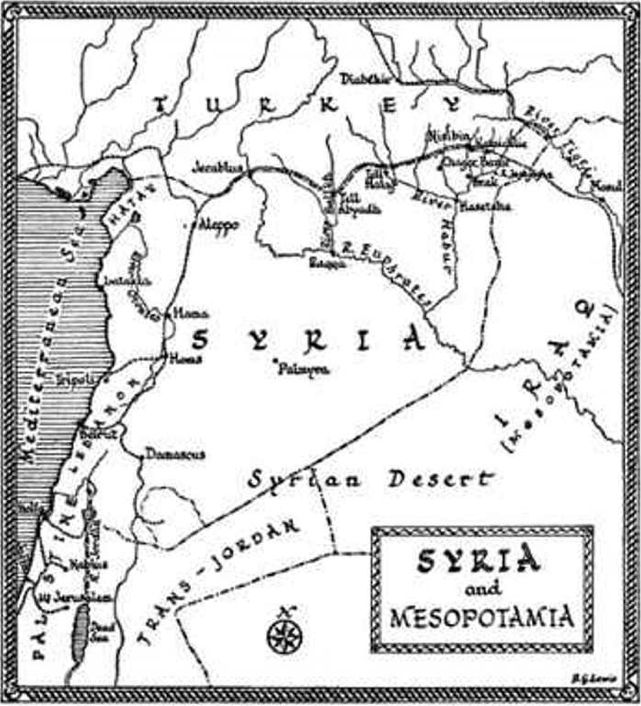
She began writing it before the Second World War and then laid it aside. After four years of the war she picked it up again, using her notes and diaries to complete this memoir, writing about her life with  Max Mallowan and his team excavating the ancient sites at Chagar Bazar, Tell Brak and other sites in the Habur and Jaghjagha region in what was then north western Syria. This map shows the area they were working in:

Syria 1930s

She wrote in the Epilogue  (written in 1944) that in remembering and recording that time it had been

… not a task, but a labour of love. Not an escape to something that was, but the bringing into the hard work and sorrow of today of something imperishable that one not only had but still has!

For I love that fertile country and its simple people, who know how to laugh and how to enjoy life, who are idle and gay, and who have dignity, good manners, and a great sense of humour, and to whom death is not terrible.

Inshallah, I shall go there again, and the things that I love shall not have perished from this earth.

With regard to her statement about death earlier in the book Agatha Christie had explained the difference between the Western and Oriental attitudes to life and death:

Accustomed as we are to our Western ideas of the importance of life, it is difficult to adjust our thoughts to a different scale of values. And yet to the Oriental mind it is simple enough. Death is bound to come – it is as inevitable as birth; whether it comes early or late is entirely at the will of Allah. And that belief, that acquiescence, does away with what has become the curse of our modern day world – anxiety. (page 96)

The emphasis in the book is on the everyday life on a dig and Agatha took an active part, helping to catalogue, label and clean the items they found as well as taking photographs and developing them. She also found time to spend on writing her books. So, although she gives a detailed account of how they worked, how they employed workmen for the excavations and servants who looked after Max and his team of archaeologists, there is not much about what they found.

Although she described the local people in her Epilogue as people, who know how to laugh and how to enjoy life, who are idle and gay, and who have dignity, good manners, and a great sense of humour, she also recorded their disputes:

Quarrelling is, in any case, almost continuous. All our workmen have hot tempers, and all carry with them the means of expressing themselves – large knives, bludgeons, and a kind of mace or knobkerry. Heads are cut open, and furious figures are entangled with each other in fierce struggles … page 86

And she also recorded this chilling statement:

We come to the question of religions generally – a very vexed question in this particular part of the world, for Syria is full of fiercely fanatical sects of all kinds, all willing to cut each other’s throats for the good cause! (page 166)

How sad and horrified she would be if she could see Syria today, but in the light of the extract above I don’t think she would have been too surprised! And sadly the places she loved are no longer the same. Here is her description of the shrine Sheikh ‘Ada near Mosul

There  can be, I think, no spot in the world so beautiful  or so peaceful. You wind far up into the hills through oak trees and pomegranites (sic), following a mountain stream. The air is fresh and clear and pure. …

And then suddenly, you come to the white spires of the Shrine. All is calm and gentle and peaceful there. Gentle-faced custodians bring you refreshments and you sit in perfect peace, sipping tea. (page 109)

Compare that with the description in The Guardian last August of the area as ‘hell on earth‘.

This book is written with love and humour – for example Agatha’s description of buying clothes for her visit to Syria because her last year’s summer clothes  are Shrunk, Faded and Peculiar – and too tight everywhere.  In the Foreword she stated that it is a book full of everyday doings and happenings with ‘no beautiful descriptions of scenery, no treating of economic problems, no racial reflections, no history.‘ I think she was under estimating her writing, because this little book has all that and more. I loved it.