What are you currently reading? What did you recently finish reading? What do you think you’ll read next?
Currently reading:
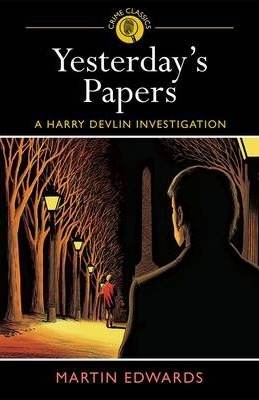
I’m reading Yesterday’s Papers by Martin Edwards – On Leap Year Day in 1964, an attractive teenager called Carole Jeffries was strangled in a Liverpool park. The killing caused a sensation: Carole came from a prominent political family and her pop musician boyfriend was a leading exponent of the Mersey Sound. When a neighbour confessed to the crime, the case was closed. Now, more than thirty years later, Ernest Miller, an amateur criminologist, seeks to persuade lawyer Harry Devlin that the true culprit escaped scot free. Although he suspects Miller’s motives, Harry has a thirst for justice and begins to delve into the past. But when another death occurs, it becomes clear that someone wants old secrets to remain buried – at any price.
Recently Finished: I’ve just finished Sword by Bogdan Teodorescu, translated by fellow blogger Marina Sofia– A shadowy killer stalks the streets of Bucharest, seeking out victims from among the Roma minority. But this is not the usual police procedural as it focuses on the effect the serial killings have on the political scene. I’ll write more about it later on.
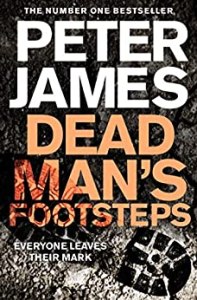
Reading Next: I’m never really sure, but it could be Dead Man’s Footsteps by Peter James. I’m reading his Superintendent Grace books in order and this is the 4th one.
Amid the tragic unfolding mayhem of the morning of 9/11, failed Brighton businessman and ne’er-do-well Ronnie Wilson sees the chance of a lifeline: to shed his debts, disappear and reinvent himself in another country. Six years later the discovery of the skeletal remains of a woman’s body in a storm drain in Brighton leads Detective Superintendent Roy Grace on an enquiry spanning the globe, and into a desperate race against time to save the life of a woman being hunted down like an animal in the streets and alleys of Brighton.
What do you think – which one would you read next?
This post has taken me hours to write using the new Block Editor which I find most confusing. I’m wondering how other WordPress users are getting on – any tips that would help me would be most welcome!
Top Ten Tuesday is a weekly meme created by The Broke and the Bookish and now hosted by Jana at That Artsy Reader Girl. For the rules see her blog.This week’s topic is Opening Lines (Best, favorite, funny, unique, shocking, gripping, lines that grabbed you immediately, etc.)
These are all opening lines that made me keen to read on. I could have chosen many others but these came to mind first.
‘Once the queen’s head is severed, he walks away.‘ ( From The Mirror and The Light by Hilary Mantel)‘
I will always remember exactly where I was and what I was doing when I heard that my father had died.’ (From The Seven Sisters by Lucinda Riley)
The thing I later remembered the most about the day the gunman came was my teacher Miss Russell’s breath.’ (From Only Child by Rhiannon Navin)
‘It was the day my grandmother exploded.’ (From The Crow Road by Iain Banks)
‘I went to Manderley again.’ (From Rebecca by Daphne du Maurier)
I’m that girl.’ (From I Know Who You Are by Alice Feeney)
‘Theirs was a land of awesome grandeur, a land of mountains and moorlands and cherished myths.’ (FromHere Be Dragonsby Sharon Penman)
‘It starts with a selfie.’ (From Anything You Do Say by Gillian McAllister)
‘The red stain was like a scream in the silence.’ (From Snowblind by Ragnar Jonasson)
’ Dying is not as easy as it looks in the movies.‘ (From Rubbernecker by Belinda Bauer)
Judith at Reader in the Wilderness hosts this meme – Bookshelf Travelling for Insane Times. I’m still enjoying looking round my actual bookshelves and re-discovering books I’ve read or am looking forward to reading. The idea is to share your bookshelves with other bloggers. Any aspect you like:
1. Home. 2. Books in the home. 3. Touring books in the home. 4. Books organized or not organized on shelves, in bookcases, in stacks, or heaped in a helter-skelter fashion on any surface, including the floor, the top of the piano, etc. 5. Talking about books and reading experiences from the past, present, or future.
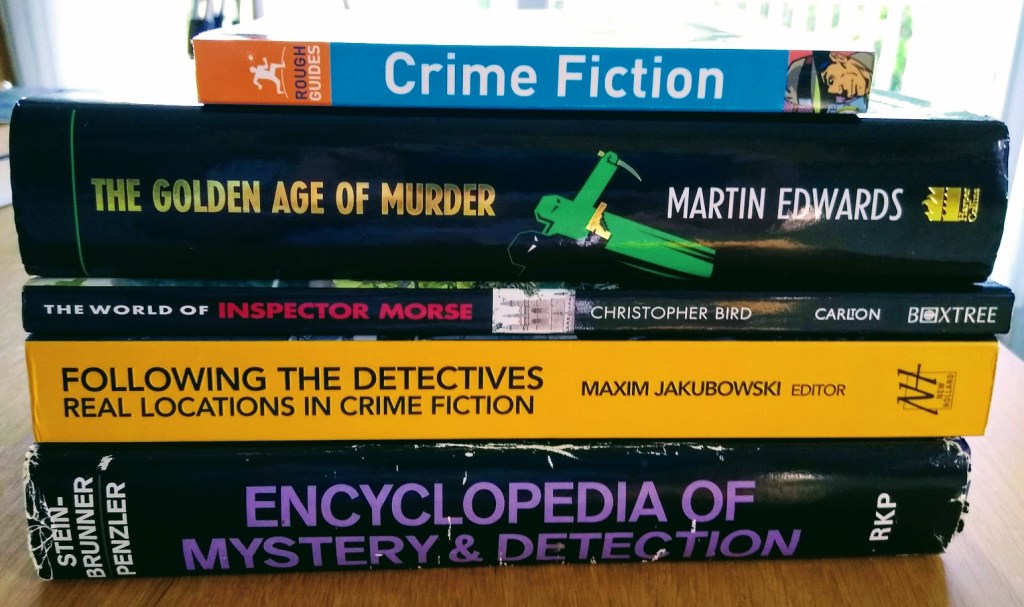
I’ve brought this pile of books together from different bookcases. They’re about crime fiction and crime fiction writers.
The book at the bottom of the pile is Encyclopedia of Mystery and Detection by Chris Steinbrunner and Otto Penzler, published in 1976. It contains details not only of mystery and crime fiction authors but also ‘biographies’ of fictional detectives, including Sherlock Holmes, Perry Mason, Hercule Poirot and Margaret to name but a few. It also includes details of films, plays, radio and TV series. And there are lots of photos.
Following the Detectives Real Locations in Crime Fiction edited by Maxim Jakubowski is another fascinating book giving details of 20 crime fiction detectives in the cities and countries in which they live and work. So, there are maps featuring real locations, such as the Oxford Bar in Edinburgh where Inspector Rebus and his creator, Ian Rankin drink. It’s a beautiful book both to look at and to read, with colour photos, details of film/theatre/TV dramatisations and clear maps showing the locations, plus links to useful websites.
The World of Inspector Morse by Christopher Bird with a Foreword by Colin Dexter is next. This is an A-Z reference detailing Morse’s and Lewis’s activities on Colin Dexter’s books and on TV and illustrated with stills from the TV series. Looking through it this morning I came across a section called ‘Literature’ – Dexter described Morse as a ‘dipper-in’ rather than a ‘systematic reader’. He loves poetry, the works of A E Houseman, his favourite author is Dickens, his second favourite Thomas Hardy. I should ‘dip-in’ to this book more often.
The Golden Age of Murder by Martin Edwards. If you enjoy the detective stories written between the two World Wars then this is the book for you. It tells the story of how the writers such as Agatha Christie and her colleagues in the Detection Club transformed crime fiction. They were interested in and influenced by a number of real crimes, both current at the time and crimes from the past, such as Dr Crippen’s poisoning of his wife. This book is crammed full of fascinating information about the period and the authors.
And finally, The Rough Guide to Crime Fiction by Barry Forshaw, another indispensable book for crime fiction lovers. This covers a variety of sub-genres from the origins of crime fiction in the 19th century with the Gothic writers to the novels of Edgar Allen Poe, Charles Dickens, Wilkie Collins, Arthur Conan Doyle to the classic mysteries of the Golden Age and onwards into the 20th century. There are sections on spies, private detectives, professionals and amateurs, serial killers, historical crime and so on.
Every Friday Book Beginnings on Friday is hosted by Gillion at Rose City Reader where you can share the first sentence (or so) of the book you are reading, along with your initial thoughts about the sentence, impressions of the book, or anything else the opener inspires.
Turn to page 56, or 56% on your eReader. If you have to improvise, that is okay.
Find any sentence (or a few, just don’t spoil it) that grabs you.
Post it.
Add the URL to your post in the link on Freda’s most recent Friday 56 post.
Page 56:
Jeannie dubbed the case Watergate: the papers loved it and made the tag their own. She had once been a disco queen and when she organised a Jive for Justice at Empire Hall, it sold out and made national headlines. A tabloid paper bought exclusive rights to her story and portrayed her as a modern Joan of Arc.
Blurb
On Leap Year Day in 1964, an attractive teenager called Carole Jeffries was strangled in a Liverpool park. The killing caused a sensation: Carole came from a prominent political family and her pop musician boyfriend was a leading exponent of the Mersey Sound. When a neighbour confessed to the crime, the case was closed. Now, more than thirty years later, Ernest Miller, an amateur criminologist, seeks to persuade lawyer Harry Devlin that the true culprit escaped scot free. Although he suspects Miller’s motives, Harry has a thirst for justice and begins to delve into the past. But when another death occurs, it becomes clear that someone wants old secrets to remain buried – at any price…
~~~
This is the fourth Harry Devlin book, although I haven’t read any of the earlier books, so plenty to look forward to. I’ve read all of Martin Edwards’ Lake District books and loved them.
22 years ago Quincy Miller was sentenced to life without parole. He was accused of killing Keith Russo, a lawyer in a small Florida town. But there were no reliable witnesses and little motive. Just the fact that Russo had botched Quincy’s divorce case, that Quincy was black in a largely all-white town and that a blood-splattered torch was found in the boot of Quincy’s car. A torch he swore was planted. A torch that was conveniently destroyed in a fire just before his trial.
The lack of evidence made no difference to judge or jury. In the eyes of the law Quincy was guilty and, no matter how often he protested his innocence, his punishment was life in prison.
Finally, after 22 years, comes Quincy’s one and only chance of freedom. An innocence lawyer and minister, Cullen Post, takes on his case. Post has exonerated eight men in the last ten years. He intends to make Quincy the next.
But there were powerful and ruthless people behind Russo’s murder. They prefer that an innocent man dies in jail rather than one of them. There’s one way to guarantee that. They killed one lawyer 22 years ago, and they’ll kill another without a second thought.
My thoughts:
Years ago I read as many John Grisham books that I could find – I loved them. So I was delighted to find that The Guardians, his latest book is really good too, even though it is written in the present tense. I often find that style irritating but in this case I was gripped by the story and the tense didn’t trouble me in the slightest.
The book is based on a real story and a real person, which gives it a really authentic feel. Guardian Ministries is based Centurion Ministries founded by James McCluskey, working to prove the innocence of convicted criminals, convinced of their innocence. The narrator, Cullen Post, a lawyer who is also a priest, is working on behalf of several prisoners. The book opens dramatically as Duke Russell is having his last meal before being executed. But the main part of the story is centred on Quincy Miller who maintains he was framed for the murder of lawyer Keith Russo and has been in prison for 22 years.
The only small criticism I have is that at first several minor characters are introduced which muddied the waters a little but once I got further into the book it became clear that there were major miscarriages of justice that Post was investigating, as he concentrates on Quincy’s case. It’s an easy read but packed with detail, a lot of it quite shocking. I enjoyed it immensely, especially learning about the US legal system.
Atlantic Books Corvus| 05 Mar 2020| 288p| Review copy| 3*
Synopsis
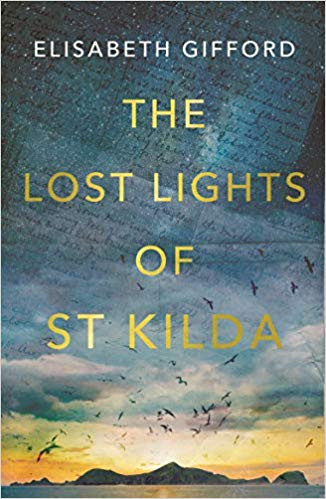
1927: When Fred Lawson takes a summer job on St Kilda, little does he realise that he has joined the last community to ever live on that beautiful, isolated island. Only three years later, St Kilda will be evacuated, the islanders near dead from starvation. But for Fred, memories of that summer – and the island woman, Chrissie, with whom he falls in love – will never leave him.
1940: Fred has been captured behind enemy lines in France and finds himself in a prisoner-of-war camp. Beaten and exhausted, his thoughts return to the island of his youth and the woman he loved and lost. When Fred makes his daring escape, prompting a desperate journey across occupied territory, he is sustained by one thought only: finding his way back to Chrissie.
The Lost Lights of St Kilda is a sweeping love story that crosses oceans and decades. It is a moving and deeply vivid portrait of two lovers, a desolate island and the extraordinary power of hope in the face of darkness.
For those unaware, St Kilda is a Scottish island in the Atlantic Ocean which had been continuously inhabited from the Bronze Age up until 1930 when the island was evacuated due to an irretrievable population crash and the logistical difficulty of getting necessary supplies to an island essentially cut off during the Winter.
My thoughts:
The Lost Lights of St Kilda is historical fiction set mainly in two time periods, 1927 and the 1940s, following the story of Chrissy, a native of the island and Fred and Archie, visiting students from Cambridge University. At first I wasn’t really involved in the plot which is basically a romance, the story of a love triangle complete with all the misunderstandings and anguish that involved. I found it rather predictable, But the highlights of the book for me are the descriptions of St Kilda, its history, the importance to the islanders of the bird life, and their isolation and the poverty they endured. The account of the island’s evacuation is particularly moving.
After a slow start, the book picks up pace and I became more involved in the story. It’s a book of two halves really – the story of the last years of life on St Kilda and a war story. It’s very well researched and Elisabeth Gifford explains in her acknowledgements that the characters are loosely based on the people who lived on St Kilda whilst remaining fictional, although some of the characters featuring in the chapters about Fred’s wartime experience are based on real people. She lists the books she used for her research – books about the island, about Atlantic seabirds and journals and biographies of soldiers who were captured during the Second World War and their escapes, all of which brought her novel to life for me.
My thanks to the publishers for my review copy via NetGalley.




 These are the rules: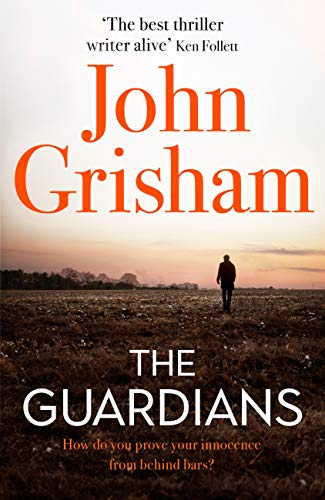
 BooksPlease