Current Library Books

I always have several books on loan from my local library. These are my current loans:

It’s no wonder my TBR pile of my own books doesn’t go down very quickly! I didn’t borrow these books all in one go – they are the result of several visits and are due back on different dates!

They are a mix of fiction and non-fiction. At the bottom of the pile are three art books – two by Barrington Barber about painting and drawing,  a comprehensive step-by-step instruction book and Anyone Can Paint about painting in watercolours, acrylics and oils,  The third art book is Cold Breeze, Dark Fire a book of paintings and drawings of North Northumberland by Peter Podmore.  Podmore lives in this area and paints mainly outside using pastels, oils, acrylic and charcoal – such inspiring, beautiful and dramatic paintings.

Next up in the pile is Stephen Fry’s memoir, More Fool Me, his third volume. It begins with a synopsis of his earlier books, which as I haven’t read them is very helpful.

Then up to the fiction beginning with a Catherine Cookson, The Silent Lady. I haven’t read many of her books, but this one appealed to me. It’s her last novel, written when she was very ill, but she was convinced that she had a good story to tell.

The Spice Merchant’s Wife by Charlotte Betts. This is one of those books that I know nothing about or about its author, but took down off the library shelves on an impulse. I like to try new-to-me authors and this is one of my favourite genres – historical fiction set in 1666.

Trouble Brewing by Dolores Gordon-Smith, chosen because it’s crime fiction set in 1925, written in the classic mystery style, according to the back cover.

I’ve enjoyed The Woods by Harlan Coben, so I thought I’d try another one and picked up Tell No One, about a couple visiting a lake that had been part of their lives since they were children – then the wife is kidnapped and killed.

More historical fiction with The Botticelli Secret by Marina Fiorato. I liked her earlier book The Madonna of the Almonds, about the artist Bernadino, a protege of Leonardo da Vinci. This one is about the model of Botticelli’s painting La Primavera.

Margaret Forster is one of my favourite authors, so I thought The Seduction of Mrs Pendlebury could be a safe bet for me. Mrs Pendlebury lives in Islington, has little in common with her neighbours and keeps herself to herself – gradually she comes out of her shell. Nina Bawden quoted on the back cover describes it as a tragi-comedy.

Finally, the book at the top of the pile, The Silver Pigs by Lindsey Davis, a Marcus Didius Falco novel set in the time of the Emperor Vespasian – historical crime fiction, a combination of two favourite genres. I’m surprised at myself that I’ve never read any of this author’s books, she ‘s written nineteen novels, but at least I’m starting with the first one in this series.

I just need to get reading!
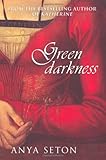
Green Darkness by Anya Seton

I finished reading Green Darkness a couple of weeks ago and have been wondering what to write about it or whether to write anything at all. I thought I’d read the book years ago, not long after it came out, but as soon as I began what I thought was a re-read I realised that this was completely new to me – I just thought I’d read it because I’d visited Ightham Mote, a beautiful 14th century moated manor house in Kent where part of Green Darkness is set.

A brief synopsis from Goodreads:

This story of troubled love takes place simultaneously during two periods of time: today and 400 years ago. We meet Richard and Celia Marsdon, an attractive young couple, whose family traces its lineage back to medieval England. Richard’s growing depression creates a crisis in Celia, and she falls desperately ill. Lying unconscious and near death, Celia’s spirit journeys backward to a time four centuries earlier when another Celia loved another Marsdon.

I wasn’t enthralled by it and nearly abandoned it after the first few chapters set in 1968, because the characters didn’t come over as real and the writing in accents was awful. But once I got on to the historical part, set in the 16th century it was better, so I read on.

There are some books that are easy to write about – this isn’t one of them so this is a brief post. Green Darkness is written around the premise of reincarnation, so the characters/personalities feature in both time periods. I didn’t think this was successful, but seemed contrived. For me the book would have been better as straight historical fiction.

Reading Challenges: Color Coded Challenge – green (I don’t know why this book is called Green Darkness – if the book explains the title I missed it). What’s In a Name – a book with a colour in its title. Historical Fiction challenge – 16th century England. My Kind of Mystery Challenge.

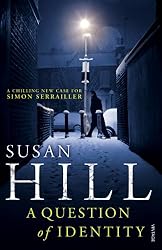
A Question of Identity by Susan Hill

I began reading A Question of Identity, the 7th Simon Serrailler book by Susan Hill immediately after I’d finished reading the 6th book, The Betrayal of Trust (see my previous post), which had left some issues unresolved. I was hoping to find out more in this book and I wasn’t disappointed – which is one reason for reading these books in order. Another reason is to follow the continuing story of Simon and his family. And a third reason is that Susan Hill always focusses on one or more psychological/moral/ ethical issues.

Summary (back cover):

How do you catch a killer who doesn’t exist?

One snowy night in the cathedral city of Lafferton, an old woman is dragged from her bed and strangled with a length of flex.

DCS Simon Serrailler and his team search desperately for clues to her murderer. All they know is that the killer will strike again, and will once more leave the same tell-tale signature.

Then they track down a name: Alan Keyes. But Alan Keyes has no birth certificate, no address, no job, no family, no passport, no dental records. Nothing.

Their killer does not exist.

I much preferred this book to the previous one. It is more balanced between the crime and the continuing story of the main characters. I suspect it may be incorrect in describing police procedures – I don’t know and really it doesn’t bother me, this is fiction after all and I have no difficulty in believing in the world of Serrailler and Lafferton that Susan Hill has created.

The main theme in this book, as the title indicates is ‘identity’ and its importance, how it is concealed, whether a personality can be changed convincingly and completely, or whether eventually the façade will crack and the real character reassert itself.

Susan Hill is also very good at creating tension and suspense. You know there are going to be murders (just as in Casualty you know there’s going to be a terrible accident etc), but that just increases the suspense. She builds up the setting and the characters and I was hoping against hope that one of the characters would not be a victim – and of course she was. I suspected the identity of the killer quite early on and hoped I was wrong about that too – but I wasn’t.  I began to feel very uncomfortable about the fate of the elderly, living on their own, frail and vulnerable …

It’s the psychological/social elements of A Question of Identity that appealed to me more than the crime, although these elements are inevitably so closely connected.

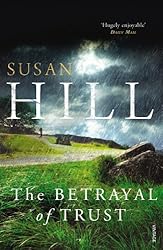
The Betrayal of Trust by Susan Hill

So far this year I’ve been reading from my own bookshelves – books I’ve owned before 1 January. I’ve had The Betrayal of Trust by Susan Hill, the 6th in the Simon Serrailler series, for nearly a year now. Like the earlier books, this one is  character-driven, concentrating on the people involved in the crime and Simon’s family, and also covering several ethical/moral/medical issues.

The crime element concerns a cold case, that of a teenager missing for 16 years. After flooding causes a landslip on the Moor her body comes to the surface together with that of an unknown female found in a shallow grave near by.The cold case is not a priority as the police force is struggling with staff shortages and cuts – Simon has to solve the cases mainly on his own, with the occasional help from DS Ben Vanek.

But the police investigations are not the main subject of this book. It focuses on the problems of ageing, hospice care, Motor Neurone Disease, assisted suicide, Parkinson’s Disease and Alzheimer’s Disease. A lot to cope with all at once and at times I found The Betrayal of Trust a deeply depressing book.

Having said that, as with Susan Hill’s other books, this is fluently written, looking at all sides of the issues, highlighting the dilemma facing those with terminal and debilitating illnesses, and those looking after dementia patients. The Serrailler family life has moved on from the last book, but Simon’s strained relationship with his father continues. He fails in love with a stunningly beautiful woman, which causes yet more complications – he just  doesn’t seem capable of having a happy relationship!

Although this is a quick read it’s also rather dark, with some dodgy and sinister characters and I was expecting it to be better than it is. It is a complex novel but the solution to the crime mystery soon becomes evident and is rather rushed at the end. There are several issues left unresolved and I hope they will be clarified in the next book in the series, A Question of Identity, which is next up for me to read.