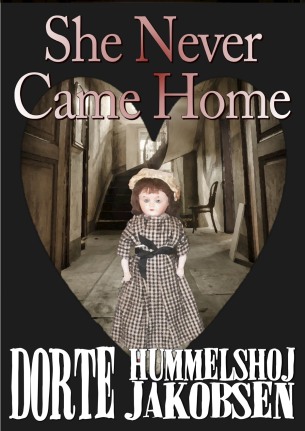
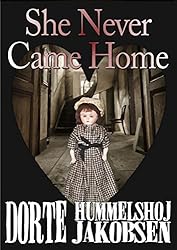
She Never Came Home by Dorte Hummelshoj Jakobsen

She Never Came Home is a perfect little ghost story for Halloween. Dorte Hummelshoj Jakobsen spins a suspenseful story of Alice and her husband Peter and their little dog, Foxy as they move into an old farmhouse deep in the Danish countryside. Just why is Foxy nervous about the cupboard under the sink, what is in the bedrooms upstairs that are excluded from their tenancy agreement, and why has the house been empty for over thirty years?

Both Peter and Alice are out of work, but Peter still has to work out his notice in Germany and leaves Alice alone in the house… Alice slowly discovers the horrible truth.

I really liked this short story, with its chilling atmosphere and shocking twist at the end. In just a few pages Dorte Hummelshoj Jakobsen has written such a compelling and entertaining tale.

This is my last entry in this year’s R.I.P. challenge and another one for the My Kind of Mystery challenge.

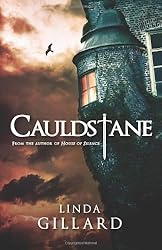
Cauldstane by Linda Gillard

Linda Gillard describes her book, Cauldstane  as ‘a gothic novel in the romantic suspense tradition of Daphne du Maurier, Mary Stewart & Victoria Holt.‘ It is a ghost story, set in a Scottish tower house in the Highlands:

Cauldstane stood, heroic, long-suffering, defying all that the centuries had thrown at it. (Wet rot and dry rot have proved more damaging to many a castle than the depredations of enemy artillery). I saw an ivy-clad tower, much taller than it was wide, with more windows than I could easily count, the whole topped by conical-roofed turrets and looking, from a distance, like a toy. (page 6)

The narrator is Jenny Ryan who is employed by Sholto MacNab, a retired adventurer and Laird of the castle, to ghost write his memoirs. Cauldstane, a beautiful castle is fast falling into disrepair and the MacNabs are struggling to maintain or even keep it.

When he employs Jenny Sholto jokes that every castle should have its ghost. Cauldstane not only has a ghost, there is also the MacNab curse, which affects the women the McNabs marry, with three deaths (two accidents and a suicide) attributed to the curse, and the legend of the Cauldstane claymore, supposed to possess supernatural powers to protect the MacNabs from evil.

Jenny immediately falls in love with the castle, but as she settles in a few things begin to disturb her – her notes on her laptop disappear. As she learns more about the MacNabs and their history, family secrets begin to surface. But what is the truth behind these stories? It seems to hinge on Meredith, Sholto’s second wife who was killed in a horrific car crash.

Cauldstane is peopled by well drawn colourful characters, a beautifully described atmospheric setting and a wealth of story-telling, recreating the past seamlessly interwoven with the present. Jenny not only falls in love with the castle, but also with Sholto’s heir, his son Alec and as she does so more strange events occur and it becomes obvious that there is a malign presence in the castle that doesn’t want her there. And it makes its presence known in a modern way – through Jenny’s laptop. No ghostly visions or  spooky voices, but a thoroughly evil presence capable of writing on the laptop as well as moving objects and putting Jenny’s life in danger, along with the music that apparently only Jenny can hear.

As well as being a gripping tale Cauldstane is also about fear. The epigraph from The Devil’s Dictionary by Ambrose Bierce (1842 – 1914) sets the tone: ‘Ghost: the outward and visible sign of an inward fear‘.  The MacNabs are not the only ones with things to fear in their past, for Jenny too has a troubled past and both have to learn how to overcome their fears. Cauldstane is also about loss and revenge, about good versus evil and the power of love.

Linda Gillard lives in the Scottish Highlands. She has written seven novels. I enjoyed this one very much but my favourite of hers is still Star Gazing. For more information about Linda Gillard and her books see her website, Linda Gillard – Author.

Reading challenges: Read Scotland 2014, My Kind of Mystery and R.I.P. IX.

She Never Came Home – FREE for Halloween!

She never came home

To celebrate Halloween, Dorte Hummelshoj Jakobsen has made her latest ghost story, She Never Came Home, free today and tomorrow.

Short story of 9,000 words – crime & ghosts. 

Grab it while you can, and feel free to share the news with your friends or blog readers – and remember to keep the lights on! 

Muhahaha!

http://authl.it/1zt

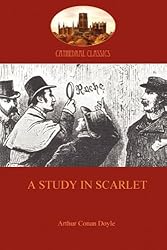
A Study in Scarlet by Sir Arthur Conan Doyle

This is the first Sherlock Holmes and Dr Watson mystery, published in 1887. A Study in Scarlet is a novel in two parts. The first, narrated by Dr John Watson, begins in 1881 with Watson on nine months convalescent leave from the army, having been shot in his shoulder whilst in Afghanistan, followed by an attack of enteric fever. As a result he was weak and emaciated – ‘as thin as a lather and as brown as a nut.‘ He was looking for lodgings when he met a friend who introduced him to an acquaintance who was working in the chemical laboratory at the hospital – Sherlock Holmes, who he described as ‘a little too scientific for my tastes – it approaches to cold-bloodedness. … He appears to have a passion for definite and exact knowledge.’ 

They get on immediately and take a suite of rooms in 221B Baker Street, after Holmes astounded Watson by deducing that Watson had served in Afghanistan. Holmes describes his occupation as a ‘consulting detective‘ solving crimes for both private individuals and the police, using his intuition, observation and the rules of deduction. Tobias Gregson and Lestrade both Scotland Yard detectives regularly ask Holmes for his help.

Very soon they are involved in investigating the murder of Enoch J Drebber, an American found dead in the front room of an empty house at 3 Lauriston Gardens, off the Brixton Road,  with the word “RACHE” scrawled in blood on the wall beside the body.

A Study in Scarlet is a superb story introducing Conan Doyle’s characters – Holmes reminds Watson of

… a pure-blooded well-trained foxhound as it dashes backwards and forwards through the covert, whining in its eagerness, until it comes across the lost scent.

Holmes is his brilliant best, leaving the police officers behind as he discovers the killer. And there then follows a flashback, narrated in the third person, to Part II The Country of the Saints to America in 1847, specifically to a Mormon community, explaining the events that led up to to the murder, where John Ferrier and his adopted daughter Lucy are first rescued from death in the desert and then subjected to the community’s rules, specifically with regard to Lucy’s marriage. At first I just wanted to get back to the murder inquiry and find out how Holmes discovered the murderer’s identity, but soon I was engrossed in the American story. Eventually the two parts come together in Chapter VI as Watson resumes the narrative and  Holmes reveals how he solved the problem by reasoning backwards and from a ‘few very ordinary deductions‘ was able to catch the criminal within three days.

I thoroughly enjoyed this story, written in a straightforward style with enough description to visualise both Victorian London and the American Wild West. I’d watched the TV version A Study in Pink in the Sherlock series, which although very different in some respects is surprisingly faithful to the book in others. I like both versions.

Sir Arthur Conan Doyle was born in Edinburgh in 1859 and died in 1930. He studied medicine at Edinburgh University, becoming the surgeon’s clerk to Professor Joseph Bell said to be the model for Sherlock Holmes’ methods of deduction. He gave up being a doctor with his success as an author and became involved in many causes – including divorce law reform, a channel tunnel, and inflatable life jackets. He was instrumental in the introduction of the Court of Criminal Appeal and was a volunteer physician in the Boer War. Later in life he became a convert to spiritualism.

See Fantastic Fiction for a list of works by Sir Arthur Conan Doyle.

Challenges: Read Scotland 2014, the Colour Coded Challenge, Mount TBR 2014 and My Kind of Mystery.
The Lake District Murder by John Bude

I first came across John Bude’s books nearly a year ago on Martin Edward’s blog Do You Write Under Your Own Name and thought they looked very interesting. His books are amongst those published by the British Library – reprints of unknown and undiscovered murder mysteries written in the thirties.  John Bude, whose real name was Ernest Carpenter Elmore, was writing in the Golden Age of detective fiction in the years between the two world wars. In 1953 he became one  of the founding members of the Crime Writers’ Association.

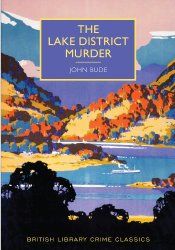
Anyway I made a mental note about the name and it lodged in the back of my mind until this September when I was in the Lake District and came across The Lake District Murder in the tourist information office in Glenridding on the shores of Ullswater. It has a striking cover, reproduced from a London & North Eastern Railway travel poster dating from the 1920s, showing a small steamer boat sailing on Ullswater, surrounded by the hills and mountains of the Lake District.

The LD mystery

The artist was John Littlejohns, who was born in Devon in 1874. He was a painter, illustrator, writer and teacher. As we had just been on a boat trip on Ullswater, in the Lady of the Lake (originally a steamboat), this immediately caught my eye.

The Lake District Murder as Martin Edwards writes in the introduction is ‘a world away from the unreality of bodies in libraries and cunningly derived killings on transcontinental trains.’ It is a police procedural, showing in intricate detail how the detectives investigate a crime. In this case a body is discovered in a car outside a lonely garage on a little used road. At first it appears that Jack Clayton one of the garage owners had committed suicide, but there are a couple of clues pointing to murder and when Inspector Meredith discovers that Clayton was planning to marry and move abroad it turns into a murder investigation. But what is the motive for murder and as everyone seems to have an alibi, who had the opportunity to kill Clayton? 

This book really takes you back in time. It was first published in 1935, which means that police methods of investigations particularly in rural areas was very different. Inspector Meredith uses buses or trains or travels the local roads on a motor cycle with a side car and pops into the local post office to use the telephone. It’s a slow process.

Having recently visited the Northern Lakes, I was fairly familiar with the landscape and could follow the action quite easily, but what I did find difficult was following the calculations Meredith and his colleagues carried out to work out petrol deliveries to the local garages, the lorries’ loads and the petrol storage capacities at the various garages. Inspector Meredith is a likeable character, with a happy home life, although his wife thought the police force made more than enough demands on his time  and tried to discourage their son’s interest in police affairs.

The Lake District Mystery is Bude’s second mystery novel. His first was The Cornish Coast Mystery,  and the third is The Sussex Downs Mystery (due to be released 27 October) both also reprinted by the British Library.

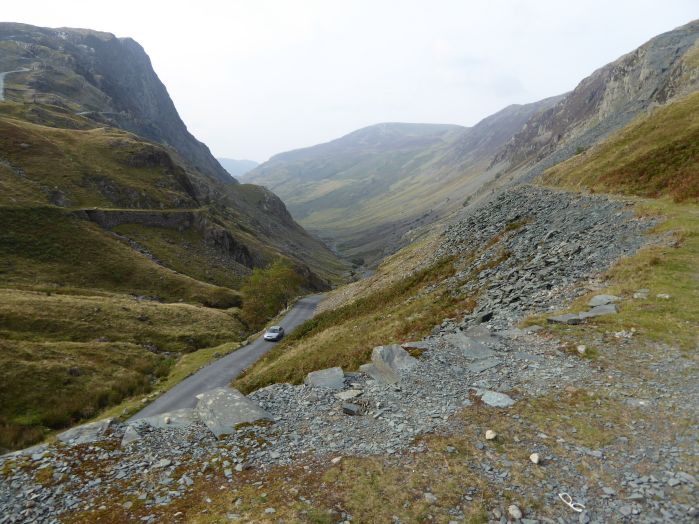
The Lake District – Honister Pass

Honister Pass P1010084

Whilst we were staying in the Lake District a few weeks ago we drove through the Honister Pass, one of the highest passes in Cumbria. It connects the Buttermere Valley with the eastern end of Borrowdale Valley. There is a slate mine but we didn’t have time to take a tour – just enough time for a quick drink and a look around.

Honister Slate Mine entrance
Honister Sky High Cafe P1010069
Honister Sky High Cafe

The little stone garden is most unusual:

Honister - stone garden
Honister – stone garden
Honister - stone garden
Honister – stone garden

and they fly the flag in the cafe:

Honister Sky High Cafe

as well as in words on this slate at the entrance:

Fly the Flag
Fly the Flag

For more Saturday Snapshots see Melinda’s blog West Metro Mommy Reads.