Tantalus by Jane Westwell

Tantalus: the sculptor's story by [Westwell, Jane]

I came across Jane Westwell’s novel, Tantalus, originally published under her pen name Jane Jazz, when she made a comment on one of my posts. It’s a love story set in the Yorkshire moors and marble mountains of Tuscany. The opening paragraph drew me in:

Journal of Thomas Hope: 30 June 1967

You were just 17, and I was now 70 years old. Your hair shone like burnished copper and you sparkled with youth, while I faded into the winter of my life.


Tantalus is a love story with a difference. The lovers are separated not by barriers of race, class or creed, but by something much more devastating  – by time. They can see and can talk to each other  but can never touch. Theirs is an impossible love as each is trapped in their own time and space.

It’s a moving story, written beautifully. Once I started reading I didn’t want to stop. It begins with Tom’s diary entry after he came out of his house as Sylvia was walking past. Sylvia then takes over the narrative, telling Emily their story:

I need to start at the beginning – the real beginning I mean, not this brief encounter on the footpath when your mum and I were just teenagers.

I need to ask you to undo the top few buttons of reality, and I need to fast forward eight years to that night of blind terror – the night I first saw the eyes in the wall.

How could I stop reading after that opening! And I had no trouble at all in undoing my buttons of reality.

Fast forward from 1967 to 1975 as Sylvia moves into an old house, the house she has known about and dreamed of living in since her childhood, Birchwood House. Sylvia had polio as a child and consequently has a withered leg. She is a painter, fascinated by a marble statue of a lady by the lake in the local park. She had thought of this lady as her secret friend ever since her mother pointed out that the statue had a damaged leg like hers – the statue is even called ‘Sylvia‘.

Birchwood House is a large Victorian semi-detached house, joined back to back with Oakwood House. Her life changes after she moved into Birchwood and sees through the wall of her studio into Oakwood and the eyes of the young sculptor, Tom who lived there 50 years earlier. I wondered if Tom was a ghost, or a figment of Sylvia’s imagination, the result of her loneliness? But I became increasingly sure that he was a reality as Sylvia centred her life and work on Tom and somehow they were able to communicate over a gap in time.

There is so much in this book that I loved – the characters, the story, the charged emotions and longing, the setting (in Yorkshire and Tuscany), and the art – the paintings and the sculpture. And one of the things that came as a complete surprise was the mention of Edmund Blair Leighton and his painting The Accolade. Tom describes it to Sylvia:

It portrays a maiden queen, with glorious autumn tresses, conferring the order of knighthood on a worthy squire. I was captivated by her loveliness, but never saw her like till now. You, my lady, are the living embodiment of his vision of beauty, and I the humble knight who kneels before you. (Loc 937)

I love this painting and have a tapestry of it hanging in the hall.

The Accolade P1090454

As I read on I began to hope that Tom and Sylvia would meet in real time, but this is not a slushy romance. It is such a poignant story, full of emotion and very moving, which I found completely absorbing. There is so much more I could write, but not without giving away too much of the plot.

This is Jane Jazz’s debut novel and I do hope that she will write another book.

I read Tantalus on my Kindle:

  • Format: Kindle Edition
  • File Size: 3632 KB
  • Print Length: 316 pages
  • Simultaneous Device Usage: Unlimited
  • Sold by: Amazon
  • Language: English
  • ASIN: B00I9E6ANU

Tantalus is a perfect title for the novel as according to Greek myth Tantalus was famous for eternal punishment by being made to stand in a pool of water beneath a fruit tree with low branches, with the fruit ever eluding his grasp, and the water always receding before he could take a drink.

For more information about Jane Jazz and her novel go to her website: Tantalus.

And after I’d finished reading Tantalus I realised that it a perfect fit for Carl’s Once Upon a Time Challenge.
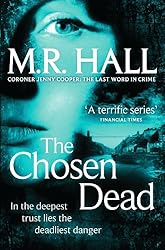
Book Beginnings: The Chosen Dead

What to read next is nearly always a difficult question, the problem being that I have so many books I’ve bought/borrowed that I really want to read right now and much as I would like to I can’t read them all at once.

So, this morning here I am nearly ready to start a new book and wondering which one to go for. It could be The Chosen Dead by M R Hall, his fifth novel in the Coroner Jenny Cooper series.

It begins:

Scottsdale Arizona, 12 March 1982

The last thing Roy Emmett Hudson was expecting on the eve of his forty-first birthday was a bullet in the head, but life and death are only a single breath apart, and as a biologist, he appreciated that more than most. Even as he strolled across the company lot to the Mercedes Coupé he had driven all winter without once raising the roof, his killers’ thoughts were already moving on to where they might dump his body so that it might never be found.

I’ve read three of the earlier books in the series, and liked them, so I’m hoping this one will be good. It’s an intriguing beginning because it doesn’t seem likely that Coroner Jenny Cooper could be involved in investigating this death as she is a Bristol coroner …

Synopsis from the back cover:

When Bristol Coroner Jenny Cooper investigates the fatal plunge of a man from a motorway bridge, she little suspects that it has any connection with the sudden death of a friend’s thirteen year old daughter from a deadly strain of meningitis. But as Jenny pieces together the dead man’s last days, she’s drawn into a mystery whose dark ripples stretch across continents and back through decades. In an investigation which will take her into the sinister realms of unbridled human ambition and corrupt scientific endeavour, Jenny is soon forced to risk the love and lives of those closest to her, as a deadly race to uncover the truth begins . . .

Every Friday Book Beginnings on Friday is hosted by Gillion at Rose City Reader where you can share the first sentence (or so) of the book you are reading, along with your initial thoughts about the sentence, impressions of the book, or anything else the opener inspires.

Black Dogs by Ian McEwan

Black Dogs 001Black Dogs is one of Ian McEwan’s earlier books (his fifth), first published in 1992. The narrator is Jeremy who lost his parents in a road accident when he was eight and from then on he is fascinated by other people’s parents, particularly his in-laws, Bernard and June Tremaine. When he first met them they were living apart, barely on speaking terms. Starting from a shared belief in communism, they had separated when June turned to God after an encounter with evil in the form of two black dogs. What actually happened doesn’t become clear until the end of the book.

Jeremy is writing a memoir about their lives. The book shifts in time and perspective as he talks to Bernard and June separately. So it moves from Wiltshire, where he visits June in 1987 where she is living in a nursing home, to Berlin with Bernard, when the Wall came down in 1989. Then it moves back in time to 1981 at Majdanek where Jeremy met Jenny, Bernard and June’s daughter, during a visit to the death camp near Lublin in Poland; then to the present day (1989) at the family house at St Maurice de Navacelles in Languedoc in southern France; and finally to 1946 with Bernard and June, newly married on their honeymoon in St Maurice de Navacelles, where June had her encounter with the black dogs.

In 174 short pages the characters come alive, their ideas and meditations are revealed, and the places they inhabit are easily visualised. Black Dogs is a book that gets inside its characters’ minds. It centres around love, loss and longing. The incidents Jeremy describes are open to interpretation – June and Bernard are the extremities, neither seeming to be on the same wave length; Bernard a rationalist and a scientist, June a mystic and believer, seeing the same events through different perspectives. Jeremy is impatient with the difficulty of communication, seeing

an image of parallel mirrors in place of lovers on a bed, throwing back in infinite regression likenesses paling into untruth. (page 90)

The question of the black dogs hangs over the narrative – were they symbolic of evil, or an expression of Churchill’s term for depression, or real creatures? Their impact was immense however you look at it. Black Dogs is a book I really enjoyed reading and thinking about after I finished it. 

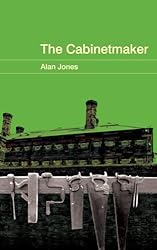
The Cabinetmaker by Alan Jones

When Alan Jones emailed me about reading his book The Cabinetmaker he described it as a gritty crime novel based in Glasgow that tells the story of a local cabinetmaker, Francis Hare, father of a murdered son, and John McDaid, a young detective on the investigation.

He went on to say that it contained some strong language, some sleazy police and a smattering of Glasgow slang, which did make me unsure I wanted to read it. But he also said that it combined Glasgow gang culture, sloppy policing and amateur football with fine furniture making and taking that into account I thought that it probably wouldn’t be your normal run-of-the mill crime fiction.

And I was right – it is different and I did like it, despite some of the language (which actually is no worse than in some other books) and there are no truly gruesome descriptions to put me off. In parts I thought it lost focus somewhat, the crime and justice aspects becoming a bit lost in a wealth of detail about football and furniture making, but apart from that it is a intricately plotted book which had me totally gripped. By the end of the book I realised that there is a purpose to those chapters beyond Alan Jones’s obvious love of football and furniture making. Within them lie the clues to what was really going on in Francis and John’s lives.

The Cabinetmaker follows John McDaid’s life from his first day as a detective up to his retirement in 2008, focussing on one crime – the killing of Patrick Hare, a student by a gang of thugs in Glasglow’s west end. The killers were tried but walked free.  From that point onward the story is of John and Francis and their search for justice.  Patrick’s death was a turning point in their lives and although they become friends through a shared interest in football and cabinet making, under pinning everything is their desire for justice.

There are many characters, including police and villains and at times some of them did begin to blur in my mind, with the exception of Francis, John and Sarah, Patrick’s girl friend, who all stand out as vivid and believable people. There are many twists and turns in the story, before the full truth is revealed. It’s a novel of loss and retribution.

Alan Jones (his pen name) is Scottish, living on the Clyde coast. I see from this interview on Omnimystery News that he is writing another book – I’ll be looking out for it.

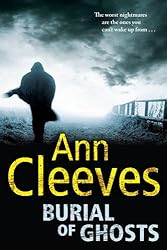
First Chapter, First Paragraph: Burial of Ghosts

First chapterEvery Tuesday Diane at Bibliophile by the Sea hosts First Chapter First Paragraph Tuesday Intros, where you can share the first paragraph, or a few, of a book you are reading or thinking about reading soon.

Today’s pick is a book that I mentioned in my post the other day on New Additions at BooksPlease. It’s Burial of Ghosts by Ann Cleeves.

It begins:

My nightmares feature knives and blades and blood. I don’t do falling down holes or being chased through deserted streets. And though I usually dream in black and white, the blood is very red, glossy, and it slides out from the rest of the scene, which is flat and dull. The worst thing is that when I wake, I realise it wasn’t a dream at all.

I’m in Blyth. It’s market day and I’m there to shop for Jess. There’s a stall where she buys all her fruit and veg – she knows the bloke who runs it and he always gives her a good deal. It’s mid-morning , with lots of people about. It’s not long before Christmas and everyone’s in the mood when they have to buy, even if the stuff’s crap, otherwise they feel they’re not prepared. A foggy, drizzly day, and cold with it. There’s a raw east wind which cuts into the skin. But it doesn’t draw blood. Not like the scissors I buy in Woolworths. I ask the assistant to take them out of the plastic packet to check they’re sharp. I run my thumb across the blade and there’s a small read line and then tiny, perfectly round red drops like jewels. I fumble with the money when I pay, not because of the cut, which is already healing, but because my hands are freezing.

What do you think? Would you keep reading?

Burial of Ghosts is a standalone book. It’s not a new book as it was first published in 2003 It’s now available in a new Pan paperback edition, which was published in September 2013.

Note: I see ITV are trailing series four of Vera when the first episode will be an adaptation of Harbour Street, the sixth and latest Vera Stanhope book. I really must read that one soon.

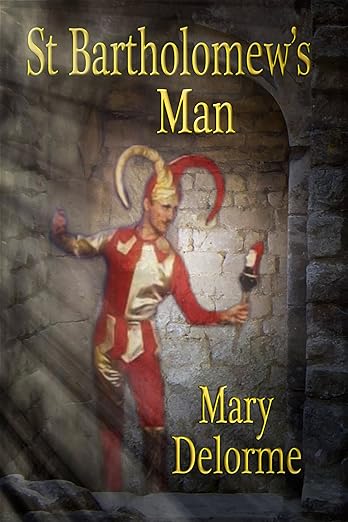
St Bartholomew's Man by Mary Delorme

I was intrigued when I was asked if I would like to read Mary Delorme’s book St Bartholomew’s Man, about Rahere, a man who was a court jester to Henry I and who was also instrumental in the foundation of St Bartholomew’s Hospital in 1123. I was intrigued because it seemed an odd combination, that a jester and the founder of St Bartholomew’s should be one and the same person. And I wondered how that had come about.

It is historical fiction but as Mary Delorme clarifies in her Author’s Note it is based on fact with this proviso:

Almost nine hundred years lie between Rahere and myself; enough to blur historical facts, and leave room for doubt. Rahere is often described as a man of lowly origins, and a jester – something I find difficult to accept, bearing his mind his outstanding achievements and experiences. I therefore began my novel assuming that he was more highly born; not of the highest, but still an educated man. (Loc 26)

It seems to me that she has thoroughly researched her material, and managed to incorporate it seamlessly into her book. St Bartholomew’s Man follows the life of Rahere, from his childhood growing up as an orphan in a monastery, where he was one of the singing children, and he helped the monks in their healing work.

It is a book that left me knowing a lot more about the late 11th and early 12th centuries. It tells of the lives of ordinary people, of the monastic life and above all of the dangers and turbulence of life, moving through the oppressive reign of the irreligious William II (William Rufus), the more settled and peaceful reign of Henry I, followed by the violent conflict that ensued with the reign of Stephen and Matilda. I liked the historical setting and the detail both about healing and building methods. The plot kept me interested to read on to find out whether Rahere succeeded, despite all the suffering he endured and the challenges he had to overcome, in fulfilling his vow to build a hospital to care for the poor in London. The characterisation is good and I felt all the main characters came over as real people, who grew and developed throughout the book.

I enjoyed reading this book, which made me want to find out more about Rahere and St Bartholomew’s. St Bartholomew’s Hospital website outlines the history of the Hospital and St Bartholomew the Great’s website gives some information about the founding of the Priory church and Prior Rahere. Rahere’s tomb is in the church.

Then there is Rudyard Kipling’s poem Rahere, based on the legend that Rahere founded St Bartholomew’s Hospital after suffering a bout of depression and seeing a family of lepers in a London street. I also see that Rosemary Sutcliff’s children’s book The Witch’s Brat is set in the reign of Henry I and features Rahere – I’m hoping to read that one too.

My thanks to Jon Delorme for providing a copy of St Bartholomew’s Man for review, a book that entertained me and led me on to other sources of history and literature. I really want to know more about the 12th century. My knowledge is limited to schoolgirl history and Ken Follett’s The Pillars of the Earth!