New Additions at BooksPlease

Dance of Love pile

I’ve acquired a mixed batch of  books recently, some old and some new- one very new, not yet published actually, a review copy of The Dance of Love by Angela Young (publication date 31 July).  I’m looking forward to reading it very soon. I read her first book Speaking of Love in 2007 – now available on Kindle.

The Dance of Love is set against the backdrop of the Edwardian age, moving from the ballrooms of London to the grand houses of Scotland and Devon, and there is a link to the tragedy of the Titanic.

Another new book is Casting the Net by Pam Rhodes, which came to me from the publishers via LibraryThing’s Early Reviewers Programme. This is described on the back cover as ‘light and amusing’, a ‘social comedy’ but dealing with issues of faith, family and friendship. It’s the second book in The Dunbridge Chronicles. I haven’t read anything by Pam Rhodes, but remember seeing her on Songs of Praise. It promises to be a bit different from the usual books I read.

Then there are some library books:

A Trick of the Light by David Ashton, a Scottish actor and writer – a new-to-me author, but it turns out he has written for film, television, theatre and radio. This book is crime fiction – an Inspector McLevy Mystery – set in Edinburgh in 1881, where a vicious murder has been discovered. It features a young Arthur Conan Doyle who has recently graduated from medical school.

Burial of Ghosts by Ann Cleeves – not a Vera or a Shetland book, but a stand-alone book in which Lizzie Bartholomew, running away from her past goes on holiday to Morocco where she has a brief affair. She returns to England only to find her nightmares are far from over.

The Man Who Smiled by Henning Mankell. I’ve probably watched the TV version of this book with Kenneth Branagh as Kurt Wallender because the synopsis does sound familiar, but I often prefer books to theirTV versions so I borrowed the book anyway. It was the title as much as anything that attracted me – Wallender is not known for his cheery disposition!

And finally in a different genre again The Roundabout Man by Clare Morrall (another new-to-me author). I think I’ve read about this book on some book blogs. The idea of a man living on a roundabout in a caravan seemed funny and quirky, and reading the blurb it promises to be a suspenseful tale too as the man (Quinn) is forced to confront his past.

Happy Birthday BooksPlease!

SevenBooksPlease is 7 Today!

An unbelievable seven years have gone by since I started my blog! There have been many changes in those years but I’m still here on my blog. I love reading and seven years ago I decided to write about the books I read, partly to help me remember what I’ve read and also to extend the pleasure of reading and to record what I thought about the books. And so ‘BooksPlease‘ was born.

I thought of calling my blog ‘Books Matter‘, or ‘Book Matters‘ but decided that it should be ‘BooksPlease‘ because they do and also because if somebody asked me what I wanted for my birthday or Christmas when I was a child I always said ‘ooh, books please!

I can hardly believe that I’ve been blogging this long. There have been, inevitably, ups and downs over the years and there have been times when I’ve thought of giving it up, but it’s become as much a part of my life as reading is and I carry on regardless. One of the unexpected pleasures of blogging has been the contact with other like-minded people all over the world, book lovers I would never have known about, or been able to ‘meet’ who have contributed to my blog with their comments. Thank you to all of you – and I hope to continue ‘talking’ to you as long as possible.

The Baileys Women's Prize for Fiction 2014

Yet another book award – this one is the Baileys Women’s Prize for Fiction. This year’s judges are Helen Fraser, Caitlin Moran, Sophie Raworth, Mary Beard, and Denise Mina.

It’s not a new award – it was formerly known as the Orange Prize for Fiction, set up in 1996 and is awarded for the best novel of the year written by a woman in the English language. Previous winners include A.M. Homes, Barbara Kingsolver, Zadie Smith, Lionel Shriver, Andrea Levy and Kate Grenville.

The books on the shortlist are:

  • The Lowland by Jhumpa Lahiri
  • A Girl Is A Half-Formed Thing by Eimear McBride
  • The Goldfinch by Donna Tartt
  • Burial Rites by Hannah Kent
  • Americanah by Chimamanda Ngozi Adichie
  • The Undertaking by Audrey Magee

Every book on this year’s list, bar The Undertaking, has been previously nominated for a major award – A Girl is a Half-formed Thing was on the inaugural Folio Prize list; Burial Rites was shortlisted for the Guardian First Book Award; The Lowland made it to the Man Booker shortlist; whilst Americanah beat Donna Tartt’sThe Goldfinch to the American National Book Critics’ Circle Award last year.

The winner, to be announced on 4th June, will receive a cheque for £30,000 and a limited edition bronze known as a ‘Bessie’, created by the artist Grizel Niven.

The only one of these books I have is The Goldfinch by Donna Tartt. I started to read it in February this year but I’ve only read up to page 87. It has nearly 800 pages, so it’s really too early in the book to make any sort of judgement on it. But, my initial thoughts were that it was going to be a book I could get really engrossed in, but then the story seemed to get swamped in too much detail, too much description and I wanted it to get a move on. So, I stopped reading. I expect I’ll pick it up again soon – I know other book bloggers have rated it highly.

I think Americanah looks very interesting and I loved the two of Chimamanda Ngozi Adichie’s books that I’ve read, Purple Hibiscus and Half of a Yellow Sun, so I’m hoping to read this one too.

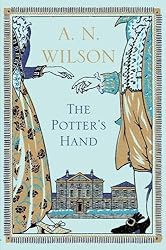
The Potter's Hand by A N Wilson

Now that the TBR Triple Dog Dare has finished I am free to read anything I want. I have bought/borrowed a few books since the beginning of the year and I immediately turned to The Potter’s Hand by A N Wilson, a library book I borrowed in March and fortunately I’ve been able to renew it. I had actually read the first couple of chapters, because I just couldn’t stop myself once I’d glanced at the dramatic opening paragraph, which I wrote about in a Book Beginnings post in March, but I resisted reading any more until April!

The novel begins in 1768 and roughly follows the fortunes of the Wedgwood family until 1805, 10 years after the death of Josiah Wedgwood, an English potter and the founder of the Wedgwood company. I say roughly because the narrative moves back and forth in time and place. It is a most remarkable book, which kept me wanting to read it each time I had to stop reading – it’s a long book which took me several days to read.

As Wilson explains in an Afterword the broad outlines of the story and most of the details are true, but he has altered dates and rearranged historical events and nearly all the letters are invented. It is ‘meant to be read as fiction, even thought it is intended in part, as an act of homage to one of the great men of our history.’

For me it really did convey what it must have been like to live in that period – whilst the the American War of Independence, the French Revolution, were taking place. It was a time of great change (what time isn’t?) both social and political change as the industrial revolution got under way in England. It’s full of ideas about colonialism, the abolition of slavery, working conditions, and women’s rights. It brought about small changes as well as big ones – for example, before Josiah’s time many families ate off pewter plates or wooden platters, but with his production of creamware ‘there was hardly a respectable household in the kingdom which did not eat its dinner off well-glazed delicate plates.’

Wedgwood’s fame was international and resulted in an order to supply Catherine the Great, the Empress of Russia with an enormous dinner service – the Frog Service, decorated with illustrations of grand houses, scenes of country estates, parks and gardens and numerous other British landscapes. And his great creation towards the end of his life was the Portland Vase, a copy of the original cameo glass Roman vase. But Wedgwood was not only a master craftsman, he was also involved with his friends – philosophers, scientist and inventors – in the development of the canals and roads improving transportation as his factory grew and prospered .

It’s big on character (lots of them), the main ones being Josiah Wedgwood himself, ‘Owd Wooden Leg‘, his daughter Sukey, his nephew Tom Byerley, his childhood friend Caleb Bowers and Blue Squirrel, an American Cherokee Tom fell in love with in America. But there are plenty more who come in and out of the narrative along the way, both fictional and historical, including Voltaire, George Stubbs (who painted the Wedgwood family portrait) and Samuel Taylor Coleridge. I was particularly interested in Dr Erasmus Darwin, Charles Darwin’s grandfather, with his stammer and familiar way with his lady patients (if Wilson’s depiction is true to life) and his ideas on creation and evolution.

Overall it is the story of a remarkable family, their lives, loves, work, illnesses, depressions, addictions and deaths. I found it fascinating throughout, whether it was set in America during the fight for independence, or in England in Wedgwood’s factories, or his grand new house Etruria Hall, or travelling through England on the new canals.

Walter Scott Prize for Historical Fiction

Historical fiction is one of my favourite genres, so I was immediately interested to read that the shortlist for the £25,000 Walter Scott Prize for Historical Fiction has been announced. The Prize honours the achievements and legacy of Sir Walter Scott, the founding father of the historical novel and the winner will be announced at the Borders Book Festival in Melrose, Scotland, on 13 June.

To qualify, books must be by authors from the UK, Ireland or the Commonwealth.

The shortlist is:

  • LIFE AFTER LIFE by Kate Atkinson
  • THE LUMINARIES by Eleanor Catton
  • HARVEST by Jim Crace
  • FAIR HELEN by Andrew Greig
  • AN OFFICER AND A SPY by Robert Harris
  • THE PROMISE by Ann Weisgarber

Life After Life (which won the Costa Novel Award) is the only one of these books that I have, but I fancy reading some of the others, such as Luminaries, which won the Man Booker Prize and Fair Helen set in the Borders in the 1590s, based on a Border Ballad and legend often called €˜the Scottish Romeo and Juliet’. And I’ll certainly take at least a look at the others before June.

Shiny New Books!

Ever wondered about all the new books pouring out into the booksellers and libraries, about whether they’re any good or not?

Well, tomorrow sees the launch of a new quarterly online magazine Shiny New Books: what to read next and why. It’s the creation of some of my favourite book bloggers, Annabel from Annabel’s House of Books, Victoria from Tales from the Reading Room, Simon from Stuck-in-a-Book, and Harriet from Harriet Devine’s Blog, and will be full of information about the best books published each quarter – fiction, non-fiction, and reprints, including author interviews, behind-the-scenes pieces by publishers, and other bonus material.

You can sign up for the newsletter on the website, like on Facebook, follow on Twitter, and on Feedly (or any other feed reader you use). The newsletter will have bonus material, and come out more frequently than the quarterly magazine issues.