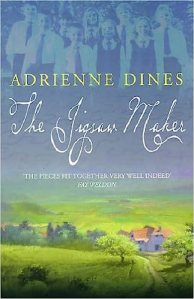
The Jigsaw Maker by Adrienne Dines

It was back in July 2007 that I bought The Jigsaw Maker and it’s been sitting on the to-be-read bookshelves ever since. It was worth waiting for as I thoroughly enjoyed it.

Lizzie Flynn has a shop in a village near Kilkenny, a sort of knick-knack shop selling a variety of goods, cards, flower arrangements, home-made sweets, that needs brightening up and bringing up to date. Much like Lizzie herself, a single lady nearing 50. Her settled life is turned upside down with the arrival of the Jigsaw Maker – Jim Nealon, a stranger who walks into her shop one morning and asks her to sell his beautiful jigsaws.

But these are no ordinary jigsaws. Jim makes wooden jigsaws, tiny intricately shaped pieces ‘finely cut so that they were more like buttons than jigsaw pieces’  And each one is individual showing a photograph of a real place accompanied by a personalised history of the scene:

It’s not just history,’ Jim said. ‘It’s real life. You don’t just know what it looks like now; you get a feel for what it was like in its heyday. It’s a personal memory. (page 8.)

He proposes to take photos of places, not the tourist attractions, but the places their ancestors might have lived and worked. He asks Lizzie to help him by writing about the scenes. To begin with he shows her a photo of the local school and asks her to picture herself back there in 1969 and write what she remembers – what it was like to be a pupil there.

It just so happens that 1969 had been quite an eventful year. This opens up the floodgates of memory for Lizzie as painful and puzzling events from that year almost over power her. Looking back at the child she was she realises that not everything was as it had appeared to her then.

It is just like a jigsaw – all the pieces are there and both the reader and Lizzie have to put them together correctly to get the correct picture. This is a beautifully written book, one with pace and tension in just the right places. I could visualise the scenes and the characters and I became anxious for Lizzie as she realised the truth not only about the events she had seen, but also about her place in those events. There are plenty of repressed secrets that come to the surface and an added mystery too – who is Jim? Why has he come to the village and why did he ask Lizzie in particular to help him?

I hope I’m not going to wait another 5 years to read more books by Adrienne Dines. There are two more: Toppling Miss April and Soft Voices Whispering.

  • My rating: 4.5/5
  • Paperback: 307 pages
  • Publisher: Transita (10 Feb 2006)
  • Language English
  • ISBN-10: 190517523X
  • ISBN-13: 978-1905175239
  • Source: I bought it
  • Author’s website and blog

Saturday Snapshot

Our back garden isn’t the usual type of garden as it’s mainly grass, a stream and woodland. At the end of January we had a tidying-up session in the woodland and a small fire burning small branches that the wind had blown down.

Further down the wood the snowdrops are still in flower.

See more Saturday Snapshots on Alyce’s blog, At Home With Books.

A Classics Challenge – February Prompt: Character

This month’s focus from Katherine of November’s Autumn for the Classics Challenge is on character. Write about a character you find interesting, it doesn’t have to be your favorite. Perhaps your least favorite or a minor one: choose any.

I’m answering a combination of her Level 1 and 2 questions. What phrases has the author used to introduce this character? Find a portrait or photograph that closely embodies how you imagine them.  Has your opinion of them altered? Do you find them believable? Would you want to meet them?

I read The Woman in White in January and wrote some thoughts about previously. The book has some very interesting characters and I’ve chosen to describe the villain – Count Fosco, a friend of Sir Percy Glyde.

We see him first through Marian Halcombe’s eyes (see my earlier post for her description). She is Laura’s half- sister and I think she is the real heroine of this book. She describes Fosco:

He looks like a man who could tame anything. If he had married a tigress, instead of a woman, he would have tamed the tigress.

The man has interested me, has attracted me, has forced me to like him.

he is immensely fat. Before this time I have always disliked corpulent humanity.

here, nevertheless, is Count Fosco, as fat as Henry the Eighth himself, established in my favour, at one day’s notice, without let or hindrance from his own odious corpulence. Marvellous indeed!

She is impressed most by his unfathomable grey eyes, which have a cold, beautiful, irresistible glitter and hold an extraordinary power, one which forces her to look at him and causes her sensations she would rather not feel. Although an Italian, he speaks excellent English. He is old (sixty!), but his movements are light and easy. He is very sensitive to noise and winced when Sir Percy Beat one of the spaniels – he cares for animals more than he cares for humans.

And his most curious peculiarity is his fondness for pet animals – a cockatoo, two canaries and a whole family of white mice, all of which are familiar with him. The birds sit on his fat fingers and the mice crawl all over him, popping in and out of his waistcoat. He kisses them and twitters to his birds.

Below is an illustration from the 1865 edition of the book, which doesn’t really portray him as I see him.

But this is more like it – Michael Crawford’s portrayal in the West End musical in 2004.

As for his character, Marian may be attracted to him, but he is is a true villain, completely domineering, sinister, clever and untrustworthy. He is powerful, a sensualist whose wife is completely besotted by him. Whilst it might seem from my description that Fosco is a caricature, he does come across as a believable character and certainly one I would not wish to meet.

Teaser Tuesday – Testament of Youth

I’m currently reading Testament of Youth by Vera Brittain. She was born in 1896 and this book is an Autobiographical Study of the Years 1900 – 1925. 

I’ve read up to the beginning of 1915, just after the outbreak of the First World War. It’s fascinating and there are so many passages I could highlight, but for now I’m quoting these that I read this morning. Vera Brittain wrote this book in 1933 and she pointed out the change from 1915 to 1933. Just think  of the vast difference between life now and then, nearly 100 years ago.

Sophisticated present-day girls, free immediately after leaving school to come and go as they wish, or living, as independent professional women, in their own rooms or flats, have no conception of the difficulties under which courtships were contracted by provincial young ladies in 1915. There was no privacy for a boy and girl whose mutual feelings had reached their most delicate and bewildering stage; the whole series of complicated relationships leading from acquaintance to engagement had to be conducted in public or not at all. (page 120)

Everything in a young woman’s life was supervised and discussed in the family circle, letters were observed and commented upon. Vera had never been anywhere by herself until she left home to go to Oxford University, on train journeys her ticket was bought for her and she had to send a telegram home immediately she arrived.

In 1915 (aged 19) she was deeply in love with a young man, Roland Leighton, her brother’s friend, but had never been alone with him or without constant observation and the possibility of interruption. She wrote:

Consequently, by the middle of that January, our desire to see one another alone had passed beyond the bounds of toleration. (page 121)

For more Teaser Tuesdays go to Should Be Reading.

Sleeping Murder by Agatha Christie: a Book Review

Sleeping Murder is Miss Marple’s last case, published posthumously in 1976, although Agatha Christie had written it during the Second World War. Miss Marple investigates a murder that had happened 18 years ago.

 As I began to read I thought it seemed familiar and then I realised I’d watched the TV version a few years ago, with Geraldine McEwan as Miss Marple and after a couple of chapters I remembered who the murderer was. This didn’t spoil my enjoyment as I was able to see the clues as they cropped up.

Newly married Gwenda has bought a house in Devon. She had only recently returned to England from New Zealand where she had been brought up by an aunt after the death of her parents when she was a small child. She immediately felt at home in the house, but then began to have strange premonitions and whilst she was at the theatre watching The Duchess of Malfi  she had a vision of a murder at the house she had just bought. She heard the words:

‘Cover her face. Mine eyes dazzle, she died young …’

Gwenda screamed.

She sprang up from her seat, pushed blindly past the others out into the aisle, through the exit and up the stairs and so to the street. She did not stop, even then, but half walked, half ran, in a blind panic up the Haymarket (Page 27)

She is convinced that she is going mad, but she is helped by Miss Marple, whose nephew, Raymond West is a distant cousin of Gwenda’s husband, Giles. It’s a most baffling ‘˜cold case’, because first of all they have to discover who, if anyone, had been killed, where, when and why. It does all rather depend on a number of coincidences, beginning with the fact that Gwenda has bought the house that she had lived in as a very young child, but as Miss Marple explains to Gwenda:

‘˜It’s not impossible, my dear. It’s just a very remarkable coincidence – and remarkable coincidences do happen. You wanted a house on the south coast, you were looking for one, and you passed a house that stirred memories and attracted you. It was the right size and a reasonable price, so you bought it. No, it’s not too wildly improbable. Had the house been merely what it is called (perhaps rightly) a haunted house, you would have reacted differently, I think. But you had no feeling of violence or revulsion except, so you have told me, at one very definite moment, and that was when you were just starting to come down the staircase and looking down into the hall. (Pages 33-4)

That moment, as it turned out was very significant, indeed.

Sleeping Murder is a satisfying puzzle and I liked this last view of Miss Marple, compassionate and shrewd and this description of her appearance:

Miss Marple was an attractive old lady, tall and thin, with pink cheeks and blue eyes, and a gentle, rather fussy manner. Her blue eyes often had a little twinkle in them. (page 26)

  • My rating: 4/5
  • Paperback: 304 pages
  • Publisher: HarperCollins; Masterpiece edition (Reissue) edition (2 Jun 2008)
  • Language English
  • ISBN-10: 0007121067
  • ISBN-13: 978-0007121069
  • Source: I bought the book