After the Armistice Ball by Catriona McPherson

After the Armistice Ball is the first book in the Dandy Gilver series. I’ve read a couple of the later books in the series and had to read this one in order to find out how Dandy (short for Dandelion) first became an amateur detective, or Society Sleuth, as she is called on the book cover.

It all began when there is an alleged theft of Lena Duffy’s jewels at Daisy Esslemont’s annual Armistice Ball in 1922 and Daisy asks Dandy to find out what really happened. Dandy is a bored wife, whose husband, Hugh is the ‘hunting, shooting and fishing’ type. The theft of the jewels is rapidly pushed to the sidelines after the death of Lena’s daughter, Cara in a lonely beach cottage in Galloway. Accompanied by Cara’s jilted fiancé, Alec Osborne, Dandy is faced with the puzzle of Cara’s death. Was she killed, or did she commit suicide? She had died in a fire, whilst on her own in the cottage – why was the cottage always kept so hot, so hot that the coal that was supposed to last all winter had been finished in one week?

The setting in the 1920s is convincing, the sense of dislocation after the First World War, the class divide and the contrast between the idle rich and the poor. The locations are beautifully described, and the characters are lively and come to life, particularly Dandy, although Hugh does seem to be a cardboard cut-out, but the book dragged in the middle as Dandy and Alec went over and over, and over the events and theorised about what had happened and why.

I too puzzled over the mystery and I did find the ending rather confusing, so much so that I had to re-read parts of the book to sort out what I thought had happened. I’m still not sure, but I think I know. Having said all that, I did enjoy the book, and apart from the middle section I raced through it and that’s probably where I missed some salient points.

My Rating: 3/5

I borrowed the book from my local library
Death Comes To Pemberley by P D James

I read Death Comes to Pemberley over the weekend and although I thought it was OK I was disappointed. I love Jane Austen’s Pride and Prejudice and I like PD James’s books, so this book should have been just right for me. But maybe it was just the wrong book for me because I have yet to read a sequel/spin-off by a different author that I have enjoyed. They never live up to the original and if this had been written by anyone except P D James I probably wouldn’t even have looked at it.

The book is set in 1803, when Elizabeth and Darcy have been married for six years. It begins with a rather lengthy Prologue in which P D James summarises the events told in Pride and Prejudice and tells what has happened in the intervening years. Eventually the mystery is revealed when Lydia arrives at Pemberley and shrieking hysterically tells how Wickham and Captain Denny had disappeared into the Pemberley woods, shots were fired and she is sure Wickham is dead. In fact it is Denny who is dead and a drunk, and distraught Wickham babbles that he has killed him.

It should have been good, but the characters were flat. Six years of marriage had changed Elizabeth beyond recognition, Darcy was a pale, ineffectual figure and Colonel Fitzwilliam was no longer the likeable character he is in Pride and Prejudice. It’s plodding and repetitive. P D James has done her research into the early 19th century murder investigations but it’s clumsily written as exchanges of conversation between the characters – for example would Darcy, a magistrate really need to be told how the system worked? As for the murder mystery, it just fizzled out with a less than convincing result.

On the plus side there are some good descriptive passages, mainly of the Pemberley Estate and a vignette where Mr Bennet is found by Darcy in his library reading the Edinburgh Review.

My rating: 2/5

I borrowed the book from my local library.

As a result of reading this I’ve now started a re-read of Pride and Prejudice and the first chapter convinces me that my recollection of Jane Austen’s sparkling writing is accurate. I shall never read another spin-off again. It was worth reading Death comes to Pemberley to be reminded of Jane Austen’s brilliance.

Saturday Snapshot

My photos this week are a few of Cragside in Northumberland, now owned by the National Trust. It was built in 1863, with further extensions over the next 15 or so years, by William Armstrong, who later became Lord Armstrong. Armstrong was a remarkable man – a scientist, an innovator and a successful industrialist.

We visited it last year. Here is the view of the house approaching from the public car park:

and the view from the gardens:

It has to be one of my favourite National Trust properties and it’s a very popular house with everyone else too – the place was packed when we were there last April. There is so much to see inside the house, too much for one post. The house was very modern for its times, with all the latest and advanced technical devices of the day.

One of my favourite rooms is the Library, with its  stained glass windows, comfy chairs, leather sofas and the latest lighting available. This was the first room in the world to be lit by hydro-electricity.

The light suspended from the ceiling has four bulbs within the ornate and fringed light shade. I tried very hard to get a photo without any of the other visitors, but gave up when there was just one person looking out of the window – anyway he gives scale to the room.

There are four more bulbs around the room, place in globes, sitting on vases:

The books are in oak bookcases around the room:

Note the library steps at the left-hand side of the photo.

Click on the photos to enlarge them.

At a later date I might post more photos – of the kitchen with its dishwasher, the lovely dining room with its William Morris stained glass windows and of the amazing Gallery, with its collection of paintings and sculptures. As for the Drawing Room, this was not to my taste at all with its huge marble chimney piece.

See more Saturday Snapshots on Alyce’s blog At Home With Books.

Book Beginnings on Friday

I’ve just finished reading Standing Water by Terri Armstrong, which I greatly enjoyed and will write more about it in another post. But for now here are the opening lines:

On the way to the funeral Hester started to cry. Neal, driving the ute, glanced at her. He reached over and squeezed her hand, too tightly. The tears wouldn’t stop. She pulled in jagged breaths and held a tissue to her face. Without warning, Neal swerved the ute into a gravel siding, throwing her against the door. He kept the engine idling.

‘For Christ’s sake, Hester. We’ll be there in five minutes.’

‘I know. Sorry.’ She had to pull herself together. She turned her head to look at the roadside scrub, focused on the pale, thin limbs of a top-heavy mallee tree.

‘Wasn’t even your bloody mother,’ Neal muttered.

These lines caught my imagination – I assumed that Neal and Hester were an apparently unemotional son and a very upset daughter-in-law. They drew me into the story and also very definitely set the scene for me, in Western Australia – what I wondered is a ‘mallee tree’. (I thought maybe a eucalyptus, and was pleased to discover that it is.)

Standing Water is Terri Armstrong’s first novel and is the winner of the 2010 Yeovil Literary Prize (pre-publication). It is to be published by Pewter Rose Press on 28 February. (My copy was sent to me by the publishers.)

Book Beginnings is hosted by Katy at A Few More Pages every Friday.

Choosing a Classic

It’s time I began reading another classic for the Classics Challenge. I thought I’d look at the openings of some to see which takes my fancy.

Wives and Daughters by Elizabeth Gaskell:

To begin with the old rigmarole of childhood. In a country there was a shire, and in that shire there was a town, and in that town there was a house, and in that house there was a room, and in that room there was a bed, and in that bed there lay a little girl; wide awake and longing to get up, but not daring to do so for fear of the unseen power in the next room – a certain Betty, whose slumbers must not be disturbed until six o’clock struck, when she awakened herself ‘as sure as clockwork’, and left the household very little peace afterwards.

It reminds me of the children’s song Old MacDonald had a Farm with its repetitions. The little girl is Molly Gibson and Betty with the unseen powers is the family’s servant. It promises a story of a family and Molly’s place within it and this opening interests me. I don’t know anything about the book and have not seen any of the TV adaptations, so I’m coming to it with a completely open mind – no other interpretations to influence my reading of Elizabeth Gaskell’s words.

Silas Marner by George Eliot:

In the days when the spinning-wheels hummed busily in the farmhouses – and even great ladies, clothed in silk and thread-lace, had their toy spinning-wheels of polished oak – there might be seen, in districts far away from the lanes, or deep in the bosom of the hills, certain pallid undersized men, who, by the side of brawny country-folk, looked like the remnants of a disinherited race.

This one looks good too about village/rural life at the beginning of the 19th century. The only book by George Eliot that I’ve read is Middlemarch, which I loved. You have to have time and patience to read her books. Silas Marner, however, is a much shorter book with less characters than Middlemarch.

Three Men in a Boat by Jerome K Jerome:

There were four of us – George and William Samuel Harris, and myself, and Montmorency. We were sitting in my room, smoking, and talking about how bad we were – bad from a medical point of view I mean, of course.

We were all feeling seedy, and we were getting quite nervous about it.

Yet another author I know nothing about and as for the book I only know it’s reckoned to be a comedy. Again I have very few preconceptions about this book and have no ideas about the characters or what happens. I think Montmorency may be a dog as the book’s full title is Three Men in a Boat (to say nothing of the dog).

Now I just have to decide which one to read.

Wondrous Words Wednesday

Wondrous Words Wednesday is a weekly meme where we share new (to us) words that we’ve encountered in our reading. It is hosted by Kathy, over at BermudaOnion’s Weblog.

My words this week come from After the Armistice Ball by Catriona McPherson, set in 1922.

  • jounced – ‘Alec increased the speed again as we passed the sign for Reivers Rest and we jounced over the close-cropped turf faster and faster until the car rounded the last of the gorse into the open and skidded to a slithering halt.

I could tell from the context what ‘jounced’ means, but it’s a word I’ve not come across before. Looking it up I found it does mean just what it sounds like – ‘to jounce is to move or cause to move with bumps and jolts’ (from The Free Dictionary).

I like the Wikipedia definition of jounce – ‘in physics, jounce or snap is the fourth derivative of the position vector with respect to time, with the first, second, and third derivatives being velocity, acceleration, and jerk, respectively; in other words, the jounce is the rate of change of the jerk with respect to time.’ As I said, just what I thought it was!

  • Thawpit – ‘I should begin calmly but ready to dissolve into tears if the occasion arose and a corner of my handkerchief was soaked in Thawpit to help with the dissolving.’

I had no idea what Thawpit was – and amazingly discovered that it was a a stain remover, a solvent that containing carbon tetrachloride. It’s no longer available, presumably because of the danger of sniffing it etc. No wonder Dandy Gilver (the amateur sleuth in the book) ‘succumbed to a fit of weeping’ when she ‘dabbed her eyes’ with the Thawpit soaked hankie.

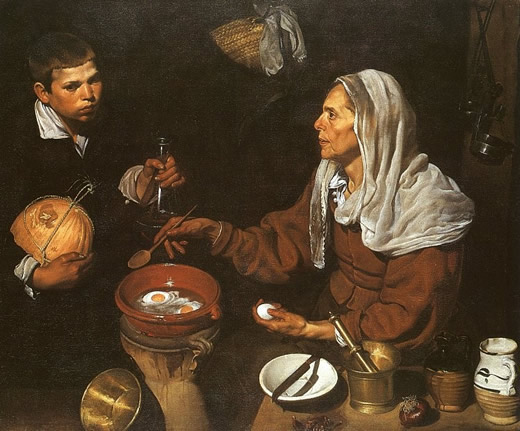
  • chafing-dish – ‘I trigger no obvious trip-wire en route from my bedroom to the ground floor, but every morning Pallister appears with a chafing-dish just as I’m sitting.’ He then cooked Dandy’s eggs.
An old woman poaching eggs in a glazed earthenware chafing dish over charcoal

A chafing-dish is a new term to me. Wikipedia explains that it is ‘a kind of portable grate raised on a tripod, originally heated with charcoal in a brazier, and used for foods that require gentle cooking, away from the fierce heat of direct flames.’