ABC Wednesday – K is for …

… Kingsolver

For my ABC Wednesday posts I’ve been highlighting either authors or artists whose work I enjoy. This week it’s the letter K and there was no doubt about who that brought to mind – Barbara Kingsolver, who is the author of one of my very favourite books – The Poisonwood Bible.

I bought this book in an airport bookshop just before boarding a plane to go on holiday to Cyprus; that gave me plenty of time to read a good chunk of the book before we landed. I remember being very amused by the description of how the Price family got round the forty-four pound per person luggage limit on their flight to the Congo. I’d just struggled to get our luggage allowance down to the required limit for our holiday, but I hadn’t thought of doing what they did – each of them wearing multiple layers of clothing and other goods, such as tools and cake-mix boxes tucked out of sight in their pockets and under their waistbands. Cake-mixes were an essential item as Mrs Price said, ‘they won’t have Betty Crocker in the Congo.’

I soon read the rest of the book by the side of the pool, my hands covered in sun cream removing the gold lettering of Barbara Kingsolver’s name.

This is the book’s description from the back cover:

Told by the wife and four daughters of Nathan Price, a fierce evangelical Baptist who takes his family and mission to the Belgian Congo in 1959, The Poisonwood Bible is the story of one family’s tragic undoing and remarkable reconstruction over the course of three decades in postcolonial Africa. They carry with them all they believe they will need from home, but soon find that all of it – from garden seeds to Scripture – is calamitously transformed on African soil.

It is a brilliant book – one that I’ve read at least twice and would eagerly read again. The setting and historical figures and events are real, even though the characters and story are fictional. Barbara Kingsolver writes in her author’s introduction to the book that she relied on her memory, travel in other parts of Africa and many people’s accounts of the natural, cultural and social history of the Congo/Zaire to write the novel.

She wrote that her parents, who were different in every way from the parents in the book, were

… medical and public-health workers, whose compassion and curiosity led then to the Congo. They brought me to a place of wonders, taught me to pay attention, and set me early on a path of exploring the great, shifting terrain between righteousness and what’s right. (page x)

It’s a book that has stuck long in my memory, maybe because it paints such a remarkable picture based on reality and truth.

I’ve read some of her other books, namely The Bean Trees, Homeland and Other Stories, and Prodigal Summer,and whilst I enjoyed them, none of them were, I thought, as good as The Poisonwood Bible. I have The Lacuna, waiting to be read.

For more information see Barbara Kingsolver’s own website.
Crime Fiction Alphabet – Letter L

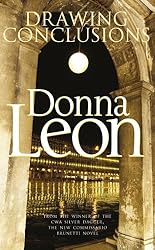
Donna Leon’s Drawing Conclusions is my choice to illustrate the letter L in Kerrie’s Crime Fiction Alphabet.

This is the 20th book in her Commissario Guido Brunetti series. Brunetti is somewhat of a rarity in crime fiction novels – a detective who is happily married with two children. He doesn’t smoke or drink to excess and often goes home for lunch to his beautiful wife Paola.

It’s set in Venice where Donna Leon has lived for many years. I was immediately drawn into this book, with its wonderful sense of locality, believable characters and intricate plot.  Anna Maria Giusti discovers her elderly neighbour Constanza Altavilla lying dead on the floor of her apartment. Apparently she has died from a heart attack but Brunetti, called to the scene because there was blood on the floor, suspects that she may have been attacked as there are bruises on her neck and shoulders. His boss, Vice-Questore Patta wants to close the case but Brunetti decides to make further investigations.

He meets Signora Altavilla’s son and visits the nursing home where she had been helping out. His suspicions are further aroused when the nun in charge of the home is reluctant to answer his questions and by the conversations he has with some of the people she visited. With the help of Inspector Vianello and Signorina Elettra, Patta’s secretary, he discovers a network of deception and lies.

This is a reflective and thoughtful book and I was completely engrossed in it. I haven’t been to Venice, but it came to life as Brunetti walks the streets:

As he walked alongside Rio della Tetta, Brunetti was cheered, as always happened when he walked here, by the sight of the most beautiful paving stones in Venice. Of some colour between pink and ivory, many of the stones were almost two metres long and a metre wide and gave an idea of what it must have been to walk in the city in its glory days. (page 63)

It’s well-paced and there are several unexpected twists that kept me wondering almost to the end what had actually happened to cause Signora Altalvilla’s death. It’s more than crime -fiction as Brunetti ponders on life, the problems of ageing, and the nature of truth and honesty. I didn’t want the book to end – that’s how good it is.

  • Hardcover: 272 pages
  • Publisher: William Heinemann (7 April 2011)
  • ISBN-10: 0434021431
  • ISBN-13: 978-0434021437
  • Source: Review copy

Seen in the Back Field

I looked up from the computer the other morning and spotted a hare in the field behind our house. Then another one ran up and they both bounded off. I  grabbed my camera and was only just quick enough to get a photo of this one as it was running out of sight.

Library Loot

This is a sign that I’m a hopeless bookaholic. Despite listing books I’ve had for ages and still haven’t read – not mentioning all the to-be-read books all around the house – yesterday I went to the library and came home with these books:

  • The Fanatic by James Robertson is historical crime fiction, described on the back cover as ‘an extraordinary history of Scotland: a tale of betrayals, stolen meetings, lost memories, smuggled journeys and disguised identities.‘ I’d enjoyed his second book The Testament of Gideon Mack a few years ago. And how could I resist bringing this book home when I saw it began in Bass Rock, which is just up the coast from us – see my photo here.
  • Stories of the Railway by V L Whitechurch. From the book cover I learnt that V L Whitechurch was a celebrated crime writer and an expert railway enthusiast. He wrote a large number of crime short stories set in the golden age of Britain’s railways – this selection was originally published in 1912 as ‘Thrilling Stories of the the Railway‘. I’d read about him on Martin Edward’s blog and was pleased to find a copy on the library shelves.
  • The Oxford Murders by Guillermo Martinez. I’d read about this book, a mix of murder and maths and wondered whether my elementary grasp of maths would be enough for me to follow the equations  and cryptic symbols involved in solving this mystery.
  • The London Train by Tessa Hadley. There seems to be a theme here in my choice, following on from the Stories of the Railway. In this book, the London train between Wales and London, connects two stories that are interlinked through ‘a single moment concerning two lives stretched between two cities’.

And last but by no means least two books on watercolour painting, because this is now taking up some of my reading time. On Thursdays I go to a local art group and dabble in paint. I mentioned this a while ago on my blog and people asked to see some of my paintings. Here are two I don’t feel too embarrassed to show:

ABC Wednesday J is for …

… the Jabberwock

From Lewis Carroll’s Through the Looking Glass, illustration by John Tenniel.

This was a great favourite of mine as a child and I still love the poem, Jabberwocky which begins:

Twas brillig and the slithy toves

Did gyre and gimble in the wabe;

All mimsy were the borogroves,

And the mome raths outgrabe.

Beware the Jabberwock, my son!

The jaws that bite, the claws that catch!

Beware the Jujub bird, and shun

The frumious Bandersnatch.

I had no idea what the words meant but I loved the sound of them and learned them off by heart. Humpty Dumpty explains to Alice that ‘brillig’ means ‘4 o’clock’, ‘slithy’ means ‘lithe and slimy’ and ‘toves’ are something like badgers  and lizards and corkscrews, to ‘gyre and gimble’ means to go round and round like a gyroscope and make holes like a gimlet and the ‘wabe’ is a grass-plot around a sundial – as shown in this illustration also  by John Tenniel:

An ABC Wednesday post.

Crime Fiction Alphabet – K is for …

… Karen Maitland

Karen Maitland writes medieval mysteries. She has a doctorate in psycholinguistics and has done all kinds of jobs from cleaner to lecturer, egg packing to dance-drama, before she started writing for a living in 1996. She has travelled and worked in many parts of the world, from the Arctic Circle to Africa, and now lives in the medieval city of Lincoln in England. She is a member of the Crime Writers’ Association, the Historical Novel Society, the Society of Authors and of International Thriller Writers. And she is now one of the Medieval Murderers.

The first book of hers that I read is Company of Liars: a Novel of the Plague, set in the 14th century about a group of nine people travelling to escape from the plague and suspected of concealing the killer of a little girl. It’s a memorable book, with a colourful cast of characters. Although it is a long book (over 550 pages) and there are many other characters than the group of nine I had no difficulty keeping track of who was who. It’s full of suspense and drama and I loved it.

Her second medieval mystery is The Owl Killers: a Novel of the Dark Ages. Again this is set in 14th century England, this time in ‘an isolated village where pagan Owl Masters rule through fear superstition and murder’ (from the back cover). I haven’t finished reading this yet but it’s promising to be equally as good as Company of Liars. Karen Maitland is a wonderful storyteller and her descriptions of the place and period draw me in as though I was actually there.

Her latest book is The Gallows’ Curse, set in the reign of King John (1210). The ‘plot involves people-trafficking, murder and, oh yes… a very feisty dwarf and a eunuch with a hunger for revenge’.

For more crime fiction ‘K‘ entries see Kerrie’s Crime Fiction Alphabet.