The Sunday Salon

Today I’ve been reading more from Eden’s Outcasts: the story of Louisa May Alcott and Her Father. At long last, as I have been reading this book for ages, I have arrived at the time of Louisa’s life where she has written and published Little Women. Up to this point (about 60% of the book) most of it has been about Bronson Alcott, her father and it is Louisa who I find most interesting.

Louisa wrote in vortices – completely engrossed in her writing, with barely time for anything else, so intense was her concentration. Mostly she wrote in her bedroom at a desk Bronson had built for her, but sometimes she sat on the parlour sofa. Her family knew that if the bolster pillow next to her stood on its end they could speak to her, but if the pillow lay on its side they couldn’t disturb her. In two and a half months she had completed writing 402 manuscript pages and at the end of it she had briefly broken down.

Little Women was an instant success, the first printing of 2,000 copies sold out within days of the book’s release and another 4,500 copies were in print by the end of the year (1868). Three months later she had written the second part of Little Women – the book I know as Good Wives. She had

… plunged back into a creative cortex on November 1, vowing to write a chapter a day. She worked ‘like a steam engine’, taking a daily run as her only recreation and barely stopping to eat or sleep.  Falling behind the ambitious schedule she had set for herself, she spent her birthday alone’writing hard.’ (page 345)

She put her heart and soul into her writing.

Both Louisa and her father were complex characters and Matteson’s biography is detailed and in depth. It’s not a quick read, but then biographies never are in my experience.

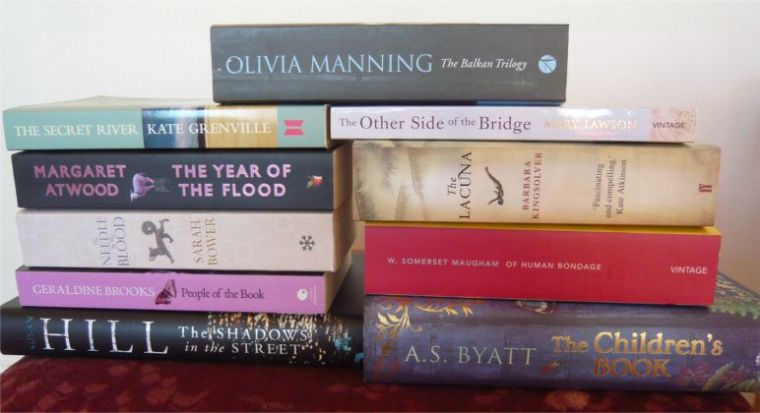
Top Ten Unread Books

Top Ten Books I Absolutely Had To Have – But Still Haven’t Read. I saw this on Litlove’s blog and thought it was a great idea. You never know it might just spur me on to read some of these.

They are all books I was driven to buy but the impulse to read them had passed by after I bought them, replaced by the urge to read other books. I still would love to read them.

They are:

  • The Balkan Trilogy by Olivia Manning. I’ve read and was deeply engrossed in the first two of these – The Great Fortune and The Spoilt City as separate books, three years ago! At the time I wanted to read the final book as soon as possible, but I couldn’t find it published as a separate book and so a year later I bought the Trilogy including all three books. I still haven’t read the third one Friends and Heroes. The three books are a portrait of Guy and Harriet Pringle’s marriage during the Second World War.
  • The Other Side of the Bridge by Mary Lawson. I bought this three years ago after I’d read and loved Crow Lake by Mary Lawson. Like Crow Lake, The Other Side of the Bridge is set in Canada, this time about two brothers in the 1930s, when their uneasy relationship is driven to breaking point.
  • The Lacuna by Barbara Kingsolver. The Poisonwood Bible by Barbara Kingsolver is one of my favourite books, so I just had to get this book. It’s so long though and I read several indifferent reviews which made me less inclined to start it – but I do intend to read it, just not yet.
  • Of Human Bondage by W Somerset Maugham. I’d read a few of Maugham’s books a while ago and full of enthusiasm wanted to read this one, said to be the most autobiographical of his masterpieces. I got it for a Christmas present in 2008 andI’m still anticipating it will be very good.
  • The Children’s Book by A S Byatt. I have this in hardback as I couldn’t wait for it to come out in paperback. I’ve read many conflicting reviews about how good or otherwise it is and have actually read some of it. But it’s got such a huge cast of characters and I wanted to read Wolf Hall at the same time and couldn’t cope with two such long and complicated books, so I temporarily put down The Children’s Book to read later – then other books got in the way. I’ll need to go back to the beginning when I do get back to it.
  • The Shadows in the Street by Susan Hill – another book I wanted to have before it was available in paperback. This one is the fifth in her Simon Serrailler novels.
  • People of the Book by Geraldine Brooks. I loved March by Geraldine Brooks, which prompted me to look for more by her. This one has had good reviews all round and I have absolutely no idea why I didn’t read it straight away.
  • The Needle in the Blood by Sarah Bowyer. I seem to have had this book for ages, spurred on to read it by so many good blog reviews a few years ago and it’s still sitting here unread, a novel about the women who created the Bayeux Tapestry.
  • The Year of the Flood by Margaret Atwood. Well, I love Margaret Atwood’s books, so how could I not buy this one? It covers the same time period as Oryx and Crake,  a book which I’d read some time ago and remembered as being one I had to concentrate on – not a book to skip through. So I thought I’d better wait for a suitable frame of mind to read this – it hasn’t arrived yet. But I do want to read this.
  • The Secret River by Kate Grenville – another book I’ve had for nearly three years, inspired by other bloggers to buy it I still haven’t started it. I love books about the settlers/convicts lives in 19th century Australia. I really must read this soon.


The Orange Prize Longlist

The Orange Prize longlist was announced yesterday. I like to follow this but actually I’ve read very few of the books listed in previous years. The ones I have read have been outstanding, so maybe I should pay more attention to the lists, but looking at this article in the Guardian I can’t say that the subjects are attractive:

Debut novelists will make up nearly half of the Orange prize for fiction longlist, which this year tackles strikingly difficult subjects: incest, sadistic cruelty, polygamy, child bereavement, hermaphroditism and mental illness. There is, though, also alligator wrestling in the 20-strong list, and Susanna Reid, the BBC Breakfast news presenter and judge for this year’s prize, insisted there was much joy to be derived from the books.

I’ve read just one book from this year’s longlist: Whatever You Love by Louise Doughty, which is about Laura whose nine-year old daughter, Betty has been killed by a hit and run driver. I found it to be well written but a harrowing book to read that is startling and shocking in parts.

The only other book that I know anything about is Room by Emma Donoghue, about a mother and son imprisoned in a room. I’ve seen several reviews and read the opening pages, which didn’t make me want to continue with the rest of the book. So far my knowledge of the books seems to confirm that they’re filled with depressing reading, but will I find the joy that Susanna Reid is talking about?

I’m looking at the other books on the list and there is a gallery with summaries of the books on this Guardian page. You can also download free samples from the Kindle Store on Amazon.

ABC Wednesday – I is for Irises

Irises by Vincent Van Gogh, 1889

Van Gogh painted Irises after he committed himself to the asylum at Saint Paul-de-Mausole in Saint-Remy, France. He began the painting only one week after he entered the asylum. He was probably influenced by Japanese woodblock prints; the black outlines in Irises is typical of the Japanese prints.

Irises is on the list of the most expensive paintings ever sold, selling for 54 million dollars in 1987.

It’s beautiful.

The Matchmaker of Kenmare by Frank Delaney

The Matchmaker of Kenmare by Frank Delaney turned out to be a mammoth read that took me far longer than I expected. I received my copy, an advanced uncorrected proof – without the lovely cover I’ve shown here – courtesy of Meier, the marketing company. It’s a story of journeys, of love and romance, and of war and mystery. I should have loved it, but I didn’t.

It’s narrated by Ben McCarthy looking back on his life as he tells his story to his children. Set during World War II, Ben, still grieving after the disappearance of his wife Venetia ten  years earlier, is travelling around Ireland collecting folklore and trying to find out what has happened to her. He meets Kate Begley, known as the Matchmaker of Kenmare and they become friends. Ireland was neutral during the war but that didn’t stop Ben and Kate’s involvement, after Kate’s husband Charles Miller, an American soldier is reported killed in action. I found it hard to get interested in the story at the beginning and in fact stopped reading it for a while. It was slow to get going and I had to keep looking back trying to work out what was happening and who was who. It didn’t help that this book follows on from a previous one that I haven’t read, which tells the story of Venetia’s mysterious disappearance.

It gathered pace for a while as Kate and Ben travelled to Europe trying to find Charles, who Kate refuses to believe is dead, and into the war action. And there is plenty of action when they are captured by the Germans, despite their Irish neutrality. Even though the war is coming to an end they are in desperate danger. This is, I think, the best part of the book, full of tension and pace. Neutrality is a theme throughout the book. As Frank Delaney writes in his Author’s Note:

… the word neutrality has many shades. For example official papers, released long after 1945, show that Ireland did, in fact, exploit the war politically and contributed many actions to the Allied cause. As to affairs of the heart, who would ever dare to define where friendship should end and passion begin?

Did Ben eventually find out what happened to Venetia and was Charles really dead? I read on, and on, and on as Kate and Ben continued to search for Charles after the war ended. The section where Kate stands waiting for the troops returning from the war, hoping to find Charles amongst them was very moving. But I became tired of their searches and by the time I came to the section where they are travelling to Lebanon in Kansas, the centre of America, the episode with a giraffe and small pig was almost too much to believe. It had all the trappings of a “tall tale”.

Overall, I did enjoy most of it. The book rambles along with many diversions from the main story, some amusing like Neddy who hires a set of false teeth, ‘a set of tombstone dentures’ to make him more attractive to a prospective wife, but mostly I found them distracting. It has a mythic quality. Ben was taught to view his life as though it were a myth, a legend and there are many hints all the way through of the tragic events that are about to unfold – too many hints, I thought, which meant that there were few if any surprises.  Interspersed with Ben’s narration are excerpts from Kate’s journal and his own journal and yet at times the text read more as an objective rather than a personal narrative.

Here is a book trailer featuring Frank Delaney reading from his book.

I agree with Dorothy in her review at Books and Bicycles, in which she says ‘The book would have worked better if told in a more direct manner, without all the editorializing from the older version of Ben and that it ‘does have its pleasures ‘” as you can imagine, the love triangle that develops between Kate, Ben, and Charles is consistently interesting ‘”unfortunately, the quality of the writing kept interfering with the fun.’

And for a more favourable review see Karen’s post on her Cornflower Books blog – ‘it’s a beautifully pitched, fluent story of charm, humour and some inspired ‘“ and even Homeric ‘“ touches.’

The Matchmaker of Kenmare

  • Hardcover: 416 pages
  • Publisher: Random House USA Inc (1 April 2011)
  • Language English
  • ISBN-10: 1400067847
  • ISBN-13: 978-1400067848
  • Source: free review copy

This is my second book for the Ireland Reading Challenge.

Crime Fiction Alphabet – Letter J

I was undecided what to write about for the letter J in Kerrie’s Crime Fiction Alphabet series. I could have chosen P D James’s book The Private Patient, or Peter James’s Not Dead Enough or Jed Rubenfeld’s The Interpretation of Murder, all of which are in my to-be-read piles. But these, inviting though they are, are longish books and I haven’t started any of them yet.

Instead I picked one of the books I’ve borrowed recently from the library by Janie BolithoBetrayed in Cornwall, a quick, easy read. Janie Bolitho was born in Falmouth, Cornwall and her books have a very strong sense of place. She became a full-time writer after being employed as a bookmaker’s clerk, a debt collector, a tour operator’s assistant and a psychiatric nurse. She died of breast cancer in 2002. The first book of hers I read was Snapped in Cornwall, which is the first book in her series of mysteries featuring Rose Trevelyan (see  my review). I think Betrayed In Cornwall (the fourth in the series) is a better book.

Rose is an artist and is holding her first solo exhibition in oil paintings. When her friend Etta Chynoweth doesn’t turn up at the pre-opening private viewing she is concerned and then shocked to discover that Joe, Etta’s son had been found dead at the bottom of a cliff, a packet of heroin near his body. The police think he was involved in drug dealing but Rose and Joe’s family can’t believe that. Rose is convinced that Joe was murdered and that he was set up. Then Joe’s sister, Sarah goes missing. She’d seen Joe with two men on the night he died, near where he died. Did she know too much? Etta has been having an affair with a married man – is he involved and how? Rose has her own ideas and sets about investigating on her own, then everything goes wrong. Add into this mix Rose’s relationship with DI Jack Pearce, a relationship she had broken after a year. Everyone except Rose can see how he still feels about her but she just cannot admit what she feels about him.

I enjoyed this book for what it is, a murder mystery with a ‘cosy’ feel. The characters are quickly drawn, but I still felt they were believable, the writing is fluent, and the Cornish location is superb.