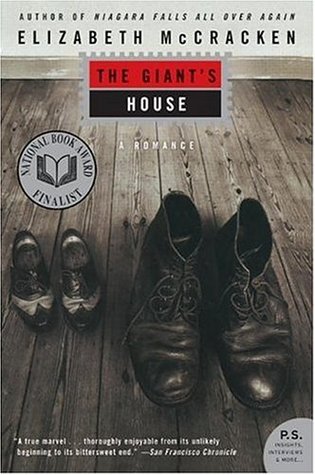
I recently moved to a different server and there are some posts that weren’t imported. This is one of them. I first posted this review of The Giant’s House by Elizabeth McCracken, the first book I reviewed in May 2007.
 I’m not sure of my reaction to The Giant’s House. It is a touching account of the relationship of Peggy Cort, an introverted librarian and James Sweatt, who she meets when he is eleven years old and who grows up to be the tallest man in the world. Peggy lives in a small world of her own; an orderly and precise world devoid of men. During the course of James’s short life he changes Peggy’s life forever. I found it to be an unlikely romance with a slightly disturbing edge to it.
As a former librarian I found the descriptions of Peggy’s library and her thoughts about librarians to be realistic, so I wasn’t surprised to read that she used to be a full-time librarian:
I am a librarian and you cannot stop me from annotating, revising, updating.
People think librarians are unromantic, unimaginative. This is not true.
A good librarian is not so different from a prospector, her whole brain a divining rod. She walks to books and stand and wonders: here? Is the answer here? The same blind faith in finding, even when hopeless. If someone caught me when in the throes of tracking something elusive, I would have told them: but it’s out there. I can feel it God wants me to find it Never jump to conclusions when trying to answer a reference question. My job was to show people – even people I liked – how to use the library, not to use it for them.
Although explaining how the library worked was satisfying, I always felt restricted as a librarian that I was not the one doing the research. However, it is good to be able to search for information, even if you’re not the one using it and it is an extremely useful skill to have.
The most poignant parts of the book are when Peggy expresses her longing to be with James. She is envious of his school friends and the times they have together listening to music, dancing and enjoying being together: ‘Some nights I could not bear all that youth and possibility: I’d hear laughter through the door and I’d turn around and leave.‘
She doesn’t like to be touched and comments on the dancing:
I saw through the window a boy and girl dancing – or should I say, embracing while revolving in tandem. The music was slow treacle … Other people’s happiness is always a fascinating bore. It sucks the oxygen out of the room: you’re left gasping, greedy, amazed by a deficit in yourself you hadn’t ever noticed.
The descriptions of James however, left me feeling as though I was a voyeur – from the descriptions of not only his height but also of his whole body such as the condition of his feet encased in shoes that he had quickly grown out of so that he couldn’t feel his feet, which were ‘meaty‘, with an acrid smell, and the ‘toes were the worst: the nails curled around their own toes, or knifed into their neighbors …‘
Similarly the account of his ‘giantism‘ left me feeling uneasy, with its emphasis on being a freak; perhaps that is Elizabeth McCracken’s skill in writing leaving me with this discomfort about mine and others’ reactions to people who are physically different. But it is not only James who is different Peggy is also a misfit: ‘Oh, I was a scandal … they talk about me in this town. I have passed into legend.’ Yet I found it easier to read about Peggy’s difficulties than about James’s.
All in all, this book gave me much to think about. The characters are well delineated, and even the minor ones, described with economy, are distinct. Peggy as the narrator gives a cool, precise account and I liked the humorous touches. The ending is a little surprising, although some of it was signalled in advance. The final chapter worked well for me in concluding the story.


 BooksPlease