Six Degrees of Separation from  After Story by Larissa Behrendt to The Butterfly Room by Lucinda Riley

It’s time again for Six Degrees of Separation, a monthly link-up hosted by Kate at Books Are My Favourite and Best. Each month a book is chosen as a starting point and linked to six other books to form a chain. A book doesn’t need to be connected to all the other books on the list, only to the one next to it in the chain.
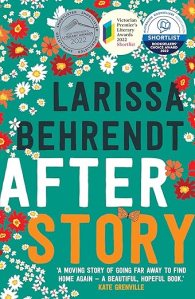
This month starts  After Story by Larissa Behrendt. This is the description on Amazon UK:

When Indigenous lawyer Jasmine decides to take her mother, Della, on a tour of England’s most revered literary sites, Jasmine hopes it will bring them closer together and help them reconcile the past. Twenty-five years earlier the disappearance of Jasmine’s older sister devastated their tight-knit community. This tragedy returns to haunt Jasmine and Della when another child mysteriously goes missing on Hampstead Heath. As Jasmine immerses herself in the world of her literary idols – including Jane Austen, the Brontë sisters and Virginia Woolf – Della is inspired to rediscover the wisdom of her own culture and storytelling. But sometimes the stories that are not told can become too great to bear. Ambitious and engrossing, After Story celebrates the extraordinary power of words and the quiet spaces between. We can be ready to listen, but are we ready to hear?
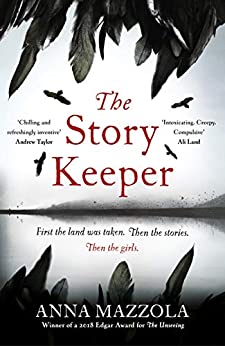
My first link is using the word Story, in the title, and it’s also a book about storytelling – The Story Keeper, set on the Isle of Skye in 1857, by Anna Mazzola. It stresses the importance of folk tales – stories that have been told to make sense of the world and reflect people’s strengths, flaws, hopes and fears. 

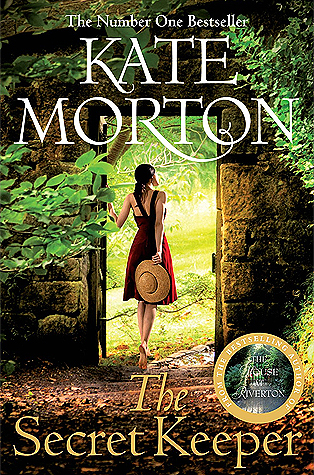
My second link is The Secret Keeper by Kate Morton, a story moving between time periods from 2011, back to the 1960s and also to the 1940s. It begins in 1961 in Suffolk when sixteen-year old Laurel is shocked when she sees her mother stabbing a stranger who had come to their farm. 

In my third link another sixteen year old girl, Nouf ash-Shrawi, disappears from her home in Jeddah, in The Night of the Mi’raj by Zoë Ferraris, just before her arranged marriage. Her body is eventually found in a desert wadi. It appears that her death was an accident and that she died by drowning in the wadi after a sudden storm.

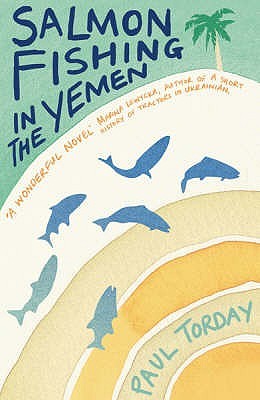
My fourth link is Salmon Fishing in the Yemen by Paul Torday about a project to introduce salmon fishing in the waters of the Wadi Aleyn in the heart of the mountains of Heraz, in Yemen.

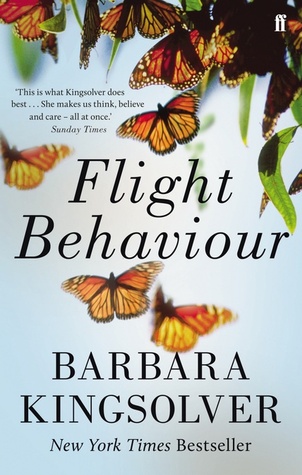
My fifth link takes the chain from the mountains of Heraz to the Appalachian Mountains in Flight Behaviour by Barbara Kingsolver in which a young mother discovers a beautiful and terrible marvel of nature: the monarch butterflies have not migrated south for the winter that year.

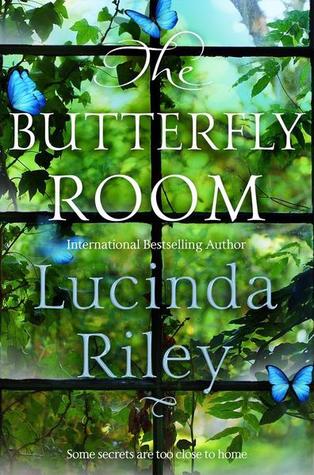
My final link is to The Butterfly Room by Lucinda Riley. The story revolves around Posy Montague and her family home, Admiral House in the Suffolk countryside. Her father encouraged her to draw plants and showed her how to catch butterflies. As a child Posy thought The Butterfly Room in the Folly in the grounds of Admiral House  looked like a fairy-tale castle with its turret made of yellow sandy brick. But the Folly was not the wonderful place she imagined – and there is a dark secret hidden behind its locked door.

The books in my chain are all fiction including historical fiction, mysteries and crime fiction. The chain travels through Australia, the UK, Saudi Arabia, Yemen and the USA,

Next month (October 5, 2024), we’ll start with Colm Tóibín’s Long Island.
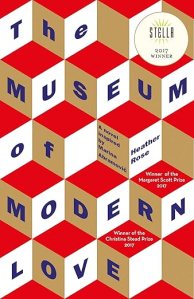
Six Degrees of Separation from The Museum of Modern Love to:

It’s time again for Six Degrees of Separation, a monthly link-up hosted by Kate at Books Are My Favourite and Best. Each month a book is chosen as a starting point and linked to six other books to form a chain. A book doesn’t need to be connected to all the other books on the list, only to the one next to it in the chain.

This month starts with The Museum of Modern Love by by Heather Rose (Kate’s pick was inspired by Sue’s recent post about writers and artists). I haven’t read this, but I would like to. This is the description on Amazon UK:

Arky Levin, a film composer in New York, has promised his wife that he will not visit her in hospital, where she is suffering in the final stages of a terminal illness. She wants to spare him a burden that would curtail his creativity, but the promise is tearing him apart. One day he finds his way to MOMA and sees Mariana Abramovic in The Artist is Present. The performance continues for seventy-five days and, as it unfolds, so does Arky. As he watches and meets other people drawn to the exhibit, he slowly starts to understand what might be missing in his life and what he must do.

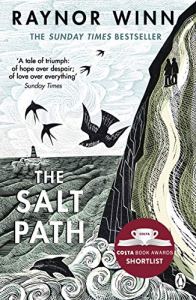
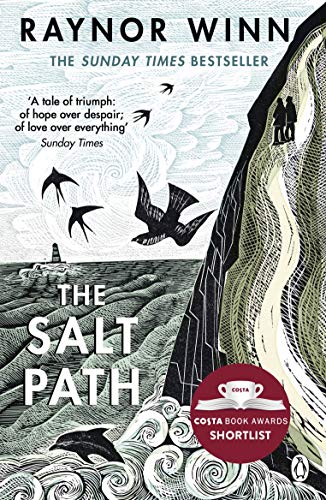
My first link is via a terminal illness to The Salt Path, Raynor Winn’s memoir about walking the South Coast Path when Moth her husband was diagnosed with a terminal illness. They were homeless, with no means of income except for £48 pounds a week. They had lost their home, business and livelihood, after investing in one of a friend’s companies that had failed. It is about the determination to live life, about overcoming pain and hardship, and the healing power of nature. It is about homelessness and the different reactions and attitudes of the people they met when they told them they were homeless.

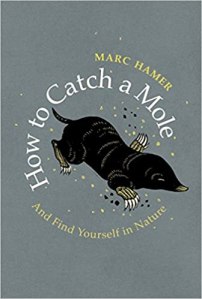
My second link is How to Catch a Mole by Marc Hamer, part memoir, part a nature study of the British countryside, part poetry, and, of course, about moles. After leaving school Marc Hamer was homeless for a while. He has worked in art galleries, marketing, graphic design and taught creative writing in a prison before becoming a gardener. And before writing this book he had been a traditional molecatcher for years.

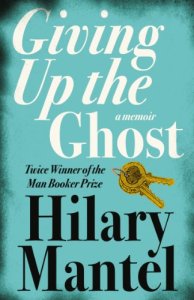
My third link is Hilary Mantel’s Giving Up the Ghost, a remarkable memoir. It came across to me as being clear, honest and very moving. She thought it was because of her that her parents were not happy and that without her they would have had a chance in life. It didn’t get any better when her father left home and she was left to live with two younger brothers, their mother and her mother’s lover. Home was a place where secrets were kept and opinions were not voiced. Her experience of ghosts at the age of 7 was horrifying as she felt as though something came inside her, ‘some formless, borderless evil’.

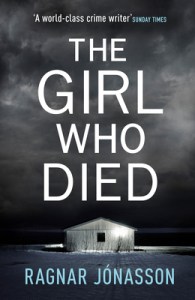
My fourth link is The Girl Who Died by Ragnar Jonasson, Icelandic noir, a mix of horror and psychological thriller, with a strong sense of place. Skálar is a close-knit community that doesn’t welcome newcomers, keeping its secrets well hidden. The only person who welcomes Una, to the village is Salka, the mother of Edda, one of the two girls Una is to teach. Her house is said to be haunted by the ghost of a young girl who had died fifty years earlier,

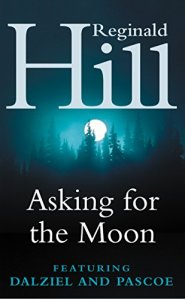
My fifth link is Asking for the Moon by Reginald Kill, a collection of four novellas. Two of them feature ghosts, Pascoe’s Ghost and Dalziel’s Ghost. But I think that the best one is the first story, The Last National Service Man which tells how Dalziel and Pascoe first met. Neither of them are impressed by the other. Dalziel thinks Pascoe is everything he dislikes – a graduate, well spoken, and a Southerner from south of Sheffield. Pascoe thinks Dalziel is an archetypical bruiser who got results by kicking down doors and beating out questions in Morse code on a suspect’s head.

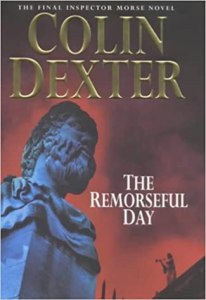
My final link is to the final Inspector Morse novel, The Remorseful Day by Colin Dexter. The plot is detailed, complex and as usual, with Morse, a puzzle type murder mystery with plenty of challenging clues. Sergeant Lewis is left to investigate the murder of nurse Yvonne Harrison that had remained unsolved for a year. When Morse phones to say he is feeling unwell Lewis is most concerned – Morse seldom mentioned his health, what is wrong with him?

The main focus of the book is on Morse and how he copes with his illness and his drinking habits. It becomes obvious just how alone he is in the world and how devastating his situation is to Lewis.

The first three books in my chain are memoirs and the other three are crime fiction/psychological thriller novels. Beginning in America it travels to the UK, then to Iceland, before ending back in the UK.

Next month (September 7, 2024), we’ll start with  After Story by Larissa Behrendt.

The Salt Path by Raynor Winn

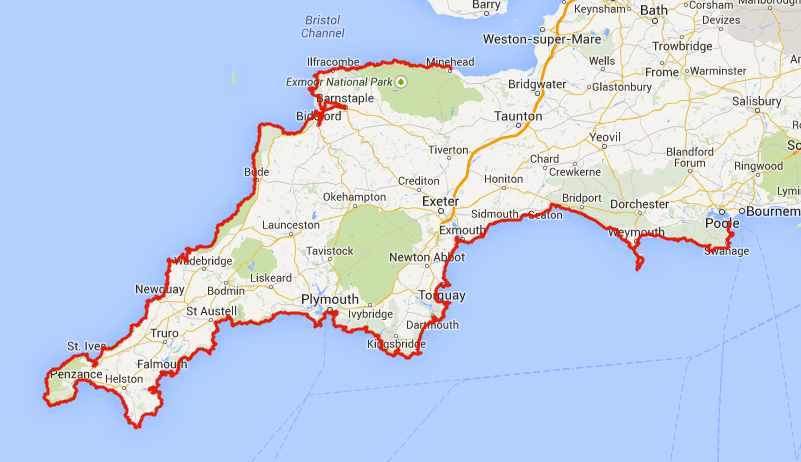
Just days after Raynor learns that Moth, her husband of 32 years, is terminally ill, their home is taken away and they lose their livelihood. With nothing left and little time, they make the brave and impulsive decision to walk the 630 miles of the sea-swept South West Coast Path, from Somerset to Dorset, via Devon and Cornwall.

Carrying only the essentials for survival on their backs, they live wild in the ancient, weathered landscape of cliffs, sea and sky. Yet through every step, every encounter and every test along the way, their walk becomes a remarkable journey.

The Salt Path is an honest and life-affirming true story of coming to terms with grief and the healing power of the natural world. Ultimately, it is a portrayal of home, and how it can be lost, rebuilt and rediscovered in the most unexpected ways
.

I first wrote a short post about The Salt Path in this post. I bought the book in 2018 and was keen to read it, but so many other books intervened, and it was only when I saw Raynor Winn on Kate Humble’s Coastal Walks programme on the South West Coastal Path that I remembered about her book.

Raynor and Moth Winn, a couple in their 50s, were homeless, with no means of income except for £48 pounds a week. They had lost their home, business and livelihood, after investing in one of a friend’s companies that had failed. They found out that they were liable to make payments towards the debts of the company, were taken to court and ended up losing not only their savings but also their farm and home.

Despite finding out that Moth has a rare terminal illness, they decided to walk the South Coast Path. He had been diagnosed with corticobasal degeneration (CBD), a brain disease for which there is no cure or treatment apart from pain killers and physiotherapy. The consultant told him that he shouldn’t tire himself, or walk too far and to take care on the stairs. Their decision to walk the Path and camp wild seemed to me both brave and foolhardy and I read this book with absolute amazement that they could take themselves away from medical care and set off, almost totally unprepared and not fit enough to walk 630 miles along a coast path.

At first it was really difficult as Moth struggled with pain and exhaustion, and it horrified me that he could carry on in that condition. They had reached the Valley of Rocks in north Devon, when he sat down on the rocks. He felt he was eighty and was so tired that he hurt everywhere:

Can’t tell if I’m half asleep, or wide awake. It’s like my head’s in fog and I’m walking through treacle. This is the most bollockingly stupid thing we’ve ever done. I want to lie down.(page 58)

He had been taking Pregabalin to ease the nerve pain and had been told not to just stop taking them because of the immense list of withdrawal symptoms. But that is what he had done – they had left his supplies behind them, ready to put in the rucksack, but had forgotten them. Fortunately after a while the pain lessened, he felt much better and his head was clearer. The walking had helped!

They had little to live on, their diet involved lots of rice and noodles, supplemented with wine gums and foraging for blackberries, mushrooms and dandelions. They took it at their own pace, following Paddy Dillon’s Walking Guide of the trail from Minehead on the Somerset coast right round Devon and Cornwall to Poole in Dorset, stopping to pick up their money and buy supplies along the route. But as winter was on the way when they reached Lantic Bay and Pencarrow Head they decided to take up a friend’s offer to stay with her for the winter free of rent if they could help with her building and on her farm.

However, once they stopped walking, Moth’s stiffness and his neurological pain increased and he struggled to move. He seemed to be deteriorating so quickly without the Pregabalin. But they were determined to finish the walk and completed it the next year. Once more, as they walked Moth’s condition improved. He didn’t understand how, thinking it may have ‘something to do with heavy endurance exercise‘, causing some sort of reaction that that they didn’t understand. He didn’t know how it worked but he just felt great.

Living with a death sentence, having no idea when it will be enacted, is to straddle a void. Every word or gesture, every breath of wind or drop of rain matters to a painful degree. For now we had moved outside of that. Moth was on death row, but he’d been granted the right to appeal. He knew CBD hadn’t miraculously disappeared, but somehow, for a while, it was held at bay.(page 243)

The Salt Path is not a book about walking the South Coast Path because you love walking, nor because you want the challenge of walking 630 miles, nor because you love wild camping. And it is not just about about the beauty of the surroundings and the experience of being close to nature (although that is there in Ray Winn’s beautiful descriptive writing). It is about the determination to live life, about overcoming pain and hardship, and the healing power of nature. It is about homelessness and the different reactions and attitudes of the people they met when they told them they were homeless. Some were hostile, some recoiled in horror and moved away as though they were social pariahs. Others were sympathetic and generous.

In this post I have concentrated on Moth’s health, because that is what struck me most as I was reading the book. But there is so much more in it than that. It’s one of the most remarkable books that I have read. I admired their determination and persistence in the face of all the difficulties and obstacles they met, but it is definitely not something I could ever undertake. It both fascinated and appalled me.

After I read The Salt Path I wondered how Ray and Moth are now and came across this article in The Herald, dated 20 September 2020, in which Raynor Winn looks back over these life-changing and challenging events. At lot has happened since then and the story of that is in her second book, The Wild Silence. You can follow Raynor on Twitter @raynor_winn.

  • Publisher : Michael Joseph; 1st edition (3 Sept. 2020)
  • Language : English
  • File size : 3148 KB
  • X-Ray : Enabled
  • Word Wise : Enabled
  • Print length : 280 pages
  • My Rating: 4*

My Friday Post: The Salt Path by Raynor Winn

Every Friday Book Beginnings on Friday is hosted by Gillion at Rose City Reader where you can share the first sentence (or so) of the book you are reading. You can also share from a book you want to highlight just because it caught your fancy.

This week I’m featuring a book I’m about to start. It’s The Salt Path by Raynor Winn. It was her first book and it was shortlisted for the 2018 Costa Biography Award and the Wainwright Prize. I want to read it because it’s a true story about a couple, Raynor and Moth, her husband who is terminally ill, who had lost their home and their business. Faced with this terrible situation they decided to buy a tent and walk the Salt Path, the south-west coastal path, from Minehead in Somerset to Poole in Dorset, via Devon and Cornwall.

There’s a sound to breaking waves when they are close, a sound like nothing else. The background roar is unmistakable, overlaid by the swash of the landing wave and then the sucking noise of the backwash as it retreats.

Also every Friday there is The Friday 56, hosted by Freda at Freda’s Voice. *Grab a book, any book. *Turn to Page 56 or 56% on your  ereader . If you have to improvise, that is okay. *Find a snippet, short and sweet, but no spoilers!

  1. Grab a book, any book.
  2. Turn to page 56, or 56% on your eReader. If you have to improvise, that is okay.
  3. Find any sentence (or a few, just don’t spoil it) that grabs you.
  4. Post it.
  5. Add the URL to your post in the link on Freda’s most recent Friday 56 post.

Page 56:

The first time I saw Moth across the sixth-form college canteen I was eighteen. He was wearing a white collarless shirt as he dipped a Mars bar in a cup of tea. I was mesmerised.

Since travelling the South West Coastal Path, Raynor Winn became a regular long-distance walker and writes about nature, homelessness and wild camping. She lives in Cornwall. Her second book, The Wild Silence, is her follow-up book. I bought The Salt Path in 2018 and was keen to read it, but so many other books intervened, and it was only when I saw Raynor Winn on Kate Humble’s Coastal Walks programme on the South West Coastal Path that I remembered about her book.