The Maigret books are also a good choice for Novellas in November, they’re all under 200 pages. I’ve been a Maigret fan for a long time, ever since I was in my teens, watching the TV series with Rupert Davies in the title role. And I’ve been reading the Maigret series as I’ve come across the books in libraries, bookshops, and more recently as e-books, so not in the order they were originally published.
Penguin| 2014| 164 pages| My own copy| 3*
This is a short review because, once more I’m behind with writing reviews. The Yellow Dog is the 5th book in the new Penguin Maigret series, translated by Linda Asher. It was first published in 1931 and also published in a previous translation as A Face for a Clue. It’s a tale of small town suspicion and revenge.
In the windswept seaside town of Concarneau, a local wine merchant is shot. In fact, someone is out to kill all the influential men and the entire town is soon sent into a state of panic. For Maigret, the answers lie with the pale, downtrodden waitress Emma, and a strange yellow dog lurking in the shadows…
It’s only 134 pages but with a slow start it did seem longer than that. It begins with the shooting of Monsieur Mostaguen, a local wine merchant, followed by the appearance of the yellow dog, a big, snarling yellow animal, and then an attempt at poisoning for Maigret to investigate. I wondered what the significance of the yellow dog was and who it belonged to; no one seems to know. The locals had never seen it before and they all viewed it with fear and suspicion. I’ve read some of the earlier Maigret and have noted before that I’ve been confused and baffled, with little idea of what was going on and it was just the same with this book. Maigret doesn’t seem to be very concerned about the man who was shot and seriously injured, nor about the attempted poisoning until there’s a murder and another man disappears. He walks around the town, observing but not actively investigating.
Simenon is good at conveying atmosphere and skilled at setting the scene and drawing convincing characters in a few paragraphs. As the book begins there’s a south-westerly gale slamming the boats together in the harbour in Concarneau and the wind surges through the streets. Contrast the weather at the beginning of the book with the change by the time Maigret is getting close to clearing up the mystery – the weather turned fine, with a vibrant blue sky, the sea sparkled, and ‘the Old Town’s walls, so gloomy in the rain, turn a joyful, dazzling white.‘
I don’t think this is one of the best Maigret book, but it is puzzling with Maigret keeping his thoughts to himself until the end of the book, when like Agatha Christie’s Hercule Poirot, he explains it all.
Top 5 Tuesday was created by Shanah at Bionic Book Worm, and it is now being hosted by Meeghan at Meeghan Reads. For details of all of the latest prompts for April to June, see Meeghan’s post here
We’re continuing reading around the world this month and today the topic is Europe. The books I’ve chosen are crime fiction and historical fiction.
France: When I think of French crime fiction Georges Simenon’s Maigret immediately pops into my mind. Simenon was actually Belgian, not French, but the Maigret books are set in France (mainly in Paris). Simenon wrote 75 novels and 28 short stories featuring Commissaire Jules Maigret and I first knew of them from a friend at school who loved the books. Then there were the numerous TV productions with Rupert Davies as Maigret and more recently Rowan Atkinson has played the role of Chief Inspector Maigret in the 2016 ITV series.
I’ve read several of the Maigret books. The Man on the Boulevard is the 41st book in the series. There were lots of things I liked in this book – the attention to detail, the descriptions of the weather (cold and wet), and the characters themselves. It’s set in Paris and without knowing the location of the various boulevards I could still get a good impression of the city and its suburbs.
It has a puzzling murder to solve – Louis Thouret is found stabbed in a little alleyway. Seemingly a perfectly ordinary man of regular habits who had left his home in the suburbs to go to his job as a storekeeper in Paris for the past twenty five years. It turns out that Louis had a double life that his wife knew nothing about. It appears he had been having an affair and for the past three years he had not had a job. I liked the theme of a man following a double life and the way Louis resolves his problem of keeping up appearances with his wife and family althoughI thought his method of maintaining his income was rather implausible.
Italy: A Sea of Troubles by Donna Leon, whose books are crime fiction, but also discuss various social and cultural issues and A Sea of Troubles, the 10th Commissario Guido Brunetti novel, is no exception. Brunetti is one of my favourite detectives. He is happily married with two children. He doesn’t smoke or drink to excess and often goes home for lunch to his beautiful wife Paolo, who is a wonderful cook – in this book she treats him to a delicious apple cake made with lemon and apple juice and ‘enough Grand Marnier to permeate the whole thing and linger on the tongue for ever.’ (page 238)
I read it eagerly, keen to get to the bottom of the mystery surrounding the deaths of two clam fishermen, father and son, off the island of Pellestrina, south of the Lido on the Venetian lagoon, when their boat suddenly exploded. As well as the mystery the issues Leon highlights in this book are concerning pollution and the overfishing of clams that is destroying the clam beds.
Spain: C J Sansom’s Winter in Madrid, which I think is one of the best books I’ve read, a book that had me in tears as I was reading about the devastation, desolation and waste of war. It is an action packed thrilling war/spy story and also a moving love story and historical drama all rolled into this tense and gripping novel. Sansom vividly conveys the horror and fear of the realities of life in Spain during the Spanish Civil War and the first two years of the Second World War.
The opening chapter dramatically sets the tone for the book with the brutality of the Battle of Jarama in 1937 then leaps straight into the bombing of London in 1940. Then Harry Brett, traumatised by his injuries at Dunkirk is sent to Spain to spy for the British Secret Service. He is plunged into the terrible living conditions in Madrid where people are starving, children are left homeless to fend for themselves and wild dogs roam the rubble of bombed houses.
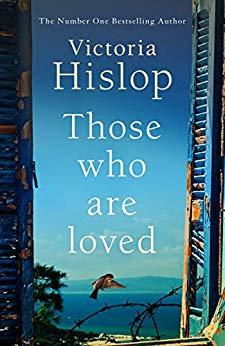
Greece: Those Who Are Loved by Victoria Hislop, one of the most moving novels I’ve read. It is historical fiction ‘set against the backdrop of the German occupation of Greece, the subsequent civil war and a military dictatorship, all of which left deep scars’. It begins slowly and it was only at about the halfway stage that it really took off for me. But then, the book sprang to life, the pace increased, and I was totally gripped and moved as history and fiction came together dramatically in glorious technicolor, telling the story of the characters personal lives and their parts in the action.
The main character is Themis Koralis/Stravidis (in Greek mythology Themis is the personification of fairness and natural law). In 2016 she is a great grandmother and realising that her grandchildren knew very little about Greek history she decided to tell them her life story, beginning from when she was a small child in the 1930s, through the German occupation of Greece during the Second World War, the civil war that followed, then the oppressive rule of the military junta and the abolition of the Greek monarchy, up to the present day.
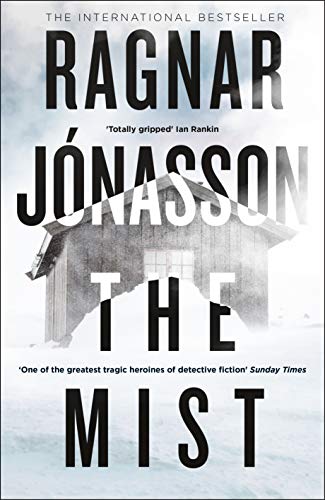
Iceland: The Mist by Ragnar Jonasson, the third novel in the HiddenIceland series. Detective Inspector Hulda Hermannsdottir is worrying about her daughter, Dimma and her relationship with her husband, Jon. Alongside the story of what is happening in her personal life, she is also investigating the disappearance of a young woman and a suspected murder case, a particularly horrific one in an isolated farmhouse in the east, where Erla and her husband, Einar live. When a stranger, lost in a snowstorm arrives Erla invites him in and the nightmare begins.
I loved the setting, Jonasson’s writing bringing the scenery and the weather to life – you can feel the isolation and experience what it is like to be lost in a howling snowstorm. The emotional tension is brilliantly done too, the sense of despair, confusion and dread is almost unbearable.
Cécileis Dead by Georges Simenon, translated by Anthea Bell, an Inspector Maigret novel.
Synopsis (Amazon)
Poor Cécile! And yet she was still young. Maigret had seen her papers: barely twenty-eight years old. But it would be difficult to look more like an old maid, to move less gracefully, in spite of the care she took to be friendly and pleasant. Those black dresses that she must make for herself from bad paper patterns, that ridiculous green hat!
In the dreary suburbs of Paris, the merciless greed of a seemingly respectable woman is unearthed by her long suffering niece, and Maigret discovers the far-reaching consequences of their actions.
This novel has been published in a previous translation as Maigret and the Spinster.
My thoughts:
This is one of the best Maigret books I’ve read – and it is complicated, remarkably so in a novella of just 151 pages. At first it seems quite straight forward. Cécile has been wanting to see Detective Chief Inspector Maigret for months, sitting patiently in the ‘Aquarium’, as the waiting room at the Police Judiciaire in Paris, is known. She was convinced that someone had been breaking into her aunt’s apartment. But no one takes her seriously and Maigret is always busy, until one day he decides to see her. But she had left the waiting room, so he goes to the apartment where she lives with her elderly aunt, Juliette Boynet, the owner of the apartment building. She wasn’t there, but her aunt was – lying dead on the floor, strangled. Cécile was missing and the title tells you why – she was indeed dead.
And from then on, the mystery became more complex, with several suspects with a variety of motives. Juliette was very wealthy, but also miserly. She had a large family, mostly estranged from her and at odds with each other. They all turn up for her funeral, arguing about who should take precedence in the funeral cortège, and about who should inherit her money and property.
Maigret has to sort it out in his own way – musing over the details and feeling bad that he hadn’t spoken to Cécile earlier, thinking her worry over an intruder who just moved things around the apartment without taking anything was trivial. We see more of how he thinks and works when later in the investigation he is accompanied by an American, a Mr Spencer Oates from the Institute of Criminology of Philadelphia, who had asked if he could study Maigret’s methods.
This is the second time I’ve read Cécile is Dead. I first read it in 2018, but didn’t write about it at that time. Reading it for the second time, I realised I had forgotten all the details – it was like reading a new book. I thoroughly enjoyed it. It is either the 20th or the 22nd Maigret novel – Amazon records it as the 20th, whereas Goodreads has it as the 22nd! Whichever it is, it is a good read.
Penguin Classics|2 October 2014|160 pages|Paperback|4*
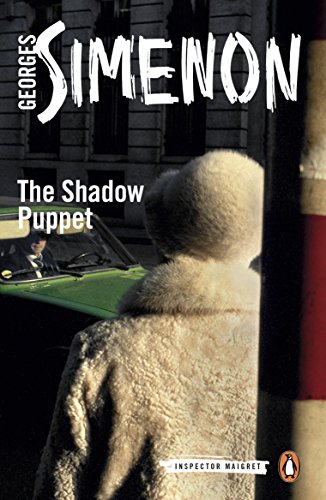
Georges Simenon wrote his 13th Maigret book, The Shadow Puppet in December 1931 at the villa Les Roches Grises at Antibes (Alpes-Maritimes) on the French Riviera. It was first published in 1932 under the title L’Ombre chinoise.
It’s the second Maigret book I’ve read in the last two days and I think this is better than the other one I read, The Saint-Fiacre Affair. It is a more typical murder mystery – a man is shot dead in his office in the Place des Vosges in Paris and Maigret uncovers a tragedy involving desperate lives, unhappy people, addiction and an all-consuming greed. He gets to the truth through careful examination of the facts, questioning those involved and applying his knowledge and understanding of human nature.
One evening Raymond Couchet, the owner of a serum company in the Place des Vosges, was shot dead, seated at his desk, and the safe behind him was empty, the 3600 francs that should have been there have gone. The building contains Couchet’s medical laboratory as well as residential apartments, set around a central courtyard. Called to the scene Maigret notices the shadowy figures in the lighted windows of the building and suspects that the murderer could be one of the residents of the apartments where Couchet’s first wife, Juliette Martin and her husband live. Then there is his son, Roger, a drug addict living in the Hôtel Pigalle, and in the next room to him, Couchet’s girlfriend, Nine Moinard, a dancer at the Moulin Bleu.
It is an entertaining mystery and Maigret finds himself getting to really like Couchet as the details of his life emerge – and equally disliking both his son and his bitter ex-wife. What I like about these Maigret books are that they are concise and tightly structured yet convey such convincing characters and depths of perception. In this particular book Maigret comes across feelings of enmity, greed, class distinction, hatred and paranoia in the course of his investigations.
Reading Challenges – Calendar of Crime (the setting is a place of employment), and Mount TBR 2019 (a book I’ve owned for 2 years)
Penguin Classics|6 November 2014|160 pages|Paperback|3*
The Saint-Fiacre Affair by Georges Simenon was first published in January 1932, under the title Maigret Goes Home. My copy is one of the Penguin Classics publications in new translations.
Saint-Fiacre is where Maigret was born and grew up. His father had been the steward of the château there for thirty years. So when an anonymous note predicting a crime during All Souls’ Day mass at the church is handed in to the Moulins police office, Maigret went back there for the first time since his father had died. It is a melancholy visit for as well as a death to investigate, Maigret finds so much had changed and the atmosphere was oppressing him – he had never imagined that he would find the village in such a sorry state.
The predicted deathtook place in the church whilst Maigret was attending the the first Mass on All Soul’s Day –the old Countess of Saint-Fiacre died during the mass, of heart failure. But Maigret soon discovers that the heart attack had been brought on when the Countess reada fake newspaper story of her son’s suicide that had been planted in her missal. Maigret suspects a number of people could have been responsible – her son, Maurice, her secretary/lover, Jean, the steward, Ernest and his son, Emile.
I enjoyed this book, although I found it rather disjointed and at times couldn’t follow very easily who was speaking, so it was a bit difficult keeping track of what was going on – maybe that was my problem, I’m not sure. But I thought the melancholy atmosphere and the descriptions of the chateau and Maigret himself were well done and it is packed with drama and tension. The denouement in which Maigret reveals the truth reminded me of the way Poirot rounds up all the people involved and explains who had done the deed and why, and why it was a crime that was not punishable by the law.
Penguin is publishing the entire series of Maigret novels in new translations. This novel has been published in a previous translation as Maigret at the “Gai-Moulin”.
The Dancer at the Gai-Moulin by Georges Simenon, translated by Siân Reynolds is one of the early Maigret books, first published in 1931. Two teenage boys, Delfosse and Chabot, attempt to burgle Le Gai-Moulin, a nightclub in Liege in Belgium, but on finding a body they panic and leave, fearing they’ll be suspected of murder. The next day, to the boys’ amazement, the corpse is found in the Botanical Gardens in a large laundry basket in the middle of a lawn. Who was he, who killed him, why was he killed and who had moved the body from the nightclub to the Botanical Gardens?
This short book is mainly concerned with Delfosse and Chabot and their subsequent actions that set them at odds with each other and land them in police custody. It’s an unusual Maigret book in that Detective Chief Inspector Maigret is not immediately involved in the police investigation – that is carried out by Chief Inspector Delvigne of the Belgian police and part of the mystery is why Maigret is even in Liege. Adèle is the dancer referred to in the title but she doesn’t play a major role in the book, although the two teenagers are obsessed with her. It’s quite a puzzle and Maigret doesn’t reveal his thoughts, or his reasoning until the end, much to the annoyance of Delvigne.
The plot is unconvincing and Maigret’s actions seem quite implausible, but that didn’t spoil my enjoyment of this book. It’s not really the crime that is in focus, as Simenon is skilled at setting the scene and drawing convincing characters in a few paragraphs. In this novel the two boys and Adèle stand out:
She wasn’t beautiful, especially now, lounging about in her mules and shabby peignoir. But perhaps, in the familiarity of this intimacy, she held even more allure for him.
How old was she, twenty five, thirty? She’d certainly seen life. She often talked about Paris, Berlin, Ostend. She mentioned the names of famous nightclubs.
But without any excitement or pride, without showing off. On the contrary. Her main characteristic seemed to be weariness, as could be guessed from the expression in her green eyes, from the casual way she held a cigarette in her mouth, from all her movements and smiles. Weariness with a smile. (page 28)
I knew that Simenon was a prolific author, writing seventy five novels and twenty eight short stories featuring Maigret, but I was surprised to find that The Dancer at the Gai-Moulin was the 10th book that he published in 1931. By the end of 1931 his books had been translated into 18 languages.
Paperback: 160 pages
Publisher: Penguin Classics (7 Aug. 2014)
Language: English
ISBN-10: 0141393521
ISBN-13: 978-0141393520
Source: my own copy – thanks to Sarah’s Giveaway at Crimepieces blog
My rating: 3.5*
This book slots into the only reading challenge I’m doing this year – What’s in a Name 2018. It fits into the category of a book with the word ‘the‘ used twice in the title. It is also one of my TBR books (a book I’ve owned prior to 1 January 2018) and also a book on my Classics Club list.









 BooksPlease