New-To-Me Books August 2015

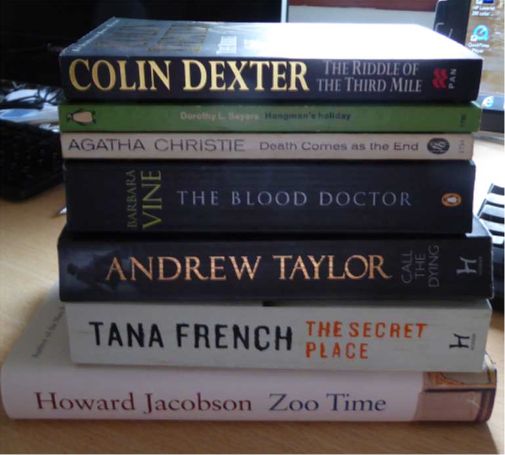
Another visit to Barter Books in Alnwick resulted in another pile of books to add to my TBR shelves.

From top to bottom they are:

  • The Riddle of the Third Mile by Colin Dexter – to fill in my gaps in reading his Inspector Morse books. This is the 6th in the series – Inspector Morse isn’t sure what to make of the truncated body found dumped in the Oxford Canal. He suspects it may be all that’s left of an elderly Oxford don last seen boarding a London train days before.
  • Hangman’s Holiday and Other Stories by Dorothy L Sayers – the ninth in her Lord Peter Wimsey series, this includes  four Wimsey stories, six stories featuring Montague Egg (travelling salesman for Plummet & Rose, Wine & Spirits), and two more separate stories.
  • Death Comes as the End by Agatha Christie – this is one of the last few books of hers I have yet to read. It’s historical crime fiction set in Egypt 4,000 years ago, written drawing on her experience of several  expeditions to the Middle East with her husband, Max Malloran, an eminent archaeologist.
  • The Blood Doctor by Barbara Vine (Ruth Rendell) – one of her psychological thrillers, described on the back cover as ‘a chilling tale of ambition, obsession and bad blood.‘ I still have a lot of Barbara Vine/Ruth Rendell books to read.
  • Call the Dying by Andrew Taylor – I’m jumping into a series with this book as this is the 7th in the Lydmouth mysteries and I haven’t read any of the others. They are all are set in and around a fictional town on the Anglo-Welsh borders in the years after World War II.
  • The Secret Place by Tana French – the 5th in the Dublin Murder Mystery series. I read the first,  In the Woods a few years ago and liked its psychological elements and the twists and turns.  In this book Detective Stephen Moran investigates the murder of handsome, popular Chris Harper when sixteen-year-old Holly Mackey brings him a photo of Chris with the caption, I KNOW WHO KILLED HIM.
  • Zoo Time by Howard Jacobson – a complete change from crime fiction – a book I bought in Tescos for £1. It’s described on the book cover as  ‘a novel about love – love of women, love of literature, love of laughter. It shows our funniest writer at his brilliant best.‘ I felt like reading something different.

If you’ve read any of these books I’d love to know what you think about them.

Partners in Crime – The Secret Adversary: Tommy and Tuppence

Well, I suppose I should have expected this – I was looking forward to the new BBC1 series of the Tommy and Tuppence stories, Partners in Crime advertised as ‘loosely based‘ on Agatha Christie’s novels, but the first episode was last night ,The Secret Adversary was disappointing to say the least as not much of Agatha Christie’s story was left.  I knew it had been moved to the 1950s instead of the 1920s and was wondering what else had been changed.

Well, practically everything else, so much so that most of it bore no resemblance to the original. It was not only the wrong era but also the characters were different – TV Tommy, as David Walliams played him for most of the episode, is a bumbling fool who had not taken part in the War due to being wounded by a delivery van (I think that’s what the TV Tommy said), with a vacant look on his face , and obsessed with bees. Tommy and Tuppence as described by Agatha Christie are ‘˜an essentially modern-looking couple’, childhood friends who after the First World War were both stony broke and who decided to set up a joint venture under the name of the Young Adventurers Ltd, initially intending to hire themselves out to commit crimes.The ‘real’ Tommy had been wounded in the War, not once but twice, Tommy and Tuppence never met Jane Finn and Julius Hersheimmer was a young white man who says he is Jane’s cousin – not her uncle. I could go on!
OK, so it was easy watching, Jessica Raine made a good, meddling and determined Tuppence and it was amusing at times. But to enjoy this I’ll have to forget it has any connection with Agatha Christie whatsoever and I don’t know that I can do that, for the next five episodes. It’s so annoying to keep saying ‘it’s not like that in the book’.

Agatha Christie: Tommy and Tuppence

Tomorrow night sees the start of a new six part series on BBC1 – Partners in Crime. According to the Radio Times the episodes are loosely based on The Secret Adversary, the first of the Tommy and Tuppence stories and N or M?, the third story.

But, as I have come to expect with TV/film adaptations, this is not the original story as the action has been transposed from 1922 and 1940 (the original settings of these two books) to the 1950s. Still I have great hopes for the series, with David Walliams as Tommy and Jessica Raine as Tuppence, although I’m wondering what else has been changed.

This is what I wrote about The Secret Adversary in January 2011:

The Secret Adversary was first published in 1922. It was Agatha Christie’s second book and the first featuring Tommy and Tuppence. In this book they have just met up after World War One, both in their twenties: ‘˜an essentially modern-looking couple’. They are both stony broke and decide to set up a joint venture under the name of the Young Adventurers Ltd, initially intending to hire themselves out to commit crimes.

A Mr Whittington overhears their conversation and offers Tuppence their first assignment, but when she tells him her name is ‘˜Jane Finn’ he acts very strangely and thinks she is blackmailing him. From then on Tommy and Tuppence set out to find Jane Finn, a name Tommy had overheard from a conversation in the street.

Reading it reminded somewhat of Enid Blyton’s adventure books, mixed up with P G Wodehouse’s books. It’s a spy/detective story that is fast and furious with Tommy and Tuppence landing themselves in all sorts of dangerous situations. It’s also full of red herrings and they’re never very sure who they can trust. Tommy and Tuppence advertise for information relating to Jane Finn and have two responses. One is from Mr Carter, from British Intelligence who tells them that Jane Finn, a survivor from the torpedoed Lusitania, was handed a certain document ‘“ a secret agreement, with a ‘˜new and deadly significance’. The second response is from Mr Julius P Hersheimmer, a young American, who says he is Jane’s cousin and wants to find her.

Just who is the mysterious Mr Brown, the secretive mastermind behind a plot to unite all of England’s enemies, overthrow the government and cause anarchy?  There is no clue to his real identity, he remains elusive and always in the background. But it becomes clear that he is one of two people and as I read I swung from believing it to be one character to the other.

One point of interest is the brief mention of Inspector Japp, of Scotland Yard. His role in this is merely incidental.

I enjoyed this book and I liked Tommy and Tuppence, who by the end realise they are in love. Agatha Christie only wrote five books featuring this couple. Unlike Miss Marple and Hercule Poirot, Tommy and Tuppence age as the books were written (links to my posts):

Format: Kindle Edition
File Size: 378 KB
Print Length: 229 pages
Source: Project Gutenberg E-Book

First Chapter, First Paragraph Tuesday: Parker Pyne

Every Tuesday Diane at Bibliophile by the Sea hosts First Chapter, First Paragraph Tuesday Intros, where you can share the first paragraph, or a few, of a book you are reading or thinking about reading soon.

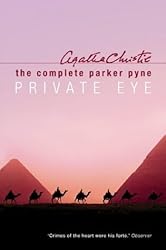
I’ve been looking at some of Agatha Christie’s short stories and wondering which to read first. One of the collections I own is The Complete Parker Pyne: Private Eye. It looks a good place to start.

In the Author’s Foreword Agatha Christie tells how she came to write these stories:

One day, having lunch at a Corner House, I was enraptured by a conversation on statistics going on at a table behind me. I turned my head and caught a vague glimpse of a bald head, glasses and a beaming smile – I caught sight that is, of Mr Parker Pyne. I had never thought about statistics before (and indeed seldom think about them now!) but the enthusiasm with which they were being discussed awakened my interest. I was just considering a new series of short stories and then and there I decided on the general treatment and scope, and in due course enjoyed writing them.

I like the details she gives – the Corner Houses, smarter and grander than tea shops and noted for their art deco style first appeared in 1909 and  remained until 1977. And I love the fact that she was eavesdropping on the conversation going on behind her and the insight this gives into how she got ideas for her stories.

The stories were all written in the 1930s and first appeared in various UK and US magazines. The first story in this collection is The Case of the Middle-Aged Wife and it begins:

Four grunts, an indignant voice asking why nobody could leave a hat alone, a slammed door, and Mr Packington had departed to catch the eight forty-five to the city. Mrs Packington sat on at the breakfast table. Her face was flushed, her lips were pursed, and the only reason she was not crying was that at the last minute anger had taken the place of grief, ‘I won’t stand it,’ said Mrs Packington. ‘I won’t stand it!’ She remained for some moments brooding , and then murmured: ‘The minx. Nasty sly little cat! How can George be such a fool!’

Agatha Christie: Short Stories

Agatha ChristieSo far in reading Agatha Christie’s books I’ve concentrated on reading her full length novels and have only read some of her short stories. As I’ve nearly read all of her novels, although none of those she wrote as Mary Westmacott, I’ll be reading more of her short stories from now on.

So far I’ve read the following short story collections:

  • The Thirteen Problems – Miss Marple stories. It was first published in the UK in 1933, collecting together 13 short stories previously published in various magazines. The first story The Tuesday Night Club introduces the character of Miss Marple.
  • The Hound of Death – 12 stories of unexplained phenomena, in most cases tales of the supernatural rather than detective stories. Of the twelve stories I think The Witness for the Prosecution is the best. Agatha Christie later wrote a play based on this story which has subsequently been adapted for film and television.
  • The Labours of Hercules – 12 short stories featuring Hercule Poirot, first published in 1947. Poirot is thinking of retiring, but before he does he wants to solve 12 more cases and not just any cases. These have to correspond to the Twelve Labours of Hercules, specially selected problems that personally appeal to him.
  • Murder in the Mews – four stories about crimes solved by Hercule Poirot, first published in 1937.
  • The Adventure of the Christmas Pudding and a Selection of Entrées – 6 short stories

I also have the following collections to read:

  • Poirot Investigates – 11 Poirot stories
  • The Golden Ball and Other Stories – 14 stories
  • The Mysterious Mr Quin – 12 stories
  • The Complete Parker Pyne: Private Eye – 14 stories
  • Miss Marple and Mystery – 55 stories

By my reckoning Agatha Christie wrote 157 short stories, published in a number of collections. Wikipedia records that she wrote 153 short stories, published in 14 collections in the UK and in the US. Some stories were published under different names in the US Collections. And some stories appear in more than one collection, which is rather confusing.

So, I’ve compiled a list arranged in a-z order of titles from the list of books on the Official Agatha Christie Site. My list is on my Agatha Christie Short Story Progress Page.

Sad Cypress by Agatha Christie

Sad Cypress, first published in 1940, is a most satisfying mystery, in which Hercule Poirot discovers that almost everyone he talks to is lying. Only the doctor, Peter Lord, believes that Elinor Carlisle did not kill Mary Gerrard, her rival in love, despite the fact that it seems that only Elinor had the motive, the opportunity and the means to poison Mary with morphine hydrochloride. Peter, who is in love with Elinor, appeals to Poirot to prove that she is innocent.

Sad Cypress has a clever and most complicated plot, as is usual in an Agatha Christie book, and it kept me guessing right to the end. Her portrayal of Elinor is excellent – on the surface a calm, almost detached character underneath she is in turmoil, full of repressed passion and unrequited love as it becomes obvious to her that Roddy, her fiancé does not in fact love her and this leads her into actions that seem to point to her guilt.

Then there are the social and cultural themes that always interest me in Agatha Christie’s books. There is the clear distinction between the classes, knowing one’s place in society shown in the relationships between Elinor and Mary, and the almost comic depiction of the two nurses, Nurse O’Brien and Nurse Hopkins, with their gossip over cups of tea. Other themes are the nature of love, and the basis for a happy marriage, the damage caused by family secrets, the ethics of euthanasia, and the difference between thinking about murder and actually committing murder.

This book, if not the best of Agatha Christie’s books, is easily one of my favourites.  I quoted the opening paragraph of Sad Cypress in My Friday Post earlier this month.

The cover photo shown above is my own copy. Details of the latest edition are:

  • Paperback: 288 pages
  • Publisher: HarperCollins (21 May 2015)
  • Language: English
  • ISBN-10: 0008129576
  • ISBN-13: 978-0008129576

This is the first of my books for the 10 Books of Summer 2015 Challenge.