Ten Little Niggers by Agatha Christie

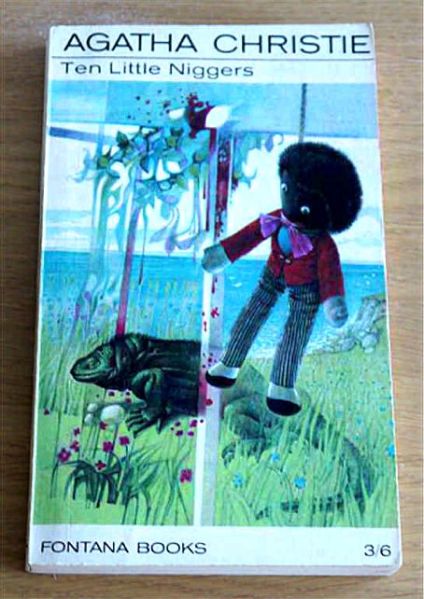
I wondered when I began to write this post whether to use the current title, And Then There Were None, for this book, but chose to use its original title, Ten Little Niggers as that is the title of my copy, a 1968 reprint of its first publication in the UK in 1939. Because of its offensive title it was first published in the US a few months later in 1940 as And Then There Were None.

Ten Little Niggers

Description from the back cover:

10 people are invited to a fabulous mansion on Nigger Island off the coast of Devon. Though they all have something to hide, they arrive hopefully on a glorious summer evening… But soon a series of extraordinary events take place: the island is suddenly bathed in a most sinister light .. panic grips the visitors one, by one … by one… by one…

Eight people are invited to the island (based on a real island – Burgh Island off the south west coast of Devon). They are met by the butler and housekeeper/cook who explain that the owner, Mr Owen (U.N.Owen) has been delayed but has left instructions for their reception. In each of their rooms is a framed copy of the rhyme about the ten little nigger boys who all met their death. On their first evening they sit down to dinner in good spirits until, without any warning they hear a Voice accusing each of them (including the butler and housekeeper) of having caused the deaths or murdered a number of people. From that point onwards, one by one they are found dead, corresponding to the deaths in the rhyme and one by one a china figurine on the dining room table mysteriously disappears.

As the weather worsens they are stranded on the island and unable to leave or to get help from the mainland. Agatha Christie has created not only a ‘locked room’ type of mystery but also a mystery full of suspense, as the guests try to identify Mr U N Owen and become increasingly suspicious of each other. Their fear is further amplified by the house itself, which surprisingly is not an old Gothic house full of creaking wood and dark shadows –

But this house was the essence of modernity. There were no dark corners – no possible sliding panels – it was flooded with electric light – everything was new and bright and shining. There was nothing hidden in this house, nothing concealed. It had no atmosphere about it.

Somehow, that was the most frightening thing of all …

They exchanged good-nights on the upper landing. Each of them went into his or her own room, and each of them automatically, almost without conscious thought, locked the door … (page 52)

Despite their precautions the deaths continue, and each time no one sees or hears anything. I’d marked the page with the rhyme and kept flipping back to it to check how the next victim was going to meet with death, as I tried to work out who the murderer was and how he/she was able to carry out the murders unobserved. What makes it more tense for the reader (or at least for me) is the technique Agatha Christie makes of revealing the thoughts of the remaining characters, but without letting on who the thinker is.

In 1943 Agatha Christie adapted the book into a play, changing the ending, and there have been several film versions, none of which I’ve seen, so I didn’t know who the murderer was, although I knew the outline of the plot. Part way through the book I thought – ah, there is only one person who could be the murderer and I was right. I must re-read the book sometime to see if there were any clues, because if there were I missed them. My idea was based on the probability of that character being the murderer rather than any specific clues.

It is an ingenious mystery, revolving around the concepts of guilt and justice. There was no doubt that each of the victims had committed murder or caused/influenced the death of another person. But did the punishment fit the crime and could it ever be justified? As the murderer explains in an epilogue there were varying degrees of guilt among the victims and those whose guilt was lightest were killed off first!

This is possibly the most famous of Agatha Christie’s books. In her Autobiography Agatha Christie wrote that she had written the book because it was so difficult to do and the idea fascinated her. I found it fascinating too, but as an exercise and a puzzle rather than as a novel. Writing about the play and the book she stated:

I don’t say it is the play or the book of mine I like best, or even that I think it is my best, but I do think in some ways that it is a better piece of craftsmanship than anything else I have written. (page 489 of An Autobiography)

I agree.

New-To-Me Books

I went to Barter Books in Alnwick last week and was really delighted to find these books:

Heatwave etcFrom the bottom up they are:

  • Instructions For A Heatwave by Maggie O’Farrell – this was right at the top of a bookcase, far too high up for me to reach, but a helpful member of staff got it down for me. It’s one I’ve had on my wishlist since I read The Hand that First Held Mine, which I thought was excellent. This is her sixth book and is a portrait of a family in crisis during the heatwave in 1976.
  • The Shooting Party by Isabel Colegate – this is the book to read in October for Cornflower’s Reading Group. I read about on the morning I was going to Barter Books  was amazed to find a good hardback copy just as though I’d reserved it. The shooting party takes place in autumn 1913 – ‘Here is a whole society under the microscope, a society soon to be destroyed.’ I began reading it in the shop whilst having a cup of coffee and it promises to be really good.
  • Ordeal by Innocence by Agatha Christie – I always check which Agatha Christie books are in at Barter Books. Sometimes there aren’t any I haven’t read, but this time there were two. This one does not feature Poirot or Miss Marple, not like the TV adaptation that had Miss Marple (in the form of Geraldine McEwan), solving the mystery. In her Autobiography Agatha Christie wrote that ‘of her detective books the two that satisfy me best are Crooked House and Ordeal by Innocence.’ (An Autobiography page 538)
  • Ten Little Niggers by Agatha Christie – I was so pleased to find this book as it’s one of the best-selling books of all time and one I’ve never read, although I remember the basics of the plot from TV/film versions. I’ve beenlooking out for it for ages. The book was originally published in 1939, when the title would have given little offence in the UK, but it was different in the USA and it was first published there in 1940, a few months later, as And Then There Were None. This copy was published in 1968 in the UK and still has its original title, as the book continued to be published under this title until 1985 . I was quite startled, though, to see the cover picture showing a golliwog:

Ten Little Niggers

I’m looking forward to reading all of them – and the pleasurable problem now is deciding which one to read first – it maybe Ten Little Niggers! Again quoting from her Autobiography, Agatha Christie wrote that:

It was well received and reviewed, but the person who was really pleased with it was myself, for I knew better than any critic how difficult it had been. (page 488)

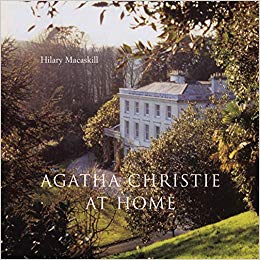
Agatha Christie at Home by Hilary Macaskill

One of the things that struck me when I was reading Agatha Christie’s An Autobiography was her love of houses. It stemmed from her childhood dolls’ house. She enjoyed buying all the things to put in it – not just furniture, but all the household implements such as brushes and dustpans, and food, cutlery and glasses. She also liked playing at moving house, using a cardboard box as a furniture van.

Writing about her life with her husband, Max Mallowan she wrote:

We were always choosing sites for houses. This was mainly owing to me, houses having always been my passion – there was indeed a moment in my life, not long before the outbreak of the second war, when I was the proud owner of eight houses. (page 440 of An Autobiography)

Agatha Christie at Home Macaskill

So when I saw that Hilary Macaskill had written this book – Agatha Christie at Home – I knew immediately that I wanted to read it. It’s a beautiful book, with many photographs – more than 100 colour photos – illustrating Agatha’s life and homes. I took my time reading it, first of all looking at the photos, before reading the text.

There is a Foreword by Mathew Prichard, her grandson, explaining the love his grandmother had for Devon, in particular for Torquay, where she was born and Greenway, the house that had a special place in her heart.  He expressed his hope that this book will ‘transmit some of the magic that my whole family felt when they were there.’  And this book does indeed do that!

There is an overview of Agatha Christie’s life followed by descriptions of the houses and countryside she loved – from Ashfield in Torquay her first home, where she was born and brought up to Greenway, a Georgian mansion above the River Dart, now owned by the National Trust.

There are no spoilers in this book but Hilary Macaskill has identified the settings Agatha Christie used in her books and how some of the place names have been altered, but are still recognizable from her descriptions. I hadn’t realised that the names of some of her characters are taken from the names of streets or villages, such as Luscombe Road in Paignton which she adopted for Colonel Luscombe in At Bertram’s Hotel.

It’s a useful book too if you want to find out more about visiting Devon with tourist information and website addresses. The final chapter is about Agatha Christie’s legacy and her continuing popularity both nationally and internationally. As well as being able to visit Greenway, which has been restored to the way it was when Agatha lived there, there are events to celebrate her life and works, such as the annual Agatha Christie week that takes place in Torquay each September around her birthday.

I haven’t been to Greenway, although I have stayed in Torquay, but that was before Greenway was open to the public. It is enormously popular – on the first day it was opened over 400 visitors came to see the house. But Agatha Christie was a very private person and I can’t imagine what she would have thought about that. After all she had refused permission for an ‘authorized life’ to be written, stating:

‘I write books to be sold and I hope people will enjoy them but I think people should be interested in books and not their authors.’ (page 129)

Knowing that I think I’d feel I was invading her privacy if I did go to Greenway!

Third Girl by Agatha Christie

Third Girl was first published in 1966. In it Poirot is probably meant to be approaching eighty, although if he had aged with the books he would have been well over a hundred! Anyway, the young lady who comes to see him about ‘a murder she might have committed‘ runs out of his room after blurting out:

You’re too old. Nobody told me you were so old. I really don’t want to be rude but – there it is. You’re too old. I’m really very sorry.’ (page 13)

Poirot is bored. He had finished his Magnum Opus, an analysis of detective fiction writers, in which he had spoken scathingly of Edgar Allen Poe, and had complained of the lack of method or order in the romantic outpourings of Wilkie Collins. He had no idea what to do next, so, his interest is aroused by the young lady’s announcement and he sets out to discover what murder she ‘might have committed.’ It turns out that Mrs Ariadne Oliver had told the girl about him when talking with friends about detectives and together they discover that she is Norma Restarick, the ‘third girl’, sharing a flat with two other girls.

Norma thinks she might be crazy, but won’t see a doctor. She doesn’t always remember what she has done. She hates her stepmother and thinks she might have poisoned her. Poirot is intrigued but when a suspicion of espionage surfaces it is all too much for him:

Poirot gave an exasperated sigh.

‘Enfin,’ he said, ‘it is too much! There is far too much. Now we have espionage and counter espionage. All I am seeking is one perfectly simple murder. I begin to suspect that that murder only occurred in a drug addict’s brain! (page 211)

But as Poirot reminds himself it is his ‘metier’ to deal with murder, to clear up murder, to prevent murder and eventually with a casual phrase spoken by Mrs Oliver it all becomes clear to him.

The plot is complex, which is rather puzzling,  but for me Third Girl is also interesting because of its commentary on the 1960s culture seen through the eyes of the older characters – the disparaging remarks about the youth of the day – beatniks, long hair, clothes that were of doubtful cleanliness, and skimpy skirts, and the Van Dyke type clothes some of the young men wore, the drink and drugs and wild parties. Mrs Oliver has her usual gripe about people saying things to her about her books and how they longed to meet her, making her feel ‘hot, bothered and rather silly‘ and how much they love the ‘awful detective Sven Hjerson‘ she had created and now hates.

Maybe it’s not one of Agatha Christie’s best books but I think it’s very entertaining.

Agatha Christie: An English Mystery by Laura Thompson

It took me weeks to read Laura Thompson’s book Agatha Christie: An English Mystery. It has taken me several days to write and re-write this post because I’ve found it difficult to put down my thoughts about it without going into too much detail (and this is still a long post). My overall impression of the book is that I felt as though I was intruding into Agatha Christie’s private life that she had not wanted to be made known. I also think that Laura Thompson had found it difficult to separate the woman from her writing, because throughout the book facts are interspersed with suppositions drawn from Agatha Christie’s novels and in particular from Unfinished Portrait, a novel Agatha wrote under the pseudonym, Mary Westmacott.

Agatha Christie: An English Mystery is described as a ‘perceptive and stylish biography‘ on the jacket sleeve, but it is not just a biography; it is also a study of Agatha Christie’s novels, drawing conclusions from her writing about her thoughts, feelings and emotions and a fictionalised version of Agatha’s disappearance in 1926. Laura Thompson’s sources are unpublished letters, papers and notebooks.

First of all, concerning the study of the novels I was dismayed as I was reading this book at the amount of information she reveals about the crime fiction novels, including giving away who the murderers are in a number of cases. Charles Osborne’s book The Life and Crimes of Agatha Christie is much better, outlining the books, not just her crime novels but also her non-fiction, stories for children, poetry and plays in chronological order and nowhere does he reveal the identity of any of the murderers.

Then the fictionalised version of Agatha’s disappearance is in a chapter called ‘The Quarry‘, which begins ‘Time for a new story‘, words which did not immediately alert me that Laura Thompson was no longer writing strictly from the sources at her disposal but also from her imagination, putting words into Agatha Christie’s mouth that she could not have known, and describing her reactions to the people she met and the newspaper reports of her disappearance. Later in this chapter she wrote:

All biography is story-telling. No life is a code to be deciphered: there will always be gaps and inconsistencies, and it is stories that make the missing connections. Omniscience is for Hercule Poirot. Real life knows less; it has the beauty of mystery; and this, despite the books she wrote, was something that Agatha understood very well. She must have known she had created a puzzle of a different order, with all the geometric complexity of ‘Roger Ackroyd’ – and how to work it out? Turn it this way? That way? – and yet the twist in the tale: it was true, and therefore it could never be solved. It was perfect in fact. The perfect metaphor for human mystery. What could be more impenetrable than the woman who moved through Harrogate like a smiling ghost, reading newspaper reports about her own vanished self? (page 219)

I just wish she had not gone so far down the story-telling line in this book and had left this episode of Agatha Christie’s life as an impenetrable mystery, or at least had made it clear straight away when she was writing imaginatively. I have absolutely no objections to fictionalised versions of a life (for example I really liked Justine Picardie’s book Daphne: a novel, which merges fact and fiction) but I do think it should be obvious that it is fictionalised. Nor do I object to different interpretations of

Laura Thompson quotes from Unfinished Portrait, using this as evidence of Agatha’s thoughts, beliefs, and emotions. In Osborne’s book he also states that Unfinished Portrait, which was published in 1934, is based on events in Agatha’s life:

The story of Celia is remarkably similar to the story of Agatha as readers were eventually to be offered it in ‘An Autobiography’ more than forty years later. Several incidents are common to ‘An Autobiography’  and ‘Unfinished Portrait’, and the novel is quite clearly a fictionalised, more detailed, and emotionally more forthcoming version of the first third of the biography. The portraits of Celia’s mother and her grandmother are really of young Agatha Miller’s mother and the grandmother with who she stayed in Ealing. The men in Celia’s life are the men in Agatha’s life, and Dermot, whom Celia marries, is Archie Christie. (page 105)

but he also quotes from Max Mallowan’s writings about the book, pointing out it is a blend of fact and fiction:

The book is not one of her best because, exceptionally, it is a blend of real people and events with imagination. Only the initiated can know how much actual history is contained therein, but in Celia we have more nearly than anywhere else a portrait of Agatha. (page 106 of ‘The Life and Crimes of Agatha Christie’)

It is evident that Agatha Christie wrote about things she knew – the use of poisons from her work in a pharmacy during the First World War and her journey on the Orient Express are just two examples. Laura Thompson later in the book acknowledges that it is impossible to know what Agatha really thought – this is in the chapter called ‘The Second Husband‘, (page 298) writing about Agatha’s reaction to the Woolleys’ interference with her honeymoon with Max Mallowan. And she acknowledges that it would not have occurred to Agatha Christie that conclusions about her character would be drawn from her remarks in the novels about Jews, ‘blacks’ and servants, so I think it is difficult to decide what inferences can be drawn about Agatha from her fiction!

The last sections of Thompson’s book deal in detail with Agatha Christie’s tax problems and there is a rather ‘gossipy’ section about whether or not Max was having affairs. Overall, I think that the book as a biography is unbalanced, concentrating on the events surrounding Agatha’s disappearance and there is much speculation and supposition. I prefer Agatha’s own version of her life: An Autobiography, in which she merely referred to the events of 1926 thus:

The next year of my life is one I hate recalling. As so often in life, when one thing goes wrong, everything goes wrong. (page 356)

Finally, if biography is ‘story-telling’, about making connections to fill in the missing gaps with stories, then I’m not sure I want to read it and there have been several times when reading this book that I’ve thought about abandoning it. I’m uncomfortable with the feelings it can provoke – disliking gossip, distrusting witnesses who may have a private agenda, and squeamishness about reading private correspondence. I felt all of this whilst reading this book.

I went back to a book I read a few years ago – Hermione Lee’s book Body Parts: Essays on Life-Writing.This is about writing biography and the relationship of biography to fiction and history. Lee writes that biographies must give a ‘quasi-fictional, story-like shape to their material (or no none will read them)’, but against this there is the ‘responsibility for likeness and the need for accuracy’.Gaps and silences give rise to interpretations ‘through a process of conjecture, invention, intuition and manipulation of the evidence.’  Biography may seem as if it is factual because it is constructed from sources such as letters, diaries and other people’s accounts, etc but it is inevitably an interpretation and quasi-fictional. I have to remember that – it’s a reading between the lines! And as Lee says:

Whether we think of biography as more like history or more like fiction, what we want is a vivid sense of the person.

What makes biography so curious and endlessly absorbing is that through all the documents and letters, the context and the witnesses, the conflicting opinions and the evidence of work, we keep catching sight of a real body, a physical life: the young Dickens coming quickly out of a room, sprightly, long-haired, bright-eyed, dandyish, in crimson velvet waistcoat or tartan trousers …

As I read Laura Thompson’s book I did catch glimpses of Agatha Christie, but they were rather swamped by inferences drawn from her books, by the fictionalised version of her disappearance and by the descriptions of her tax problems towards the end of her life. I felt closer to the real Agatha Christie whilst reading her Autobiography. As well as being a record of her life as she remembered it and wanted to relate it, it’s also full of her thoughts on life and writing and in particular about her love of life and the joy of being alive.

But I will carry on reading biographies!

Greenshaw's Folly: a Miss Marple Mystery

Agatha Christie’s Marple last night was Greenshaw’s Folly. I saw in the Radio Times that it was based on Christie’s short story of the same name and so I read it before watching the programme. It’s less than 20 pages and I wondered how the script writers were going to make it last 2 hours, even with the advert breaks. Well, of course, they padded out with other plot elements and characters. And there are more murders, and some farcical scenes with policemen running wild – all a bit of a mess really, but lightly done.

Greenshaw’s Folly is a house, visited by Raymond West (Miss Marple’s nephew), who does not appear in the TV version and Horace Bindler, a literary critic (an undercover reporter in the TV version). It’s an unbelievable architectural monstrosity, built by a Mr Greenshaw. Raymond explained:

‘He had visited the chateaux of the Loire, don’t you think? Those turrets. And then, rather unfortunately, he seems to have travelled in the Orient. The influence of the Taj Mahal is unmistakeable. I rather like the Moorish wing,’ he added, ‘and the traces of a Venetian palace.’ (extract from the short story)

The short story is compact, whereas the TV version is packed with poisonings, ghosts, locked rooms, concealed identities, and so on. But apart from that, I’m not going to try to compare the TV show to the short story as there are so many differences that they are really two separate entities. And both are enjoyable in their own way. Julia Mackenzie is nearly right as Miss Marple, not as good as Joan Hickson, but then who could be. I just wish the sweet smile was toned down a little. The rest of the cast included Fiona Shaw, Julia Sawalha, Joanna David, Judy Parfitt, Robert Glenister and Jim Moir (aka Vic Reeves). All were very good, especially Bobby Smalldridge as Archie Oxley (Mrs Oxley’s young son who does not appear in the short story).

Greenshaw’s Folly was first published in the Daily Mail 3 – 7 December 1956 and is included in Miss Marple and Mystery The Complete Short Stories.

I see that one of the plot elements involving the use of atropine and its antidote has been taken from one of the other stories in this collection, The Thumb Mark of St Peter, first published in 1928. I think the script writers must have had great fun with these stories.