Book Beginnings: Before the Fact

I went to Barter Books yesterday and came home with several crime fiction books, plus a book on painting with pastels and a book on Northumberland’s coastal castles.

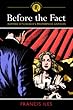
The book I’m writing about today is one of the crime fiction books, that I was quite excited to find, because I’ve never read anything by Francis Iles, the pseudonym of Anthony Berkeley Cox (1893-1970), a journalist and mystery writer from the Golden Age of crime fiction.

The book is his second novel written as Francis Iles, Before the Fact and it is a psychological study of a potential murderer as seen through the eyes of his intended victim. It begins:

Some women give birth to murderers, some go to bed with them, and some marry them. Lina Aygarth had lived with her husband for nearly eight years before she realized that she was married to a murderer.

I’m eager to read on …

For more Book Beginnings on Friday see Gilion’s blog Rose City Reader.

Wondrous Words Wednesday

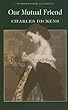
I’m currently reading Our Mutual Friend by Charles Dickens. It’s taking me quite a while as it’s a long book of just over 800 pages and there are many characters and sub-plots. There are also many new-to-me words!

I’m reading it in bed on Kindle, a free edition without any notes, but, of course Kindle has its own built in dictionary, which I’m constantly using. During the day I’m reading the Wordsworth Classic edition, which does have notes, and illustrations and an introduction, all of which help with understanding the literary references as well as words that are no longer in current use.

For today I’m just going to pick out one word: hippedEugene Wrayburn has been telling Mortimer Lightwood, his friend and fellow lawyer about how he enjoys goading the schoolmaster, Bradley Headstone, by walking all over London knowing that he is being followed by Headstone. He describes this as enjoying the ‘pleasures of the chase’. Lightwood says he doesn’t like it. Eugene then says:

‘You are a little hipped, dear fellow’, said Eugene; ‘you have been too sedentary. Come and enjoy the pleasures of the chase.’

I wasn’t at all sure I knew what that meant – was Lightwood getting a bit broad in the hips, sitting down too much, a bit too fat, maybe and needing the exercise?

One of the Kindle dictionary defines it as ‘having hips of a specified kind: a thin-hipped girl, so maybe that’s what Dickens meant – Lightwood has fat hips! Another definition given on Kindle is ‘obsessed or infatuated with‘, which seems to fit better.

The Wordsworth Classics edition has a more appropriate definition, I think. Hipped meaning ‘depressed‘. Lightwood needs more exercise to lift his mood.

Then I wondered how my Chambers Dictionary defined hipped. It has several to choose from, including the more modern use of ‘hip‘, meaning ‘following the latest trends in music, fashion, political ideas, etc’, ‘ the fruit of the dog-rose or other rose‘, and so on. But the one that fits is:

hipped: melancholy; peevish, offended, annoyed; obsessed.

No wonder, it’s taking me longer than usual to read this book, when just one little word takes up so much thought. :)

Wondrous Words Wednesday is a weekly meme created by Kathy at BermudaOnion, where you can share new words that you’ve encountered or spotlight words you love.
Crime Fiction Alphabet: N is for …

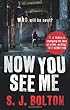
 … Now You See Me by S J Bolton

I’ve enjoyed S J Bolton’s earlier books, but I hesitated several times before deciding to read Now You See Me, because it begins with such a brutal killing. I’d read the opening pages on Amazon using the ‘Click to Look Inside‘ feature and didn’t like it. I usually steer clear of books with such graphic descriptions of murder, but I knew that I liked S J Bolton’s writing and that others had given it good reviews, so eventually I read further on.

I’m glad I did because, despite the brutal murders, it is compelling reading, with a complex plot and convincing characters.

Summary from S J Bolton’s website:

Despite her life-long fascination with Jack the Ripper, young detective constable Lacey Flint has never worked a murder case or seen a corpse up close. Until now ‘¦

As she arrives at her car one evening, Lacey is horrified to find a woman slumped over the door. She has been brutally stabbed, and dies in Lacey’s arms.

Thrown headlong into her first murder hunt, Lacey will stop at nothing to find this savage killer. But her big case will also be the start of a very personal nightmare.

When Lacey receives a familiar letter, written in blood, pre-fixed Dear Boss, and hand delivered, it is clear that a Ripper copycat is at large. And one who is fixated on Lacey herself. Can this inexperienced detective outwit a killer whose infamous role model has never been found?

I don’t have a fascination with Jack the Ripper and began to be a bit  weary about the copycat nature of the killings, but then the scenario changed and it became clear that there was more to the killings than just copying the Ripper. It’s narrated by Lacey, a strong character, one who thinks for herself, is a loner, and is not content to merely follow police procedure. But I didn’t warm to her until near the end of the book. She knows more than she is letting on to her fellow police officers and I was very suspicious of her motives and conscious that she was not a reliable narrator.

S J Bolton is very skilled in leading the reader up the garden path, providing plenty of hints that could be significant or be dead ends. This book (like her others) is fast-paced, full of suspense and tension, with a chilling and dramatic ending.

  • Paperback: 512 pages
  • Publisher: Corgi (26 April 2012)
  • Language: English
  • ISBN-10: 0552159816
  • ISBN-13: 978-0552159814
  • Source: My own copy
  • My Rating: 3.5/5

For more Crime Fiction Alphabet posts see Kerrie’s blog Mysteries in Paradise. The posts must be related to either the first letter of a book’s title, the first letter of an author’s first name, or the first letter of the author’s surname, or even maybe a crime fiction “topic”. But above all, it has to be crime fiction.

Saturday Snapshot: Marlow

D took this photo of Marlow Bridge in Buckinghamshire several years ago. Marlow Bridge crosses the River Thames between Marlow and Bisham in Berkshire. There has been a bridge here since the 14th century, but this suspension bridge was erected in 1829 -1832.

We used to live in Buckinghamshire and often visited Marlow. I took the photo shown below when the grandchildren were younger, playing in Higginson Park.

Marlow is also the home of Sir Steve Redgrave, the Olympic Rowing Champion who won gold medals at five consecutive Olympic Games from 1984 to 2000. His statue stands in Higginson Park – in the background of my photo. For a better photo of his statue see Wikipedia – I was taking a photo of the grandchildren, not Sir Steve’s statue. :)

For more Saturday Snapshots see Alyce’s blog At Home With Books.

From the Archives

Simon at Stuck in a Book has a series of posts in which he revisits his old reviews. I think it’s a good idea and thought I’d do something similar, because one of my reasons for writing this blog is to help me remember what I’ve read.

Like Simon I’ve been writing a blog since 2007 so I’m kicking off by looking back into my archives at Historical Fiction books – one from each year, with links to my posts, a short summary and a quotation from my review:

1) Here Lies Arthur by Philip Reeve – an adventure story, set in Britain in AD 500, telling the story of King Arthur.

From my review: ‘The picture Reeve paints is of a turbulent and harsh world, with Arthur as a war-leader in a land where opposing war-bands fight for supremacy.’

2) Winter in Madrid by C J Sansom – set in Spain during the Spanish Civil War and the first two years of the Second World War.

From my review: ‘an action packed thrilling war/spy story and also a moving love story and historical drama all rolled into this tense and gripping novel.’

3) The Company of Liars by Karen Maitland – Set in England in 1348 it tells the tale of a group of people fleeing across the country as the plague moves inland from the ports.

From my review: ‘As you would expect from the title the members of the group, a conjuror, a one-armed storyteller, a musician and his apprentice, a young couple on the run, a mid-wife and a strange child who can read the runes are all liars, with secrets that gradually exposed as they journey on. ‘

4) Wolf Hall by Hilary Mantel – the story of Thomas Cromwell, the son of a blacksmith, and his political rise, set against the background of Henry VIII’s England.

From my post: ‘What I found most enjoyable was the way this book transported me back to that time, with Mantel’s descriptions of the pageantry, the people, the places and the beliefs and attitudes of the protagonists.’

5) Fair Exchange by Michèle Roberts – set in England and France in the late 1700s/early 1800s during the French Revolutionary period.

From my post: ‘there is a fair bit in this book about women’s rights and their place in society, and about the question of nurture versus nature in bringing up children.’

Over to you now – which great historical fiction books have you enjoyed?