Guilty Consciences: a Crime Writers’ Association Anthology

I’ve taken my time reading this collection of short stories Guilty Consciences: a Crime Writers’ Association Anthology, edited by Martin Edwards, who has also contributed one of the stories. I read them one or two at a time, which for me is the best way.

The contributors are Robert Barnard, Ann Cleeves, Bernie Crosthwaite, Judith Cutler, Carol Anne Davis, Martin Edwards, Jane Finnis, Peter James, Alanna Knight, Susan Moody, Sarah Rayne, Claire Seeber, L.C.Tyler, Dan Waddell and Yvonne Walus, and there is an introduction from the current Chair of the CWA, Peter James.

I haven’t been too keen on short stories in the past but I enjoyed this collection and think it’s one of the best I’ve read. As Peter James writes in his introduction:

I believe the short story is long overdue for a renaissance, and the ideal literary form for our increasingly busy, time-poor modern lives. What better for a quick read between tube station stops, or using your e-reader to turn a tedious airport security queue into fifteen minutes of surprises and delight?

Or as I found the ideal length to read at breakfast.

As the title suggests the stories all reveal various aspects of a guilty conscience. I find it hard to write about short stories without giving away the plot, so here are just a few notes on some. There are many I could pick out but these particularly stand out in my memory, now that I’ve read the book:

  • Hector’s Other Woman by Ann Cleeves – an intriguing insight into Vera Stanhope’s past and her motivation for joining the police, as Vera recollects her visit to Holy Island with her father whilst she was in the middle of her A-level year.
  • Squeaky by Martin Edwards – about a couple who both have something to hide and how their marriage began to fall apart when Squeaky came into their lives.
  • Deck the Hall with Poison Ivy by Susan Moody – a cautionary story about Christmas and a family’s arrangements.
  • The Train by Dan Waddell – as a husband anxiously waits for the return of his estranged wife he remembers their lives together and vows it will be different this time.

All the contributions were written specially for this collection with the exception of The Visitor by H R F Keating, who died in 2011, a story that had previously been included in a Penguin India collection, featuring Inspector Ghote. Ghote’s visitor is consumed with guilt about something that he had done in the past – but had he?

An excellent collection.
Crime Fiction Alphabet: M is for …

… M R Hall

Biography summarised from M R Hall’s website:

Matthew Hall was born in London in 1967, he was educated at Hereford Cathedral School and Worcester College, Oxford,where he graduated in law. He lives and works in the Wye valley in South Wales. He spends much of his spare time looking after his sixteen acres of woodland and working for the conservation of the countryside.

After working as a barrister, mostly in the field of criminal law he then went on to become a screen writer and producer, including writing episodes of such dramas as  Kavanagh QC starring John Thaw and Dalziel and Pascoe. His first season of writing the Channel 5 series, Wing And A Prayer earned him a BAFTA nomination in the best series category.

Novels:

I’ve read his debut novel, The Coroner, which was published in 2009 and was nominated for the Crime Writer’s Association Gold Dagger in the best novel category. In this book Jenny Cooper, a newly appointed Coroner, divorced, and recovering from a nervous breakdown gets involved in investigating the deaths of several teenagers at local detention centres. Has her predecessor neglected some crucial information in this area? As Jenny digs deeper, she encounters a solid wall of bureaucratic resistance. But Jenny just won’t give in until she gets to the truth.

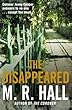
The second novel in the Jenny Cooper series, The Disappeared, was published in the USA by Simon and Schuster on December 1st 2009 and in the UK by Pan Macmillan in January 2010. I’ve yet to read this book in which Jenny investigates the disappearance of a British student, Nazim Jamal. She is beginning to settle into her role as Coroner for the Severn Valley. But as the inquest gets under way, a code of silence is imposed on the inquest and events begin to spiral out of all control, pushing Jenny to breaking point.

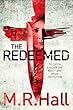
I thoroughly enjoyed the third novel in the same series, The Redeemed, which was published in April 2011 in the UK and May 2011 in the USA. With an accusation of murder hanging over Jenny’s head her lone quest for justice takes her to the heart of the fight between good and evil, sex and the supernatural, and on a dark inner journey to confront ghosts that have haunted her for a lifetime.

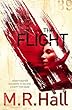
The fourth in the series, The Flight was published in the UK on 2 February 2012. I’ve recently read this one and have to say that I don’t think it’s as good as the other two I’ve read.

Flight 189 has plunged into the Severn Estuary, an area outside Jenny Cooper’s jurisdiction, but she is handling the cases of a sailor, washed up on her side of the river and that of a 10 year old girl, who was a passenger on the flight. Jenny is never one to back away from handling sensitive issues and when the authorities want her cases to be dealt with by Sir James Kendall, a recently retired High Court judge,the coroner for the inquest into the crash, she resists and insists she carries out her own investigations. Each time they try to halt her inquest she finds ways of carrying on.

My problem with this book wasn’t Jenny’s role.  I like the way Jenny perseveres, her sympathies for the bereaved parents, her own fragile psychological make-up and how she deals with her problems with her father. These elements are in the other books too, but in The Flight I thought they were overwhelmed by all the technical details of the aircraft and how it came to crash. I prefer the smaller scale inquests, rather than this ‘disaster film’ genre – but, I think, it would make a good disaster film.

If you’re nervous about flying, (which I’m not, although I did feel glad I’m not booked on a flight soon as I was reading it) it is definitely a scary book, even though M R Hall in his Author’s Note at the end of the book says this about the safety of flying:

Next time you fly – or perhaps you are in a plane right now? – remember that a short drive through town remains statistically far more dangerous than your flight by a factor of many thousands to one. The most perilous parts of your journey are the ones to and from the airport. I am reliably informed that you are precisely eighty-seven times more likely to choke on the ice cube in your gin and tonic than to perish in a crash. So sit back and enjoy the movie – the numbers say it’ll never happen to you.

Mmm – do I really find that comforting?

A Crime Fiction Alphabet post for the letter M. For more posts see Kerrie’s blog Mysteries in Paradise.

Saturday Snapshot: Views of the Holy Island of Lindisfarne

Lindisfarne is one of my favourite places, cut off from the mainland of Britain twice a day by the tides and accessed over a causeway. We went there last Tuesday and here are a few photos I took then together with one I took on an earlier visit.

Lindisfarne Priory was founded in 635 by Aidan, an Irish monk who came to the island from the monastery on Iona, founded by St Columba. It was the home of the Lindisfarne Gospels.

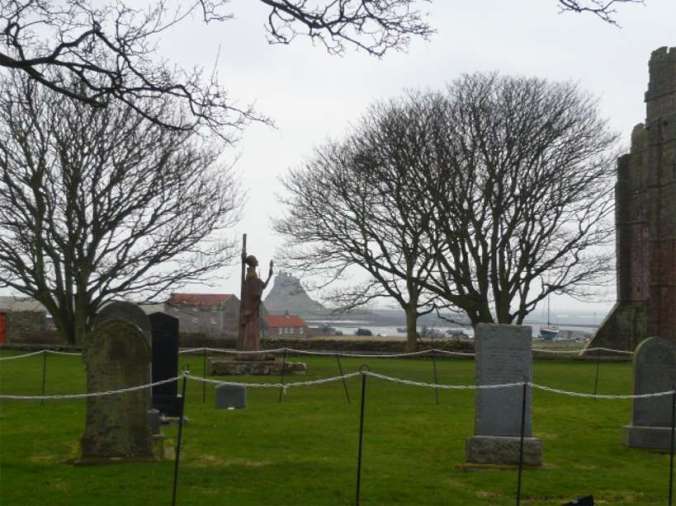
I took the photo below in February 2011, on a cold winter’s day. It shows the statue of St Aidan in the Priory grounds with Lindisfarne Castle, across the bay, in the background.

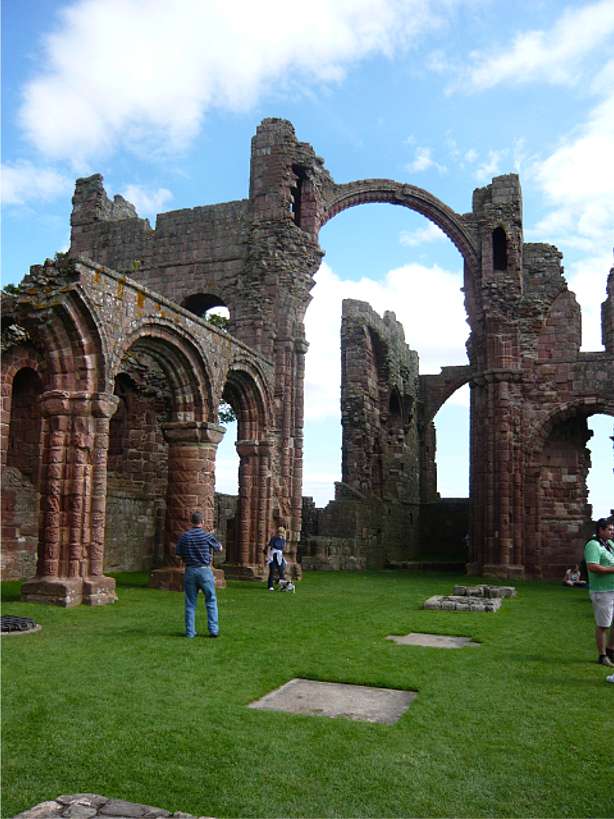
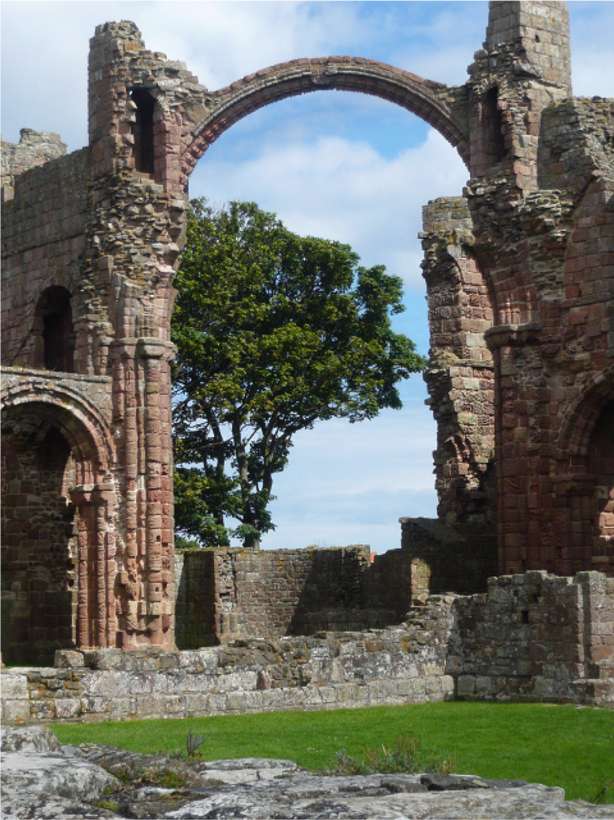
The monastery was originally wooden buildings  and the remains that we see today are those of the 12th century priory, probably standing on the site of the 7th century monastery. The Priory’s former grandeur is still there to see:Lindisfarne was also the home of Cuthbert, who became the prior in 685. Eleven years after his burial it became a shrine when his body was exhumed and was found to be undecayed. One hundred years later when the monks fled from the island during Viking raids they took his relics with them, eventually re-establishing his shrine in Durham Cathedral in 995.

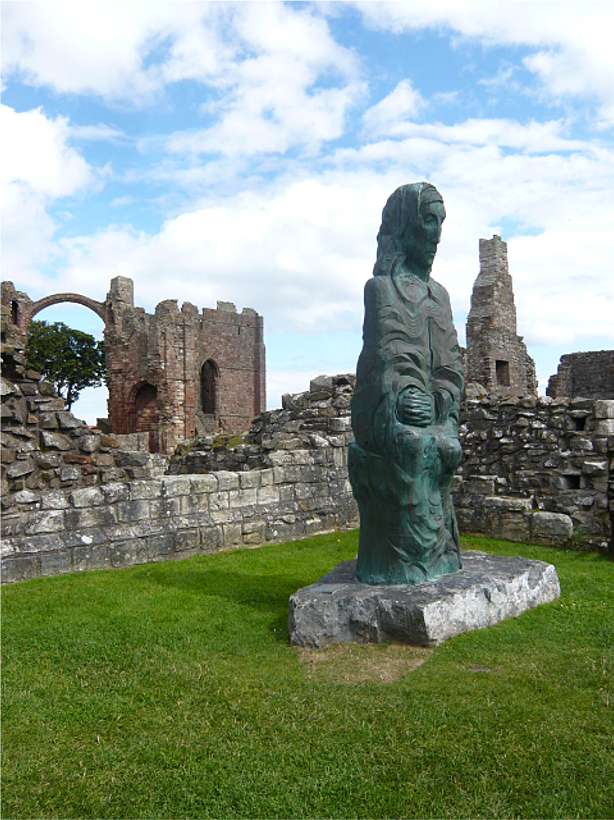
This sculpture of St Cuthbert is cast in bronze, originally carved from an elm tree. It shows a contemplative Cuthbert:

Last Tuesday was one of the hottest days of the year. We had intended to visit the castle as well, but as so many other people had the same idea we just went for a walk round the foot of the castle, then along the coast and back inland.

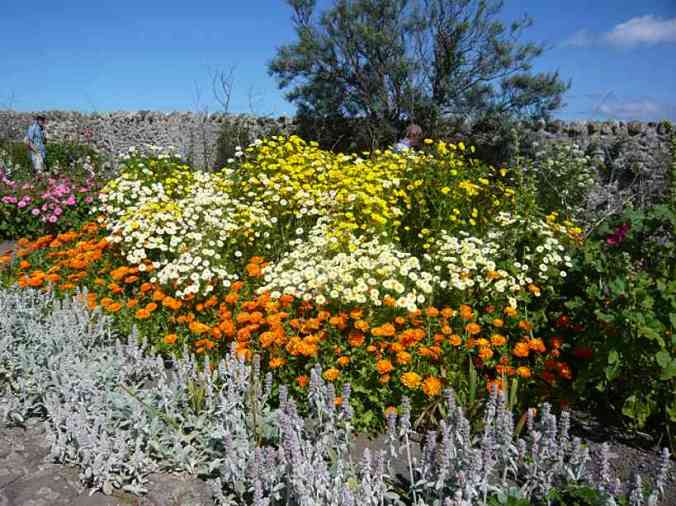
We stopped for a look at the walled garden designed by Gertrude Jekyll in 1911.

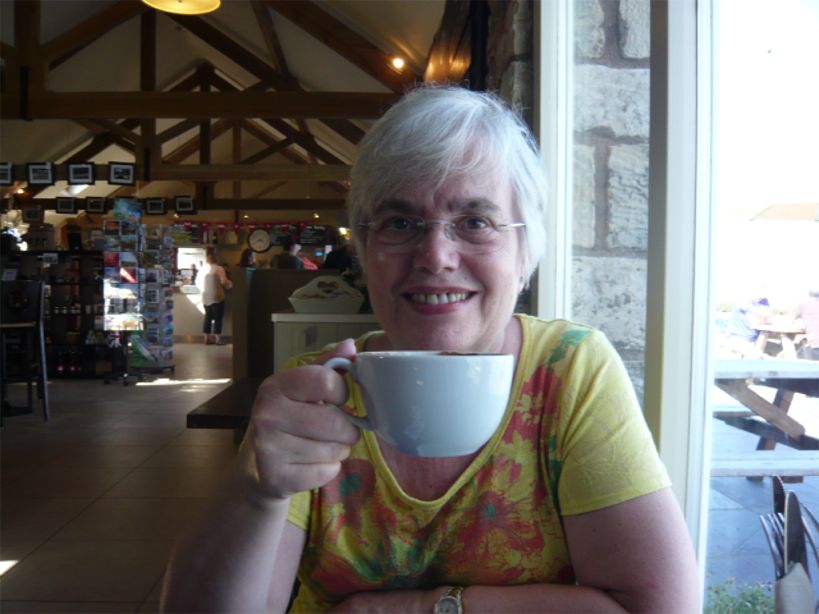
And then carried on to the coast line: On the way home we stopped at The Barn at Beal, on the mainland, just over the causeway, for a cup of coffee.

A Saturday Snapshot post – see more on Alyce’s blog At Home with Books.

A Mercy by Toni Morrison

Toni Morrison is the author of ten novels, from The Bluest Eye(1970) to A Mercy (2008). She has received the National Book Critics Circle Award and the Pulitzer Prize. In 1993 she was awarded the Nobel Prize in Literature. She lives in New York.

I recently read A Mercy. I found it a difficult book, both to understand and to appreciate. In fact once I’d read it I went back to the beginning and read it again, almost straight away and then found myself turning back to the first page again.The narration moves between the characters and at times I wasn’t sure whose voice I was reading and had to backtrack several times. Even on the second reading, I was not sure, even though the characters have different ways of talking.

From the back cover:

On the day that Jacob, an Anglo-Dutch trader and adventurer, agrees to accept a slave in lieu of payment of a debt from a plantation owner, little Florens’ life changes. With her intelligence and passion for wearing the cast-off shoes of her mistress Florens has never blended into the background and now at the age of eight she is taken from her family to begin a new life. She ends up part of Jacob’s household, along with his wife Rebekka, Lina their Native American servant and the strange and melancholy Sorrow who was rescued from a shipwreck. Together these women face the trials of their harsh environment as Jacob attempts to carve out a place for himself in the brutal landscape of the north of America in the seventeenth century.

It’s definitely character-based, and the plot is hard to follow (at least I thought so), although on the second reading it was much clearer. It begins with a confession:

Don’t be afraid. My telling can’t hurt you in spite of what I have done and I promise to lie quietly in the dark – weeping perhaps or occasionally seeing the blood once more – but I will never unfold my limbs to rise up and bare teeth.

and it was only at the end that I could understand the beginning.The writing is lovely, the mood is melancholy and touching.The setting is America in the 1680s – 1690. It’s a land still largely unknown territory that regularly changed hands, a land where you couldn’t be sure who was friend or foe. The themes of this novel are slavery, racism and religion, with a mighty emphasis on motherhood and the position of women in that time and place.

A Mercy is not my favourite Toni Morrison book and I wouldn’t recommend it to anyone who hasn’t read any of her other books, but it is thought provoking and moving. I prefer Song of Solomon and Beloved.

  • Source: my own copy
  • Rating: 3/5

Birthday Treats

Yesterday was my birthday. I had some lovely presents, including two books:

Inspector Alan Grant of Scotland Yard, recuperating from a broken leg, becomes fascinated with a contemporary portrait of Richard III that bears no resemblance to the Wicked Uncle of history. Could such a sensitive, noble face actually belong to one of the world’s most heinous villains – a venomous hunchback who may have killed his brother’s children to make his crown secure? Or could Richard have been the victim, turned into a monster by the usurpers of England’s throne?

Grant determines to find out once and for all, with the help of the British Museum and an American scholar, what kind of man Richard Plantagenet really was and who killed the Princes in the Tower.

A fascinating blend of history and mystery.

  • A Room Full of Bones by Elly Griffiths. I posted the opening lines in yesterday’s post. This book is the fourth of the Ruth Galloway investigations. The description on the back cover is –

Night falls on Halloween eve. The museum in King’s Lynn is preparing for an unusual event – the opening of a coffin excavated from the site of a medieval church. But when archaeologist Dr Ruth Galloway arrives to supervise, she finds the museum’s curator lying dead beside it. Ruth and Detective Inspector Nelson are forced to cross paths once again when he’s called in to investigate the murder, and their past tensions are reignited. And as Ruth becomes further embroiled in the case, she must decide where her loyalties lie – a choice that her very survival depends on.

It was the perfect summer’s day and we went over to the Holy Island of Lindisfarne, one of my favourite places. We’ve been there a few times, but never in such good weather. We went round the Priory, walked up to the castle and then along the coast and back inland again. Here’s one of the Priory – I’ll put up some more photos of the day later in the week. Whilst on the island D bought me this book:

Lindisfarne: the Cradle Island by Magnus Magnusson – a history of the island from the beginnings to the present day, telling the story of people and nature. Known as ‘the cradle island’ it is the ancient shrine of Celtic Christianity and the home of the Lindisfarne Gospels.

ABC Wednesday: D is for Degas

Edgar Degas (1834 – 1917) was a French artist and is perhaps most well known for his paintings of dancers; ballerinas were his favourite subject:

This is The Dance Class, oil on canvas, 1874 (the Metropolitan Museum of Modern Art). Here the dancers are in various poses at the end of a rehearsal. You can see the exhaustion on their faces and in their figures – see the girl at the front scratching her back, the girls at the back sunk to the floor, and the girl on the right, her arms folded, shoulders rounded and her head drooping down. I love the contrast between them and the rigid figure of the ballet master.Their flimsy tutus stand out so well against the hard diagonal floorboards.

I also like painting L’Absinthe, also called The Absinthe Drinker, A Sketch of a French Café,  or Figures at Café. It’s oil on canvas, 1876 (Musée D’Orsay). It’s a melancholy painting of a forlorn couple in the Café de la Nouvelle-Athènes in Paris.

They are drowning their sorrows. She is drinking absinthe, ‘the Green Fairy’, a lethal drink that was later banned. She is seen staring into space, sad, and desolate, lost in her own world. He is also in his own world, detached, his head turned away from her, as though they aren’t together. Degas’s models for the painting were Ellen Andre, an actress and Marcellin Desboutin, an engraver and artist. They were both annoyed by the painting, which depicted them as alcoholics and Degas had to state publicly that they were not.

I like it just because it tells a tale. It is so expressive and the detail is so fine, the slump of her shoulders, her air of exhaustion and his desire not to be there come over to me so powerfully. It gives the impression that Degas painted this from real life, but actually he painted it in his studio, with the pair carefully posed.

An ABC Wednesday post.