First Chapter, First Paragraphs: The Unquiet Bones

Uetred thought he had discovered pig bones. He did not know or care why they were in the cesspit at the base of Bampton Castle Wall.

Then he found the skull. Uetred was a villein, bound to the land of Lord Gilbert, third Baron Talbot, lord of Bampton Castle and had slaughtered many pigs. He knew the difference between human and pig skulls.

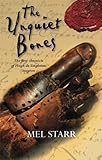
I was browsing in the library, when the medieval style script on the spine of this book caught my eye. Taking it from the shelf I was also struck by the dramatic cover, showing a strange wooden or leather artificial foot. When I read the opening paragraphs and flicked through the pages I decided to borrow the book. It seems it’s a good choice because the library assistant said she had enjoyed it as she likes historical crime fiction – so do I. And there are more books in the series.

It’s The Unquiet Bones: the first chronicle of Hugh de Singleton, surgeon by Melvin R Starr.

I was interested in the foot – is it a genuine medieval prosthetic? I discovered that it is actually an Ancient Egyptian prosthetic toe found on a female mummy at Luxor. The big toe is carved from wood and has holes for lacing it to a leather-type casing.

Now, as far as I know, this is nothing to do with The Unquiet Bones, which is set in the English village of Bampton, but I think it’s fascinating. It certainly drew my attention to the book.

First Chapter, First Paragraphs is a weekly event hosted by Diane at Bibliophile By the Sea.

Books for Cat Lovers

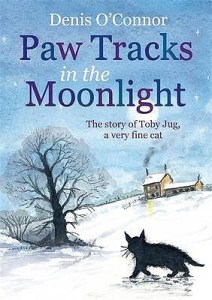
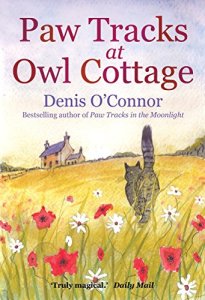
I loved both these books by Denis O’Connor:

Paw Tracks in the Moonlight and Paw Tracks at Owl Cottage.

Denis O’Connor trained as a psychologist and teacher. Throughout his career he taught in schools and lectured in colleges and universities. He holds a doctorate in education and psychology and is now retired, living with his wife Catherine and his two Maine Coon cats in a remote country cottage in Northumberland.

Paw Tracks in the Moonlight tells the story of how he rescued a kitten during a snowstorm and how kitten survived, despite the vet’s prediction that he wouldn’t. O’Connor lived at Owl Cottage and as he was out at work all day he put the kitten in a jug to keep him safe and named him Toby Jug. This memoir covers the first year of Toby Jug’s life and it’s a remarkable story because this is no ordinary cat (if such a creature exists, that is). He is a Maine Coon cross. He learns to walk on a lead and even goes on a camping trip on horseback during the summer in the Cheviot Hills with O’Connor.

Paw Tracks at Owl Cottage chronicles O’Connor’s experiences with four more cats, all Maine Coons. He had moved from Owl Cottage, unable to face living there after Toby Jug died in 1978, but years later, when he took early retirement, Owl Cottage came up for sale – and he and his wife bought it. it’s a wonderful place for cats and they acquired four – Pablo, Carlos, Luis and Max. The book is divided into sections describing each cat and there are also reminisces of Toby Jug, with more stories of their lives together.

Both contain beautiful descriptions of the Northumberland countryside, most of which I’m familiar with, which made the books even more special for me. Inevitably the death of Toby Jug filled me with sadness, but both books are full of the cats’ personalities and the joy they brought to O’Connor and his wife. They demonstrate the close bonds that are possible between people and cats:

I tell them [his friends who are astonished at the close bonds]  I believe that any animal, be it a horse, dog, cat, parrot or budgerigar, will always respond to kindly attention and caring affection, and that I know this because I’ve made good friendships with them all.

But to return to how I am with our cats, I can honestly state that quite apart from loving them deeply and being loved in return, I know them inside their minds and they know me; we are linked on a mental plane of mutual affection and understanding. (page 222 of Paw Tracks at Owl Cottage)

Definitely books for cat lovers!

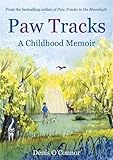
Denis O’Connor has written a third book (which I haven’t read) – Paw Tracks: a Childhood Memoir, described on Amazon as ‘a searingly honest account of how the power of nature can lift the human spirit and overcome the most unloving of childhoods.’

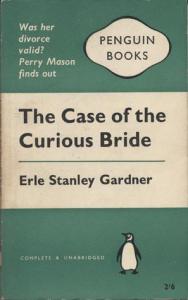
The Case of the Curious Bride by Erle Stanley Gardner

First published in 1935 The Case of the Curious Bride is the 5th Perry Mason book by Erle Stanley Gardner.

Synopsis extracted from the back cover:

An attractive young woman calls at Perry Mason’s office to inquire if a friend can marry again without getting a divorce as her husband had been presumed killed in an air accident seven years previously. Mason sees sinister implications and as a result of his investigations – helped by his secretary Della Street – dramatic developments lead to a court case in which the tables are turned on the police.

My view:

There are plenty of twists and turns in this mystery surrounding Rhoda Montaine, who is accused of murder and it certainly looks as though she is guilty.  I found it very puzzling. I also thought it was unsatisfactory as Perry Mason resorts to trickery, fooling everyone. At times I was at a complete loss to understand what he was doing and why. It all becomes clear at the end, but I found it far-fetched.

  • Paperback: 208 pages
  • Penguin Books 1960 (first published by Cassell 1935)
  • Source: I bought the book
  • My Rating 2/5
  • Challenges: Mount TBR, What’s in a Name 6 (a book with an emotion in the title)

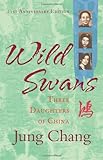
Wild Swans by Jung Chang

It’s taken me a couple of months to read Wild Swans: Three Daughters of China (first published in 1991), Jung Chang’s book about her grandmother, her mother and herself, telling of their lives in China up to and during the years of the violent Cultural Revolution. Her family suffered atrociously, her father and grandmother both dying painful deaths and both her mother and father were imprisoned and tortured.

Needless to say that this is a harrowing book to read, but it’s also an eye-opener (for me at any rate) about what happened in China under Mao.

Jung Chang was born in Yibin, Sichuan Province, China, in 1952. She was briefly a Red Guard at the age of fourteen, and then a peasant, a ‘barefoot doctor’, a steelworker and an electrician. She came to Britain in 1978, and in 1982 became the first person from the People’s Republic of China to receive a doctorate from a British university. Wild Swans  won the 1992 NCR Book Award and the 1993 British Book of the Year. She lives in London.

In Wild Swans she casts light on why and how Mao was able to exercise such paralysing control over the Chinese people. His magnetism and power was so strong and coupled with his immense skill at manipulation and his ability to inspire fear, it proved enough to subdue the spirit of most of the population; not to mention the absolute cruelty, torture and hardships they had to endure.

I wondered how she knew so much about what happened to her mother and grandmother (I don’t know nearly as much about mine) but in the Introduction she explains that when her mother came to visit her in London they talked every day for months. She talked about their eventful lives – her grandmother had been a concubine of a warlord general and her mother had joined the Communist underground at the age of 15. She also recorded sixty hours of her memories.

I wrote a bit about the book in a Book Beginnings post at the end of last November, when I’d just started to read it. It’s a personal story, reflecting the twentieth century history of China. A remarkable book, full of courage and spirit.

  • Paperback: 720 pages
  • Publisher: HarperPress; New edition edition (1 Mar 2012)
  • Language: English
  • ISBN-10: 0007463405
  • ISBN-13: 978-0007463404
  • Source: borrowed from a friend

Tolkien, The Hobbit and Middle-Earth

The Hobbit
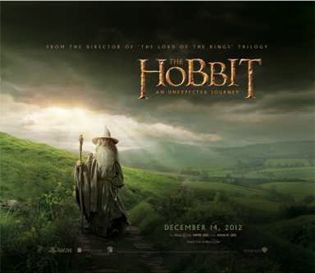
Last Wednesday we went to see The Hobbit: an Unexpected Journey. Whereas I’ve read The Lord of the Rings several times, I’ve never read The Hobbit, so the story was new to me. It meant that I could watch the film, totally unbothered by any changes from the book. And no doubt there are differences, as the book has been transformed into three films.

I enjoyed the film immensely, although, as I expected, there was too much fighting for my liking, which made my eyes glaze over. (This is my normal reaction to fighting scenes.) The hobbit, Bilbo Baggins, Gandalf and a party of dwarves, led by their king, Thorin Oakenshield go on a quest to recover the lost Dwarf Kingdom of Erebor and its long-lost treasure, guarded by Smaug, the dragon. Their journey takes them into great danger through lands occupied by orcs, goblins, wargs and sorcerers and sees the first meeting of Bilbo and Gollum (Andy Serkis) in which Bilbo gains possession of the precious Ring.

Martin Freeman was perfect as Bilbo Baggins, as was Ian McKellen as Gandalf, and Richard Armitage as Thorin Oakenshield. It was Ken Stott’s voice (and his mouth) that made me realise he was taking the part of Balin the dwarf, but I completely failed to see that the Goblin King was played by Barry Humphries. The rest of the cast was also excellent and the scenery was magical.

There are many books now about Tolkien and his writings – I have just two books of reference on Tolkien’s works, both from pre-movie days:The Tolkien and Middle Earth Handbook by Colin Duriez, which is a mine of information about Tolkien’s life, thoughts and writings. It’s an A-Z of people, places and things of importance in Tolkien’s books as well as containing details of Tolkien’s friends, colleagues, writers and thinkers who influenced his work.

Tolkien is now so well known, not only through his books, but also through Peter Jackson’s films, that it’s hard to believe that at one time his publishers thought the The Lord of the Rings could make a financial loss for them. Duriez writes:

In those unenlightened days, the learned Professor could mutter the word ‘Orc’ at uncouth behaviour, or exclaim ‘Mordor in our midst’ at an ugly example of modern life, without its meaning being known to the general public.

I think this book is a good source to discover information not only about the characters, but also the back-stories of Tolkien’s invented mythology. It is, of course, selective and certainly doesn’t aim to be comprehensive, because of the sheer volume and breadth of Tolkien’s works, but it’s certainly a good starting place.

The other book I have is A Tolkien Bestiary by David Day. A bestiary is an illustrated book about beasts, popular in the Middle Ages and this one includes Tolkien’s fantastical beasts and monsters, together with the races, flora and fauna that inhabit Middle-Earth and the Undying Lands. There are colour and black and white illustrations, maps, time charts and genealogical tables, plus a useful index. A mine of information from before Peter Jackson’s movies were made. Here, for example is the illustration of Gandalf (very similar to Ian McKellan’s portrayal, I think!) and of Gandalf and some of the dwarves making their way to Bilbo’s house in the Shire:
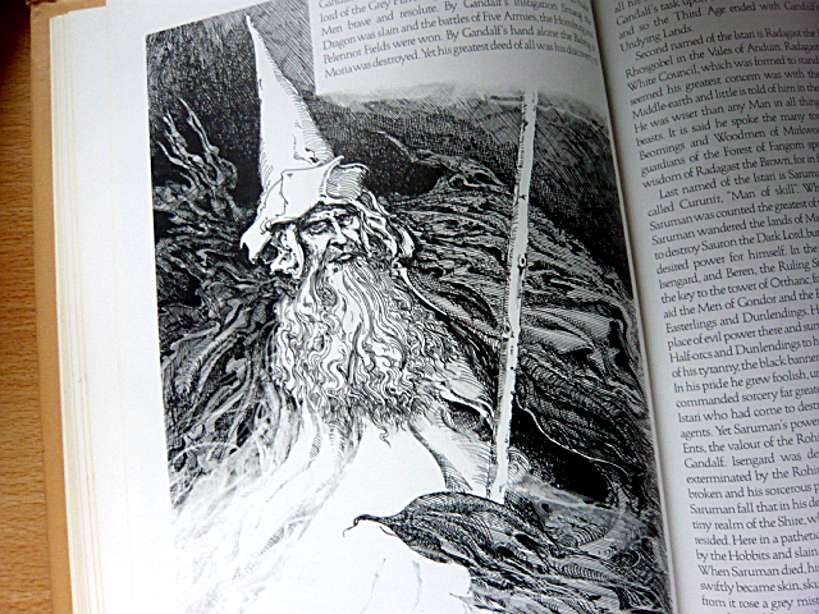
Tolkien Bestiary Gandalf

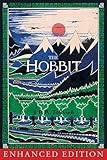
Since seeing the film I’ve downloaded an Enhanced Edition of The Hobbit. This has illustrations and audio/video content available for iPads, iPhones, and iPod Touch devices, including J R R Tolkien singing and reading from his book.

It also includes illustrations by Tolkien and one of the manuscript pages of his original draft of the first chapter. In the Foreword, Christopher Tolkien, Tolkien’s son reveals that his father had a clear recollection of writing the opening sentence of The Hobbit. It was whilst he was sitting correcting School Certificate papers and on a blank piece of paper he scrawled: ‘In a hole in the ground there lived a hobbit.’ He did not know then and later why that came into his head, but years later it became The Hobbit. And he couldn’t remember when. But his sons think it must have been around 1929. During the years that followed Tolkien wrote more of the book and became engrossed in The Silmarillion, the myths and legends of his invented world.

Now I just need to read the book itself! And then I may have to re-read The Lord of the Rings, and find a biography of Tolkien too. There are so many books about Tolkien – can anyone recommend any of them?