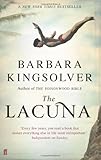
The Lacuna by Barbara Kingsolver

Some years ago I was browsing in a bookshop at Gatwick airport to add to the books I’d brought with me to read on holiday and I bought Barbara Kingsolver’s The Poisonwood Bible. I loved it. I’ve read some of her other books, but none as good as The Poisonwood Bible. When I saw that she had written The Lacuna and it had won the 2010 Orange Prize for Fiction, (actually beating Hilary Mantel’s Wolf Hall!) I bought it, expecting great things. That was two and half years ago and it’s only this year that I’ve read it.

I was disappointed as I don’t think it’s as good as either Wolf Hall or The Poisonwood Bible. There some good parts, but overall I was glad to finish reading it. It’s a long tale (670 pages), moving from Mexico in the 1930s to the McCarthy trials of alleged communists in the USA of the 1940s and 1950s. I thought it began and ended well, with good descriptions and fascinating characters, but I got bored several times in the middle.

It’s the story of Harrison Shepherd, the son of a Mexican mother and an American father and it’s told through his diaries and letters together with genuine newspaper articles, although whether they reported truth or lies is questionable. It begins in Mexico where Harrison’s mother took him to live when she left his father to live with a Mexican businessman, she calls Mr Produce the Cash behind his back. I thought this part came to life with lyrical descriptions of the people and the landscape. But it is only in the second half of the novel that I felt Harrison himself came alive as a character, no longer talking about himself in the third person, ‘the boy’, and referring to himself as ‘I’.

Throughout the book Kingsolver intermingles real characters and events with her fictional ones and I thought that worked well. There are the artists Diego Rivera and his wife Frida Kahlo. Harrison works for Diego, mixing plaster for his huge murals he painted in Mexico City. Whilst working for Rivera, who was a communist he met and subsequently worked for the exiled Bolshevik leader, Lev Trotsky. And it is this connection that eventually lands him in difficulties later on when he had moved to live in the USA and became a novellist writing historical fiction about the Aztecs. He is accused of being a communist and being Un-American.

I found the historical parts very interesting as I knew nothing about Rivera, or his wife, and very little about Trotsky and the McCarthy trials. But eventually I found the level of detail was just too much and the story meandered, losing impetus. Harrison himself comes across as too passive, too accepting of what ever happened to him, a victim of circumstances. Much more interesting is the second narrator, Violet Brown who becomes his secretary and friend, who saved his diaries from being burnt.

There are several instances of lacunas, missing parts and gaps, scattered throughout the book. For example, some of Harrison’s diaries and notebooks go missing. As a boy he loved swimming and diving into a cave, which is only available at certain tides:

Today the cave was gone. Saturday last it was there. Searching the whole rock face below the cliff did not turn it up. Then the tide came higher and waves crashed too hard to keep looking. How could a tunnel open in the rock and then close again? … Leandro says the tides are complicated and the rocks on that side are dangerous, to stay over here in the shallow reef. He wasn’t pleased to hear about the cave. He already knew about it, it is called something already, la lacuna. (page 45)

But although The Lacuna is well written and well researched I felt there was something missing, the personal elements that brought the story to life for me were few and far between; I couldn’t feel involved and just wanted it to end. I persevered because it has had such good reviews and recommendations, but sadly it dragged for me.

Saturday Snapshots

Coldstream Old Marriage House

This is the 18th century Old Marriage House in Coldstream. It was also the Toll House for the bridge, which crosses the River Tweed from Coldstream in Scotland to Cornhill-on-Tweed in England. The Old Marriage House is at the Scottish end of the bridge and is now a private home. But from 1754 until 1856 it was popular (like the Smithy at Gretna Green) for runaway marriages, because during that period under Scottish law couples could get married without parental consent and without giving prior public notice.

In the 19th century 1,446 ‘irregular’ marriages, valid in Scots law were conducted by ‘priests’, whose numbers included local men such as shoemakers and molecatchers. During that period five earls and at least two, maybe three, Lord Chancellors of England were married there.

Coldstream Bridge P1060422This is the Coldstream Bridge, built between 1763-6, designed by John Smeaton. It replaced the old ford across the river.

For more Saturday Snapshots see Alyce’s blog At Home With Books.

January's Books

If you look at how many books I read in January it doesn’t look as though I did much reading with just 4 books completed. I usually average about 8 books a month! But that statistic is misleading because I’ve read just as much if not more than usual because of the length of the books.

Jaunary 2013

I began reading Wild Swans:Three Daughters of China by Jung Chang last year but by January I’d only read less than a quarter of it, so I began January by reading the rest of the book, which took me up to the middle of the month. Wild Swans is an amazing book (720 pages). I wrote about it in this post.It’s a harrowing book to read, but it’s also an eye-opener (for me at any rate) about what happened in China under Mao. It’s a personal story, reflecting the twentieth century history of China. A remarkable book, full of courage and spirit.

I read just one crime fiction – The Case of the Curious Bride by Erle Stanley Gardner (from TBR books). I was disappointed really with this Perry Mason book and didn’t think it was as good as other books by him that I’ve read.

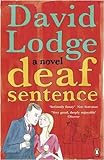
Next was Deaf Sentence by David Lodge, which I liked but didn’t love. Unlike the reviewer in the Literary Review (quoted on the back cover) I didn’t find it had ‘many laugh-out-loud moments‘, just a few amusing bits that made me smile. But is it a moving and at times melancholy book.

In a much lighter vein, although sad in parts is Paw Tracks at Owl Cottage by Denis O’Connor, which I read on my Kindle. It chronicles O’Connor’s experiences with four more cats, all Maine Coons, at his Northumberland cottage.

So, not a large number of books but a lot of reading, because I’ve also been reading Barbara Kingsolver’s The Lacuna, another long book which I’ve finished this morning. I suppose that goes under February’s books!

Deaf Sentence by David Lodge

I have mixed feelings about Deaf Sentence, but overall, I liked it.

Synopsis from the back cover:

Retired professor of linguistics Desmond Bates is going deaf. Not suddenly, but gradually and – for him and everyone nearby – confusingly. It’s a bother for his wife, Winifred, who has an enviably successful new career and is too busy to be endlessly repeating herself. Roles are reversed when he visits his hearing-impaired father, who won’t seek help and resents his son’s intrusions. And finally there is Alex. Alex is the student Desmond agrees to help after a typical misunderstanding. But her increasingly bizarre and disconcerting requests cannot – unfortunately – be blamed on defective hearing. So much for growing old disgracefully …

After an amusing start, the book almost slowed down to a stop for me with too much detail. It was only towards the middle of the book and the final third that it really came alive for me. It’s a mixture of reflections on deafness, life, death, ageing and bereavement.

It switches between the first person and the third person, which does give it a slightly disjointed effect but highlights Desmond’s unease with his situation. Not only is he having to come to terms with his increasing deafness but also with his retirement from the academic world. He still hankers after his position as a Professor of Linguistics. He’s having to deal with academic rivalry, and his feelings of isolation and inadequacies in his relationship with his wife and family.

I liked the word-play, the misunderstood conversations and the comedy surrounding deafness and the references to authors, poets and artists who had also suffered. But overall I thought this was a melancholy book about the problems of ageing, not just deafness:

Deafness is a kind of pre-death, a drawn-out introduction to the long silence into which we will all eventually lapse. (page 21)

I did enjoy the picture of Gladeworld that Lodge painted – if you’ve been to Center Parcs it’s instantly recognisable! Desmond likens it to ‘a benevolent concentration camp. A benign prison’, with the Tropical Waterworld a modern version of Dante’s Inferno, with

… half naked crowds tossed in the turbulent waves, or hurtling down the spirally semi-transparent tubes at terrifying velocity, or tumbled arse over elbow through the rapids, choked with water, blinded by spume, spun round in whirlpools, dragged backwards by undertow, entangled with each other’s limbs, bruised and battered by impact with the fibre glass walls, to be tipped at last into a boiling pit at the bottom … (page 225)

I know this from my own experience!

But contrast this with Desmond’s visit to Auschwitz – a real hell on earth. As Desmond reflects there are no words adequate to describe the horror of what happened there and no adequate emotional response:

In the end perhaps the best you can do is to humble yourself in the face of what happened here, and be forever grateful that you weren’t around to be drawn into its vortex of evil, in either suffering or complicity. (page 269)

Lodge acknowledges that Desmond’s deafness and his Dad have their sources in his own experience and for me this is the heart of the book, the parts that captured real life with depth of feeling, emotion and empathy. For these reasons I did like this book.

  • Paperback: 320 pages
  • Publisher: Penguin (4 Jun 2009)
  • Language: English
  • ISBN-10: 0141035706
  • ISBN-13: 978-0141035703
  • Source: I bought the book

Pride and Prejudice 200th Anniversary

Title page from the first edition of the first volume of Pride and Prejudice 1813

Today is the 200th anniversary of the publication of Jane Austen’s Pride and Prejudice and to mark the occasion the Jane Austen Centre in Bath is hosting a 12 hour readathon (click this link to go to the readathon site) of the book. It’s taking place at the Centre in Gay Street and will be filmed and broadcast around the world live on the internet.

From 11am this morning Pride and Prejudice will be read in short 10 minute segments by up to 140 celebrities, authors, politicians, musicians, Olympians, school children, competition winners and personalities.

Saturday Snapshot: Heidi doesn't like the snow

We’ve had snow and more snow, our garden and the surrounding fields are all white, but the main roads are clear, and we haven’t had the snow that’s brought some parts of the UK to a standstill.

This morning the sun is shining, and the snow is sparkling in the sunlight.

Snow P1080401

The paw prints in the snow shows that Heidi has been across it, but she’s not keen. This morning she wanted to go out through the patio door:

Snow Heidi 26 Jan 13

but she didn’t want to get her feet cold and wet:

Snow Heidi (2) 26 Jan 13

So she came in and tried the back door, but that was no better:Snow Heidi (3) 26 Jan 13

She stayed away from the snow and soon came back inside the house.

For more Saturday Snapshots see Alyce’s blog At Home with Books.